How to Ask for Donations From Individuals, Companies & More
Raise More Money For Your Cause With These Top Tips
Expand Your Donor Base With the Actionable Steps Below
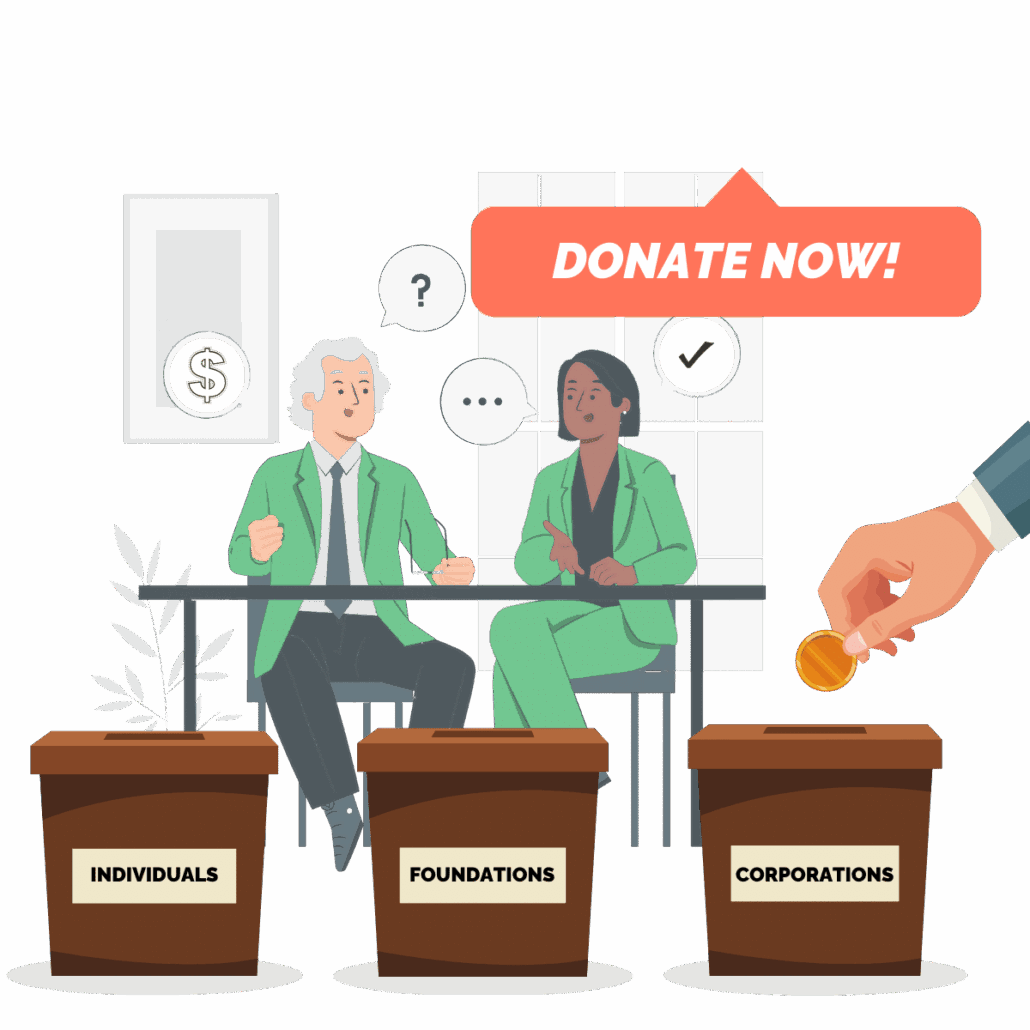


Nonprofits solicit donations from a wide range of sources. Understanding the nuances of each type of supplier goes a long way in guiding your appeal strategy.

Individuals—including one-time, repeat, and recurring donors—have the potential to be one of the most valuable sources of revenue for your nonprofit. In fact, recent fundraising research reports that individual Americans alone give between $300 and $500 billion each year to charitable causes. That’s an estimated 64% of total giving!
This generally includes (but is not limited to) individual donations made via:
Regardless of gift size or method used, these contributions provide much-needed support and funding to power your operations. The important thing to remember, however, is that every donor is unique and valuable. Each one should be treated as a person rather than a wallet!
For the best results, aim to deepen your connection with individual donors. Engage each person in a number of ways, ultimately empowering your team to build long-term relationships that generate lasting support for your cause.

More and more, companies are giving back to provide their corporate philanthropy and corporate social responsibility (CSR) initiatives with a powerful boost. Your organization can be the beneficiary of that charitability. Sometimes, all you have to do is reach out and ask!
Businesses can support your organization in a number of ways, which include:
When you empower individual donors to partake in workplace giving programs on your behalf, you can leverage relationships with employees to build deeper partnerships with their employers, too.
The best way to uncover each of these opportunities? Using a corporate giving database like Double the Donation!

Foundations are nonprofit entities that award grants to help other nonprofits further their causes. They can stem from a company’s philanthropy (i.e., corporate foundations like the GE Foundation, which also runs the General Electric matching gift program) or be organized as a family-run entity (like the Bill and Melinda Gates Foundation).
Regardless, foundations provide nonprofit funding in a few key ways:
Most often, foundations contribute grants to nonprofits with missions similar to theirs. Nonprofits are typically required to utilize grant funding for a particular project or program and follow the foundation’s instructions for submission and use of funds. We recommend conducting prospect research on a regular basis to scope out the opportunities that may be available to you!
Online fundraising is the simplest, most cost-effective, and highly efficient way to solicit donations from anyone who has an internet connection. If your organization isn’t making use of the many online donation tools designed to collect funds online, it’s surely missing out.
Plus, asking for donations from individuals via online channels makes it easy for donors to give instantly to their favorite nonprofits and causes. These typically include a range of gifts, from small, monthly contributions to major donations and everything in between.
To maximize the benefits your organization receives from online fundraising, be sure to market your online donation form to your audience and encourage generous and convenient giving. Especially in the digital revolution of the last few years, online donation forms have become universal, much-needed giving tools. And they’re not going anywhere anytime soon, either!

Start by developing an online donation page for your organization. While you may decide to build one from scratch, it’s generally more cost-effective to enlist the services of an online fundraising company. Do some research and determine the best solution for your team and its fundraising needs!
Then, begin actively promoting your donation form. Donors won’t know about it unless you tell them! Place a large “Donate Now” button prominently on your website and include a link to the page in donor-facing communications.
And don’t forget about marketing matching gifts on your website, either. By creating a dedicated matching gifts web page and adding a matching gifts blurb to your giving forms, you can increase program awareness and participation alike.
Finally, make sure your donation page works on devices like smartphones and tablets, too, as mobile giving (including text-to-give, QR codes, and mobile-responsive donation pages) is a popular preference among individual donors.
In today’s competitive landscape, paid advertising empowers an organization to stand out. Depending on your intended audience, you might enlist traditional methods to promote your fundraisers, like radio or print ads. However, online paid advertising allows you to tap into tons more prospects, even when it comes to targeting a local audience.
And, believe it or not, you can get started with paid advertising for free. After applying for the Google Ad Grants program, approved nonprofits receive $10,000 worth of free credits to spend on Google Ads each month (up to $329 per day).
Once you’re approved, choose keywords to target (i.e., things your audience would look up on Google), then write an ad that encourages readers to click through to your site. Google then places these ads at the top of the search engine results page for your chosen terms.
This is a great way to ask for donations, whether you’re connecting with new donors or retaining current ones. Promote your event pages, campaign pages, donation forms, or any other web pages that will push your mission forward.

To get started, you’ll need a secure website that thoroughly explains your cause. Google has a strict website policy that you’ll need to follow, so make sure your site is up to par before applying.
Then, you’ll complete your application. This process includes:
Take some time to learn the basics of managing a Google Ad Grant account, create well-written ads, and devote 2 to 3 hours each month to ongoing maintenance.
If this seems like a lot to handle, a Google Ad Grants manager like Getting Attention can be a big help!
Emails are typically best suited for mass communication with donors on a regular basis. Though email is one of the most cost-effective ways to raise money, investing time and resources in the strategy is only worthwhile if you write great emails that make people want to give.
Fundraising emails can be sent to just about any supporter. However, they shouldn’t be used to ask for major gifts or as a substitute for face-to-face conversations. Instead, emails can be used to solicit small-dollar or mid-level contributions, invite supporters to attend upcoming events, send fundraising updates, and more!

You’ll first need a list of donors’ email addresses if you want to start sending out email appeals. (Hint: Consider an email appends service to locate additional contact info for your supporters.)
Next, segment donors into appropriate groups based on characteristics like giving history, capacity, communication preference, etc. You don’t want to send the same email to a loyal supporter that you would a brand new donor. That would come across as impersonal and would be less likely to inspire the recipient to give.
Then, write a great email. Be sure to clearly state your fundraising need and how the donor can get involved. Don’t forget to link to your donation page!
Looking for a creative new way to solicit donations from your supporters? Sell fundraising cards to your supporters to raise some extra cash for your mission. By providing something in return for gifts, you’ll incentivize more donors to give.
While eCards can help your organization raise funds year-round, there’s really no limit on what you create designs for. To spark inspiration, some of our favorite card-worthy occasions include:
You have a few options for selling eCards to donors. Fundraising Letters’ guide to donation eCards explains that you can offer them post-donation or as integrated donation forms. The first strategy allows donors to pick their card, personalize it, and choose a donation amount. Meanwhile, the second strategy allows you to embed your eCards directly into your donation confirmation page as a unique reward!
First, you’ll want to locate an affordable eCard creation tool. Ideally, use one that’s tailored to nonprofits (we recommend eCardWidget) to ensure you have all the user-friendly design tools you need from a solution that integrates with popular fundraising tools.
Next, design or customize eCards for any occasion you want. Don’t forget to infuse consistent branding, such as your organization’s color scheme, logo, and font choices, to strengthen the connection to your cause.
Finally, add the fundraising eCards directly to your site as a new page, on your donation form, or on your confirmation page. You can even add eCards to your Shopify store to sell them as fundraising products!
Direct mail, which includes sending fundraising letters, postcards, inserts, and more, is an old-school yet proven tactic for asking for donations from individuals. Even today, with the right strategy, snail mail to a select group can be a big hit.
Keep in mind that physical appeal letters don’t need to be sent to every donor and prospect in your database. Direct mail appeals lend a certain formality to a donation ask, which is important when soliciting a sizable donation from an individual or a business.

We recommend segmenting your contact list and using direct mail as a way to reach out to major donors, long-time supporters, and corporate partners.
Just remember to provide detailed instructions on how the recipient might take the next step to support your cause. For example, you might include…
This way, donors can make their gift as quickly and easily as possible.
You can even partner with a direct mail fundraising company to send your fundraising letters. Do your research and see if you can save your team time and money by outsourcing the work for less than it would cost to print and mail the letters on your own!
Using phone calls to solicit generous donations is a tried and true fundraising tactic. Why? You can host a phonathon at any point in the year! Plus, you never really need a reason to call up a few of your supporters and ask for their help.
In fact, individuals often respond well to being called and asked about donating. It’s a personal, easy, and direct way for donors to give and a relatively low-cost campaign for the organization to host.
Of course, there are optimal times for making a fundraising call, and it helps to gather information about your donors’ preferences. For example, one individual might prefer to have a conversation in the evening or on a weekend, while another may not take a call outside of regular business hours.
Either way, a phone conversation can be a good way to explain exactly what you’re going to do with a donor’s contribution. It’s also a great opportunity to talk up your organization and the specific campaign you’re running.

First, establish a plan that outlines how you’ll organize your phone fundraising campaign. Regardless of whether you’ll make calls on a case-by-case basis or host a dedicated phonathon, either supplies an invaluable fundraising avenue.
From there, you’ll want to begin developing your script. While phone conversations aren’t going to follow word for word, you’ll need to provide detailed notes to ensure callers stay on track for effective solicitations. Thus, it’s extremely beneficial for ensuring all fundraisers and staff manning the phones are well-trained and working from an engaging script.
In-person or face-to-face appeals are often reserved for major gift donors, but they can also be utilized for corporate donation requests, too! In fact, any sizable donation request should take place in a face-to-face conversation (if a prospect isn’t local to your area, a video meeting software like Zoom, Microsoft Teams, or Google Meet can suffice).
In-person meetings allow your nonprofit to properly lay out how you plan to use the donation in question. They’re your fundraiser’s chance to hype up your organization and the project or campaign that needs funding, plus answer any questions your prospect might have.

In-person donation appeals are usually reserved for major gift solicitation, so there will likely be a lot of preparation that goes into your face-to-face solicitations. Make sure that you fully research your prospect and come well-equipped for the meeting with a general script, notes, and an ask amount.
Remember that your donation request shouldn’t be too high (you don’t want to insult or otherwise put off the donor), nor should it be too low (you don’t want to leave money on the table).
Additionally, you’ll want to have an alternate plan for any answer other than an enthusiastic “Yes!” Consider adjusting the course of your conversation, asking for a lower amount, or offering another type of giving opportunity to maintain an individual’s engagement.
Asking your donors to buy branded merchandise is a great way to fundraise, and it provides a tangible incentive for donors to support your cause.
If you’re hosting a crowdfunding campaign, for example, establish giving levels that correspond with unique products. An individual who contributes $50 might receive a hat with your organization’s logo, while those at the $100 threshold may be gifted a limited-edition t-shirt.
Remember: donors feel incentivized to give when they’re promised something tangible in return. Plus, any time they wear or use their branded items, they can show off their commitment to your cause (see: free advertising!).

For apparel, you’ll need to create designs that fully encapsulate your nonprofit mission and align well with your organization’s brand. To incorporate a unique twist for your fundraiser, you can even host a design contest where supporters are encouraged to submit their t-shirt ideas and suggestions beforehand!
Then, set up an online storefront or campaign page through a product fundraising site or begin selling items at in-person events! Be sure there’s an easy way for donors to give above-and-beyond any product sales, too.
Finally, start driving traffic to your product fundraiser and encouraging supporters to place their orders.
Pledge campaigns or pledge drives are essentially time-based, high-intensity fundraising campaigns designed to drum up a lot of support quickly. The idea is to reach a wide audience of current donors and potential new supporters, encouraging as many individuals as possible to complete a gift after the drive ends.
Nonprofits often use pledge campaigns to raise support in direct response to a crisis. Think disaster relief, political advocacy, or a logistical emergency that your organization or its beneficiaries might be facing. Time-sensitive needs work particularly well here!
Some organizations, like public television and radio stations, also host very effective pledge drives as part of a broader annual campaign.

The first step in hosting a pledge campaign is to determine why your organization is hosting a pledge campaign. This will help inform your strategy and determine an ideal fundraising timeline. Then, get a campaign page set up using an online giving tool with pledge functionality.
Your team will want to source essential contact information from donors as they pledge their support in a way that doesn’t slow them down or hinder the completion of the pledge process. But you don’t actually collect payment details until after the campaign concludes!
(Note: Look for a platform that offers donors a “complete my donation now” option, but only after you’ve secured their initial pledges.)
Plus, keep in mind that pledge campaigns rely heavily on effective promotional efforts to succeed, so make sure your social media and other digital marketing outlets are ready to go. You might also want to review your data management systems to ensure you have the infrastructure in place to track and leverage all the pledge data you generate. Reaching new supporters is a major benefit of these campaigns, so you’ll need an organized way to follow up with them.
Matching gifts are generous philanthropy programs offered by thousands of corporations that employ millions of individual team members. That means a significant segment of your donor base likely works for such comanies, making their gifts eligible to go twice as far. Unfortunately, many qualifying donors remain completely unaware of the opportunity, leading to a ton of available match revenue going unclaimed each year.
When you incorporate matching gift promotions alongside a range of other individual giving channels, you have the potential to double the impact of each initial donation. So, if your organization is looking to maximize its fundraising revenue, a well-thought-out matching gift strategy is a must.
Here’s how it typically works: When an employee donates to a nonprofit organization, they submit a request to their employer, indicating the details of their donation. The employer then verifies the donation and matches it with an equal (or sometimes even greater) amount. This essentially doubles the contribution made by the individual, with additional funds being supplied by the donor’s employer.

To begin leveraging matching gift programs for your organization, there are a few key steps you can take. These include:
An effective matching gift effort can cultivate broader corporate partnerships, too! Nonprofits can leverage the donor data and connections produced by matching gifts to proactively engage with corporations in their network to establish or enhance other giving opportunities.

Whether you’re planning a gala, walk-a-thon, auction, or another type of fundraising event, strategic donation appeals can provide an excellent opportunity for organizations to maximize revenue with an engaging event experience. Plus, hosting an event allows your team to demonstrate what your nonprofit has accomplished and what it hopes to achieve in the future with the collected funds.
For the best results, let donors and volunteers know exactly what their money and time are going toward when they support your events. If you have plans to raise a lump sum in a particular time frame, communicate the goal to your attendees and ask them to help you reach it!

An annual fund generally powers a nonprofit’s operational costs, including rent or mortgage payments, other utilities, staff salaries, supplies and equipment, and other behind-the-scenes needs. It essentially serves as a means for the organization to raise unrestricted funds on a yearly basis to support its ongoing initiatives.
But where does a nonprofit get such funding? From its generous donors, of course, typically through a dedicated annual giving campaign! Just be sure to create a compelling narrative for your appeals that resonates with potential donors and demonstrates the importance of their support for your success.

If your organization has a time-sensitive need (e.g., essential building repairs after a flood) or is fundraising to support a time-sensitive need (e.g., supplies for international war relief), urgency-driven donation appeals are a must. As a result, it’s crucial to act swiftly and effectively to convey the importance and secure necessary funds.
For the best results, this should involve clearly communicating the timely nature of the need, outlining the projects or programs your organization plans to implement with the funding, and explaining why immediate action is necessary to address the issue at hand. Keep in mind that pledge drives work well here, too, allowing organizations to attract widespread support while momentum is high.

Giving Days are generally defined as short-term, 24-hour fundraising campaigns designed to generate a ton of revenue quickly for a nonprofit cause. The most well-known example, Giving Tuesday, is one of the most popular fundraising days of the year.
However, you’re free to plan a Giving Day campaign at any time. Just select the date of your choice and begin marketing the opportunity to your network of support. Many nonprofits align their Giving Days with mission-relevant awareness days or affinity months, too. For example, a health and medical organization researching breast cancer treatment options might host an annual Giving Day on National Breast Cancer Awareness Day.

The end of the year has proven to be a busy time for giving. In fact, people tend to give more in December (approximately 30% of total annual giving) than in any other month. That said, you’ll want to ramp up your donation asks toward the end of the calendar year.
Consider sending year-end appeals using a variety of channels to remind supporters how valuable their donations are as the year draws to a close. Direct mail is a classic route for these solicitations, but email, social media, phone, and donation card appeals can all contribute to a comprehensive year-end fundraising strategy.
The best part about end-of-year fundraising? Your supporters are probably already in the giving spirit. All you have to do is convince them to devote that philanthropic energy toward your organization!

Companies that offer matching gift and volunteer grant programs often have deadlines for employees to submit requests. Immediately after a donor makes a contribution or volunteers their time with your organization, send them a thank-you email to let them know you appreciate their support.
Within the acknowledgement (or, even better, in a separate message), make sure to mention the opportunity for matching gifts and volunteer grants.
Promoting matching gifts and volunteer grant opportunities prior to their request deadlines encourages donors to submit requests and secure funds on your behalf before it’s too late. With a tool like Double the Donation’s, you can even provide recipients with direct links to their employers’ request forms and eligibility criteria!

1. Start with those you know. To begin with your “easy” wins, focus on people who are already familiar with and dedicated to your cause. These individuals will be the perfect starting point!
2. Research your donors first. Preparation is crucial. By performing prospect research, you’ll gain a deeper understanding of potential donors and their capacity and likelihood of giving. Then, you can customize your ask strategy accordingly.
3. Make a plan. You don’t want to “wing it.” Make sure you and your team are prepared by developing a detailed fundraising plan and overall strategy. Stick to the plan, making adjustments as needed.

1. Know they might not say yes. People are going to push back. Prospective donors are going to want to think things through, even if they ultimately give to support your cause. And, unfortunately, some people will say no. Prepare for all eventualities with a plan for how you’ll handle each.
2. Be as transparent as possible. The more clear and concise you can be about what the money will be used for, the better. You’ll put your potential donors’ minds at ease, forge deeper connections, and increase the likelihood that supporters ultimately give.
3. Don’t fake it. Be yourself! Donors will sense if you’re not being authentic, and they’ll be less likely to trust you and the organization you represent. Instead, make an effort to build a genuine connection on behalf of a cause you care about.

1. Thank each supporter in multiple ways. Your donors and prospects need to know that you’re grateful for their involvement. Even before an individual gives an answer for your donation ask, you should be thanking them for their time and consideration. Show that gratitude by thanking them via email, phone call, or personalized thank-you card.
2. Offer other ways to get involved. Engage your donors after their initial gifts. Encourage them to participate in matching gifts. Ask if they want to volunteer. Invite them to events. Your relationship shouldn’t end with a single donation.
3. Keep the dialogue open. Follow up with donors by sharing updates and letting them know what their gifts helped accomplish. Photos, statistics, and success stories can come in handy here!
Consider reaching out to a fundraising consultancy about how to best plan and implement your organization’s donation asks. A consultant can help identify major donor prospects, organize the most effective campaigns to achieve your goals, and advise your team at every step of the way.
To get started, you’ll want to make a list of your organization’s goals, including for fundraising, donor engagement, matching gifts, and other key objectives. Then, research the best fundraising consultant for your needs. We recommend looking for a firm that has ample experience working with nonprofits of around the same size and similar fundraising capacity!

The most effective donation asks are segmented and personalized. And you’ll want a robust donor management system or CRM to supply the data you need to pull these off.

Make sure to look for a user-friendly CRM tool that offers detailed donor profiles, tailored outreach capabilities, and integrations with your existing fundraising and matching gift solutions.
As one of our all-time favorite fundraising ideas, nonprofit eCards offer an interactive way to boost generosity, reach new supporters, and supercharge donor engagement.

With an intuitive eCard fundraising platform, you can ask for donations from your audience in new and exciting ways! We recommend crafting engaging designs and offering them in exchange for contributions.
Corporate matching gifts continue to go underutilized, but investing in a matching gift automation system allows organizations like yours to scale up their marketing efforts without lifting a finger.

Double the Donation Matching was built to screen donor information, identify matches, streamline submissions, and track more gifts to completion than ever before!
With Google Ads, you can promote your fundraising and event pages using paid search real estate at no cost. And that’s with Google’s Ad Grant Program, which supplies nonprofits with up to $10,000 worth of ad space each month.

Once approved, your organization can manage its campaigns and select terms to target in the Google Ads platform or enlist the help of an expert consultant.
Crowdfunding is a lot like standard online fundraising, but the biggest difference is that the campaign page is generally hosted on a third-party website rather than your own.

It’s modern, efficient, and effective. And to get started, all you need to do is select a platform, supply campaign information (e.g., goals, outcomes, etc.), and begin promoting your crowdfunding initiative.
Peer-to-peer fundraising tools allow organizations to empower supporters to ask for donations on their behalf. Typically, each individual creates their own fundraising page and shares it with their friends and family.

It’s a great way to increase your nonprofit’s fundraising reach, connect with new supporters, and multiply your success.
Date
Your Name
Your Organization’s Name
Street Address
City, State ZIP
Dear [Donor],
I hope this letter finds you well. My name is [name], and I am [position/situation/background]. Today, I am looking to raise [amount of money] to help pay for [project/expense/cause/etc.].
[Include information about why the cause or project is important to you, personally, as well as how it could potentially impact the reader or those you serve.]
Just a small donation of $[amount] can help me [accomplish task/reach a goal/etc.].
Your donation will go toward [describe exactly what the contribution will be used for].
[When possible, add a personal connection to tie the donor to the cause.]
Thank you in advance for your support. There are several ways you can make an impact:
Thank you again!
Sincerely,
[Signature]
[Name]
Asking for donations can be a daunting task. However, with the right approach, your donation appeals can yield rewarding results for your organization and its mission.
Whether you’re soliciting gifts from individuals, companies, foundations, or other entities entirely (hint: you’ll see the greatest success from a combination of all funding types), the key to success lies in meaningful supporter relationships. Meanwhile, clearly articulating your cause and its specific needs, demonstrating the tangible impact of each contribution, and multiplying fundraising results with matching gifts can bring your efforts to the next level.
Multiply your organization’s incoming donations with matching gifts!
Double the Donation’s ultimate guide can help your fundraising team collect more revenue and engage more donors through corporate matching.
There’s more to corporate philanthropy than just matching gifts (though matching does play a key role in many employers’ strategies).
Check out some of the most offered giving programs by companies of all shapes, sizes, and sectors.
Power your donation appeals with top fundraising solutions for online giving, matching gifts, donor management, events, and more.
Learn what to look for in a software provider as you initiate the buying process here!
How to Ask For Donations Using Social Media
When to Use Social Media
Asking for donations on social media is a more casual version of asking for donations via email. It’s a type of mass communication that you can use on a pretty regular basis.
As you plan your social media promotions, keep in mind that the best case scenario involves directing followers to your website to give via your online donation page. However, even if an individual doesn’t give, you’ve still put your organization’s mission at the top of their minds.
Having said that, you shouldn’t expect to receive a ton of major gifts from a donation appeal on Facebook. Using social media as a fundraising tool is often more about spreading the word about your cause, generating supporter interest, and initiating the cultivation or stewardship processes.
How to Get Started
First, you’ll need to find a social media platform that works for you and your donors. While some social media sites contain integrated donation tools (meaning your donors can give directly through the platform itself), you’ll want to promote your online donation form on your social pages, too. If all of your supporters use Instagram, but your efforts are focused on Facebook, you’re missing the point.
Then, begin promoting your online campaign. Explain to your followers what you’re raising money for and how they can get involved (including by sharing your social post!).
You can even incorporate pictures and videos to help demonstrate giving impact and emphasize your nonprofit’s mission.