A Nonprofit’s Guide to Effective Matching Gift Processing
For many organizations, the initial donation is seen as the finish line of a successful fundraising campaign. However, for those looking to scale their impact, that first gift is often just the beginning.
A recent survey of 5,000+ nonprofits and schools reported that 56.7% of organizations say their matching gift processing workflow is functional. However, 76.4% say it takes them one to two weeks (or more) to process matching gift submissions, and only 41.4% say they’ve turned matching gift processing into a strategic stewardship opportunity by celebrating the donor’s doubled impact.
For 29% of nonprofits, the biggest processing bottlenecks stem from two sources: tedious manual data entry and donors forgetting to submit matching gift requests.
All that is to say, there’s a significant optimization opportunity in workplace giving processing, and many organizations have room for improvement in their strategies.

What is matching gift processing?
Matching gift processing is a specialized subset of nonprofit donation processing that focuses on the administrative and technical steps required to secure a secondary corporate contribution in response to an individual donor’s gift. However, it’s a process that many organizations struggle to manage efficiently.
When a donor takes the time to submit a match request to their employer, they are expressing a deep commitment to your mission. A slow or disorganized processing system can lead to frustration and, worse, the forfeiture of corporate funds. While it may seem like a back-office detail, the way your organization manages these efforts directly influences both donor relationships and your bottom line.
In this guide, we’ll walk you through everything your team should know to enhance the matching gift processing experience. This includes:
- The Foundation: Employer Data + CSR Tech
- Understanding the Typical Matching Gift Processing Workflow
- Why Advanced Matching Gift Processing Systems Matter
- How the Crohn’s & Colitis Foundation Improved Match Processing
By framing matching gift processing as a core pillar of donor stewardship, fundraising leaders can ensure that every workplace giving opportunity is tracked from inception to fulfillment. This resource explores how to move beyond manual entry to a sophisticated, automated system that maximizes workplace fundraising success.
Interested in seeing how your organization stacks up? Get started with our free processing report card generator!
The Foundation: Employer Data + CSR Tech
To master the art of matching gift processing, one must first look at the infrastructure that supports it. Before we dive into the technical steps of the workflow, we must examine the primary variables that dictate how a matching gift moves through your system: the donor’s employer and the platform that company uses to facilitate its giving.
Regularly Collecting Donor Employment Information
The success of any matching gift strategy begins with identification. If you do not know where your donors work, you cannot accurately predict or pursue matching gift revenue. In the past, nonprofits relied on anecdotal evidence or manual research to find employment data. Today, smart organizations capture this information at the point of donation using integrated search tools and automated prompts.
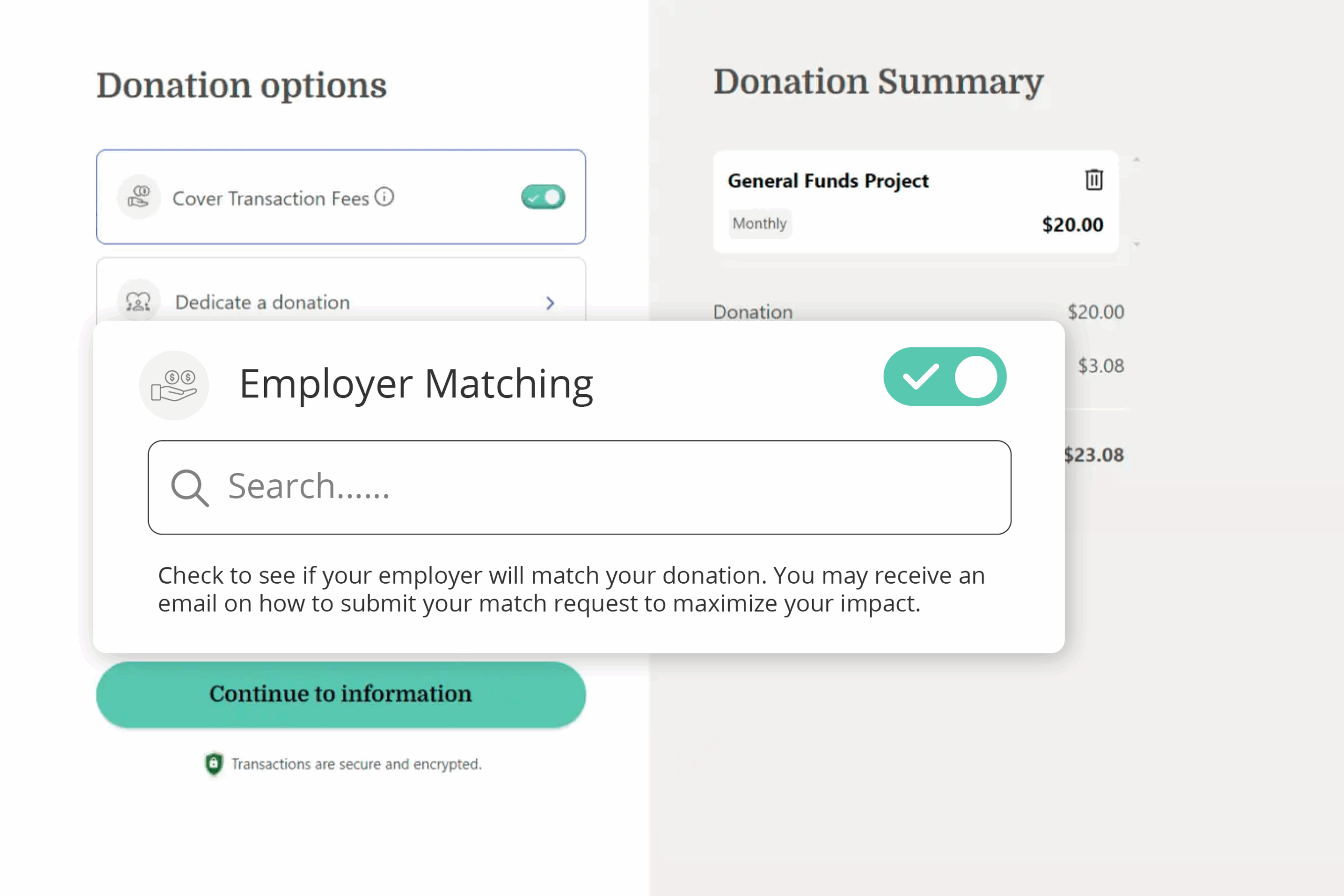
This early identification is the foundation upon which all subsequent processing steps are built. Still, our 2026 research indicates that 27.8% of nonprofit professionals say they encounter missing data when reconciling gifts ‘more often than not.’
Connecting Employer Insights to Workplace Giving Vendors
From there, it’s equally vital to understand the “hidden gem” of corporate giving: the workplace giving vendor. Most large corporations do not manage their matching gift programs internally. Rather, they use third-party CSR platforms to handle the administration, vetting, and disbursement of funds.
While there are tons of these platforms in existence, some of the ones you’ll want to be familiar with include:
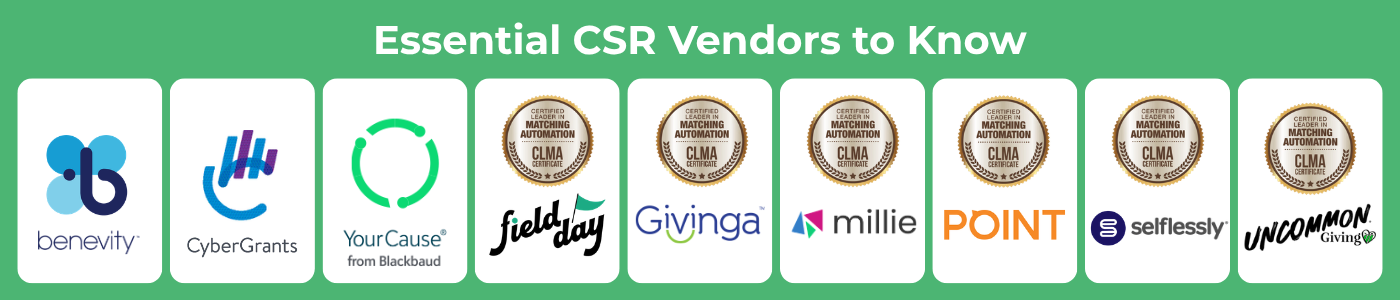
It’s important to recognize that each of these vendors has its own unique portal and verification process. If your gift processing team knows which vendor a company uses, it can better anticipate the requirements for that gift, such as whether a paper check or an electronic fund transfer will be issued.
Identifying the CSR vendor also helps in streamlining the supporter experience. By integrating Double the Donation’s suite of tools, your organization can instantly flag a donor’s eligibility and provide them with the exact link to their company’s portal. Not to mention, if a donor works for a company that uses a platform offering auto-submission functionality (those indicated with an asterisk* or CLMA badge above), the processing lift is significantly reduced.
Understanding the Typical Matching Gift Processing Workflow
Establishing a standardized system is essential for maintaining data integrity and ensuring that no match request falls through the cracks. While each nonprofit (and company) has its own nuances, the technical matching gift processing workflow generally follows a six-step cycle:
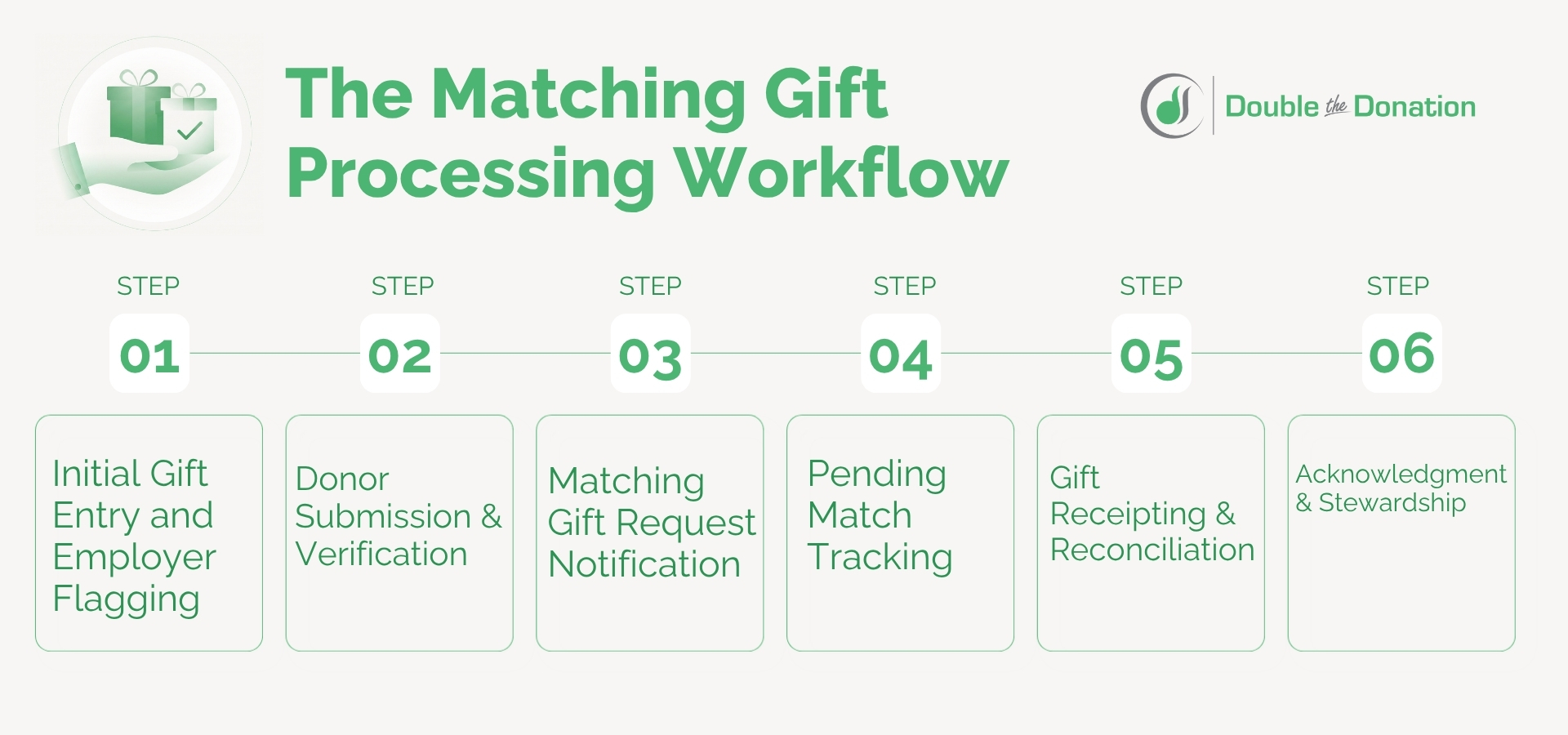
Step 1: Initial Gift Entry and Employer Flagging
The process begins when a donation is contributed via your online giving form or an offline gift is entered into your CRM. At this stage, the gift processing team should check for an associated employer.
- If the donor provided their employer’s name at checkout and that company offers a matching gift program, the gift should be categorized as “Match Eligible.”
- This flag acts as a signal for future outreach and tracking.
- If the donor provided their employer’s name at checkout and that company does not appear to offer a matching gift program, the gift should be categorized as “Likely Ineligible for Matching.”
- Donors who fall into this classification can be excellent candidates for employer advocacy initiatives!
- If the donor failed to provide their employer’s name at checkout, the gift should be categorized as “Unknown Eligibility.”
- From there, your team (or your tech) can take additional steps to gather the information, such as triggering a follow-up email or completing an employer append.
Note: Organizations that fail to identify eligibility at the moment of entry typically find themselves performing catch-up work months later (or missing out on corporate funds altogether), which is significantly less effective.
Step 2: Donor Submission and Verification
Once a donor is identified as eligible, they must submit a request to their employer, typically through one of the CSR vendor platforms noted above. While again, the process varies by company, most requests can be completed in fewer than five minutes!
From a processing perspective, your team’s role at this step is to verify that the initial gift meets the company’s guidelines. For example, some companies have a $25 minimum for matches. If your staff identifies that a gift is below the threshold, they can avoid wasting resources on a match that will never be approved. This verification step ensures that your pipeline contains only viable opportunities.
Step 3: Matching Gift Request Notification
After the donor submits their request, the nonprofit typically receives a notification from the company’s CSR vendor. This might arrive via email or as a pending item within the portal. At this stage, the gift processor must log into the portal to confirm that the donation was indeed received by the nonprofit.
This confirmation of receipt is a technical requirement that triggers the corporate approval process.
Step 4: Pending Match Tracking
After confirmation, the gift moves into a “pending” status. During this time, the gift is no longer in the donor’s hands but has not yet arrived in your bank account. Smart gift processing involves tracking these pending matches as expected revenue within your pipeline. Doing so allows your finance team to create more accurate budget forecasts based on anticipated corporate disbursements rather than historical averages alone.
Step 5: Gift Receipting and Reconciliation
When the matching gift check or EFT finally arrives, it must be reconciled against the original donor’s record. Unfortunately, this is often where technical errors occur. A corporate check might arrive with a list of twenty matches for twenty different donors. A nonprofit’s processing team must carefully parse this data to ensure each amount is attributed to the correct individual.
Accurate reconciliation is vital for maintaining clean records and ensuring that the donor’s total impact is reflected in your system.
Step 6: Acknowledgment and Stewardship
The final step in the technical workflow is acknowledging the corporate gift match. This typically includes:
- Updating the donor on the success of their matching gift. The individual donor is the hero of the matching gift story. Without their initial contribution and request, the corporate funds would never have been unlocked. Updating them is essential.
- (Optional) Thanking the corporation for its contribution. While your donor is the primary focus, the corporation is the financial partner. Acknowledging their support can also help pave the way for deeper corporate partnerships.
Closing the loop with an enthusiastic “Your gift was doubled” email is one of the most effective ways to boost donor retention and encourage future giving (and matching!).
Bonus: How Auto-Submission Simplifies Processing
While the standard matching gift workflow is already more efficient with automation, the emergence of auto-submission technology represents a significant leap forward for nonprofit gift processing. When auto-submission is enabled through a donor’s employer, the workflow changes in a few key ways:
- Instant Request Completion: Rather than the nonprofit waiting for a donor to locate their corporate portal, the match request is initiated the moment the donor provides their corporate email address on the gift confirmation screen. This ensures that the “initiated” status is triggered almost immediately after the initial gift is made.
- Higher Data Accuracy: Because the data is transferred directly from Double the Donation to the employer’s corporate giving platform, the risk of error is virtually eliminated. The donation amount, date, and nonprofit tax ID are synced perfectly, which simplifies the subsequent reconciliation for your gift-processing team.
- Reduced Chase Time: For your staff, auto-submission means fewer hours spent sending reminder emails to eligible donors. Since the application is submitted on the donor’s behalf, the pipeline moves much faster, resulting in a higher volume of completed matches without additional manual effort.
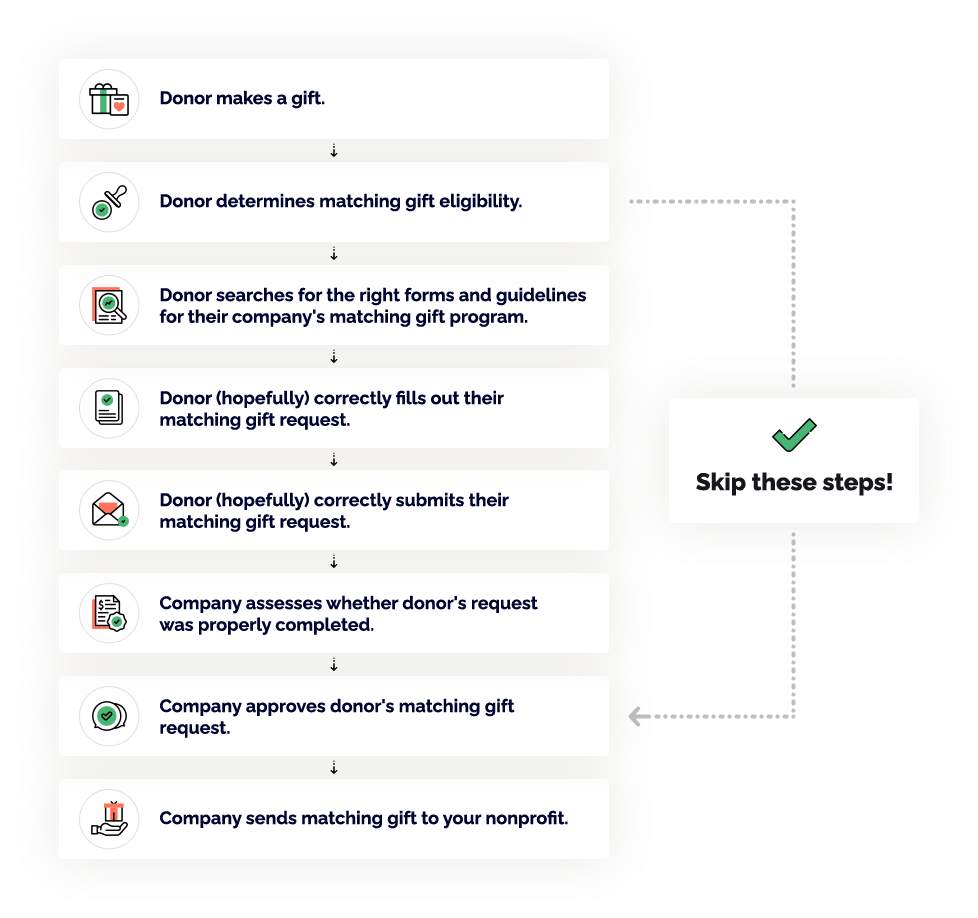
From a processing standpoint, auto-submission turns a donor-led process into a system-led process. By removing the barriers that typically lead to donor drop-off, auto-submission allows your gift processing team to manage a more predictable and robust flow of corporate revenue.
Why Advanced Matching Gift Processing Systems Matter
Many nonprofits still rely on DIY spreadsheets to track matching gifts. However, manual processing is not only time-consuming but also prone to human error. When multiple staff members are touching the same gift record across different departments, data becomes messy, and matching opportunities are easily overlooked.
The consequence of this approach is stark. The recent Nonprofit Corporate Engagement report indicates that 62% of nonprofits take more than a week to process matching gift requests, creating a bottleneck that stalls revenue and frustrates supporters.
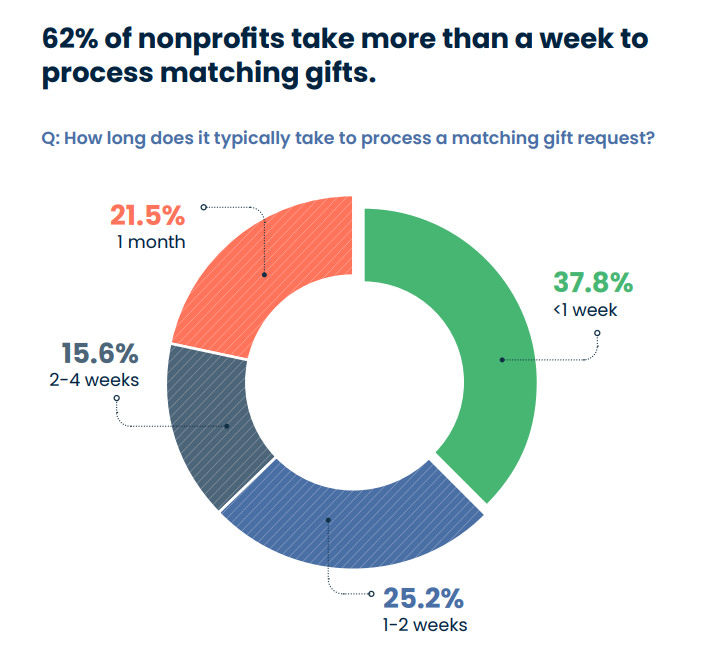
When organizations implement dedicated technology, this timeline is accelerated, allowing for a faster turnaround that keeps the gift’s momentum alive.
For example, rather than manually checking each donor against a list of matching gift companies, an automated platform like Double the Donation performs this research in real time. This ensures that every potential dollar is identified immediately.
Furthermore, advanced systems also provide robust reporting dashboards that aggregate workplace giving data, giving your National Operations or Finance teams a single source of truth.
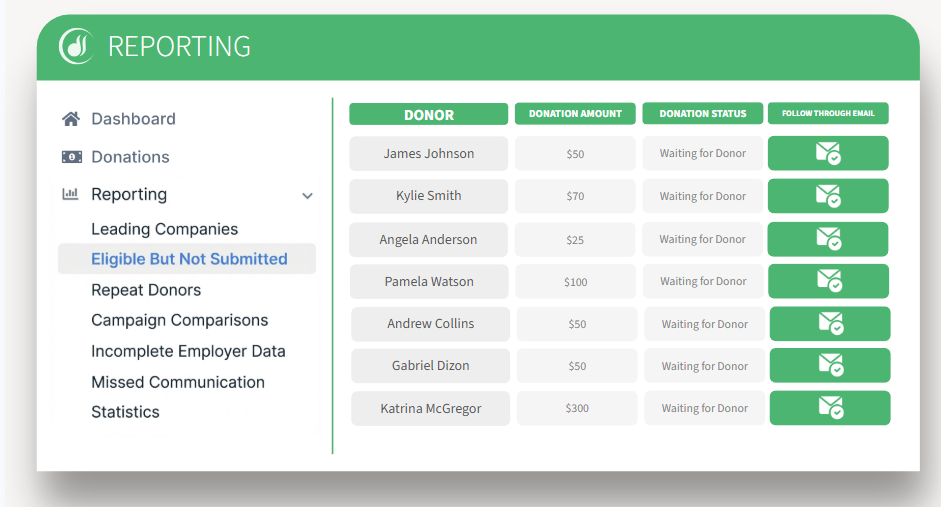
How the Crohn’s & Colitis Foundation Improved Match Processing
The Crohn’s & Colitis Foundation serves as a premier example of how technical refinement in processing leads to measurable fundraising growth. By transitioning from a decentralized, manual matching gift approach to a highly automated system with Double the Donation, the foundation achieved a 26% increase in revenue.
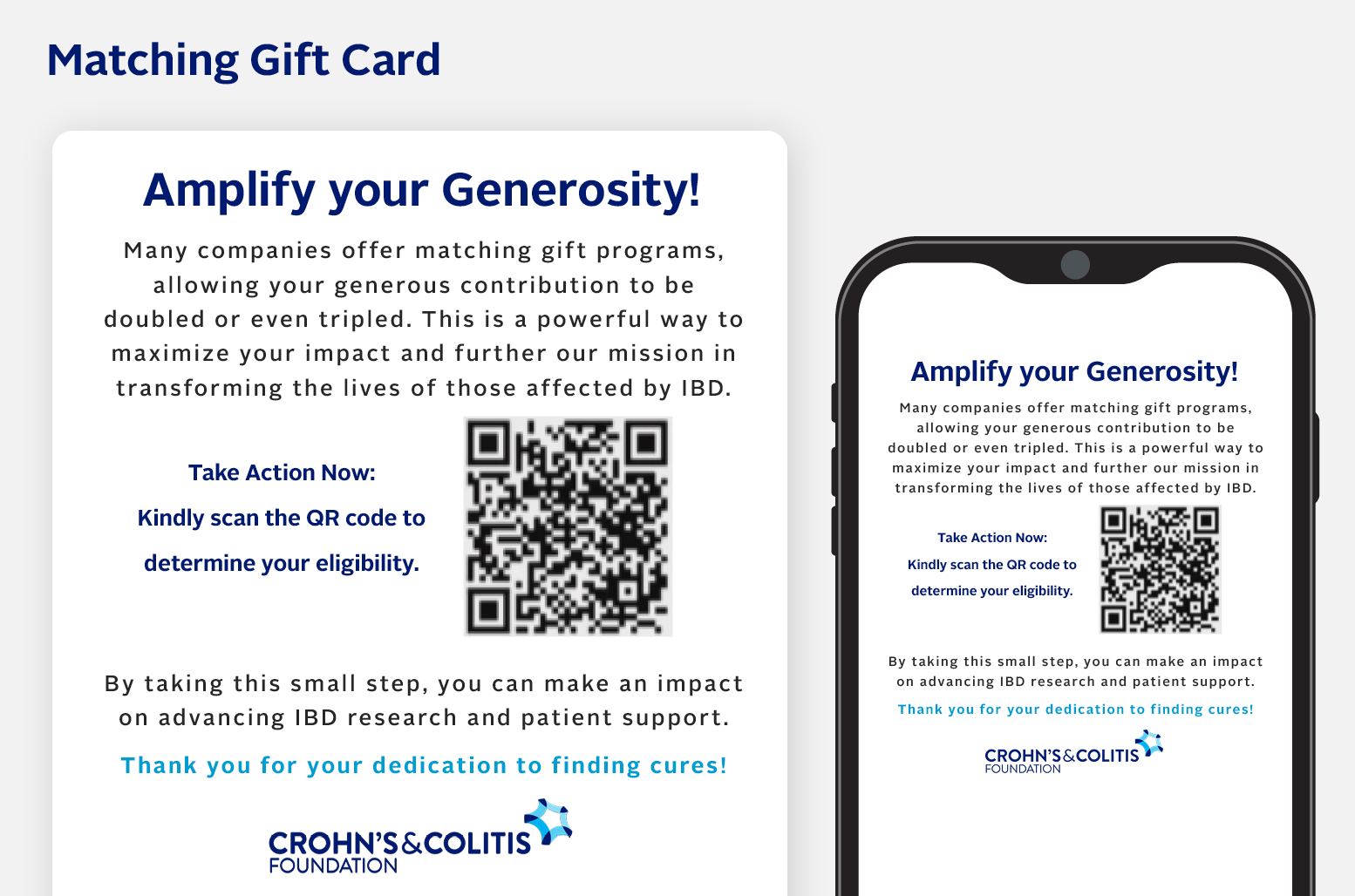
Check out the core pillars of their matching gift processing overhaul:
The Soft Credit Strategy
The foundation utilizes soft credits to maintain a 360-degree view of donor impact without double-counting the actual cash flow. When a match arrives as a corporate check, the foundation applies a soft credit to the original individual donor’s record.
Doing so allows the organization to track lifetime giving with far greater accuracy. For instance, if a donor personally contributes $500 but facilitates an additional $500 match from their employer, the soft credit system recognizes them as a $1,000-impact supporter. This nuance helps the foundation distinguish between direct donations, matching gifts, and payroll deductions, making it easy to identify “champions” within specific companies who are driving significant support.
Advanced Gift Processing and System Integration
The foundation’s move toward automation centered on establishing specific CRM fields. Each donation record now includes a “Matching Gift” property that tracks the real-time status of the match:
- Initiated: The donor has requested the match.
- Received: The corporate check has arrived and been processed.
- No Information: No match has been identified yet.
To manage this data, the foundation built a robust dashboard to assess metrics at both the national and chapter levels. This dashboard aggregates giving totals for payroll deductions, matching gift statuses, and top companies, allowing the development team to identify exactly where to deepen corporate partnerships.
The Impact of Centralization
By moving gift processing away from local chapters and into a centralized National Operations team, the foundation eliminated the “multiple hands” problem that previously led to messy records and missed revenue. This centralization resulted in:
- Speed: A 48-hour turnaround time for confirming matching gift requests
- Data Cleanliness: Standardized records that provide a single source of truth for the entire organization
- Scalability: The ability to process higher volumes of workplace giving revenue without increasing proportional staff time
By implementing these centralized strategies, the Crohn’s & Colitis Foundation moved away from the administrative bottlenecks that plague many growing nonprofits. This shift transformed their gift processing from a reactive data-entry task into a proactive revenue engine. And it ultimately allowed their staff to focus on mission-critical work while automation secured funds.
Solving the Import Logic Challenge
One of the most technical hurdles the foundation cleared was the import logic. Manually coding hundreds of small donations from corporate portals like Benevity is a massive administrative burden.
To solve this, the foundation created an automated import process using zip code and state logic. If a donor’s zip code matches a specific chapter’s territory, their CRM automatically codes that gift and the associated soft credits to that chapter. To ensure precision, they also implemented a manual exception rule. If a donor leaves a specific comment (such as “This is for Amelia’s Walk”), the system flags the record for review. This ensures the credit goes to the correct peer-to-peer fundraiser while automating the bulk of the data entry.
Final Thoughts on Effective Matching Gift Processing
Matching gift processing is essentially the last mile of the fundraising marathon. It is the technical bridge that connects a donor’s intent with a corporation’s resources. While the process involves detailed technical steps (from employer identification and soft crediting to automated CRM integration), the ultimate goal is simple: to honor the donor’s contribution and maximize the funds available for your mission.
When organizations treat processing as a strategic priority, they unlock a predictable and growing revenue stream.
Next Steps: Growing Matching Gifts with Double the Donation
If your organization is struggling with manual spreadsheets, slow turnaround times, or “missing” checks, it’s time to modernize your workflow. Luckily, tools like Double the Donation are designed to automate the most burdensome parts of the process. This ensures that your staff can spend more time on donor relationships and less time on data entry.
Explore how Double the Donation can transform your matching gift processing today and start capturing the revenue your mission deserves.