How to Speed Up Matching Gift Reconciliation: 3 Easy Steps
For many fundraising professionals, the arrival of a corporate donation is a cause for celebration. However, matching gift reconciliation, or the process of identifying which individual supporters triggered a company’s payment, is a notorious roadblock for organizations of all shapes and sizes. Without a streamlined system, these contributions can sit in administrative limbo, delaying acknowledgments and impeding financial reporting.
At Double the Donation, we understand that your time is best spent on your mission, not on deciphering vague check stubs. That’s why we’ve gathered expert-proven tips from nonprofit leaders to help navigate this technical landscape.
In this guide, we explore the specific steps your team can take to accelerate reconciliation and ensure no corporate dollar goes unclaimed:
- Demystifying the Matching Gift Reconciliation Process
- Speeding Up Matching Gift Reconciliation Step-by-Step
- Why Matching Gift Automation Outperforms Manual Systems
By implementing the right workflows, you’re able to move from reactive data entry to proactive revenue management. Thus, improving this process does more than just save time. It ensures that your data remains accurate and your donors feel seen when their employer’s contribution ultimately arrives.

Demystifying the Matching Gift Reconciliation Process
The technical details of matching gift reconciliation are often misunderstood, leading to avoidable delays. According to a Q&A session with workplace giving expert Tom Mansmith, former Senior Director of Matching Gifts for the American Cancer Society, the process relies heavily on third-party corporate vendors.
These CSR software providers work with businesses to facilitate matching gifts, volunteer grants, and payroll deductions. On the backend of these sites, nonprofits are encouraged to log in to verify contributions and view donor details.
While it can vary by company or platform, here’s how the process typically works:
- Navigate to the Platform: You’ll first need to navigate to a third-party corporate vendor platform, whether via an email notification or as part of your regular matching gift processing workflow.
- Locate the Giving Section: From there, head to the “Giving” section within the CSR platform, where you’ll see a section for all payments and transactions.
- Identify Payments: Once there, the platform will provide you with a list of payments your organization has received. It’s a good idea to have the check number, the amount, and the payment format (i.e., whether it was a check or a direct deposit) ready.
- Search and Filter: From that page, you can search by transaction ID or date to locate the exact payment.
- Review Donor Details: Once you’ve identified a payment, review the provided donor details, including which employees’ gifts the company was matching.
Mansmith recommends that you always download the reconciliation sheet from these portals. Viewing the data online is helpful for a quick check, but the downloadable sheet allows your finance department to process the payment accurately in your accounting software. This document essentially serves as the bridge between the corporate vendor and your internal records, ensuring every dollar is attributed to the correct record.
Expert Tip: When Portals Aren’t Enough ☎️
If you’re still having trouble reconciling a payment after checking the usual portals, take a page from the playbook of experienced advancement leaders. Lisa Hukill of Boys Town and Karla Ashenhurst of Phillips Exeter Academy recommend calling the business as a last resort to request additional information.
While digital tools are the primary driver of speed, a direct conversation with a company’s community relations or payroll department can help provide the final piece of the puzzle for complex or irregular disbursements.
Speeding Up Matching Gift Reconciliation Step-by-Step
While the standard workflow provides a baseline, high-growth nonprofits use specific strategies to compress this timeline and provide better experiences for their supporters. The overall goal? Moving from a drawn-out week- or month-long match processing cycle to a streamlined 48-hour (or less) turnaround.
By being proactive rather than reactive, your team can eliminate the administrative burden that leads to messy records and missed revenue. Here are the three essential steps to accelerate matching gift reconciliation.
1. Register to receive ACH payments.
The fastest way to reconcile a gift is to ensure the money and the data arrive at the same time. For this reason, physical checks are often the primary cause of friction in the reconciliation process. They require manual mail opening, physical deposits, and often supply limited documentation.
Daniel Blucker, Director of Advancement Services at Florida Institute of Technology, emphasizes that digital registration (including for Electronic Fund Transfers) is a game-changer in a recent workplace giving session.
“Giving them your information, signing up for direct ACH transfers, and getting access to their portals will give you a slew of documentation that you may not have in the paperwork that comes to you.
When finally unlocking some of those things, between Bonterra, CyberGrants, and Frontdoor… All the information’s there. But if you don’t register and maintain that login, you won’t have it.”

By taking the initiative to secure portal credentials, you effectively bypass the tedious manual research required to identify anonymous disbursements. This administrative agility ensures you can pivot from processing a payment to engaging a supporter in record time.
From there, when you close the loop while the act of giving is still fresh, you can transform what would have been a stale financial entry into a meaningful opportunity for high-touch donor stewardship.
Check out our tips for registering your org with top CSR platforms! Access the blog post here.
2. Leverage a workplace giving database.
A major bottleneck in reconciliation is the research phase. If your gift processing team does not know where a gift originated or which platform a company uses, it cannot anticipate which portal to check. However, using a comprehensive, up-to-date workplace giving database helps your organization determine exactly where disbursements should be coming from.
For example, when you leverage a platform like Double the Donation that tracks 24,000+ corporate profiles, you can flag eligible donors at the moment they give. Not to mention, you can instantly see which CSR vendor handles each corporation’s giving. This creates an invaluable data source, enabling you to forecast incoming revenue using existing employment information.
Then, when a disbursement arrives from a vendor, you can quickly cross-reference it against your list of expected matches.
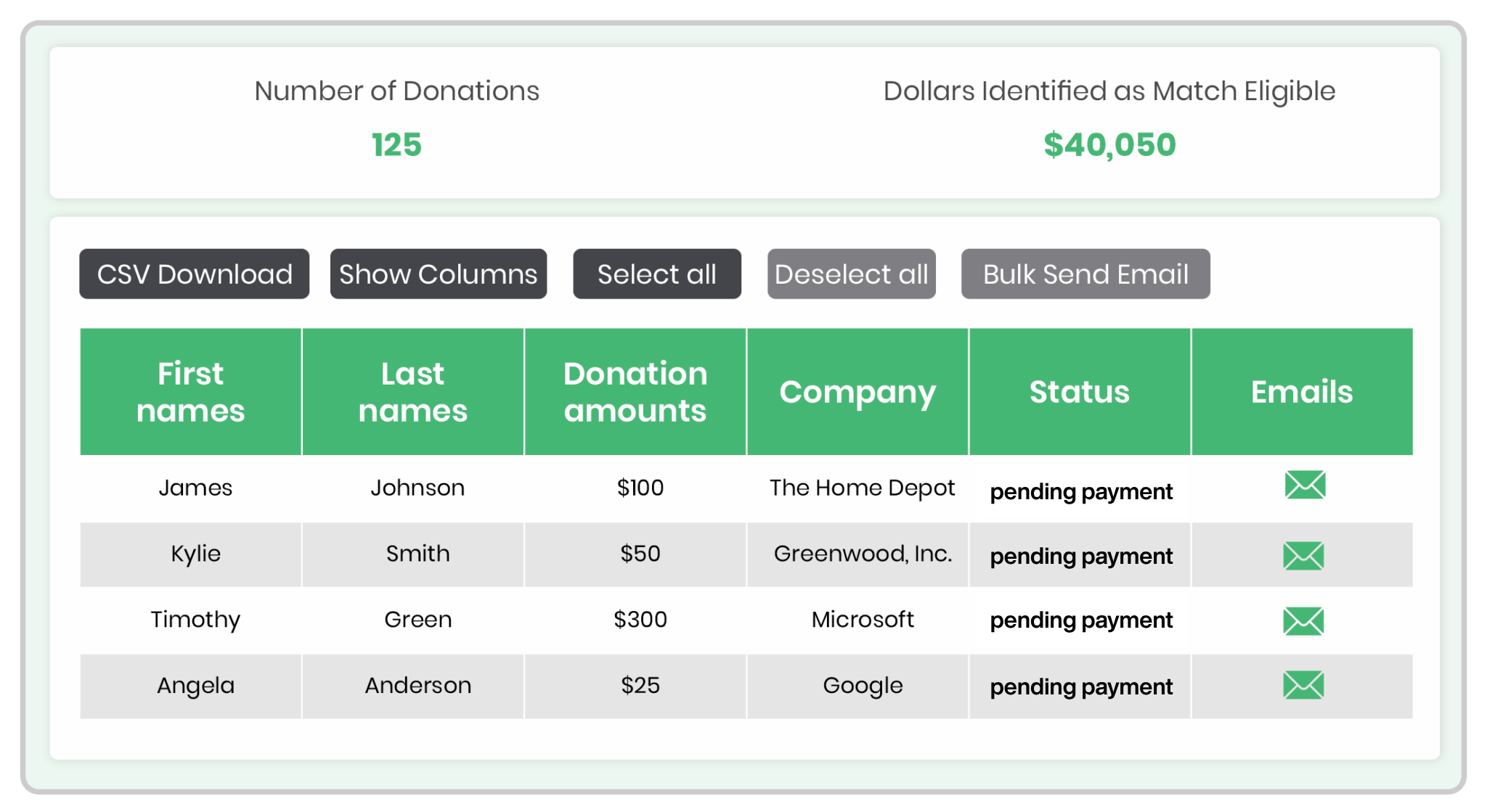
This approach greatly reduces the time spent in vendor portals because you already know which donors qualified for a match from that specific corporation.
Plus, rather than manually searching through emails or paper files, your staff can use the database to locate match ratios, submission deadlines, and direct portal links. Doing so ensures that each gift aligns with the appropriate corporate guidelines before it even enters your reconciliation pipeline.
3. Establish a centralized verification queue.
Many organizations operate with decentralized gift-processing efforts. However, having multiple people across different chapters or departments “touching” the same record often creates data silos and human error. Standardization is the not-so-secret solution, yet many nonprofits struggle with reconciliation because requests are fragmented across offices or staff members.
By transitioning your workflow to a centralized team, your organization can standardize its logic, maintaining a single source of truth.
This shift does more than just clean up records. It ensures that each request is handled with expert scrutiny, drastically reducing the time from “pending” to “received.”
When one dedicated group owns the process, you eliminate the administrative noise that slows down high-volume fundraising operations. The Crohn’s & Colitis Foundation serves as a premier example of this success. By moving reconciliation to a centralized National Operations team, the foundation achieved:
- Rapid Processing Workflows: Achieving a consistent 48-hour window for the verification and approval of incoming matching gift submissions
- Enhanced Data Integrity: Removing the “too many cooks” scenario in data entry, which prevents fragmented donor profiles and ensures financial accuracy
- Scalable Financial Gains: Realizing a 26% year-over-year surge in total matching gift funding as a direct result of standardized operations
Not to mention, a centralized reconciliation process ensures that a single team becomes fluent in navigating various CSR portals. This growing familiarity allows staff to turn a complex technical hurdle into a routine administrative task.
Why Matching Gift Automation Outperforms Manual Systems
Many small nonprofits still rely on labor-intensive spreadsheets to track their matching gifts, but this approach is fraught with roadblocks. Manual processing is time-consuming and resource-draining, not to mention it’s highly prone to human error. Plus, when data is siloed in a spreadsheet, workplace giving opportunities are easily overlooked, and deadlines are frequently missed.
“
62% of nonprofits take more than a week to process matching gift requests because of these manual hurdles.
”
On the other hand, matching gift automation systems outperform manual methods by conducting employer research in real time. Rather than manually checking each donor against static lists of companies with matching gift programs, the platform (such as Double the Donation) flags eligibility the moment a donation is made. Then, when corporate funds eventually arrive, the groundwork has already been laid through systematic tracking of the request’s progress.
Furthermore, these tools provide robust reporting dashboards that aggregate workplace giving data for your finance team. In other words, advanced automation supports matching gift reconciliation by providing clear, actionable data that integrates directly with your CRM. This technical workflow reduces the manual lift for staff, allowing them to focus on cultivation rather than data entry.
Next Steps: From Reconciliation → Revenue
Matching gift reconciliation is essentially the “last mile” of the fundraising journey. While it involves detailed technical steps, the ultimate goal is to honor the donor’s contribution and maximize your organization’s impact. When nonprofits and schools treat reconciliation as a strategic priority, they unlock a predictable and growing stream of corporate revenue.
Today, we encourage you to explore these strategies to audit and improve your own internal workflows. By modernizing your approach and leveraging the right tools, you can ensure that every workplace giving opportunity is fully realized.
Don’t let your matching gift revenue get stuck in a spreadsheet. Take the next step toward efficient processing today.
Ready to transform your matching gift reconciliation? Get started with Double the Donation and see how automation can help your organization capture more revenue with less effort.