10 Tips for Growing Workplace Giving from Industry Leaders
Double the Donation recently had the pleasure of hosting the Workplace Fundraising + Volunteering Summit. This collaborative event brought together some of the brightest minds in the nonprofit sector, and the air was thick with strategic insights on maximizing the billions of dollars in workplace giving revenue available each year.
In case you missed the live event, we’ve synthesized these impactful sessions into 10 actionable tips your team can adopt today to revitalize your strategy.
- Unlock the CSR portal “information vault.”
- Share workplace giving wins to integrate social proof.
- Complete a pre-event data audit.
- Encourage matching to reach fundraising minimums.
- Look for “unicorn” companies with standout match ratios.
- Use micro-volunteering to engage corporate employees.
- Empower supporters with “meet the moment” resource kits.
- Supply an accessible support path for interested donors.
- Identify corporate personas to tailor your partnership pitch.
- Automate relevant outreach across the supporter journey.
The reality of modern fundraising is that many organizations find themselves stuck in administrative loops or marketing voids that prevent them from effectively scaling workplace giving programs. By viewing corporate partnerships not as transactions but as holistic engagement ecosystems, nonprofits can unlock sustainable funding that compounds over time.

Looking to access recent event replays? Check out our YouTube channel to get the full insights.
#1: Unlock the CSR portal “information vault.”
When it comes to growing workplace giving, one of the most common frustrations for nonprofits is receiving a corporate check without a donor name attached. This mystery money makes stewardship impossible and reconciliation a nightmare. The solution? Taking control of your presence on CSR platforms by ensuring your organization has active, verified logins for all major platforms.
One expert speaker from FIT emphasized how these portals are the gateway to data transparency:
|
“Giving them your information, signing up for direct ACH transfers, and getting access to their portals will give you a slew of documentation that you may not have in the paperwork that comes to you. When finally unlocking some of those things, between Bonterra, CyberGrants, and Frontdoor… All the information’s there. But if you don’t register and get the login and maintain that login, you won’t have it.” — Daniel Blucker, Director of Advancement Services at Florida Institute of Technology |
 |
By being proactive about portal registration, you eliminate the administrative burden of calling companies to ask who a check belongs to. This speed allows you to thank the donor immediately, turning a cold transaction into a stewardship win.
Blucker also shared the following: “I have a list of almost 10 of them that we get donations through on a monthly basis. This requires a lot of annual recertification and making sure your information is entered correctly, from your EINs to your organization’s name. That way, when your donors search for their corporate program, your name pops up.”
Bonus: Leverage your partners for better reporting
But what if the portal isn’t providing enough insights? Annemarie Dillon from the American Cancer Society suggests using your corporate partners as leverage to demand better data from the platforms themselves.
|
“It can be really helpful to advocate through our partners, letting them know the limitations that we have. ACS has had success with companies going back to that workplace giving platform and asking for better reporting. Because for those CSR platforms, we are the beneficiaries, not the clients. Their clients are paying for their services, and oftentimes, they have a little bit more power from within to help move that forward.” — Annemarie Dillon, Director of workplace giving and matching gifts at ACS |
 |
#2: Share workplace giving wins to integrate social proof.
Donors often feel that their gifts are too small to bother with a matching request. To counter this, smart nonprofits use strategic storytelling to show that these gifts, and their matches, are the foundation of massive success.
Stacy DeVivo of Lehigh University discussed how their institution uses real-world examples to drive awareness.
|
“We promoted a donor story for Matching Wednesday. I wanted to showcase a retired alum, as I feel like this demographic is overlooked, and there are so many companies that match to retirees. So we wanted to highlight that you don’t have to be a full-time employee to take advantage of matching gifts.” — Stacy DeVivo, Assistant Director of Information Processing at Lehigh University |
 |
This specific focus on match-eligible retirees is considered a hidden gem in workplace giving. Stacy further explains, “This donor is a legacy family, not just with graduates, but also with matching gifts. His father participated in his employer’s matching gift program for 20 years. And the donor in this story, Roger, has been matching gifts since 1992, and he has continued to do so in retirement.”
This powerful quote from Roger’s testimonial illustrates the math of matching: “With Air Products matching contributions, the fund grew at twice the rate of Lehigh’s own giving, eventually exceeding the $100,000 threshold to become a permanent endowed scholarship.”
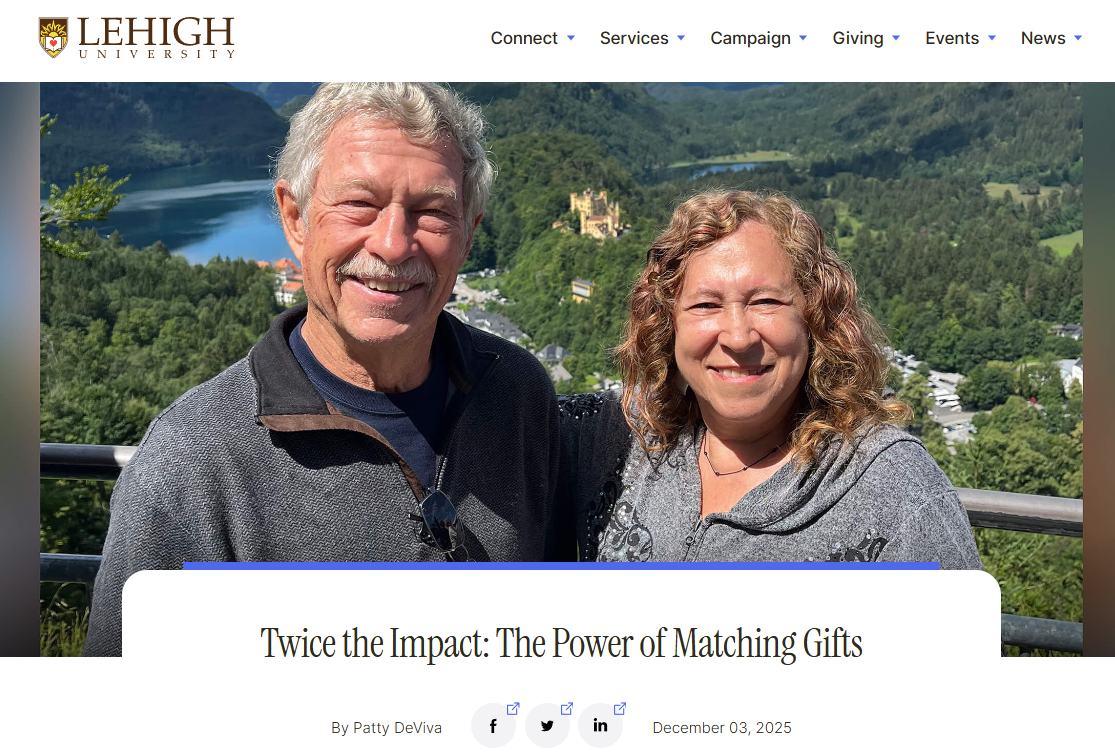
Roger’s story provides other donors with a roadmap, making the concept of doubled impact tangible rather than theoretical. Read the full post on the Lehigh University website here!
#3: Complete a pre-event data audit.
Scaling your corporate revenue doesn’t always mean finding new partners. Oftentimes, it’s about identifying who you already know. Before your next big event rolls around (such as in the 90-day window leading up to it), consider auditing your current supporter network for hidden corporate affiliations.
One recent speaker provided this helpful roadmap:
|
“I would probably start by looking at the donor data you already have, and the employer details you might not even know you have, and then developing a cultivation and stewardship strategy from a work-based giving perspective.” — Alix Samuel, Workplace Giving and Matching Gift Manager at Doctors Without Borders |
 |
Not only does this strategy help unlock support through individual matching and volunteer programs, but it also empowers your team to tap into broader sponsorship opportunities. Identifying employee clusters within your guest list positions you to approach with hard data rather than a cold pitch.
As Samuel explains, “If you have any corporate partners or donors, explore what their employee engagement and workplace giving priorities are. Identify where you have overlap and might be able to plan events and campaigns around, and expand the work together.”
When you can tell a CEO that 50 of their employees are already donating to your cause, the conversation shifts from ‘Will you support our cause?’ to ‘How can we do this better together?’
#4: Encourage matching to reach fundraising minimums.
In the world of peer-to-peer fundraising, matching gifts can be the ultimate motivator for participants who are nervous about hitting their goals. It essentially lowers the threshold for success, making high fundraising targets feel increasingly attainable.
One speaker recently shared how matching gifts are viewed as a strategic tool for social fundraising participants:
|
“For peer-to-peer events like our hikes or climbs that actually have fundraising minimums you have to hit, matching gifts are a really effective way to get to that goal. Instead of having to raise $3,000, maybe you only have to fundraise $1,500 with a $1,500 match.” — Eric Robertson, Senior Management of Corporate and Foundation Relations at the CFF |
 |
The CFF takes a high-tech approach to this: “It’s really the technical side of getting the Double the Donation widget everywhere we possibly can, in order to try to facilitate matches.” By integrating Double the Donation’s search tool directly into their mobile app, the Cystic Fibrosis Foundation empowered volunteers to reach out to donors instantly, turning every $50 ask into $100 worth of progress.
Similarly, a representative from the Crohn’s & Colitis Foundation shared how their organization uses matching gifts as a ‘budget closer.’
|
“Are you really, really close to making your campaign budget? I have an email template that our field staff can use, and they just go and find those potential matching gifts that haven’t been initiated yet. They send out that templated email and hopefully close out the budget for their campaign.” — Sara Herring, Senior Manager of National Operations at CCF |
 |
This tactic turns potential matching gift data (such as Double the Donation’s Eligible but Not Submitted report) from a passive list into an active tool to reach and surpass end-of-campaign targets.
#5: Look for “unicorn” companies with standout match ratios.
Not all matching gift programs are created equal. While a 1:1 match is considered standard, many companies are now offering 2:1 or even 3:1 ratios. Identifying these local or national “unicorns” should be a priority for any development officer.
|
“Some organizations, like Fidelity, do more than a one-to-one match. We call them our unicorns. For those with larger matches, we want to position ourselves before these parents or donors who have this unique opportunity.” — Alexandria Turnley, Director of Annual Fund and Alumni Relations at Duke School |
 |
Turnley also notes that you don’t have to guess who these companies are: “The information via [the Double the Donation] tool is really helpful in planning, strategizing, and forecasting.” By flagging these high-ratio matching gift opportunities, you can personalize your outreach, acknowledging that their $500 gift actually has a $1,500 footprint. Be sure to tailor your communications to highlight how these companies are known for “tripling” or even “quadrupling” their employees’ impact!
Interested in exploring more of these programs? Check out MatchingGifts.com’s guide to High-Ratio Matching Gifts: Companies that 3x and 4x Donations.
#6: Use micro-volunteering to engage corporate employees.
Gone are the days when every corporate group had the time for an eight-hour build day. Therefore, nonprofits that want to scale must embrace the idea of micro-volunteering.
Jacquelyn Londo, Global Impact’s Director of Partnerships and Engagement, defined micro-volunteering as “short, flexible, bite-sized volunteer activities that can be completed in five minutes to an hour, individually or as a small group, on-site, or virtually, and with minimal or no training.” She further explains that this low barrier is the key to corporate engagement and growth.
|
“Micro-volunteering has a lower barrier to participation in busy schedules, is easier for managers to approve, and can scale across locations and roles, which is great for companies with global populations.” — Jacquelyn Londo, Director of Partnerships and Engagement at Global Impact |
 |
Whether it’s writing digital thank-you notes during a lunch break or participating in a 15-minute ‘closet audit’ for ethical sourcing, these relatively small actions create the donor-volunteer affinity that leads to long-term workplace giving involvement.
#7: Empower supporters with “meet the moment” resource kits.
If a supporter is excited to help you, don’t make them do the heavy lifting of figuring out how to do it. Rather, provide them with the tools to be your internal ambassador.
Joni Celiz from Martha’s Table shared how simple resources can yield massive ROI. By providing a pre-built landing page or flyer, for example, you can empower supporters to act as your organization’s advocates. Specifically, Joni recommends “creating simple and ready-to-use resources for volunteers to use during high engagement times.”
In a recent session, the Martha’s Table team discussed “creating a landing page called Meet the Moment where supporters can find information on how to do a camp fundraiser, how to organize a clothing drive, etc.” The organization even included a printed flyer with a direct QR code for donations. The result? Here’s what Joni recalls:
|
“When one employee posted that flyer in their office, we received an additional $50,000 because a senior leader had seen it. If you put those resources in the hands of employees, they can put it in their church, they can put it at work, they can put it on community boards.” — Joni Celiz, Director of Institutional Development at Martha’s Table |
 |
#8: Supply an accessible support path for interested donors.
Even a motivated donor can get frustrated by a confusing corporate portal. If they can’t find the correct EIN or aren’t sure how to verify their initial donation, they’re likely to give up before submitting their workplace giving request.
Franny Kavin, Director of Employee Engagement at St. Jude Children’s Research Hospital, discussed how a lack of a clear donor support path is one of the main roadblocks that quietly costs organizations billions of dollars worth of revenue.
|
“Donors repeat requests. They feel like nobody reads their emails. They lose confidence in the process. Even motivated donors stop pursuing the match when support feels unreliable.” — Franny Kavin, Director of Employee Engagement at St. Jude |
 |
Kavin recommends creating a “Single Front Door” for support to eliminate donor confusion. She suggests starting with a simple thought exercise—“If a donor asked for help today, where would they go first?”—noting that providing “one front door, clear routing, and basic expectations can make a big difference.”
Whether it’s providing detailed, step-by-step instructions, sharing a dedicated email address (e.g., matchinggifts@yourorg.org), or offering a 48-hour response guarantee, reliability is the key to successful workplace giving conversions.
#9: Identify corporate personas to tailor your partnership pitch.
Scaling your corporate relationships requires understanding the personality style of the business you’re pitching.
|
“Companies have personality types. Some are introverts, some are extroverts. Some love to work with their hands. Others have lots of words that they wanna share. Some are worried about being more in the spotlight, and some like to be behind the scenes.” — John Carroll, Executive Director of City Leadership |
 |
For example, a data-heavy pitch might work for a financial firm but fail with a creative agency. Before you pitch a high-visibility partnership, ask yourself: Is this an ‘Extrovert’ company that wants its logo on everything, or an ‘Introvert’ company that would prefer to fund a specialized behind-the-scenes project?
Matching your sponsorship ask to the company’s internal vibe is what turns a one-year grant into a multi-year partnership.
#10: Automate relevant outreach across the supporter journey.
For most development teams, workplace giving falls through the cracks; not because of a lack of interest, but a lack of bandwidth. Many organizations either neglect the ask entirely or limit it to a single mention. This administrative hurdle is a documented industry pain point. According to research from Nonprofit Source, more than 80% of nonprofits struggle to build corporate giving strategies due to limited staff and resources.
To overcome these constraints and truly scale, smart fundraisers are increasingly moving away from manual follow-ups. By automating promotions across the entire supporter journey, you ensure that matching gifts and other workplace giving opportunities are identified and pursued without adding a single task to your to-do list.
When asked how to create a frictionless supporter experience despite these hurdles, here’s what Deana DeSilva from Pan-Mass Challenge had to say:
|
“It’s actually the easy part. Double the Donation does all of the work. We have the plugins, the confirmation email links, and the follow-up emails. And all of those components make it super easy to find what you’re looking for.” — Deana DeSilva, Fundraising Director at Pan-Mass Challenge |
 |
From a strategic perspective, automation serves as an educational engine for your donors and volunteers. Dominique Martinez explains that the goal is to keep supporters informed at the exact moments they are most engaged. “The system pulls in employer data and reaches out to ensure they understand their specific company’s incentives, whether that’s matching gifts, volunteer grants, or payroll giving,” Martinez explains. “Once a supporter is fully informed of their impact potential, they are significantly more likely to take that final step.”
By integrating these touchpoints into your existing donor journey, from the first gift to the final thank-you, you turn a passive list of potential matches into a consistent, high-growth revenue stream.
Final Thoughts
Workplace giving isn’t just about large-scale corporate grants. It’s about the small, recurring, and often automated contributions that happen when your supporters feel empowered at work. As these expert nonprofit leaders demonstrated, the most resilient fundraising models are built by turning employee potential into an automated engine for growth.
Quit letting available dollars slip through the cracks of your operational workflows. Whether it’s registering with a CSR portal, auditing your donor data, or launching a micro-volunteering initiative, the steps you take today will build the sustainable revenue foundation your mission needs tomorrow. Good luck!
Interested in joining the next Virtual Summit live? Click here to browse our upcoming events.