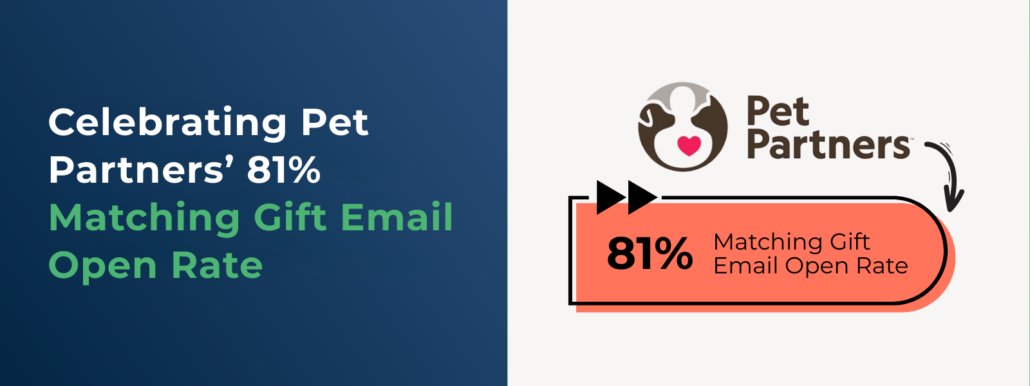
Celebrating Pet Partners’ 81% Matching Gift Email Open Rate
Introduction: Healing Through the Human-Animal Bond
For decades, Pet Partners has been at the forefront of a unique and powerful movement: utilizing the human-animal bond to improve health and well-being. The organization’s mission is grounded in the belief that animals have a profound ability to heal, comfort, and connect us. From therapy dogs visiting hospitals to reading programs in schools, Pet Partners’ teams of handlers and animals bring joy and relief to millions of people every year.
This mission relies on a complex ecosystem of support. It requires thousands of registered therapy teams, rigorous training and evaluation programs, and a robust fundraising operation to keep the infrastructure running. Like many nonprofits operating on a national scale, Pet Partners relies on the generosity of individual donors to fund its programs.
However, Pet Partners identified a specific area where they were not maximizing their potential: corporate matching gifts. They knew that many of their supporters (both donors and volunteer handlers) worked for companies that offered matching gift programs. Yet, the process of identifying these individuals and guiding them through the submission process was disjointed. Donors were often unaware of their eligibility, and the organization lacked a systematic way to bridge that knowledge gap.
By implementing an automated solution to handle matching gift emails and identification, Pet Partners transformed their approach. They moved from a passive hope that donors would find the information to a proactive system that delivered the information directly to the donor’s inbox. The results were immediate and impressive, with engagement rates that far exceeded industry norms, validating the power of targeted, automated communication.
The Challenge: Missing Opportunities in a Complex Network
The core challenge for Pet Partners was one of awareness and complexity. The case study highlights that the organization “felt they were missing out on valuable opportunities because many donors were unaware of their eligibility.” Here’s a look at why:
The Awareness Barrier
This is a classic problem in the nonprofit sector. Billions of dollars in corporate matching funds go unclaimed every year simply because employees do not know the funds exist.
- The Donor’s Reality: A donor might be passionate about Pet Partners and give generously, but they view their employment benefits as something separate from their philanthropy. They don’t make the connection that their HR department could double their gift to the therapy dog program they love.
- The Organization’s Blind Spot: Without a tool to screen for employers, Pet Partners had no way of knowing which of their thousands of donors were eligible. They couldn’t target their communications, meaning they were likely sending generic “thank you” emails to people who could have been receiving specific “match your gift” instructions.
The Peer-to-Peer Complexity
Pet Partners runs “several peer-to-peer events,” such as the World’s Largest Pet Walk. Peer-to-peer (P2P) fundraising adds a layer of difficulty to matching gifts.
- The Participant as Fundraiser: In P2P, the fundraiser is a volunteer participant. They are asking their friends and family for money. These participants are often not fundraising professionals; they don’t know the tax codes or corporate matching policies.
- The Need for Simplicity: Pet Partners needed an “efficient way to connect donors to matching opportunities” that wouldn’t overwhelm their volunteer fundraisers. If the process was too hard, participants simply wouldn’t do it.
Ashley Drew, National Director of Special Events and Field Development, summarized the need for a solution that “made matching gifts super simple for everybody.” The goal was to remove the friction so that taking advantage of matching was “easier for everyone.”
The Solution: A “Super Simple” Integration
To solve these challenges, Pet Partners turned to Double the Donation. The solution was designed to integrate seamlessly into their existing fundraising activities, making the matching gift process invisible until it needed to be visible.
1. Simplified Identification
The first step was to simplify how opportunities were identified. The solution “simplified the identification and follow-up process across campaigns.”
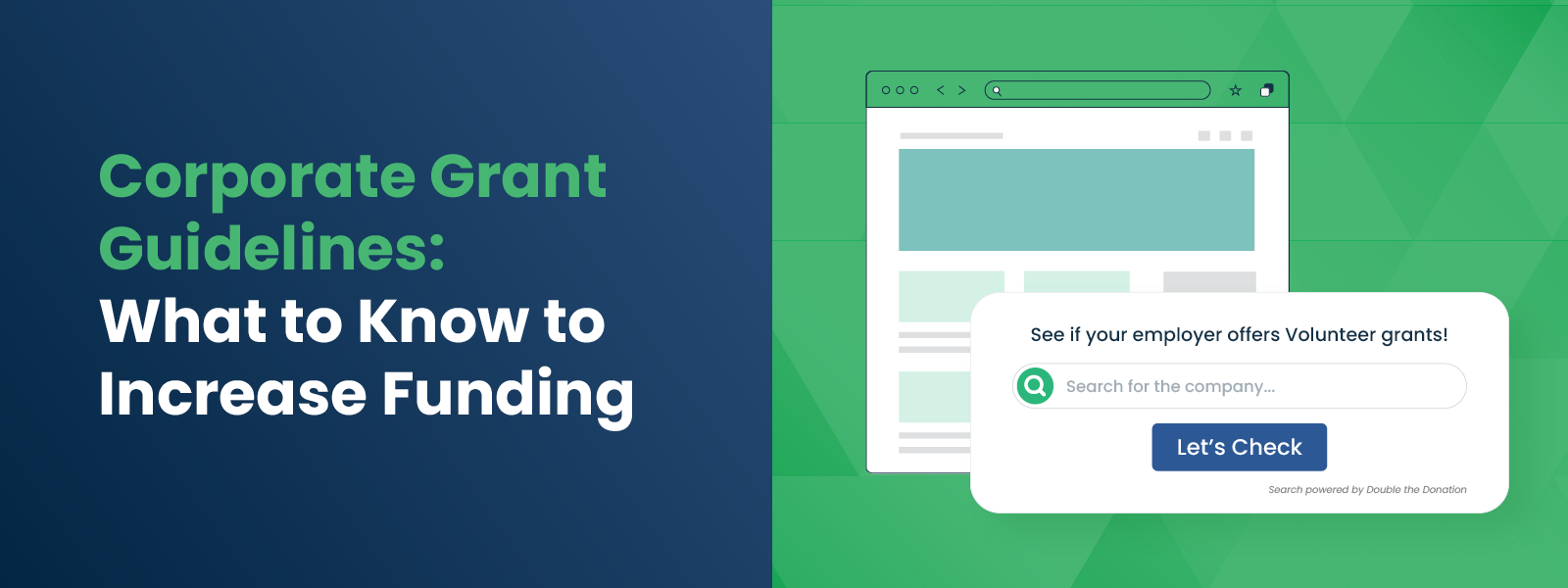
- Search Tools: Pet Partners embedded matching gift search tools directly into their donation forms and campaign pages. This allowed donors to self-identify their employer at the moment of giving.
- Cross-Campaign Consistency: Whether a donor gave to a general fund or a specific Peer-to-Peer event like the Pet Walk, the experience was consistent. The software worked across the board, ensuring no siloed data or missed opportunities.
2. Automated Next Steps
Once a donor was identified, the system took over. The case study notes that “donors receive personalized next steps through automated outreach immediately after donating.”
- Immediacy: The “immediately after donating” part is crucial. The email lands in the inbox while the donor is still thinking about Pet Partners.
- Personalization: The emails provide “personalized next steps.” This isn’t a generic “check with your HR” message. It is a specific set of instructions based on the donor’s employer (e.g., “Here is the link for Boeing employees,” or “Here is the form for Microsoft employees”).
3. The “Click of a Button” Experience
Ashley Drew described the user experience as being available “at just a click of a button.”
- User Interface: The integration placed the matching gift information prominently, likely on the confirmation screen and in the email.
- Reducing Cognitive Load: By making it a “click,” Pet Partners removed the need for the donor to think, research, or navigate away from the page. This reduction in cognitive load is essential for keeping donors engaged in the digital age.
The Results: An 81% Matching Gift Email Open Rate
The most striking result from the Pet Partners case study is the level of engagement they achieved with their automated emails. The metrics suggest that their donor base was hungry for this information.
The 81% Open Rate
Pet Partners achieved an 81% email open rate on their matching gift emails.
- Context: To understand how impressive this is, one must look at industry benchmarks. The average nonprofit email open rate is typically around 20-25%. An 81% open rate is astronomically high.
- Analysis: This suggests that the subject lines were highly effective, likely referencing the donor’s recent gift and the specific opportunity to match it. It also speaks to the high level of trust and affinity the donors have for the Pet Partners brand. When Pet Partners sends an email, their supporters open it.
High Engagement with Tools
The engagement didn’t stop at opening the email. The case study reports that 84% of donors showed moderate to high engagement with matching gift tools.
- What this means: This metric likely tracks actions such as searching for an employer, clicking a link to a matching gift form, or forwarding the email.
- The takeaway: This validates the hypothesis that donors want to match their gifts. The high engagement rate proves that the barrier was never a lack of willingness; it was always a lack of information. Once the information was provided via the “super simple” integration, the donors acted on it en masse.
Strategic Deep Dive: Peer-to-Peer and Matching Gifts
The Pet Partners case study offers valuable insights into the intersection of Peer-to-Peer (P2P) fundraising and matching gifts.
In P2P events like the “World’s Largest Pet Walk,” participants are often competing to hit fundraising goals. Matching gifts can be a secret weapon for these participants.
- Empowering the Fundraiser: By integrating the tool, Pet Partners empowered their volunteer fundraisers. A participant could tell their donor, “If you give $50, your company might match it, and that counts as $100 towards my goal!” This gives the fundraiser a compelling reason to ask for the match.
- Streamlined Follow-Up: Since the follow-up emails were automated, the volunteer fundraiser didn’t have to nag their donors to submit the paperwork. The system handled the “ask,” preserving the personal relationship between the fundraiser and their friend.
The Importance of “Super Simple”
Ashley Drew’s quote about making things “super simple” touches on a fundamental truth of modern fundraising: friction kills conversion.
- Digital Expectations: Today’s donors are used to the “Amazon experience:” one-click ordering, instant confirmation, and seamless tracking. They expect the same level of convenience from the nonprofits they support.
- Removing Barriers: If a matching gift process requires printing a PDF, signing it, and mailing it, participation will be low. By digitizing the process and putting it “at the click of a button,” Pet Partners met the digital expectations of their donors.
The Role of Automation in Event Fundraising
For an organization like Pet Partners that relies on events, automation is the only way to scale. Events generate spikes in volume: hundreds or thousands of donations coming in over a short weekend, and matching gifts can play a huge role in their success.
- Scalability: A manual team cannot process matches fast enough during an event surge. Automation ensures that the donor who gives at 9:00 AM on Saturday gets the same immediate follow-up as the donor who gives at 2:00 PM on Tuesday.
- Consistency: The system ensures that every donor, regardless of which event they supported, receives the correct information. This consistency builds a professional brand image and ensures compliance with various corporate matching policies.
Conclusion: Engaging the Passionate Donor
Pet Partners’ success is a testament to the passion of their community. Their donors believe deeply in the healing power of animals. When Pet Partners provided a way to amplify that healing through matching gifts, the donors responded with incredible enthusiasm.
The metrics tell a powerful story:
- 81% of donors opened the emails.
- 84% engaged with the tools.
These numbers are not just statistics; they represent a community fully mobilized to support the mission. By using automation to remove the barriers to entry, Pet Partners unlocked a powerful new stream of support, proving that even “super simple” changes can have a massive impact on the bottom line.
Download the full case study compilation here to uncover even more successful strategies.