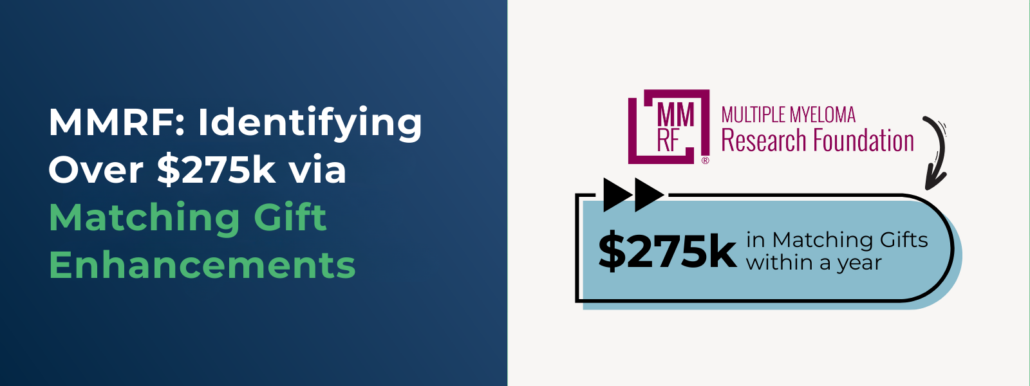
MMRF: Identifying Over $275k via Matching Gift Enhancements
Introduction: Precision Medicine Requires Precision Fundraising
The Multiple Myeloma Research Foundation (MMRF) stands as a beacon of progress in the fight against cancer. As the largest nonprofit in the world focused on finding a cure for multiple myeloma, the MMRF has built a legacy on speed, innovation, and results. Their work has helped triple the life expectancy of myeloma patients and has been instrumental in bringing nearly every new myeloma treatment to market.
This success is driven by a unique philosophy: “precision medicine.” The MMRF doesn’t just fund generic research; it drives targeted, data-driven science that delivers the right treatment to the right patient at the right time. They operate with the urgency of a startup and the rigor of a scientific institute.
However, operating at the cutting edge of science requires massive resources. Clinical trials, genomic sequencing, and data banks are expensive endeavors. To sustain this pace of innovation, the MMRF’s fundraising operations must be as precise and efficient as their research. Every dollar raised is a potential breakthrough.
Despite their sophisticated approach to science, the MMRF identified an area of its fundraising that was lagging behind: corporate matching gifts. The team knew that many of its donors worked for major corporations that would match charitable contributions. Yet, a significant portion of this revenue was going unclaimed. The issue wasn’t a lack of donor generosity, but a lack of process. By refining their digital infrastructure and upgrading their matching gift forms and search tools, the MMRF was able to identify over $275,000 in additional funding, capital that can now be deployed directly into the search for a cure.
The Challenge: The Limits of “Passive” Tools
Before achieving their current level of success, the MMRF relied on a fundraising tool that was functional but fundamentally limited. They utilized a “standalone search tool” to facilitate matching gifts.
The Passive Fundraising Trap
A standalone search tool is essentially a reference library. It lives on a dedicated page on the nonprofit’s website (e.g., “Ways to Give”). If a donor is curious about matching gifts, they can navigate to that page, type in their employer’s name, and find the necessary forms or guidelines.
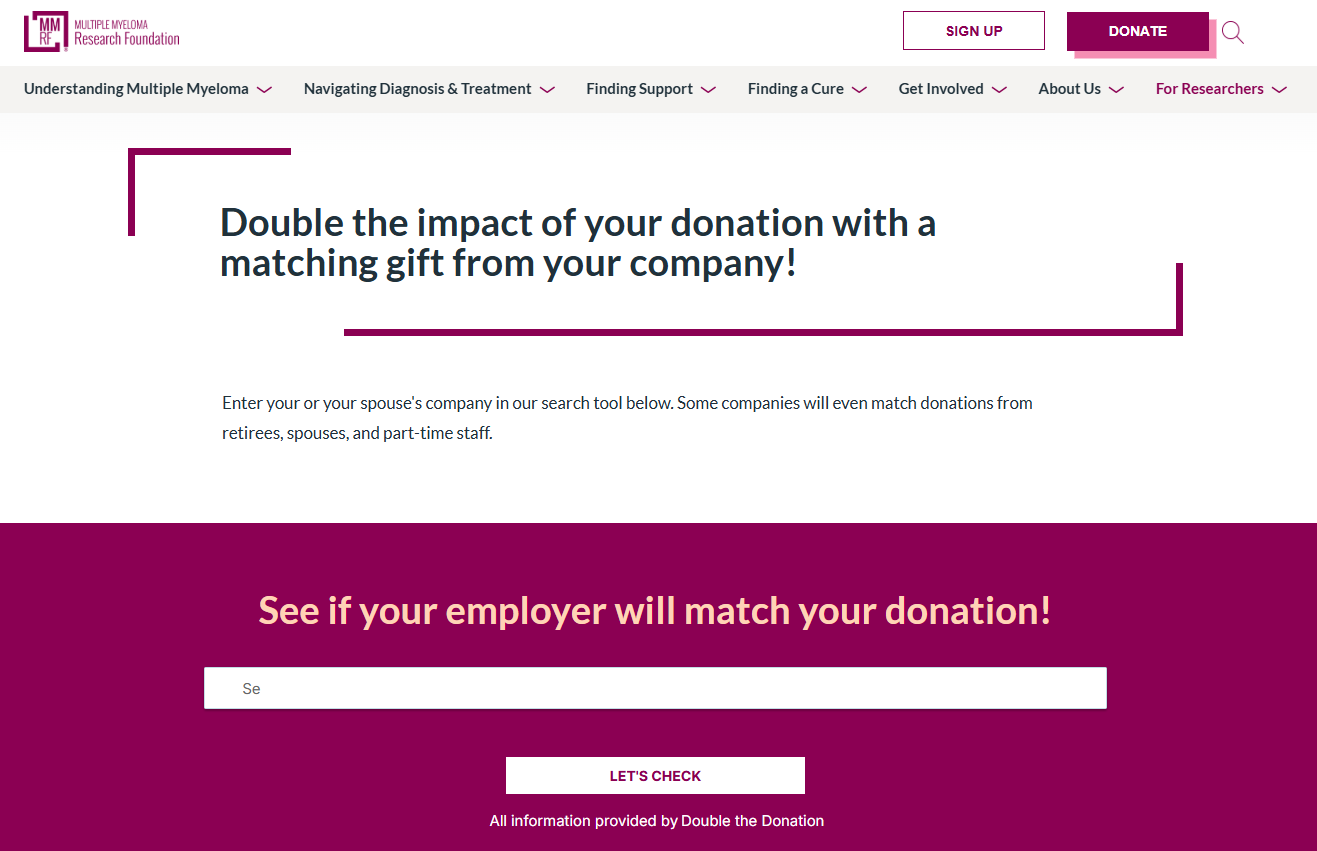
While this provides a resource for the highly motivated donor, it fails to capture the “average” donor.
- The Disconnect: Most donors give impulsively or emotionally. They land on a donation page, make a gift, and leave. They rarely navigate to a secondary “Ways to Give” page to perform research.
- The Friction: Even if a donor knows about matching, the standalone tool places the burden of effort on them. They have to stop what they are doing, find the tool, search, and then go to another site to submit.
The MMRF recognized that this passive model was insufficient for their ambitious goals. They realized they “needed a fully automated system to take a proactive approach to sourcing revenue.” In the world of cancer research, “reactive” is not a winning strategy. Just as they proactively seek out new treatments, they needed to proactively seek out matching revenue.
The Solution: Upgrading to Automated Matching Gift Forms
To solve this challenge, the MMRF upgraded its technology stack to include Double the Donation’s automated platform. This shift allowed the organization to move from a library model (waiting for donors to look it up) to a delivery model (handing the answer to the donor).
The solution was built on three pillars of automation and integration:
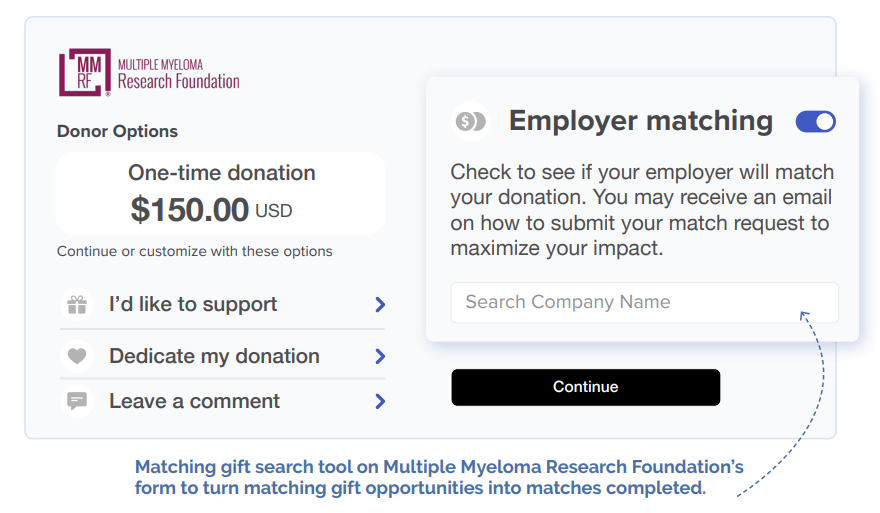
1. The Streamlined Donation Form Search Field
The first step was to integrate the search experience directly into the transaction. The MMRF implemented a “streamlined search field on the donation form.”
- Strategic Placement: Instead of hiding the search tool on a separate page, it was embedded right where the donor was already typing. As donors entered their name and payment details, they could also identify their employer.
- Real-Time Eligibility: This integration allowed the system to check eligibility instantly. It turned the donation form from a simple payment gateway into a data-enrichment tool, capturing vital employment information without slowing down the donor.
2. The Confirmation Page Plugin
Once the donation was processed, the system utilized a confirmation page plugin to maintain engagement.
- Immediate Action: The moment the credit card was charged, the confirmation page displayed “matching gift next steps.”
- Contextual Relevance: This is the ideal time to ask for a match. The donor has just finished giving; they are feeling generous and accomplished. By presenting the matching gift form or link immediately, the MMRF capitalized on that positive momentum.
3. Automated Email Outreach
Recognizing that some donors might still miss the on-page prompts, the MMRF implemented automated matching gift emails.
- The Safety Net: These emails acted as a failsafe. If a donor closed the browser too quickly, the email would arrive in their inbox a short time later, reminding them of the opportunity.
- Personalization: The emails were not generic spam; they were targeted based on the employment data (or lack thereof) captured during the donation, ensuring relevance.
The Results: Over $275,000 for Research
The transition to an automated, integrated system produced immediate financial and operational results for the Multiple Myeloma Research Foundation.
Financial Impact: $275,000 Identified
In less than 12 months, the new system identified over $275,000 in match-eligible dollars.
- Research Equivalence: In the context of medical research, $275,000 is a significant sum. It can fund specific lab equipment, cover the costs of patient enrollment in trials, or support the work of junior researchers. This revenue was “unlocked” from the existing donor base without the need to solicit new gifts.
Donor Engagement: 60% Open Rate
The engagement metrics from the case study demonstrate that MMRF donors are highly responsive to this type of outreach.
- 60% Email Open Rate: The automated matching gift emails achieved a 60% open rate.
- Analysis: This is remarkably high for the nonprofit sector. It suggests that the MMRF donor base is deeply invested in the mission. When they see an email about maximizing their impact, they open it.
- 28% Conversion: The data showed that 28% of donors accessed matching gift forms or guidelines.
- Analysis: While 28% might seem lower than the open rate, it represents a significant number of people taking a complex administrative action. Nearly one in three donors who engaged with the tool took steps toward submitting a match request.
Operational Efficiency
The system sent more than 2,600 emails automatically.
- Scale: For a fundraising team, sending 2,600 personalized emails would take weeks of manual labor. The automation handled this instantly, ensuring that every eligible donor was contacted without diverting staff time away from major donor cultivation or event planning.
Strategic Analysis: The Power of “Actionable Metrics”
A key component of the MMRF’s success was its ability to track and analyze performance. The solution provided a “matching gift dashboard” that outlined actionable metrics for matching gift fundraising success.
Why Data Matters in Precision Fundraising
Just as precision medicine relies on genomic data to determine the best treatment, precision fundraising relies on donor data to determine the best engagement strategy.
- Employer Trends: The dashboard allows the MMRF to see which companies are employing their donors. If they see a surge of donations from employees of a pharmaceutical company or a tech firm, they can tailor their corporate outreach strategies accordingly.
- Optimization: By tracking open rates (60%) and conversion rates (28%), the team can experiment with different subject lines or email timing to try to improve those numbers further. The data turns fundraising from an art into a science.
The Donor Experience: Reducing the Burden
The MMRF’s approach aligns with a broader trend in the nonprofit sector: reducing donor friction. A diagnosis of multiple myeloma is overwhelming for patients and families. The people donating to the MMRF are often loved ones, survivors, or patients themselves. They are navigating a complex medical landscape.
The last thing these donors need is a complex fundraising landscape. By upgrading its matching gift forms to be streamlined and automated, the MMRF showed respect for its donors’ time and energy.
- Simplicity: The embedded search tool meant donors didn’t have to hunt for information.
- Clarity: The automated emails provided direct links, removing the need for research.
This donor-centric approach likely contributed to the high engagement rates. When you make it easy for people to help, they will help.
Conclusion: Accelerating the Cure
The Multiple Myeloma Research Foundation is an organization built on speed. Their mission is to find a cure now. By applying that same urgency to their fundraising operations, they have unlocked a new stream of revenue to fuel their work.
The identification of $275,000+ in matching funds and the engagement of thousands of donors via automated emails prove that technology is a vital partner in the fight against cancer. By moving from a passive search tool to a proactive, automated ecosystem, the MMRF has ensured that it is leaving no stone unturned (and no dollar unmatched) in its pursuit of a world without multiple myeloma.
Download the full case study compilation here to uncover even more successful strategies.