Humane World for Animals’ $225k in Match-Eligible Gifts
Introduction: A Global Mission for Animal Welfare
Humane World for Animals is a force for good on a global scale. The organization works around the globe to promote the human-animal bond, protect street animals, and support farm animal welfare. Their mandate is broad and critical: they work to stop wildlife abuse, eliminate painful animal testing, respond to natural disasters, and confront cruelty to animals in all of its forms.
From rescuing dogs from meat farms to responding to earthquakes and floods, Humane World for Animals’ work is resource-intensive. It requires a constant stream of funding to deploy teams, provide medical care, and advocate for policy changes across different continents. To sustain this work, Humane World for Animals relies on a large number of individual donors for its fundraising. These individual supporters are the lifeblood of the organization, providing the unrestricted funds needed to respond to crises at a moment’s notice.
However, relying on individual small-dollar donors presents a unique challenge: scale. While the collective power of thousands of donors is immense, the administrative burden of managing those relationships can be overwhelming. Specifically, Humane World for Animals faced a challenge in maximizing the value of these gifts through corporate matching programs. They knew that many of their donors worked for companies that would match their contributions, but they lacked the infrastructure to connect the dots.
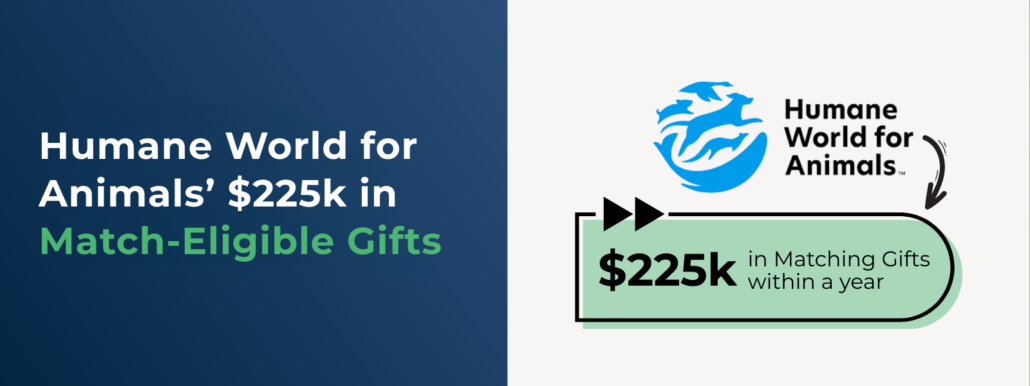
By implementing a technological solution to bridge this gap, Humane World for Animals transformed their fundraising operations. In just 12 months, they identified over $225,000 in match-eligible donations, funds that were previously invisible to the development team. This success story highlights how global nonprofits can use automation to turn local support into worldwide impact.
The Challenge: The “Needle in a Haystack” Problem
The core challenge facing Humane World for Animals was one of data visibility and administrative capacity. The case study notes that Humane World for Animals “relies on a large number of individual donors.” While this broad base of support is a strength, it created a logistical bottleneck when it came to matching gifts.
The Identification Gap
Humane World for Animals “faced the challenge of not being able to identify match-eligible donors.” In a database of thousands of supporters, identifying the specific individuals who work for companies with matching gift programs is like looking for a needle in a haystack. Without employment data attached to donor records, development staff are flying blind. They cannot ask for a match if they don’t know the match exists.
The Capacity Constraint
Even if Humane World for Animals could identify these donors manually, the follow-up would be impossible. The case study explicitly states that “following up across thousands of donations would be a manual and exceedingly time-consuming task.” Imagine a fundraising team trying to manually email 5,000 donors after a major campaign to ask about their employers. It would require hundreds of hours of staff time; time that should be spent on higher-level strategy or major donor cultivation. Because of this capacity constraint, many matching gift opportunities were simply slipping through the cracks.
The Opportunity Cost
The cost of this inefficiency was real revenue. Every unverified donor represented potential double funding that was not being collected. For an organization dealing with urgent crises like natural disasters, leaving revenue on the table is not just a financial loss; it impacts the ability to save lives.
The Solution: Automated Identification and Pursuit
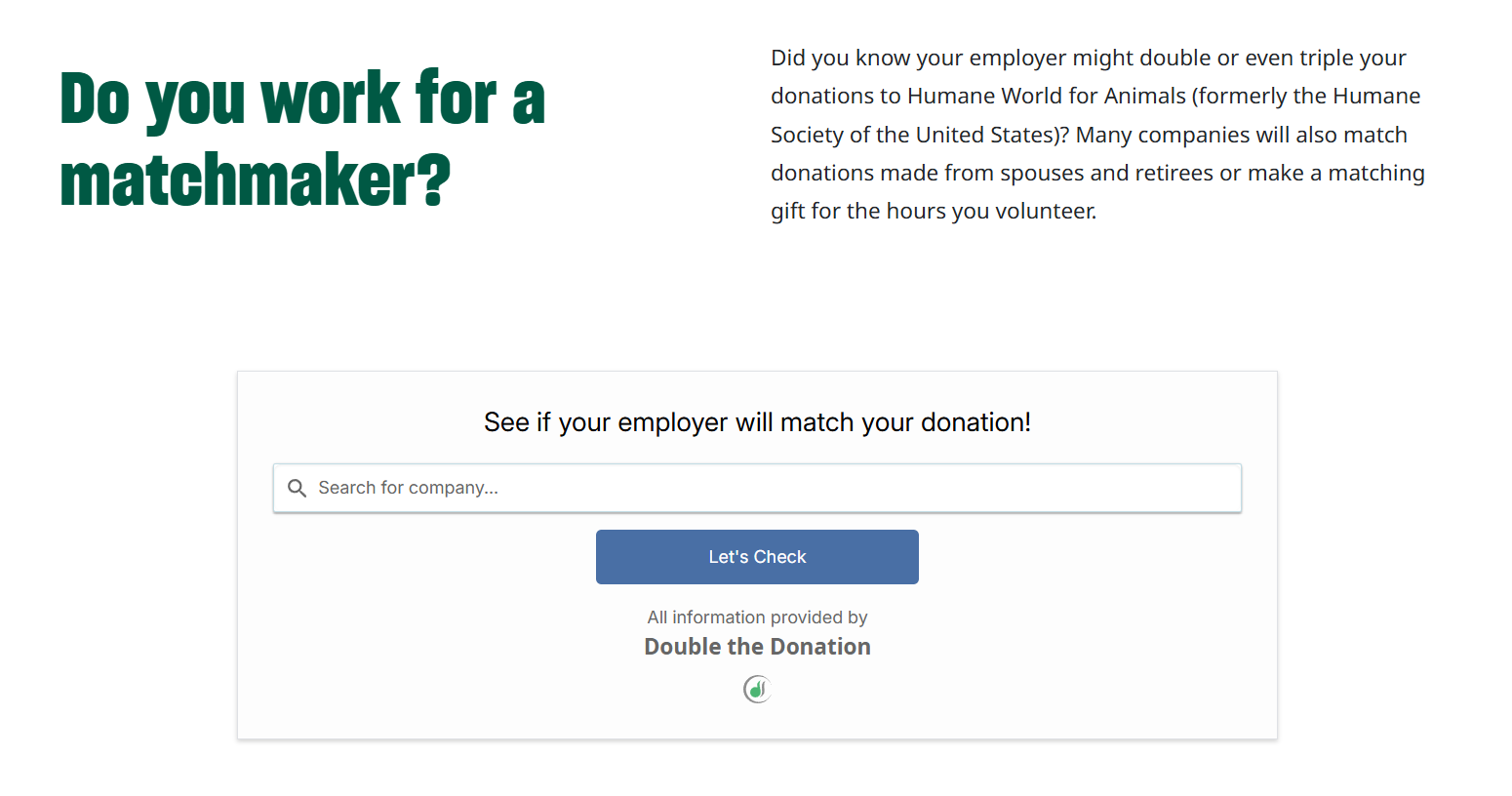
To solve this “needle in a haystack” problem, Humane World for Animals implemented Double the Donation Matching. The goal was to shift from a manual, reactive process to a fully automated system where “all matching gift opportunities are identified and pursued automatically.”
The solution involved a multi-faceted approach to automation, ensuring that donors were engaged at multiple touchpoints without requiring staff intervention.
1. Automated Identification Methods
The new system introduced “multiple matching gift identification methods.”
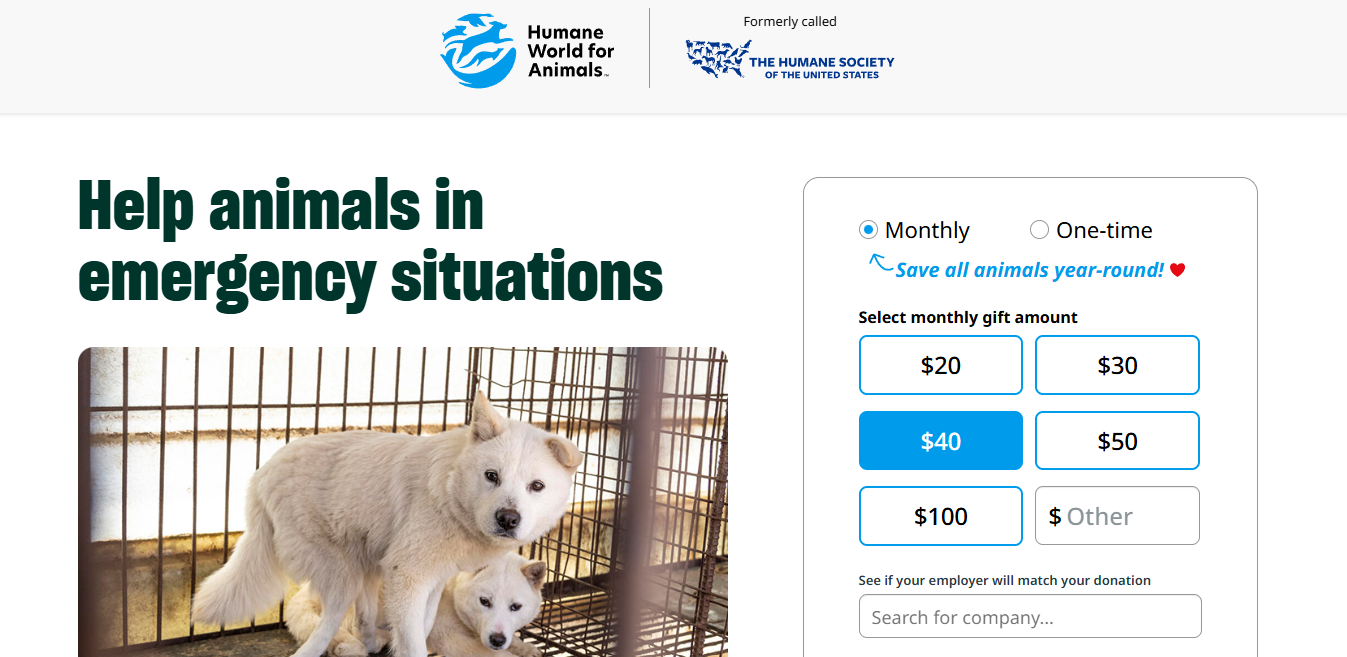
- Donation Form Search: Humane World for Animals implemented a “streamlined search field on [the] donation form.” This allowed donors to self-identify their employer at the point of transaction.
- Why this matters: Capturing this data during the donation process is the most accurate way to screen for eligibility. It removes the guesswork and provides the development team with clean, actionable data.
2. Automated Email Triggers
Once a donor was identified, the system handled the outreach. Humane World for Animals utilized “automated email triggers and timing” to contact donors.
- The Scale of Outreach: The case study notes that 64,000+ automated emails were delivered. This figure illustrates the massive scale of the operation. Sending 64,000 personalized emails manually would have been impossible for the Humane World for Animals team. Automation allowed them to communicate with every single eligible donor, ensuring no opportunity was missed.
3. Customization and Branding
A critical concern for any large nonprofit is brand integrity. Humane World for Animals needed to ensure that the automated emails didn’t feel like “bot” messages. The solution allowed for “all of these communications between donors and Humane World for Animals [to be] customized to match the organization’s existing branding and messaging.”
- Maintaining Trust: By using their own branding, Humane World for Animals ensured that the emails felt like a natural extension of the donor’s relationship with the organization. This builds trust and increases the likelihood that the donor will take action.
The Results: Immediate Revenue Growth
The implementation of Double the Donation produced immediate and quantifiable results for Humane World for Animals. The data from the case study demonstrates success in three key areas: identification, revenue growth, and operational efficiency.
1. Identification: $225,000+ Uncovered
In the last 12 months alone, Humane World for Animals identified over $225,000 in match-eligible donations. This figure represents the “hidden” potential within their existing donor base. These were not new donors; they were current supporters whose matching gift eligibility had previously gone unnoticed. Uncovering a quarter-million dollars in potential revenue is a game-changer for program funding.
2. Revenue Growth: A 17% Increase
Identification is the first step; securing the funds is the second. Humane World for Animals was successful in converting these opportunities into cash. The organization reported that the tool “increased Humane World for Animals’ matching gift revenue 17% in year 1.”
- Immediate ROI: Achieving a double-digit percentage increase in the very first year of usage is a testament to the effectiveness of the “low-hanging fruit” strategy. It shows that once the barrier to entry (awareness) was removed, donors were eager to participate.
3. Operational Scale
The most impressive metric from an operational standpoint is the 64,000+ automated emails delivered. This number represents the true value of automation. It signifies 64,000 touchpoints with donors (64,000 reminders to double their impact) that occurred without a staff member hitting “send.” This efficiency allowed the Humane World for Animals team to “ramp up our usage over the last year” without burning out their staff.
Strategic Analysis: Best Practices in Action
The success of Humane World for Animals was not accidental; it was the result of following industry best practices. Ken Waldrop, Humane Society Program Manager for Workplace Giving, highlighted exactly why the strategy worked: “Double the Donation utilizes best practices through incorporating matching gifts into the donation process and sending post-action emails to remind donors to have their company match their gift.”
The “Sandwich” Strategy
Waldrop’s quote describes a “sandwich” strategy for donor engagement:
- Pre-Action (The Top Bun): Incorporate matching gifts “into the donation process.” Ask the donor about their employer while they are giving.
- The Action (The Meat): The donor makes their gift.
- Post-Action (The Bottom Bun): Send “post-action emails” to remind them to finish the job.
This dual-approach ensures that if the donor misses the prompt the first time (during the donation), they are caught by the safety net (the email) the second time. It maximizes the conversion rate by giving the donor multiple opportunities to say “yes.”
Support and Implementation
Another key factor in Humane World for Animals’ success was the support they received during the transition. Waldrop noted that “Double the Donation’s support team was exceptional in implementing on our web pages and working out the tweaks.” For a global organization with a complex web presence, technical implementation can be a hurdle. Having a partner that provides exceptional support ensures that the tools are set up correctly to capture data accurately, which is essential for the downstream automation to work.
The Dashboard: Actionable Metrics
Humane World for Animals also utilized the “matching gift dashboard” to track their success. This dashboard “outlines actionable metrics,” giving the team visibility into their performance.
Why this matters: In international fundraising, trends can shift quickly. Having a dashboard allows Humane World for Animals to see if email open rates are dropping, or if a specific region is generating more matches than others. This data-driven approach allows for continuous optimization of the fundraising strategy.
Conclusion: Scaling Compassion Through Technology
The Humane World for Animals case study is a powerful example of how technology can amplify compassion. Humane World for Animals’ donors want to help animals; they want to stop cruelty and protect wildlife. By automating the matching gift process, Humane World for Animals gave these donors a powerful tool to double their impact without any extra cost.
The results ($225,000+ identified and a 17% revenue increase) prove that automation is not just a convenience; it is a revenue generator. By solving the “needle in a haystack” problem with automated identification and outreach, Humane World for Animals has secured vital resources to continue their work confronting cruelty to animals in all its forms.
For other international nonprofits, the lesson is clear: your donors are ready to do more. You just need to give them the tools and the reminders to do it.
Download the full case study compilation here to uncover even more successful strategies.