How Dawson School Achieved a 21x Matching Gift ROI
Introduction: The Drive for Fundraising Efficiency
In the competitive landscape of independent school fundraising, efficiency is not merely a goal; it is an absolute necessity. Schools like Dawson School rely heavily on their annual funds (specifically the Dawson Fund) to bridge the critical gap between tuition revenue and the actual cost of providing an exceptional educational experience. Every dollar raised through these campaigns supports students, faculty, and essential programs, making the maximization of each contribution a top priority for the development office.
However, development teams at independent schools often face a persistent resource paradox: they are tasked with raising increasing amounts of revenue, yet they often operate with limited time and staff to dedicate to complex prospect research. Matching gifts have always represented a significant opportunity to scale revenue, but the manual tracking required to identify eligible parents and alumni is often too cumbersome to maintain effectively.
Dawson School managed to solve this paradox through a strategic technological investment. By adopting a “quick onboarding” and “turnkey” approach to matching gifts, they rapidly grew their revenue and achieved a powerful return on investment. In their first year alone, the school realized a 21x return on their annual subscription cost, identifying tens of thousands of dollars that might otherwise have gone unclaimed.
The Challenge: Ensuring “No Opportunity is Left on the Table”
The primary objective for Dawson School was clear: they needed a way to maximize their matching gift revenue “quickly and efficiently.” The development team operated with the philosophy that “no opportunity is left on the table,” meaning they needed a system capable of capturing every potential match, regardless of how the donation was made or the technical savvy of the donor.
The Complexity of School Fundraising
Fundraising for an educational institution involves multiple channels and touchpoints. While online giving is growing, significant contributions still come through offline methods, such as checks, capital campaign pledges, or event-based giving. A matching gift solution that only addressed online credit card donations would inherently miss a large portion of the school’s fundraising volume.
The challenge, therefore, was two-fold:
- Speed: The school needed to be up and running fast, without a lengthy or complex implementation process that would distract from active campaigns.
- Comprehensiveness: The solution needed to handle both online web donations and offline gifts stored in their CRM.
Without an automated system, the “Dawson School Team” would be forced to manually research employer eligibility for every parent and alumnus; a task that is simply not scalable for a small shop.
The Strategic Pivot: Turnkey Integrations
To address these challenges, Dawson School turned to Double the Donation. The defining characteristic of this transition was the use of “turnkey integrations,” which allowed the school to launch the program rapidly and minimize technical overhead.
The strategy relied on two distinct integration points that worked in tandem to cover the entire donor landscape.
1. The Online Integration: Donation Form Embedding
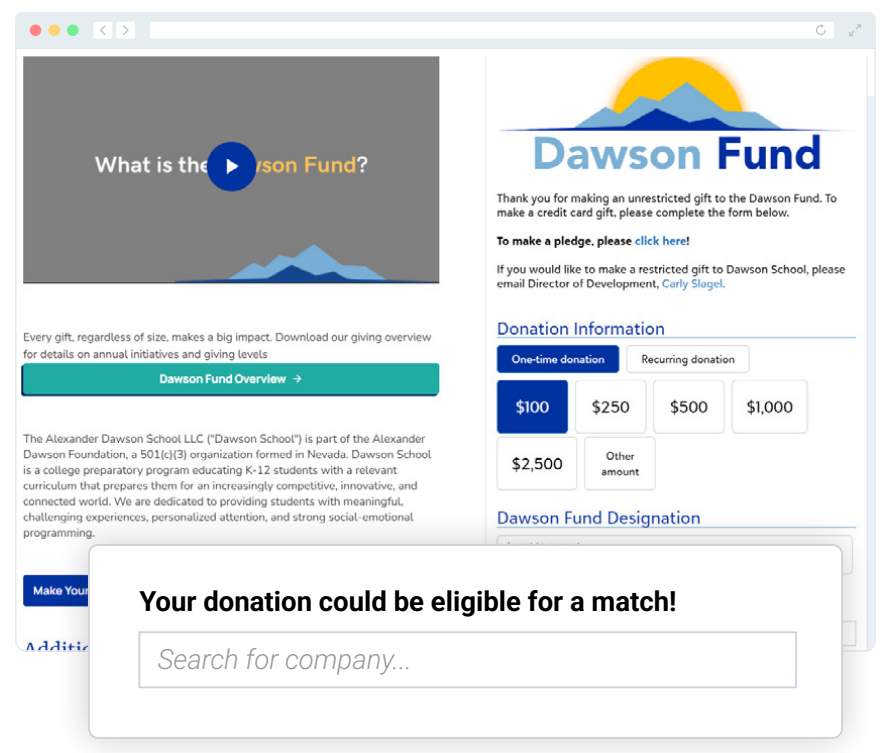
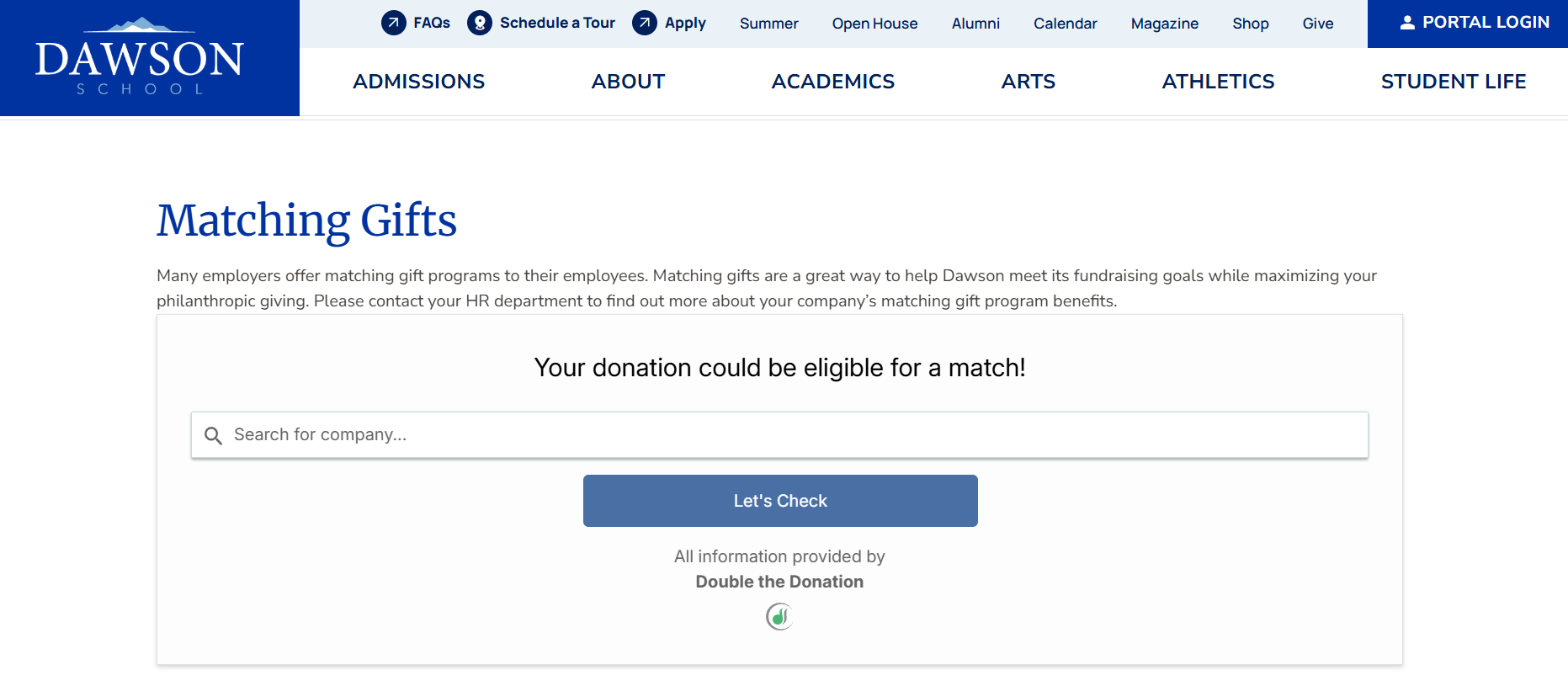
For digital donors, the experience had to be seamless. Dawson School embedded the matching gift search tool directly into their donation form.
This placement is strategic. As donors interact with the “Donation information” section of the page (selecting gift amounts such as $100, $250, $500, or $1,000), they are immediately presented with a prompt: “Your donation could be eligible for a match! Search for company.”
By integrating the search tool at this exact moment of transaction, Dawson School accomplished three strategic goals:
- Awareness: It educated donors about matching gifts while they were in the process of giving, rather than as an afterthought.
- Ease of Use: It allowed donors to search for companies (like “Google”) immediately, without leaving the donation page.
- Speed: Because the integration was “turnkey,” the school was “able to add our matching gift search tool to their donation form quickly.”
2. The Offline Integration: CRM Connection
Perhaps the most critical strategic move was connecting the matching gift software with the school’s Constituent Relationship Management (CRM) system.
Many matching gift programs fail because they ignore offline gifts. Dawson School ensured that its system could “identify and follow up on matching gift opportunities even from offline donations.” This meant that if a donor wrote a check for the “Imagine More Capital Campaign” or the annual fund, the development team could still screen that donor’s employer against the database and trigger the necessary outreach. This comprehensive approach ensured that the “no opportunity left on the table” goal was met for every type of gift, extending the reach of the software beyond just the website.
The Execution: Automating the Donor Journey
Once the integrations were live, Dawson School leveraged automation to handle the communication flow. This removed the administrative burden from the staff and ensured consistent, timely follow-up with donors.
The “Automated Outreach” system functioned as a continuous loop:
- Identification: The system identified eligible donors via the donation form or CRM screening.
- Notification: “Donors are automatically sent tailored matching gift emails that encourage action!”
Analyzing the Communication Strategy
The case study highlights the specific messaging used by Dawson School to drive results. The automated emails were designed to be informative and actionable, removing any friction for the donor.
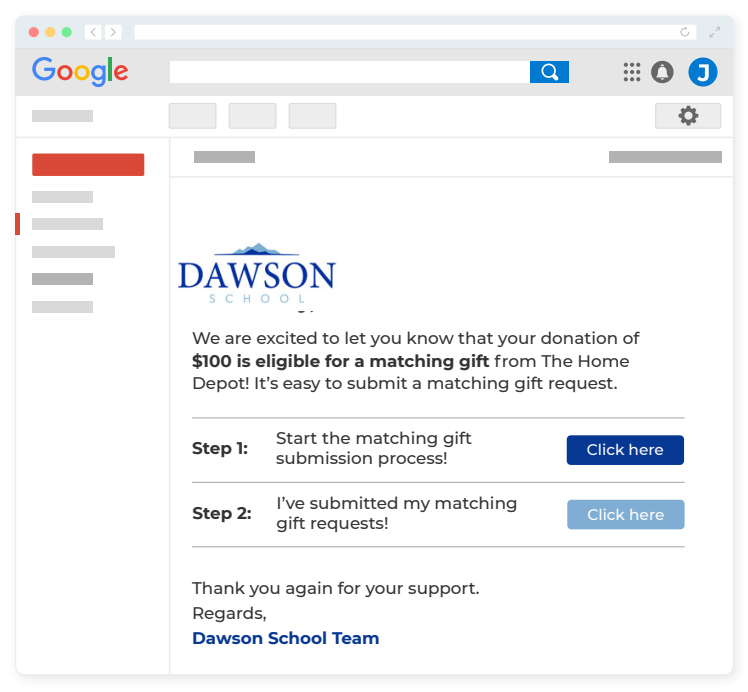
- The Subject: The emails clearly stated the value proposition, informing donors that their specific gift amount (e.g., “$100”) was “eligible for a matching gift from [Company Name].” This personalization confirms to the donor that the email is relevant to their specific recent action.
- The Call to Action: The email provided a direct link to “Step 1: Start the matching gift submission process!” with a clear “Click here” button. This makes it easy for the donor to act immediately without hunting for forms.
- Closing the Loop: The system even accounted for the final step, allowing donors to click a button stating, “Step 2: I’ve submitted my matching gift requests!”
By automating these communications, Dawson School ensured that every eligible donor received a personalized nudge, signed “Regards, Dawson School Team,” without a staff member needing to compose a single email.
The Results: A 21x Return on Investment
The impact of this strategy was immediate and financially significant. By prioritizing efficiency and automation, Dawson School achieved a level of return that is rare in fundraising investments.
Financial Metrics
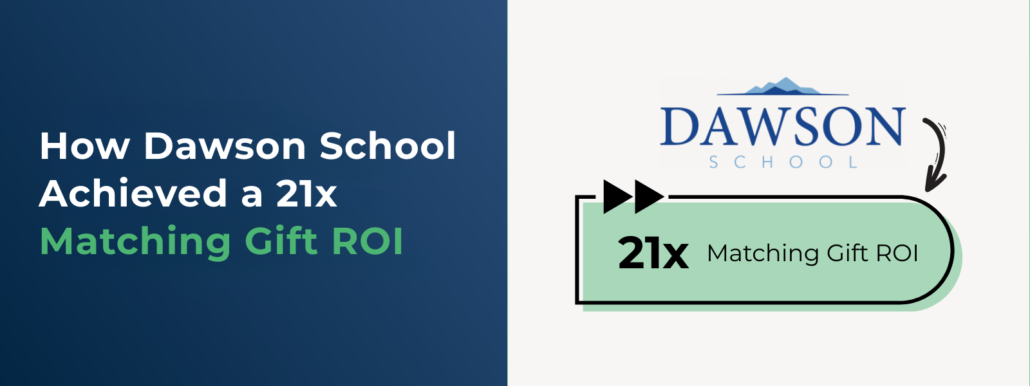
In their first year alone, the school identified approximately $30,000 in additional employer matches. When weighed against the cost of the software, this revenue resulted in a 21x return on their annual subscription cost.
This metric (21x ROI) demonstrates the high leverage of matching gift automation. For every dollar the school invested in the technology, it uncovered twenty-one dollars in potential revenue from corporate matching programs.
Operational Success
Beyond the financial numbers, the operational success was defined by the system’s ability to run in the background. The “automation ensures no opportunity is left on the table,” allowing the school to “maximize their matching gift revenue quickly and efficiently.” This efficiency is vital for independent schools, where development teams must balance annual giving, capital campaigns, and alumni relations simultaneously. The fast setup allowed the school to be “up and running… in no time,” avoiding the dreaded “implementation fatigue” that plagues many software rollouts.
Strategic Takeaways for Educational Fundraising
The success of Dawson School offers a clear blueprint for other educational institutions. The key to their 21x ROI was not just buying software; it was integrating that software into every facet of their fundraising operations.
- Don’t Ignore Offline Gifts: By integrating with their CRM, Dawson School captured revenue from checks and pledges that a web-only tool would have missed.
- Embed the Ask: Placing the search tool directly on the donation form alongside the gift amounts ($100, $250, etc.) normalized the matching process and made it part of the transaction.
- Automate the Follow-Up: Relying on “tailored matching gift emails” ensured that donors received timely instructions on how to submit their requests to employers like “The Home Depot” or “Google.”
Conclusion: Final Thoughts
For Dawson School, the implementation of Double the Donation was more than a software upgrade; it was a strategic unlocking of hidden revenue. By making the matching gift process “turnkey” and automated, they achieved a 21x ROI and identified roughly $30,000 in new funding for their students.
This case study proves that when schools remove the friction from matching gifts (making it easy for donors to search, verify, and submit), the financial returns can be transformative. Dawson School’s “Dawson Fund” is now stronger and more efficient, ensuring that the institution can continue to provide outstanding resources for its community.
Download the full case study compilation here to uncover even more successful strategies.