How Boston College Generated $141k in Alumni Matching Gifts
Introduction: The “Sleeping Giant” of Higher Education Fundraising
Boston College is more than just a university; it is a community with a deep, lifelong connection to its graduates. Like many premier higher education institutions, BC relies on the generosity of its alumni to fund scholarships, research, athletics, and campus improvements. The annual fund is the lifeblood that allows the college to maintain its standard of excellence and accessibility.
In the landscape of university fundraising, “alumni participation” is a key metric. But there is a secondary metric that often holds even greater financial potential: corporate matching gifts. Universities like Boston College have a distinct advantage in this arena. Their alumni often graduate into careers at Fortune 500 companies, financial firms, and tech giants; sectors that aggressively match employee charitable contributions.
Ideally, this should result in a flood of matching gift revenue. However, the reality for many universities is that this revenue stream remains a “sleeping giant.” Alumni are often unaware that their employer matches gifts to higher education, or they assume the process is too bureaucratic to be worth the effort.
Boston College recognized that to wake this giant, they needed to remove the friction from the process. They needed a strategy that would proactively educate alumni and automate the administrative heavy lifting. By partnering with Double the Donation, BC successfully operationalized this strategy, resulting in $141,000 in matching gift revenue.
The Challenge: High Eligibility, Low Visibility
The core challenge Boston College faced was not a lack of eligibility but a lack of visibility. The university has a massive network of successful alumni, many of whom work for matching gift-eligible companies.
The Awareness Gap
The primary barrier to alumni matching is awareness. A graduate might write a check for $100 to the annual fund every year for a decade, never realizing that their employer, perhaps a large bank or consulting firm, would have matched that $100 annually. Over ten years, that is $1,000 in lost revenue from a single donor. Multiply that by thousands of alumni, and the opportunity cost becomes staggering.
The “Friction” of Manual Processing
Even when alumni are aware, the traditional submission process is a deterrent. It often involves:
- Finding the university’s tax ID.
- Logging into a corporate HR portal.
- Filling out a complex form.
- Sending a confirmation to the university.
For busy professionals, this administrative friction is often enough to prevent the match request from ever happening. BC needed a way to “streamline our matching gift efforts” so that the process was as easy as the initial donation itself.
The Solution: A Multi-Channel Alumni Matching Strategy
Boston College did not rely on a single tool to solve this problem. Instead, they implemented a multi-channel ecosystem that surrounded the donor with opportunities to match their gift. The strategy leveraged four distinct technological integrations to ensure no opportunity was missed.
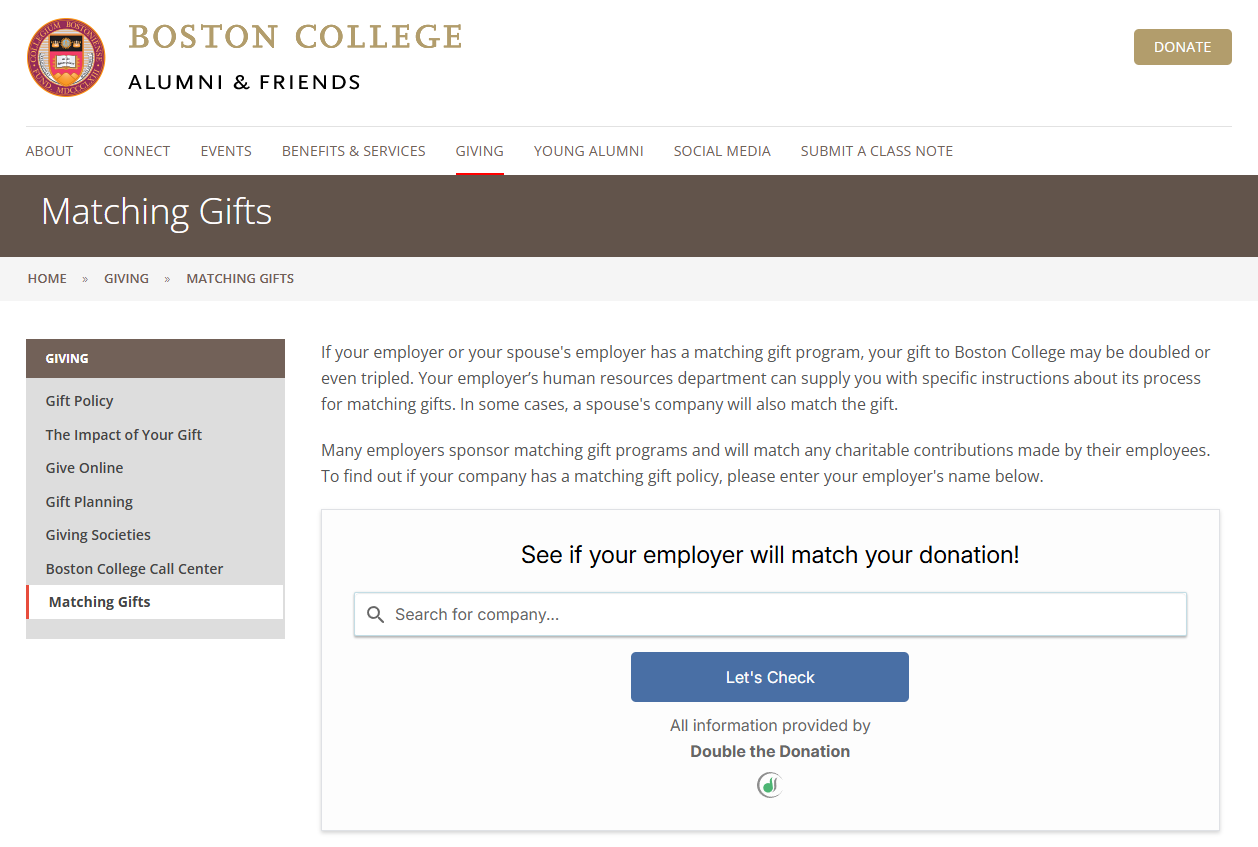
1. The Educational Hub: Dedicated Matching Gift Page
The first pillar of the strategy was education. For this reason, Boston College embedded a matching gift database on its dedicated matching gift page.
- The Strategy: This page serves as the central resource for all things matching gifts. It allows alumni to research their employer’s policy before they give, or at any time during the year. By providing a searchable database, BC empowers alumni to answer their own questions: “Does my company match?” ” What is the ratio?” “Is there a minimum?”
- SEO Value: A dedicated page also helps in search visibility. When an alumnus Googles “Boston College matching gifts,” they land on a branded, helpful resource rather than a generic tax form.
2. The Point of Sale: Donation Form Integration
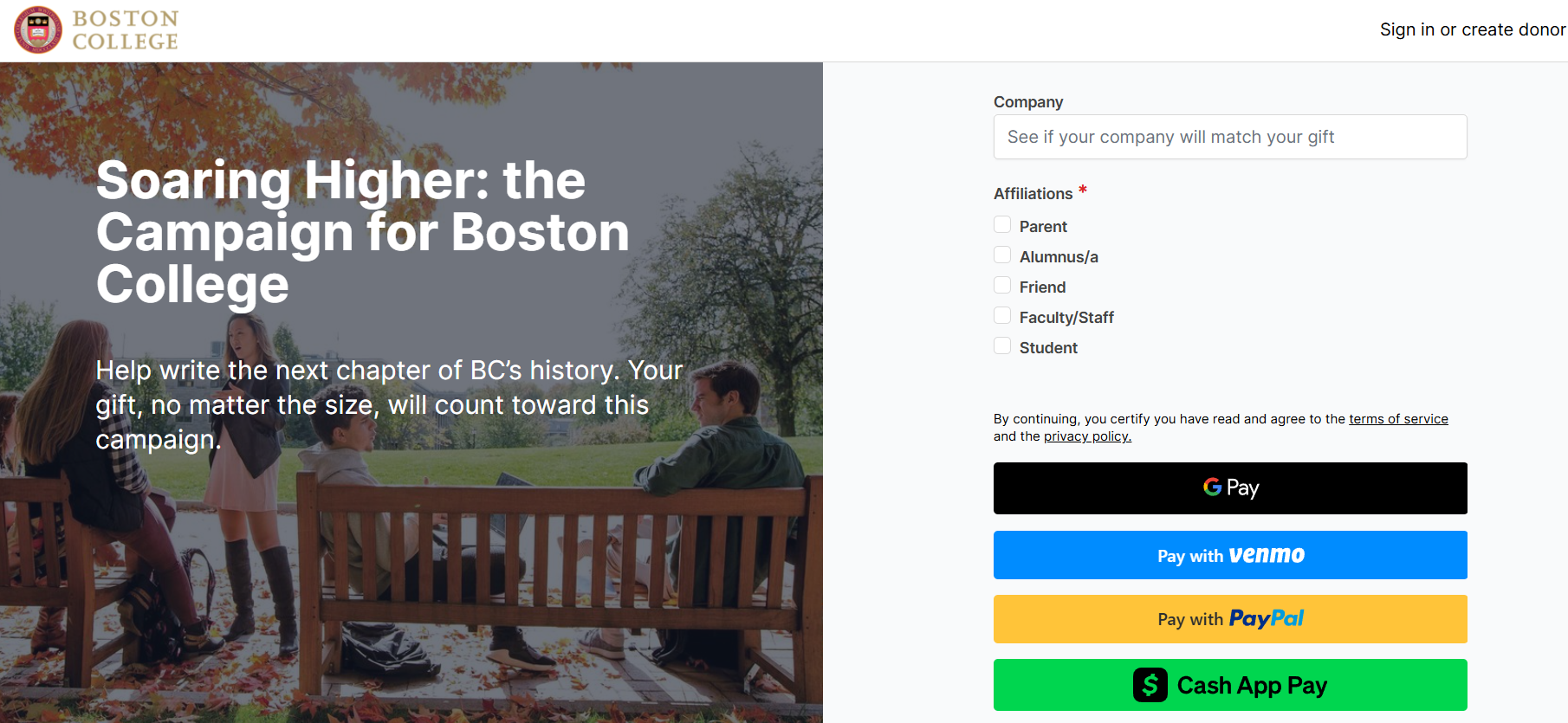
Education is valuable, but timing is everything. BC implemented a “streamlined search field on [the] donation form.”
- The Strategy: This integration captures the donor at the moment of highest intent. As the alumnus is entering their credit card information to make a gift, they are prompted to check their eligibility.
- Friction Reduction: This removes the need for the donor to remember to check later. It integrates the “ask” for the match directly into the transaction, normalizing it as part of the giving process.
3. The Offline Capture: CRM Integration
Higher education fundraising is unique because a significant volume of revenue comes from “offline” sources: checks mailed by older alumni, pledges made during reunions, or major gifts negotiated by development officers. BC ensured their strategy covered these gifts by using “CRM integration.”
- The Strategy: This allows the development team to screen offline gifts against the matching gift database. If a major donor writes a check for $5,000, the system can identify if that donor works for a matching-eligible company and trigger the necessary follow-up. This ensures that the alumni matching strategy extends to the entire donor pyramid, not just online givers.
4. The Follow-Through: Automated Email Streams
Finally, BC automated the outreach. They utilized “automated email streams” to contact donors after the gift was made.
- The Strategy: These emails serve as the closer. If a donor missed the prompt on the donation form, the email lands in their inbox with a clear call to action. It provides the specific forms and links needed for their employer, removing the “research” step for the alumnus.
The Results: $141,000 in Revenue
The implementation of this comprehensive strategy delivered tangible financial results. The case study highlights a clear victory for the Boston College team.
The Financial Metric
Over a two-year period, the system generated $141,000 in matching gift revenue.
- Analysis: In the context of an annual fund, $141,000 is a significant sum. It represents unrestricted revenue that can be deployed immediately to student needs. More importantly, this is high-margin revenue; it was generated without the cost of soliciting new donors. It is simply the maximization of existing relationships.
Strategic Validation
The success of the program validated the investment in technology. A member of the Boston College team noted, “Double the Donation has been a great partner in helping us streamline our matching gift efforts. It’s been a great addition to our fundraising strategy.”
This quote underscores the operational benefit. The tool didn’t just raise money; it “streamlined efforts,” implying that it reduced the manual workload on the BC staff, allowing them to focus on stewardship and major gift cultivation.
Strategic Deep Dive: Why This Works for Higher Ed
The Boston College case study offers a specific roadmap for other universities. The success of alumni matching relies on leveraging the unique characteristics of the alumni-university relationship.
1. The “Corporate Alumni” Factor
Universities like BC produce graduates who flock to industries with high matching gift prevalence: finance, consulting, technology, and law.
- High Eligibility: The “match eligibility” of a university’s donor base is likely higher than that of a local animal shelter or food bank. This makes the ROI on matching gift software significantly higher for universities.
- Professional Expectation: These alumni are used to digital efficiency in their professional lives. They expect their alma mater to offer a seamless, tech-enabled giving experience. A manual, paper-based process feels outdated and discourages participation.
2. The Trust Factor
Alumni trust their university. When BC sends an automated email saying, “Click here to match your gift,” the open rates and click-through rates are likely higher because of that pre-existing relationship. The automated branding ensures the request feels like a helpful nudge from a trusted partner, not spam.
3. The Reunion Cycle
Higher education fundraising is often cyclical, driven by reunions and fiscal year-ends. An automated system scales perfectly to these surges. During a “Giving Day” or a reunion weekend, donation volume spikes. A manual team cannot research thousands of gifts in 24 hours. The automated system can, ensuring that every single reunion gift is screened for a potential match.
The Role of CRM Integration in Major Gifts
The case study’s mention of CRM integration is particularly important for the higher education sector. While annual fund gifts (often $50 or $100) are handled online, the largest checks often come offline.
If a development officer closes a $10,000 gift from an alumnus at a matching-eligible firm, that match could be worth another $10,000. If the matching gift process relies solely on a widget on the donation page, that $10,000 match is lost. By integrating with the CRM, BC ensures that alumni matching is applied to the institution’s most valuable gifts. It turns the matching gift software into a tool for the Major Gifts team, not just the Annual Fund team.
Conclusion: A Lesson in Alumni Engagement
Boston College’s success with alumni matching demonstrates that “free money” is available, but it isn’t truly free; it requires the investment of infrastructure to collect it.
By building a comprehensive ecosystem (Dedicated Page, Donation Form Search, CRM Integration, and Automated Emails), Boston College removed the barriers between its alumni and its corporate philanthropy programs.
The result was $141,000 in revenue and a streamlined process that respects the time of both the donors and the staff. For other universities looking to wake the sleeping giant of corporate matching, Boston College provides the blueprint: stop waiting for alumni to ask about matching, and start automating the answer.
Download the full case study compilation here to uncover even more successful strategies.