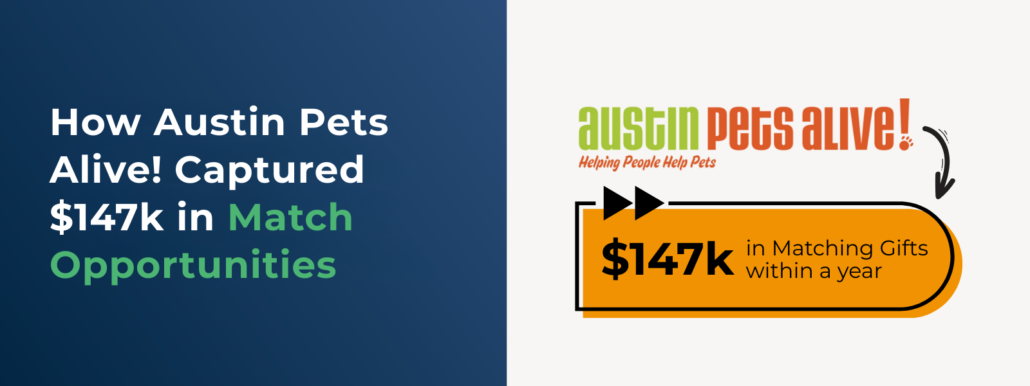
How Austin Pets Alive! Captured $147k in Match Opportunities
Introduction: The “Lifesaver” Mission and Missed Revenue
Austin Pets Alive! (or APA!) is more than just an animal shelter; it is a movement dedicated to eliminating the killing of companion animals. Their fundraising appeals center on a powerful message to their donors: “Thank you for being a lifesaver by making a gift today!” This “lifesaver” identity is central to their donor relationships, creating a deep emotional bond between the supporter and the mission.
However, even the most passionate donors often leave money on the table, not out of a lack of generosity, but out of a lack of awareness. Matching gifts represent one of the most significant untapped revenue sources for non-profits. For an organization like APA!, where resources translate directly into saved lives, missing out on these funds is a critical issue.
While APA! had recognized the value of matching gifts early on, their initial approach was passive. They realized that to truly honor their donors’ intent to be “lifesavers,” they needed to make it effortless for those donors to double their impact. By upgrading their technology stack to include fully automated matching gift identification, APA! transformed their fundraising operations, identifying over $147,000 in match-eligible dollars in less than a year.
The Challenge: The Limitations of Reactive Fundraising
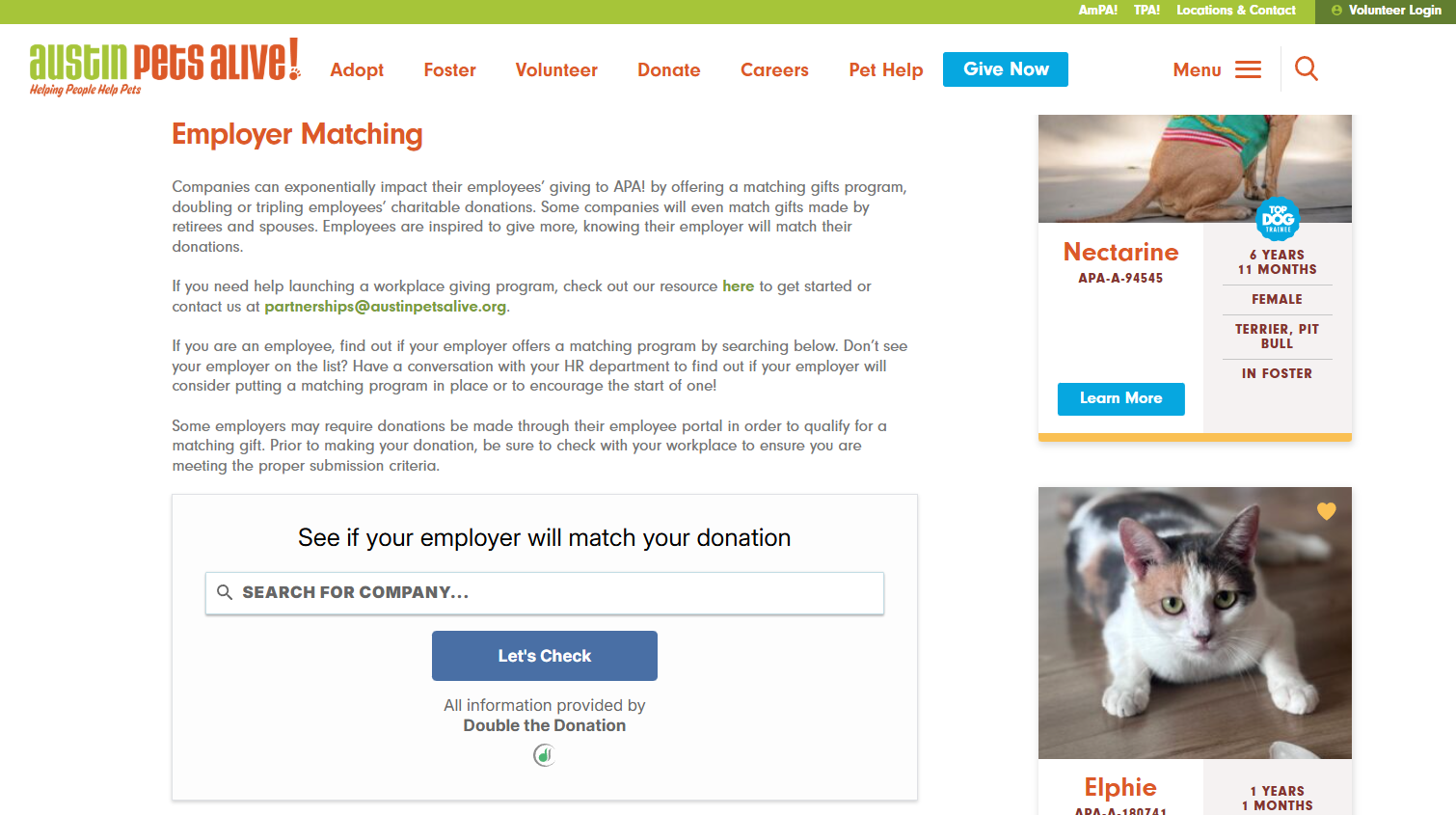
Initially, Austin Pets Alive! utilized Double the Donation’s standalone search tool. This tool provided a necessary function: it gave donors access to a searchable matching gift database. If a donor was curious about their employer’s matching policy, they could find the information they needed. However, a gap in their strategy remained.
The “Passive” Problem
The fundamental flaw with a standalone tool is that it relies entirely on the donor’s initiative. It creates a “reactive” fundraising environment where the organization waits for the donor to take the following steps:
- Realize that matching gifts are an option.
- Locate the search tool on the nonprofit’s website.
- Perform the search.
- Navigate to a separate portal to submit the request.
For a busy donor who has just completed a transaction, this friction is often enough to derail the process. APA! recognized that this passive approach meant they were “missing out on some valuable matching gift opportunities” (inferred from the decision to upgrade). They decided that they “required a fully automated system” to solve this problem.
The goal was clear: APA! needed a more proactive approach to fundraise matching gift revenue effectively. They needed to move the conversation from a hidden web page to the forefront of the donation experience.
The Strategic Pivot: Deploying Groundbreaking Technology
To execute this shift, Austin Pets Alive! upgraded to Double the Donation Matching. This upgrade was not merely a software change; it was a strategic overhaul of how they communicated with donors. The organization leveraged “groundbreaking technology” to automate three critical phases of the donor journey: identification, outreach, and measurement.
1. Identification: The Embedded Search Strategy
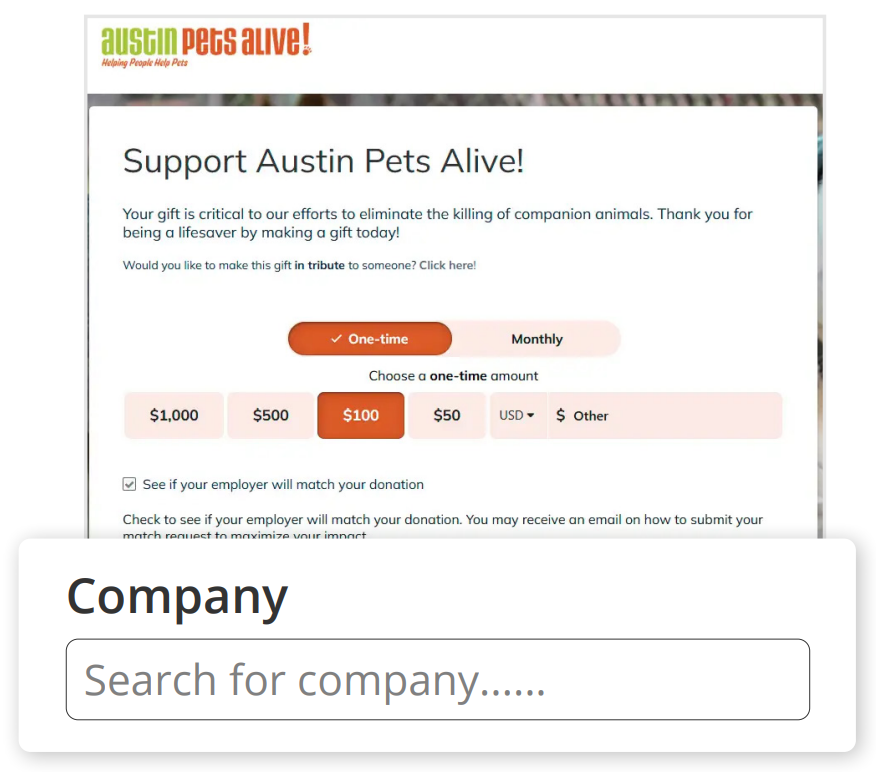
The most visible change was the integration of the matching gift search tool directly into the donation process. In their donation flow, beneath the gift amount options ($1,000, $500, $100, etc.), donors are now presented with a simple checkbox and search bar:
“See if your employer will match your donation.”
By placing this search field directly on the donation form, APA! achieved two strategic objectives:
- Real-Time Eligibility: The system “determines donor match eligibility” at the exact moment the gift is being made. There is no need for the donor to leave the page or remember to check later.
- Psychological Nudge: The prompt acts as a subtle reminder that the donor’s gift could be worth more. Seeing the search bar validates the donor’s employer as a partner in philanthropy, reinforcing the “lifesaver” identity.
2. Activation: The Confirmation Page Plugin
Once the donation is complete, the confirmation page serves as the first point of activation. APA! utilized a confirmation page plugin to provide donors with “matching gift next steps” immediately.
Instead of a generic “Thank You” page, donors who identified an eligible employer are presented with specific instructions. This immediacy is crucial. The donor is already in a “giving mindset,” and the confirmation page capitalizes on that momentum to encourage the next small step: submitting the match request.
3. Retention: Automated Email Outreach
The third pillar of APA!’s strategy was automated outreach. The organization implemented “automated matching gift emails sent to all donors.”
This feature ensures that no opportunity slips through the cracks. If a donor misses the search tool on the donation form or closes the confirmation page too quickly, the automated email serves as a safety net. These emails are “customizable and effective,” allowing APA! to maintain its unique brand voice while driving specific actions.
The email strategy was particularly successful, with over 1,500 emails sent. The content of these emails is designed to be direct and helpful, often subject-lined or headed with “Check to see if your employer will match your donation,” ensuring the donor knows exactly why they are being contacted.
The Results: A Data-Driven Success Story
The transition to a fully automated system produced immediate and measurable results for Austin Pets Alive!. The data from their case study highlights the effectiveness of the proactive strategy.
Financial Impact: $147,000 Identified
In less than 12 months, the organization identified over $147,000 in match-eligible dollars. For an animal welfare organization, $147,000 is a transformative figure. It represents medical supplies, shelter operations, and adoption events. This revenue was identified not by finding new donors, but by maximizing the value of the existing donor base; a highly efficient form of fundraising.
Donor Engagement: 60% Open Rate
One of the most impressive statistics from the APA! case study is the email open rate. The automated matching gift emails achieved a 60% open rate. To put this in perspective, the nonprofit industry average for email open rates typically hovers around 20-25%. A 60% open rate indicates that APA!’s donors are highly engaged and responsive to this specific type of communication. It suggests that donors want to know about matching gifts; they simply need the information delivered to them conveniently.
Adoption at Scale
The tools were not just used by a handful of “super donors.” The data shows widespread adoption:
- 27,000+ Donors: Over 27,000 donors engaged with the Double the Donation tools.
- Dashboard Insights: The organization utilized a “matching gift dashboard” to track these metrics, giving them actionable insights into their donor base.
Strategic Analysis: Why Automation Works for Animal Welfare
The success of Austin Pets Alive! highlights a broader lesson for animal welfare organizations. These nonprofits often rely on high-volume, lower-dollar donations compared to universities or hospitals. In this environment, manual prospect research is impossible. A development officer cannot manually research the employer of every person who donates $50 to a puppy fund.
Automation is the only viable solution to scale matching gift revenue in this sector.
- Volume Management: With over 27,000 donors using the tool, automation is the only way to process this volume of data.
- Speed to Action: Animals need help immediately. The automated emails ensure that the match request process starts now, not weeks later when a staff member finally runs a report.
- Donor Experience: The “lifesaver” narrative is reinforced when the donor sees their $50 gift potentially become $100. It validates their contribution and encourages future giving.
Conclusion: A Model for Proactive Fundraising
Austin Pets Alive! demonstrated that moving from a passive tool to a fully automated ecosystem is a game-changer. By embedding the search experience into the donation form and automating the follow-up, they removed the friction that prevents matching gifts.
The result (more than $147,000 in identified opportunities) is proof that donors are willing to take that extra step if the organization makes it easy for them. For APA!, this proactive strategy didn’t just raise more money; it empowered thousands of donors to amplify their impact, truly earning the title of “lifesaver.”
Download the full case study compilation here to uncover even more successful strategies.