How Duke School Grew its Matching Gift Revenue by 587%
Introduction: The Economics of Independent Schools
Duke School operates in a competitive and demanding educational landscape. As an independent school, it does not rely on state funding to operations; instead, it relies on tuition and, crucially, the generosity of its community. The “Dragon Fund” (Duke School’s annual giving campaign) is not just a “nice to have.” It is an essential revenue stream that bridges the gap between tuition income and the actual cost of providing a progressive, project-based education.
In this environment, every dollar raised has a direct impact on the student experience. It funds professional development for teachers, maintains the campus, and supports the financial aid that keeps the community diverse and accessible. Development directors at independent schools face constant pressure to maximize these funds. However, they often operate with lean teams, wearing multiple hats ranging from event planning to alumni relations to major gift solicitation.
Given these constraints, efficiency is the holy grail of independent school fundraising. The team at Duke School identified a significant inefficiency in their operations: matching gift revenue. They knew that their parent body (comprised of professionals in the Research Triangle area of North Carolina) likely worked for companies with generous matching gift programs. Yet, the school was not capturing this revenue at a level that matched the potential of their demographic.
By making a strategic decision to invest in automation, Duke School didn’t just see a marginal increase; they saw an explosion in growth. Achieving 5 consecutive years of matching gift growth and a 587% total revenue increase, Duke School has set a new standard for how independent schools can leverage technology to fully fund their missions.

The Challenge: “Leaving Money on the Table”
The primary challenge facing Duke School was one shared by many educational institutions: the gap between eligibility and submission.
The Demographics of Potential
Duke School is located in a region rich with corporate industry, including technology, pharmaceuticals, and higher education. This means their donor base (parents, grandparents, and alumni) has a high “match eligibility” rate. Many of these donors work for companies that will match gifts 1:1, 2:1, or even 3:1. However, potential does not equal revenue. For a match to happen, three things must occur:
- The donor must know they are eligible.
- The donor must know how to submit the request.
- The donor must actually follow through.
The Operational Bottleneck
Before automation, the burden of ensuring these three steps happened fell on the small development team.
- Manual Research: Staff would have to manually research donors to see where they worked.
- Manual Outreach: They would have to write individual emails or make phone calls to remind parents to submit their matches.
- The “Offline” Gap: A significant portion of school fundraising happens offline, through checks dropped off at the front desk, pledges made at the annual gala, or capital campaign commitments. Without a system to screen these offline gifts, they were slipping through the cracks.
The team realized they were “leaving money on the table.” They needed a way to maximize their matching gift revenue “quickly and efficiently” without hiring additional staff to manage the paperwork.
The Solution: A “Turnkey” Ecosystem
Duke School’s strategy for closing this gap was to implement a “turnkey” solution provided by Double the Donation. The strategy was not just about adding a search bar to a webpage; it was about creating an ecosystem where matching gifts were integrated into every aspect of the fundraising lifecycle.
The solution rested on three strategic pillars: Web Integration, CRM Integration, and Education.
1. Web Integration: The Point of Sale
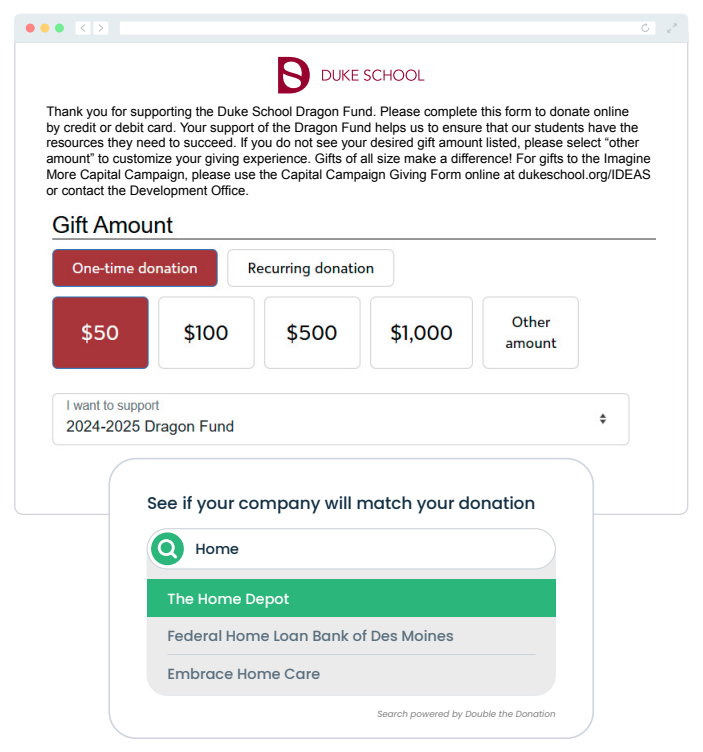
The first pillar was capturing the donor at the moment of highest intent. Duke School embedded the matching gift search tool directly into its online donation forms.
- The Mechanism: As a parent or supporter filled out the form to give to the Dragon Fund, they were prompted to search for their employer.
- The Psychology: This placement is critical. It normalizes matching gifts as part of the donation process, rather than an administrative afterthought. It suggests to the donor, “Your contribution of $500 could be $1,000 right now.”
- Ease of Use: By allowing donors to access the forms immediately upon donation, the school removed the friction of having to search for policies later.
2. CRM Integration: Capturing the “Offline” Donor
The second, and arguably most critical pillar for a school, was the integration with its CRM (Customer Relationship Management) system.
- The Reality of School Giving: While online giving is growing, major gifts and grandparent gifts often come via check. If a grandparent writes a $5,000 check for the capital campaign, they don’t interact with the online donation form.
- The Automation: By connecting Double the Donation to their CRM, Duke School ensured that every gift was screened. When a check was entered into the database, the system could automatically check the donor’s employment record (if known) or trigger an email asking them to check their eligibility.
- Closing the Loop: This ensured that the high-value offline gifts (which often have the highest matching potential) were not missed.
3. Education: The Dedicated Webpage
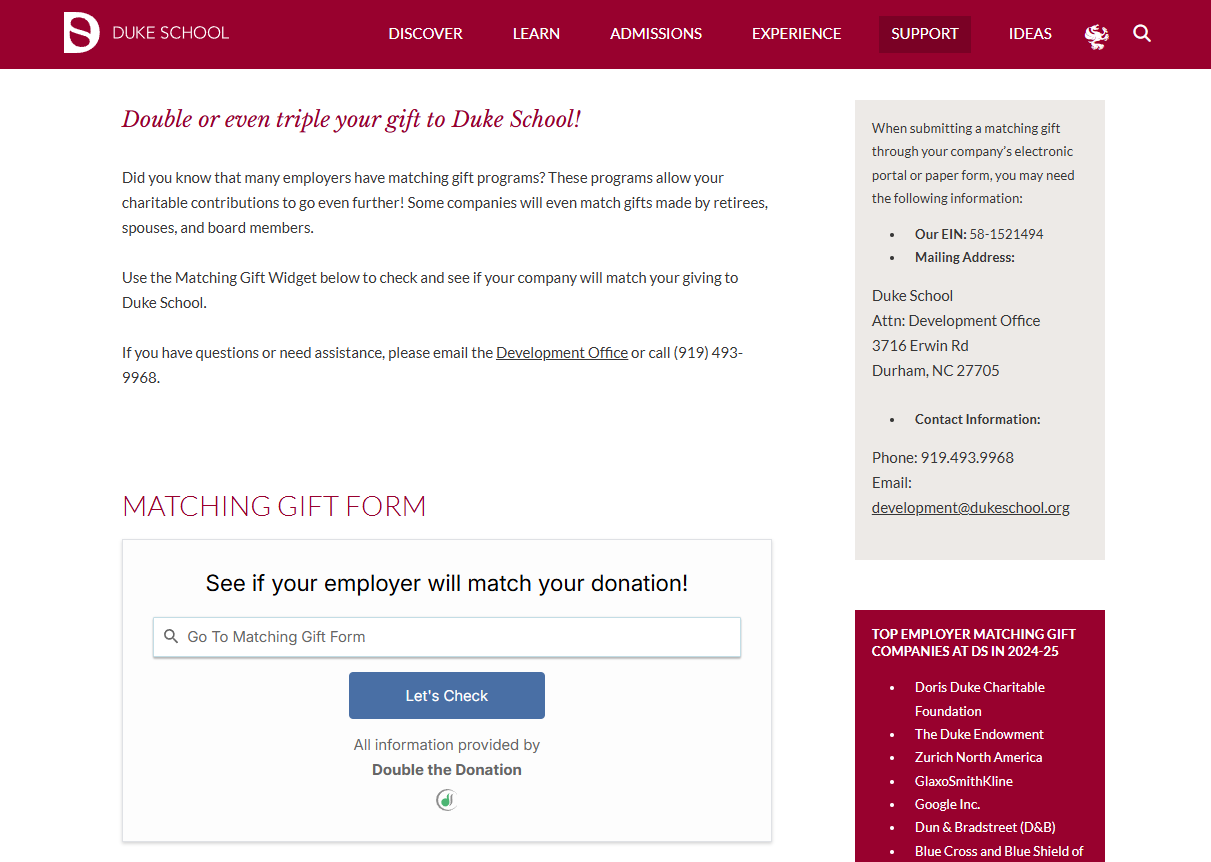
The third pillar was a dedicated matching gift webpage.
- A Central Resource: Duke School created a hub where donors could learn about the impact of matching gifts.
- Stewardship: This page served not just as a search tool, but as a stewardship tool, explaining how matching gift revenue directly impacts the students and teachers. It empowered donors to advocate for the school within their own companies.
The Results: 587% Growth and Counting
The results of this comprehensive strategy were transformative, providing a clear “before and after” picture of the school’s fundraising capacity.
Financial Impact: 587% Revenue Increase
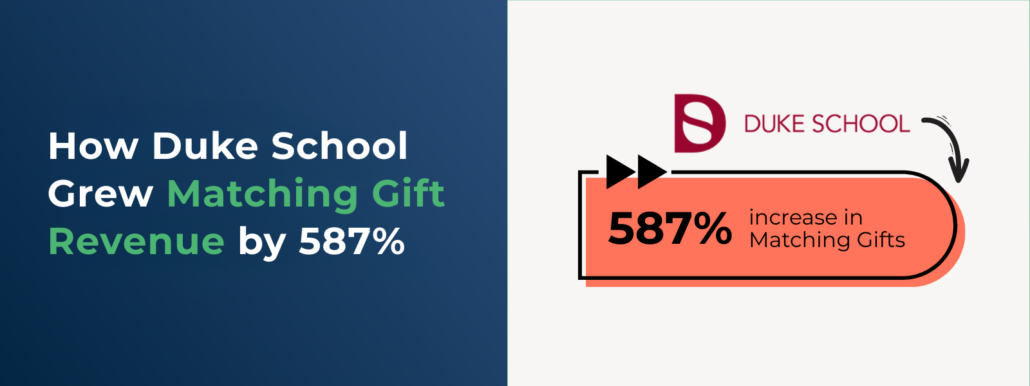
The headline statistic is the 587% increase in matching gift revenue over three fiscal years.
- Analysis: This is not a statistical anomaly; it is a structural shift. It indicates that the school was previously capturing only a fraction of the available funds. By unlocking this revenue, Duke School effectively created a new major donor stream without having to cultivate a single new donor; they simply maximized the value of the donors they already had.
Consistency: 5 Consecutive Years of Growth
The case study notes five consecutive years of matching gift growth.
- Sustainability: This proves that the strategy is sustainable. It wasn’t a one-time spike due to a single campaign. The automation created a permanent “lift” in the fundraising baseline. As new parents join the school community, the system automatically educates them, ensuring that the growth continues year over year.
Donor Participation: +133%
Revenue growth is often a lagging indicator of donor behavior. The leading indicator is participation. Duke School saw a 133% increase in the number of donors submitting matching gifts.
- Cultural Shift: This suggests a cultural shift within the parent body. Matching gifts moved from being a “secret” known only to a few savvy donors to a standard practice for the community.
- Ease of Access: The increase in participation is a direct result of the “turnkey” integration. When you make a process easier, more people participate.
The Value of a Match: +$1,600 Average
Perhaps the most impressive metric for ROI is the average match amount. Duke School reported an average match of over $1,600.
- High-Value Targets: This figure confirms that the school’s donor base is employed by companies with generous caps. A $1,600 match suggests that donors are giving significantly and that their employers are matching at high levels (likely 1:1 or 2:1).
- ROI Implication: With an average match of $1,600, the cost of the software is covered by just a handful of successful submissions, making the remaining hundreds of thousands of dollars pure profit for the school.
Strategic Deep Dive: The “Offline” Advantage in Schools
The Duke School case study highlights a unique aspect of independent school fundraising: the importance of the offline gift.
Unlike a digital-first charity, schools rely heavily on checks, stock transfers, and donor-advised funds (DAFs). These are high-friction channels for matching gifts because they are disconnected from the web experience.
- The CRM Bridge: By using the CRM integration, Duke School built a bridge between the physical check and the digital matching gift portal.
- The “Grandparent” Factor: Grandparents are major supporters of independent schools, but may be less tech-savvy. The integration allows the development team to handle the identification process on the backend, ensuring that gifts from older generations are still maximized through their (or their spouse’s) former employers or pension matching programs.
Client Perspective: Efficiency Wins
Christine McAllister, the Director of Development at Duke School, emphasized the operational benefits of the partnership:
“Double the Donation makes it so easy for our donors to submit matching gift requests and for our school to track them! We love the turnkey nature of the solution and how it helps us drive revenue.”
This quote reveals the dual benefit:
- For the Donor: It is “easy to submit.” Parents are busy; they don’t have time for paperwork.
- For the School: It is “easy to track.” The development office is busy; they don’t have time for spreadsheets.
The “turnkey nature” allowed the school to implement the solution quickly and start seeing ROI immediately, without a long, drawn-out IT project.
Conclusion: A Blueprint for Independent Schools
Duke School’s success is a blueprint for any independent school looking to grow its annual fund without burning out its staff. By recognizing that matching gifts were an untapped asset, they made a strategic investment in automation.
The return on that investment (587% revenue growth) is a testament to the power of removing friction. Duke School has proven that when you integrate matching gifts into the DNA of your fundraising operations, both online and offline, you can unlock a level of community support that transforms the educational experience for every student.
Download the full case study compilation here to uncover even more successful strategies.