Denver Rescue Mission: Scaling Match Revenue by Over 40%
Introduction: The Scale of Community Support
For more than 125 years, the Denver Rescue Mission has stood as a pillar of support for the Denver community. Their mission is holistic and vital: helping to restore the lives of people experiencing homelessness and addiction through emergency services, rehabilitation, transitional programs, and community outreach.
Operating at this level of community impact requires significant resources. The Mission generates approximately $31 million in annual contributions, a testament to the generosity of the local community and the trust the organization has built over a century of service. This funding is essential to keeping the doors open, the lights on, and the programs running for the city’s most vulnerable populations.
However, managing such a successful fundraising operation comes with its own set of challenges. Success in fundraising often leads to scale, and scale brings complexity. Denver Rescue Mission relies on a massive base of over 70,000 donors to fuel its operations. While having 70,000 supporters is a fundraising leader’s dream, it creates a significant administrative burden when it comes to maximizing the value of each gift.
Specifically, the Mission identified a critical inefficiency in how they handled corporate matching gifts. They knew that among their tens of thousands of donors, many worked for companies that would match their contributions. Yet, without a system to track these opportunities, revenue was slipping through the cracks. By turning to automation to solve their matching gift tracking challenge, Denver Rescue Mission not only recovered this lost revenue but achieved a 40% increase in matching funds.

The Challenge: The “Full-Time Job” of Manual Tracking
The core challenge facing Denver Rescue Mission was a problem of volume. The case study explicitly highlights the operational bottleneck: “As a large organization with donations coming from a base of 70,000+ donors, it has become a full-time job to track every donor’s match eligibility and the status of those matches.”
The Logistics of Manual Verification
To understand why this was a “full-time job,” one must look at the mechanics of manual matching gift processing. For a single donation, a manual process might look like this:
- Identification: A staff member receives a donation. They must look at the donor’s name and email address.
- Research: They must cross-reference that information with LinkedIn or a business database to guess the donor’s employer, or hope the donor used a corporate email address.
- Verification: If an employer is found, the staff member must research that specific company’s matching gift policy. Do they match 1:1? Is the minimum $25 or $100? Is a religious or social service organization like Denver Rescue Mission eligible?
- Outreach: The staff member must then draft an email to the donor, explaining the process and providing the correct forms.
- Tracking: Finally, they must log this interaction in a spreadsheet to ensure the donor actually submits the request.
Now, multiply that process by 70,000 donors. It is a mathematical impossibility for a standard development team to execute this for every transaction. The “full-time job” description is likely an understatement; effectively tracking 70,000 donors manually would require an entire department.
The Opportunity Cost
Because the volume was unmanageable, the organization was forced into a reactive stance. They likely processed matches that came in on their own but missed the thousands of matches that required a proactive nudge. In the nonprofit world, this is often referred to as “leaving money on the table.” For Denver Rescue Mission, this wasn’t just abstract revenue; it was funding that could provide more meals, more shelter beds, and more rehabilitation services.
The Solution: Automated Matching Gift Tracking
To solve this volume problem, Denver Rescue Mission implemented Double the Donation’s automated platform. The goal was to shift the burden of tracking from human staff to software.
The solution focused on three key areas of automation: identification, timing, and submission.
1. Automated Identification
The new system allowed Denver Rescue Mission to “uncover eligible donors automatically.” Instead of staff members researching donors one by one, the software is integrated directly into the donation flow.
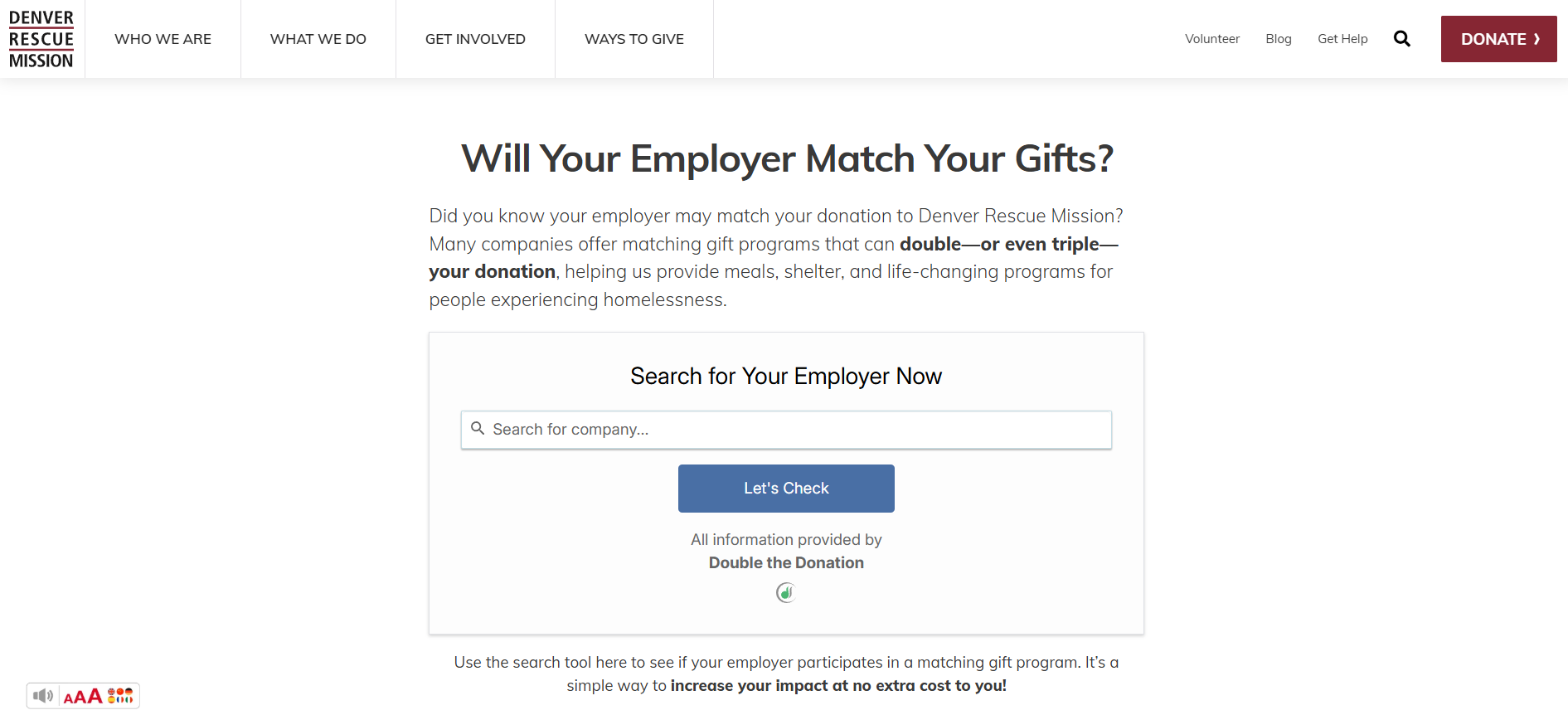
- Streamlined Search Field: The Mission added a “streamlined search field on [the] donation form.” This allowed donors to self-identify their employer at the moment of giving.
- Multiple Methods: The case study notes that there are “multiple matching gift identification methods” at play. This likely refers to the combination of the search tool, email domain screening, and post-donation follow-ups.
2. Automated Email Triggers
Once a donor was identified as match-eligible, the system took over the outreach. The solution utilized “automated email triggers and timing.”
- The “Timing” Factor: Timing is critical in fundraising. An email sent three weeks after a donation is easily ignored. An email sent immediately, while the donor is still thinking about their gift, drives action. The automation ensured that every eligible donor received the right message at the right time, without a staff member pressing “send.”
3. Streamlined Submissions
The final piece of the puzzle was the submission process itself. The system provided “streamlined matching gift submissions.” By giving donors direct access to their employer’s specific forms and guidelines, Denver Rescue Mission removed the friction that often causes donors to abandon the process.
The Results: A 40% Increase in Revenue
The impact of automating matching gift tracking was immediate and significant. The data from the case study shows that the investment paid off in two distinct ways: direct matching gift growth and broader workplace giving growth.
1. 40% Increase in Matching Gift Revenue
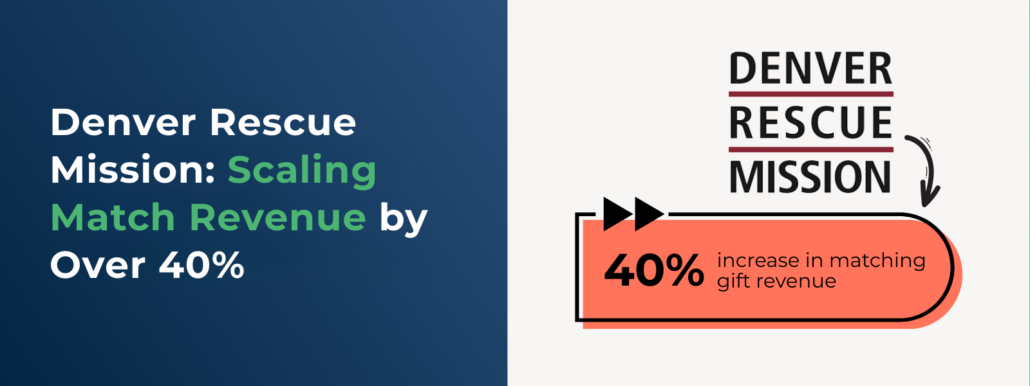
Within their “first full fiscal year” of using the new system and following the marketing guidelines, Denver Rescue Mission experienced “more than a 40% increase in our matching gift revenue.” This is a massive jump. For a $31 million organization, a 40% increase in a specific revenue stream represents a substantial influx of unrestricted funds. This growth validates the hypothesis that the manual process was indeed a bottleneck; once the bottleneck was removed, revenue flowed freely.
2. 54% Increase in Workplace Giving
Perhaps the most surprising and impressive result was the “54% increase in our broader workplace giving revenue.”
- What is Workplace Giving? This category often includes payroll deductions, volunteer grants, and annual giving campaigns run by corporations.
- Why did it grow? The automation likely raised the overall awareness of corporate philanthropy among the donor base. By consistently asking donors about their employers and matching gifts, Denver Rescue Mission reminded donors that their companies are partners in giving. A donor who looks up their employer for a match might discover they can also set up a payroll deduction, leading to this secondary surge in revenue.
Strategic Analysis: “Quick and Painless” Implementation
For many large organizations, the phrase “new software implementation” causes anxiety. It often implies months of data migration, staff training, and technical glitches.
However, the Denver Rescue Mission case study highlights the ease of this specific transition. The Vice President of Development described the system setup and integration as “very simple.”
- Support: The staff received “detailed instructions and ongoing support.”
- Usability: The VP noted that “identifying opportunities and reviewing metrics is quick and painless.”
The Value of “Painless” Metrics
In a high-volume fundraising shop, “painless” metrics are a strategic asset. The dashboard allows the team to see the health of their matching gift program at a glance. They can see how many emails were sent, how many were opened, and how much revenue was identified. This visibility allows for data-driven decision-making without requiring hours of report generation.
The Role of Faith-Based Organizations in Workplace Giving
Denver Rescue Mission’s success touches on a unique aspect of faith-based and community fundraising. Sometimes, there is a misconception that corporations will not match gifts to religious or faith-based organizations.
The fact that Denver Rescue Mission achieved a 40% increase proves that many companies do match these gifts, particularly when the organization provides essential social services like shelter and addiction recovery. By using an automated tool, the organization empowered its donors to check their specific company’s policy. Instead of assuming they weren’t eligible, donors could verify it instantly. This clarity likely unlocked a significant portion of the revenue growth.
Conclusion: Automation is the Only Way to Scale
The lesson from the Denver Rescue Mission is clear: when your donor base reaches a certain size, manual processes are no longer just inefficient; they are a liability.
With 70,000+ donors, the only way to effectively manage relationships and maximize revenue is through automation. By implementing a system for matching gift tracking, Denver Rescue Mission turned a “full-time job” into a background process that generates revenue automatically.
The results (a 40% increase in matching gifts and a 54% increase in workplace giving) demonstrate the compounding power of this strategy. For organizations serving the community on the front lines, these additional funds mean more than just numbers on a spreadsheet; they mean more lives restored and more hope delivered.
Download the full case study compilation here to uncover even more successful strategies.