How RAICES Found $80k via Matching Gift Process Improvements
Introduction: The Fight for Justice Requires Resources
The Refugee and Immigrant Center for Education and Legal Services (RAICES) stands at the forefront of one of the most complex and urgent human rights issues of our time. As a 501(c)(3) nonprofit agency, RAICES promotes justice by providing free and low-cost legal services to underserved immigrant children, families, and refugees.
The work RAICES does is resource-intensive. Legal defense is not cheap; it requires skilled attorneys, paralegals, social workers, and support staff. Furthermore, the nature of their work is often dictated by rapid policy shifts or sudden humanitarian crises. When news breaks, donors respond. RAICES often experiences surges in donation volume driven by the news cycle, with thousands of supporters stepping up to help families in need.
However, managing these surges presents a unique operational challenge. When donations pour in, the administrative burden of processing them can be overwhelming. In the rush to fund immediate legal needs, secondary revenue streams (like corporate matching gifts) can easily be overlooked. RAICES recognized that they were leaving significant funding on the table. They knew that many of their donors worked for companies that would match their contributions, but without a streamlined matching gift process, they lacked the capacity to identify and pursue those funds.
By turning to automation, RAICES transformed its approach. They moved from a system that relied on donor memory to a system that relied on data-driven triggers. The result was the identification of over $80,000 in match-eligible revenue, funds that could be deployed directly to legal defense and education services.
The Challenge: The Friction of a Manual Process
Before implementing their current solution, RAICES utilized a standalone search tool for matching gifts. While this was a step in the right direction, it ultimately fell short of capturing the full potential of their donor base.
The “Passive” Trap
A standalone search tool creates a passive fundraising environment. It relies entirely on the donor to take the initiative.
- The Disconnect: A donor visits the RAICES website to make a donation, often driven by a specific emotional response to a news event. They complete the donation form and leave.
- The Missed Opportunity: To get a match, that donor would have to know matching gifts exist, return to the website, find the specific “Matching Gifts” page, search for their employer, and then navigate to a third-party portal.
In the high-stakes, fast-paced world of crisis fundraising, this multi-step process is a recipe for attrition. Most donors, no matter how well-intentioned, will simply forget to follow through.
The Administrative Burden
On the internal side, RAICES faced the challenge of identifying eligible donors within a massive dataset. Without an automated way to screen donations against a database of corporate philanthropy policies, the development team was flying blind. They couldn’t segment their lists effectively or target specific donors with matching gift reminders. The matching gift process was manual, reactive, and disconnected from the donation experience itself.
RAICES decided they “required a fully automated system” to close this gap. They needed a more proactive approach that would insert the matching gift opportunity directly into the donor’s journey, rather than leaving it as an afterthought.
The Solution: Automating the Matching Gift Process
To solve these challenges, RAICES upgraded to Double the Donation’s automated platform. This shift represented a fundamental change in how they viewed donor engagement. Instead of treating matching gifts as a separate administrative task, they integrated it into the core fundraising flow.
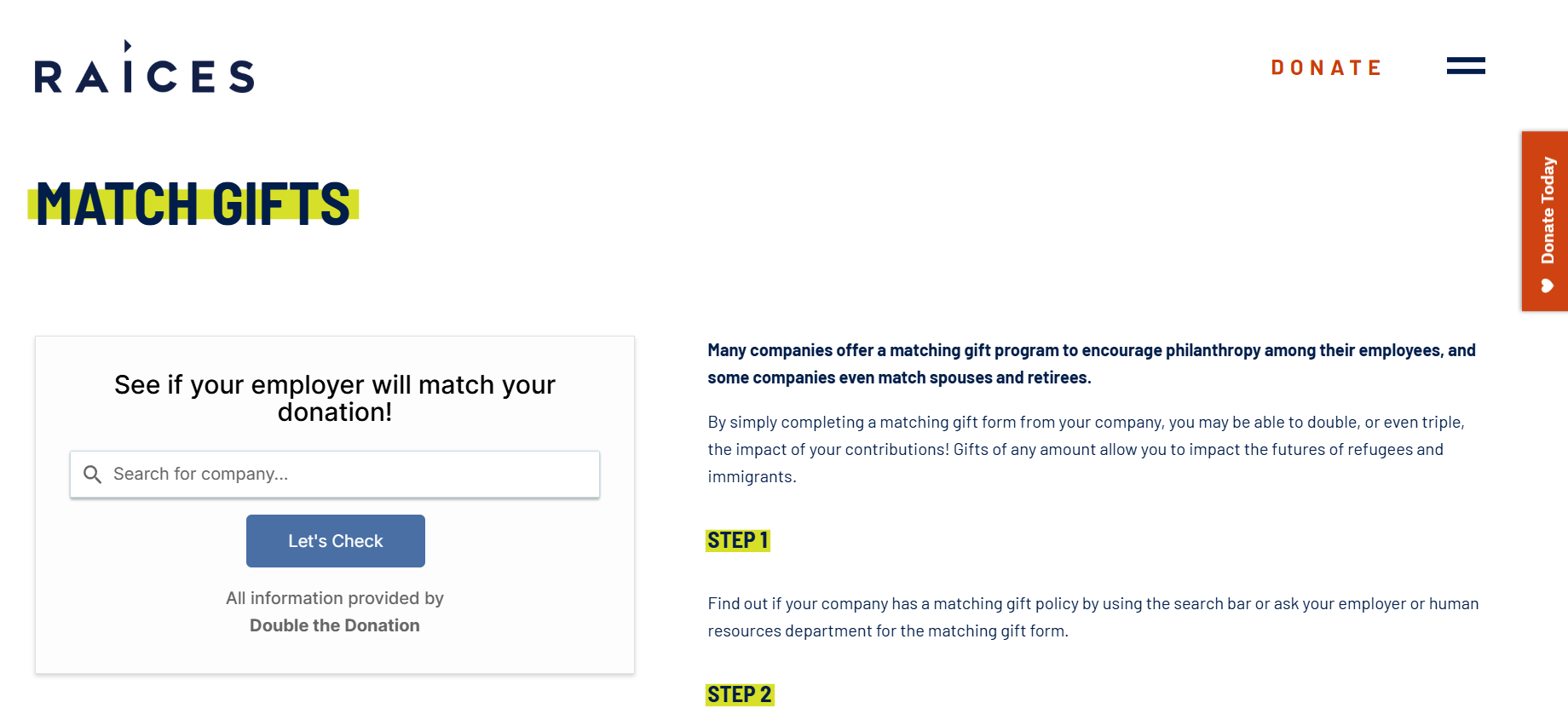
The solution leveraged three key technological components to streamline the process:
1. The Streamlined Search Field
The most critical change was the integration of the search tool directly into the donation form.
- Placement Strategy: By placing the “Streamlined search field on the donation form,” RAICES captured employment data at the moment of highest intent.
- Real-Time Screening: As donors entered their information, the system could “determine donor match eligibility” instantly. This turned a passive donation into an interactive data-capture event.
2. The Confirmation Page Plugin
Once the donation was submitted, RAICES utilized a confirmation page plugin to maintain momentum.
- Immediate Guidance: Instead of a generic thank-you message, eligible donors were presented with specific “matching gift next steps.”
- Reducing Friction: This plugin provided direct links to the donor’s corporate submission portal. The donor didn’t have to Google their company’s policy; the link was right there in front of them, just seconds after they entered their credit card information.
3. Automated Email Outreach
Recognizing that not every donor would act immediately, RAICES implemented “automated matching gift emails.”
- The Safety Net: These emails served as a reminder for donors who might have missed the prompt on the confirmation page.
- Customization: The emails were branded to match RAICES’ voice, ensuring that the request felt like a natural extension of the donor’s relationship with the organization.
The Results: $80,000 Uncovered
The transition to an automated matching gift process produced immediate and quantifiable results for RAICES. The data highlights the effectiveness of removing friction from the donor journey.
Financial Impact: $80,000 Identified
In less than 12 months, the system identified over $80,000 in match-eligible dollars. For a legal services organization, $80,000 is a significant sum. It represents hundreds of hours of attorney time, filing fees for asylum applications, or bond money for detained immigrants. This revenue was identified without the RAICES team having to manually research a single donor. It was “found money” that had previously been hidden within their donor database.
Engagement Metrics: 60% Open Rate
The engagement statistics from the RAICES case study are particularly impressive, demonstrating that their donors are highly motivated to give more when the process is easy.
- 60% Email Open Rate: The automated matching gift emails achieved a 60% open rate.
- Analysis: This is nearly triple the nonprofit industry average. It suggests that RAICES donors are deeply committed to the cause and are eager to amplify their support when prompted.
- 59% Engagement Rate: The data showed that 59% of donors engaged with the matching gift tools (accessing forms, viewing guidelines, etc.).
- Analysis: A conversion rate of nearly 60% on a secondary call-to-action is exceptional. It validates the hypothesis that the previous lack of matching gifts was not due to a lack of interest, but a lack of a clear process.
Outreach Efficiency
The system sent over 530 automated emails to match-eligible donors.
- Efficiency: Sending 530 personalized, employer-specific emails manually would take a development officer days of work. The automated system handled this volume instantly, ensuring that every eligible donor received a timely nudge.
Strategic Analysis: Why Process Matters in Advocacy
RAICES’ success offers a broader lesson for advocacy and social justice organizations. Often, these nonprofits operate in “crisis mode,” prioritizing immediate programmatic needs over back-office efficiency. However, the RAICES case study proves that optimizing the matching gift process is, in itself, a form of crisis readiness.
1. Speed is Currency
In legal defense work, speed is often the difference between deportation and asylum. Fundraising must move at the same speed. By automating the identification of matching gifts, RAICES ensures that the revenue cycle is accelerated. Funds are identified and collected faster, allowing the organization to deploy resources more quickly.
2. Maximizing the “Surge”
When a news story breaks, and RAICES receives an influx of donations, the automated system scales instantly. It doesn’t matter if 100 donors or 10,000 donors give in a single day; the software screens every single one for matching eligibility. A manual team would be crushed by a surge; the automated process thrives on it.
3. Data-Driven Decisions
RAICES utilized a “matching gift dashboard” to track their success. This dashboard “outlines actionable metrics,” giving the leadership team visibility into their matching gift fundraising performance.
- Strategic Insight: Knowing that they identified $80,000 allows RAICES to forecast revenue more accurately. It also helps them identify which corporations are represented in their donor base, opening the door for potential corporate partnerships or sponsorship opportunities in the future.
The Donor Experience: Empowering Advocates
From the donor’s perspective, the streamlined matching gift process is an empowerment tool. Donors to RAICES are often activists at heart; they want to do everything in their power to fight for immigrant rights.
By presenting them with a simple way to double their contribution, RAICES is giving them a new way to advocate.
- The Multiplier Effect: A donor who gives $50 feels good. A donor who gives $50 and sees it become $100 feels powerful. They feel like they have struck a blow for justice twice as hard.
- Corporate Accountability: For many donors, forcing their corporation to donate to a progressive cause like immigrant rights is a form of activism in itself. The automated tool makes this easy, turning a bureaucratic HR task into a moment of social justice.
Conclusion: Justice, Funded Efficiently
RAICES has proven that operational efficiency and social justice are not mutually exclusive; in fact, they are deeply interconnected. By fixing their matching gift process, RAICES unlocked $80,000 in critical funding.
They replaced a passive, standalone tool with a proactive, automated ecosystem that guides donors from contribution to match submission. The high engagement rates (60% open rate and 59% action rate) demonstrate that their community is ready and willing to do the work, provided the path is clear.
For other advocacy organizations, the takeaway is simple: Do not let administrative friction stand in the way of your mission. Automate the process, empower your donors, and ensure that every available dollar is fighting for the cause.
Download the full case study compilation here to uncover even more successful strategies.