Payroll Giving Statistics: 30+ Fun Facts for Fundraisers
Last updated: July 2026
Payroll giving is one of the most powerful yet underutilized tools in the corporate fundraising arsenal. With billions of dollars raised through the programs each year, the potential for tapping into this steady stream of revenue is immense. Unfortunately, many industry professionals have not yet grasped the true impact payroll giving can have on their missions.
In this post, we’re diving into 30 eye-opening payroll giving statistics that all fundraisers should know. For your convenience, we’ve organized the data across the following categories:
- A Brief Analysis of the Current Landscape
- Understanding the Extent of Payroll Fundraising Programs
- The (Largely Untapped) Financial Impact of Payroll Giving
- Top Marketing & Donor Engagement Strategies
- Corporate Adoption & Program Maximization
- [Bonus!] Overcoming Challenges in Workplace Giving
These facts not only demonstrate the potential of payroll giving but also provide actionable insights to help maximize participation and boost fundraising results. Let’s get started!
Scale Your Payroll Giving Revenue:
Explore the platform trusted by 8,000+ nonprofits and schools.
A Brief Analysis of the Current Landscape
Only 10.6% of nonprofits describe their current workplace giving strategy today as robust.
Experts recommend developing an approach that targets the right combination of matching, payroll giving, and volunteering programs to ensure no corporate or individual support is unclaimed. And the recent findings show there’s clear room for growth!
22% of organizations plan to prioritize payroll giving over the next 12 months.
With a growing number of organizations planning to prioritize payroll giving in the next 12 months (according to new 2026 philanthropy data), setting up a streamlined process now is essential for long-term success.
A bit of upfront homework, such as registering with companies’ CSR portals, enables organizations to sit back and relax while predictable, recurring donations flow in.
40% of nonprofits say their biggest revenue expansion opportunity is driving mid-level giving through payroll.
The convenience, impact, and flexibility of payroll deductions significantly boost charitable giving among employees, allowing companies to give more and further improve their CSR (or corporate social responsibility).
Nonprofits should actively seek partnerships with companies offering payroll giving, as this can result in a substantial increase in donations and visibility for their causes.
An estimated 59% of individuals have not yet been made aware of payroll giving.
The lack of awareness around payroll giving presents a significant challenge—and opportunity—for nonprofits. When supporters are unaware of payroll giving programs, they’re not going to sign up to give. However, by educating their audience about payroll giving, nonprofits can tap into a largely underutilized source of donations.
While young donors may be less familiar with payroll giving, they’re more likely to desire involvement.
While Millennials and Gen Zers entering the workforce may not be as aware of payroll giving, they tend to be increasingly enthusiastic about supporting social causes and are often happy to do so through their employers.
The Extent of the Payroll Giving Opportunity
Payroll giving is the most common component of employee engagement across CSR and corporate philanthropy programs.
Payroll giving is not just a method for employees to contribute financially. Instead, it’s a key aspect of broader employee engagement strategies.
For nonprofits, this means that partnering with companies to promote payroll giving can align with greater corporate efforts to boost CSR, employee morale, and overall philanthropy.
Up to 6 million U.S. employees donate to nonprofits and schools through employee payroll deductions each year.
Payroll giving is a popular option for millions of employees across the U.S., providing a steady stream of donations to nonprofits and other fundraising organizations.
These contributions, though often modest per paycheck, add up significantly over time, highlighting the potential for fundraisers to tap into the consistent revenue source.
A recent study reported that approximately 18% of individual donors qualify for payroll giving.
Nearly one in five employees are eligible for payroll giving, but many remain unaware of the programs at all.
For nonprofits and other fundraisers, it’s important to focus on educating supporters about the availability of these initiatives. Encourage them to check with their employers to see if they qualify!
Nearly 2/3 of surveyed employers match payroll donations, which represents a 58% increase since 2006.
The rise in businesses matching employees’ payroll contributions directly corresponds to the growing recognition of corporate philanthropy’s importance over the last two decades. Today, tons of companies offer matching gift programs, and the vast majority include payroll giving opportunities as well.
However, a recent survey indicated that over 43% of nonprofits say they’ve never combined a payroll gift with a corporate match (but they do want to learn how!), and 25% have never had a payroll gift matched because they didn’t know “both” was an option.
The Financial Impact of Payroll Giving
Employees contribute over $173 million to nonprofits each year through payroll giving programs.
Payroll giving is also a significant source of funds across the globe, with substantial contributions coming from over a million charitable-minded employees. This demonstrates the worldwide potential of payroll giving programs as a reliable revenue stream for nonprofits like yours!
Companies with payroll giving programs increase their total giving by more than 50%.
Although individual gifts at this level (typically defined as contributions between $250 and $2,500 annually) can be tough to secure, automatic salary deductions make larger annual commitments manageable for everyday donors.
The average payroll giving donation comes out to around $325.58 per year.
That’s around $28 a month!
While individual payroll donations may seem small, they typically total over $300 annually per employee. In other words, these gifts add up to make a significant impact on your cause. Nonprofits can emphasize this cumulative impact when encouraging payroll giving among their supporters.
Approximately $5 billion in corporate revenue is raised through workplace giving programs each year.
Workplace giving, including payroll giving programs, generates billions of dollars for nonprofits on an annual basis. This substantial amount highlights the importance for nonprofits to actively engage in workplace giving programs to secure their share of this revenue.
Top Marketing & Engagement Strategies
More than 70% of surveyed nonprofits say they don’t mention payroll giving on their websites.
However, adding clear, step-by-step enrollment instructions and leveraging tools like Double the Donation’s payroll giving module makes it simple for supporters.
All it takes is a quick search of their company name in your embedded database tool.
More than half (50.3%) of nonprofits don’t promote payroll giving programs at all.
However, adding clear, step-by-step enrollment instructions and leveraging tools like Double the Donation’s payroll giving module makes it simple for supporters. All it takes is a quick search of their company name in an embedded database tool!
16.3% of fundraising teams indicated that they promote payroll giving through their websites or blogs.
Sharing simple, step-by-step enrollment instructions and using dedicated payroll giving fundraising tools makes it easy for donors to access the information they need to get signed up.
In other words, it’s a great way to turn untapped website traffic into steady, long-term funding.
36% of nonprofits say they send a standard “thank you” to payroll giving donors.
But that leaves nearly two-thirds of organizations that appear not to acknowledge these high-value supporters at all!
Treating payroll giving donors like typical one-time givers misses a major retention opportunity. Most individuals who enroll in payroll giving programs commit to recurring, long-term impact, so development teams should spend time designing powerful engagement sequences that scale (or at least maintain) their involvement.
This might include tailored impact updates and ongoing stewardship rather than a single, generic confirmation.
Corporate Adoption & Program Maximization
Businesses that actively promote payroll giving see workplace participation rates exceeding 20%.
Effective promotion of payroll giving within a company can lead to high employee participation rates, which is beneficial for companies, nonprofits, and employees alike.
For nonprofits, this idea underscores the importance of working with employers to actively communicate payroll giving options to their employees.
Payroll giving programs are most likely to be offered by manufacturing, finance, and IT companies.
Certain industries are more likely to offer payroll giving programs, giving nonprofits an opportunity to target companies within these sectors for partnerships and campaigns focused on payroll giving. However, they’re expected to continue growing across just about every other business sector, too!
If you’re looking for donors who may qualify for payroll giving programs, take a look at those working in the manufacturing, finance and insurance, or information technology fields.
Employers offering payroll giving programs typically see higher retention and improved satisfaction.
Payroll giving programs contribute to heightened employee engagement, making them an attractive option for companies looking to increase productivity and reduce turnover.
Nonprofits can leverage this opportunity by promoting the dual benefits of payroll giving: supporting charitable causes while also enhancing workplace satisfaction.

Overcoming Challenges in Workplace Giving
Some organizations experience roadblocks when trying to launch or scale corporate giving initiatives.
Check out the video or explore the infographic to see where teams get stuck (and how you can avoid the same traps).
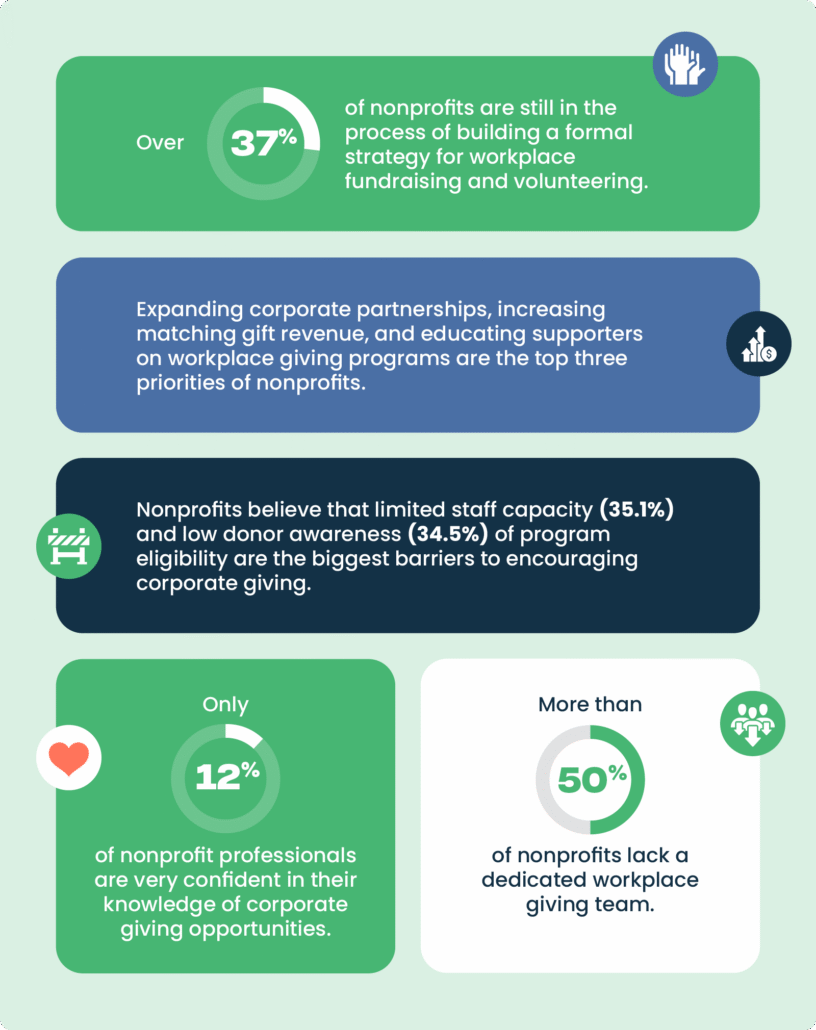
Over 37% of orgs are “in the process” of building formal strategies for workplace fundraising.
This indicates that many organizations recognize the value of corporate engagement but have yet to fully integrate it into their development framework.
Without a structured approach, nonprofits may miss opportunities to align with corporate partners’ giving priorities or effectively mobilize employee participation.
Nonprofits’ top three priorities currently include…
- Expanding corporate partnerships
- Increasing matching gift revenue, and
- Educating supporters on workplace giving programs.
This reflects a growing recognition that sustained growth depends on deepening engagement with both donors and their employers. By strengthening corporate relationships, nonprofits can unlock new funding streams and create mutually beneficial opportunities for employee participation.
Nonprofits believe limited staff capacity (35.1%) and low awareness of eligibility (34.5%) are the largest barriers to corporate giving.
With often lean teams, many nonprofits struggle to dedicate the time and resources needed to effectively communicate workplace giving opportunities and eligibility back to their supporters. That means revenue-driving opportunities like matching gifts, volunteer grants, and payroll giving often slip through the cracks.
Only 12% of nonprofits are very confident in their knowledge of corporate giving opportunities.
This signals a broader gap in internal education and access to resources that can limit fundraising potential. Without a clear understanding of available corporate giving programs, such as matching gifts, volunteer grants, and payroll giving, staff may struggle to identify or act on partnership opportunities.
More than 50% of surveyed nonprofits lack dedicated workplace giving teams.
This often means that responsibilities related to corporate partnerships and matching gifts are spread across multiple roles, adding pressure to teams that are already stretched thin. As a result, follow-up may be inconsistent, causing important opportunities to slip through the cracks.
Final Thoughts & Additional Resources
Payroll giving is a game-changer for nonprofits, offering a reliable and often overlooked source of funding. By understanding the data behind these programs, fundraising teams can better target their efforts and unlock new opportunities for their organizations.
Whether you’re looking to increase participation, educate donors, or partner directly with companies in your network, these fun facts about payroll giving provide a solid foundation to help you take your fundraising to the next level.
What’s Next? Now’s the perfect time to embrace new revenue streams and ensure your organization is reaping the full benefits of this powerful fundraising tool. Good luck!