How LCRF Uncovered $336k in Match-Eligible Dollars
Introduction: Funding “Living Breathing Science”
Founded in 2005, the Lung Cancer Research Foundation (LCRF) operates with a mission defined by urgency and hope: “Living Breathing Science.” For medical research organizations, the path from scientific hypothesis to life-saving treatment is paved with funding. Every dollar raised supports critical research, clinical trials, and the development of new therapies that can improve patient outcomes worldwide.
In this high-stakes environment, efficient fundraising is not just an operational goal; it is a moral imperative. LCRF recognized that to maximize their impact on lung cancer research, they needed to ensure that every individual donation went as far as possible. Corporate matching gift programs (in which employers match their employees’ charitable contributions) represented a vital avenue for this revenue growth.
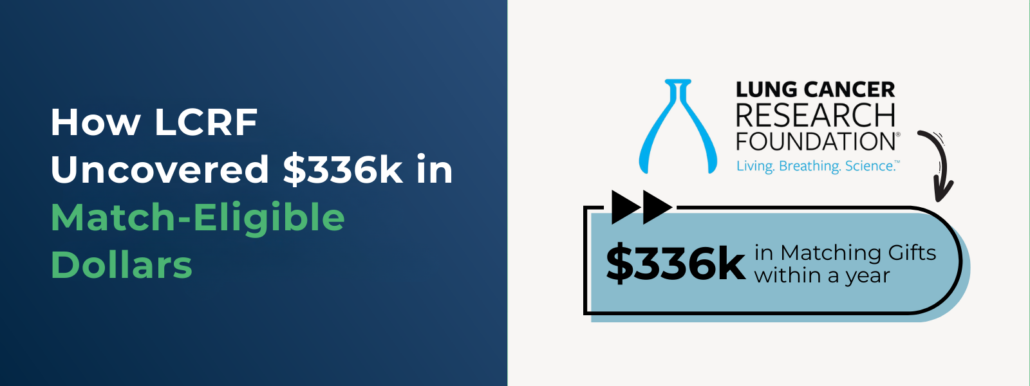
However, like many nonprofits, LCRF found that simply knowing matching gifts existed was not enough. Without a systematic way to identify donors and guide them through the submission process, significant revenue was being left on the table. By upgrading its technology to automate this process, LCRF was able to substantially transform its fundraising operations. In less than 12 months, the foundation identified over $336,520 in match-eligible dollars, proving that the right technology can effectively unlock hidden revenue streams to fuel scientific discovery.
The Challenge: The “Guesswork” of Manual Fundraising
Before implementing a robust automated solution, the Lung Cancer Research Foundation faced a significant operational challenge. The case study notes that the organization “previously pursued matching gift requests, but they did not reach their match potential.”
The Limitations of Manual Pursuit
The primary obstacle was the lack of a “robust, automated outreach strategy.” Without automation, fundraising teams are often forced to rely on manual processes that are both time-consuming and inefficient.
- Reactive Fundraising: Staff members might only know a gift is match-eligible if the donor explicitly mentions it or if the staff member happens to recognize the employer’s name.
- The “Guesswork” Factor: The case study highlights that LCRF needed a solution to “take the guesswork out of this fundraising avenue.” When relying on manual verification, development teams often have to guess which donors to follow up with, leading to wasted effort on ineligible donors and missed opportunities with eligible ones.
- Donor Friction: Even if a donor is identified, the manual process of sending them the correct forms and guidelines is slow. This delay can lead to a drop-off in donor enthusiasm.
LCRF realized that to truly scale their matching gift revenue, they needed to move beyond these manual constraints. They needed a system that could streamline the process “in their donation flow” and make it effortless for donors to participate.
The Solution: A Seamless, Automated Integration
To solve the problem of missed revenue, the Lung Cancer Research Foundation implemented Double the Donation Matching. This decision was driven by the need for a “more proactive approach” that could integrate seamlessly with their existing systems.
The solution LCRF adopted was comprehensive, addressing the entire donor journey from the moment of contribution to the final submission of the match request.
1. Streamlining the Donation Flow
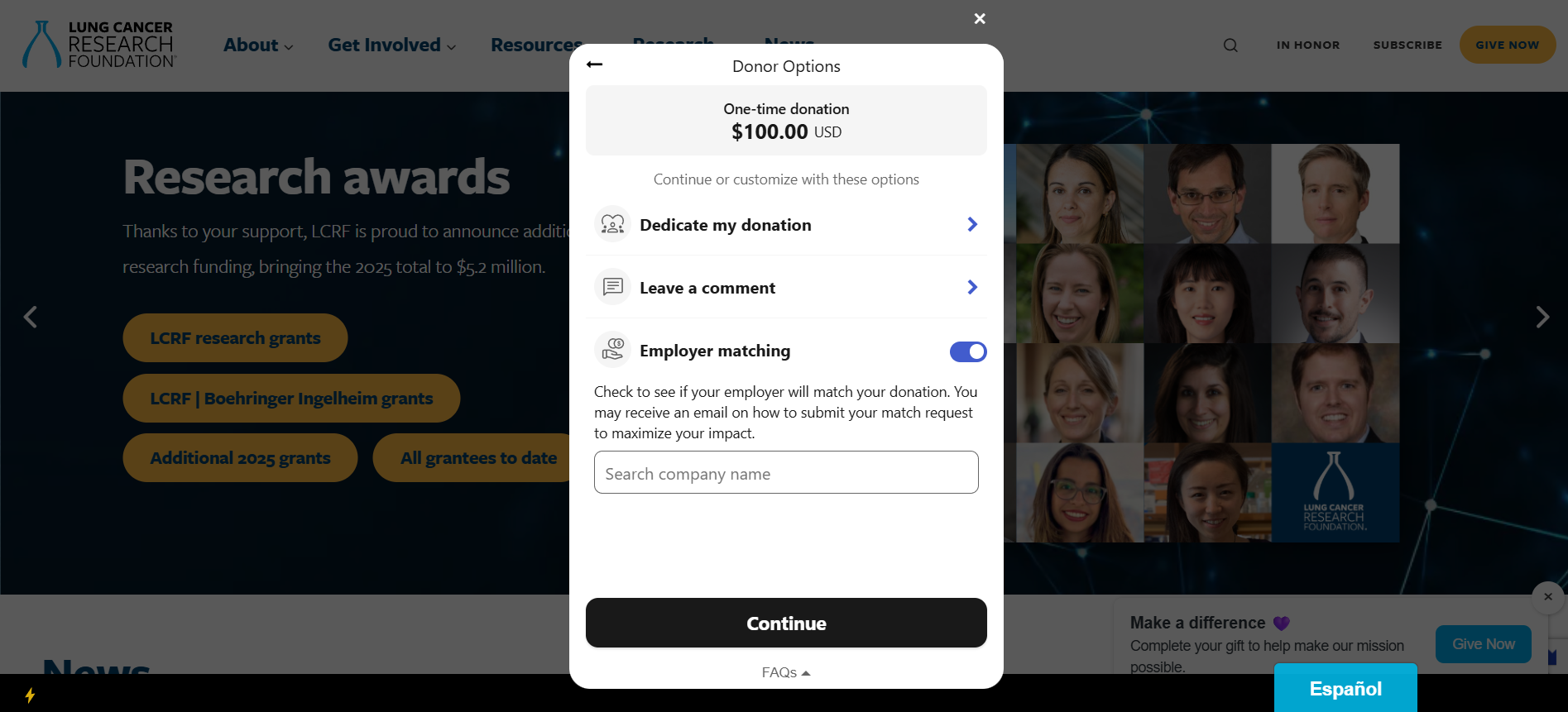
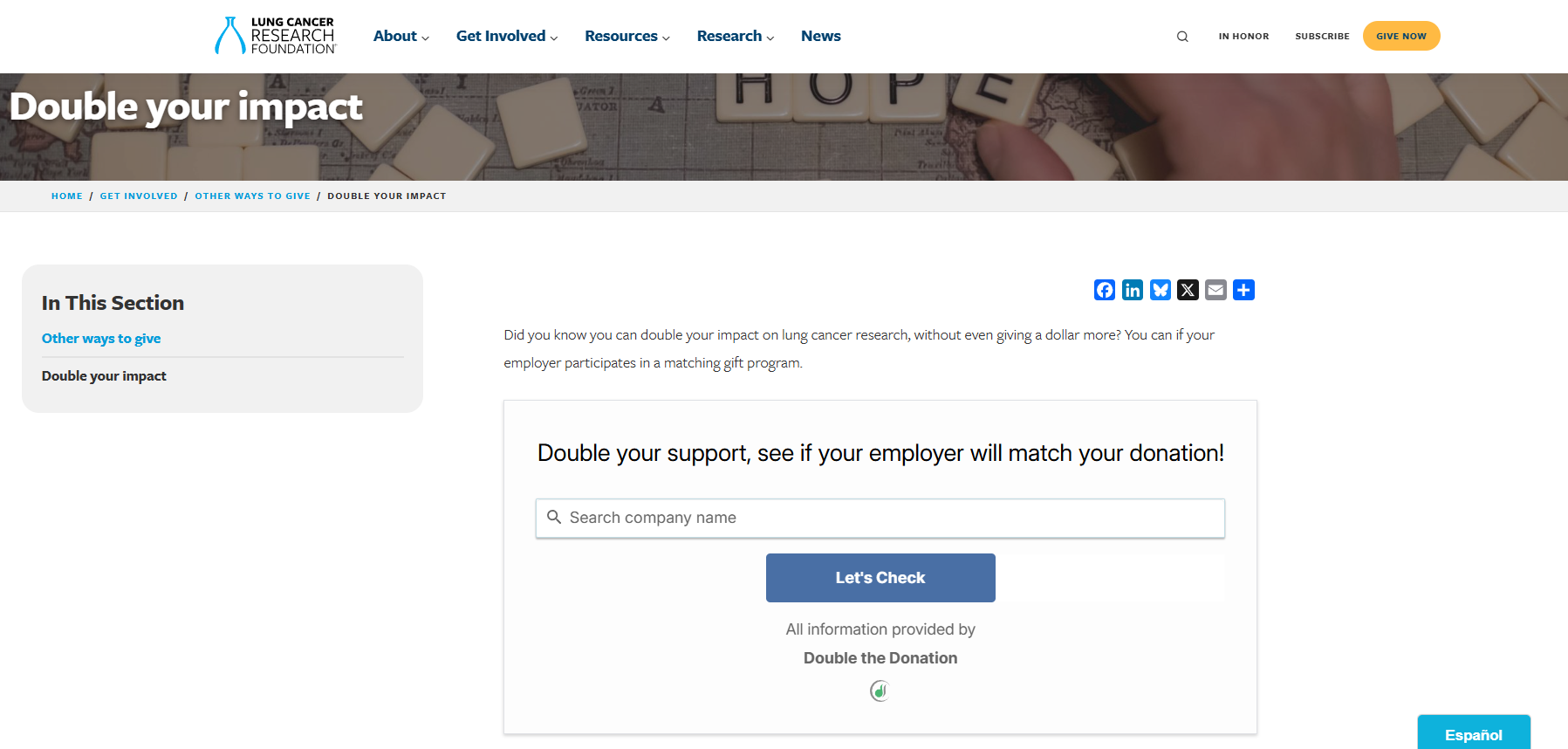
The first step in the strategy was integration. LCRF integrated the matching gift search tool “into all of our donation forms.”
- How it works: As donors navigate the donation flow, they are presented with a search field where they can “easily enter their employer name.”
- Immediate Identification: This integration allows the system to determine “donor match eligibility” in real-time. By capturing this data at the point of transaction, LCRF eliminated the need for retroactive prospect research. The system identifies the opportunity while the donor is still engaged on the page.
2. Immediate Donor Guidance
Once an eligible employer is identified, the system immediately pivots to activation. The case study notes that the tool allows donors to “receive a matching gift submission link and guidelines following their contribution.” This immediacy is critical. Instead of telling a donor, “Please check with HR,” the system provides the specific “matching gift submission link” required by that donor’s specific employer. This removes the administrative burden from the donor, making it significantly more likely that they will complete the process.
3. Automating the Follow-Up
Perhaps the most powerful component of the solution was the removal of manual outreach. The system utilized “automated email triggers and timing” to follow up with donors.
- Taking the Guesswork Out: The automation “took the guesswork out of this fundraising avenue.” The system knows exactly who to email, what information to send them, and when to send it.
- Saving Time: This process made it “easy to find matching gift opportunities, then automate follow-up strategies,” freeing up the LCRF staff to focus on other high-value development activities.
The Results: Unlocking $336k and Driving Engagement
The transition to an automated system produced immediate, quantifiable results for the Lung Cancer Research Foundation. The data from the case study demonstrates success across three key pillars: identification, revenue conversion, and donor engagement.
1. Identification: $336,520 Uncovered
The most striking statistic is the volume of potential revenue identified. In less than one year, the system identified over $336,520 in match-eligible dollars. This figure represents funds that were likely present in the LCRF donor base all along but were invisible without the right tools. By surfacing these opportunities, the foundation created a massive pipeline of potential revenue to support its research programs.
2. Revenue Conversion: A 27% Increase
Identification is only the first step; conversion is the goal. LCRF successfully turned those identified opportunities into actual cash for research. The case study reports a 27% increase in annual matching gift revenue since implementing the system. This 27% growth is a direct result of making the process easier. As Evan Bonsett-Veal, Senior Manager of the Donor Database, noted, “We’ve seen solid growth in the number of matching gifts we receive and an increase of 27% in matching gift revenue because of it.”
3. Donor Engagement: 56% Open Rate
The effectiveness of the automated outreach strategy is evidenced by the high level of donor engagement.
- Email Open Rate: The automated matching gift emails achieved a 56% open rate. The case study contextually notes that this should be compared to an “industry average of 20%.” LCRF’s open rate was nearly triple the industry standard, proving that their donors are highly receptive to these communications.
- Overall Engagement: The metrics showed 71% moderate to high donor engagement in the past year. This metric tracks donors who are “using the matching gift search tool, accessing matching forms, or opening multiple matching gift messages.”
Strategic Analysis: Accessibility and User Experience
A critical, often overlooked aspect of fundraising technology is accessibility. In other words, can all donors, regardless of their tech-savviness, use the tool?
Evan Bonsett-Veal provided a crucial insight into this aspect of the success story. He stated: “The intuitive process makes it so that constituents with all levels of technical capabilities can obtain and understand the matching gift information they need.”
Why “Intuitive Processes” Matter
For a disease-focused organization like LCRF, the donor base is likely diverse, ranging from young professionals to older adults who may be less comfortable with complex digital interfaces. If a matching gift tool is difficult to use, it creates a barrier to entry that alienates less tech-savvy donors.
- Removing Barriers: By ensuring the process is intuitive, LCRF ensures that no donor is excluded from the opportunity to match their gift.
- Simplifying Complexity: Corporate matching gift policies can be complex and bureaucratic. The tool simplifies this by distilling the information down to exactly what the donor needs: the link and the guidelines.
- Enhancing Revenue: Accessibility leads directly to revenue. If a donor can “obtain and understand” the information easily, they are more likely to submit the request, driving that 27% revenue increase.
The Role of Integration in Strategy
Another key factor in LCRF’s success was the technical fit of the solution. The organization needed a tool that would play nicely with their existing tech stack.
Bonsett-Veal emphasized that “The direct integration available to all our current platforms has made tracking matching gifts much easier.”
- Holistic Data: By integrating directly, LCRF avoided data silos. The matching gift data flows into their existing systems, making tracking “easier” and providing a clear view of donor behavior.
- Vital for Strategy: This integration wasn’t just a convenience; it was “vital to our matching gift outreach strategy.” It allowed the team to view matching gifts not as a separate, disconnected activity, but as a “fundamental piece of our matching gift program.”
Conclusion: A Blueprint for Medical Research Fundraising
The Lung Cancer Research Foundation’s experience serves as a powerful case study for any nonprofit organization, particularly those in the medical research sector, where funding is synonymous with life-saving progress.
By acknowledging the limitations of manual fundraising (the “guesswork,” the missed opportunities, and the administrative burden), LCRF was able to pivot to a strategy that worked smarter, not harder. The implementation of Double the Donation’s automated tools transformed their matching gift program from a reactive task into a proactive revenue engine.
The results speak for themselves:
- $336,520+ in match-eligible dollars identified.
- 27% increase in matching gift revenue.
- 56% email open rate, engaging donors at nearly 3x the industry average.
Most importantly, this technology has freed the LCRF team to focus on its core mission. As they continue to fund “Living Breathing Science,” they can do so with the confidence that they are maximizing every possible resource available to them. By automating the search for match-eligible dollars, LCRF helps ensure that the fight against lung cancer is funded as robustly as possible.
Download the full case study compilation here to uncover even more successful strategies.