How Lehigh University Mastered Its Matching Gift Month Push
In the competitive world of higher education fundraising, standing out in a donor’s inbox is a constant challenge. Universities are continuously vying for supporters’ attention, seeking the funding needed to support student scholarships, facility upgrades, and academic programs. While major gifts and annual fund drives are standard practice, many institutions are sitting on a goldmine of untapped potential: corporate matching gifts.
Lehigh University recently demonstrated that a strategic, focused approach to this revenue stream can yield incredible results. By implementing a dedicated matching gift month push, utilizing compelling storytelling strategies, and leveraging advanced fundraising software to do it, this school saw significant growth in both donor engagement and actual revenue.
In this deep-dive case study, we will explore the powerful tactics the institution used. Specifically, we’ll cover:
- Lehigh University’s pivot to a “Matching Gift Month” campaign
- The incredible impact of human-centric storytelling
- Successful execution of a multi-channel marketing strategy
- The technical backbone provided by the right fundraising software
- A detailed analysis of the matching gift results
- FAQ: Lehigh University’s matching gift month wins
Lehigh University’s matching gift success wasn’t accidental; it was the result of a carefully crafted plan that combined emotional connection with technical precision. Let’s dive in to learn more and see how your team can implement some of these leading recommendations.
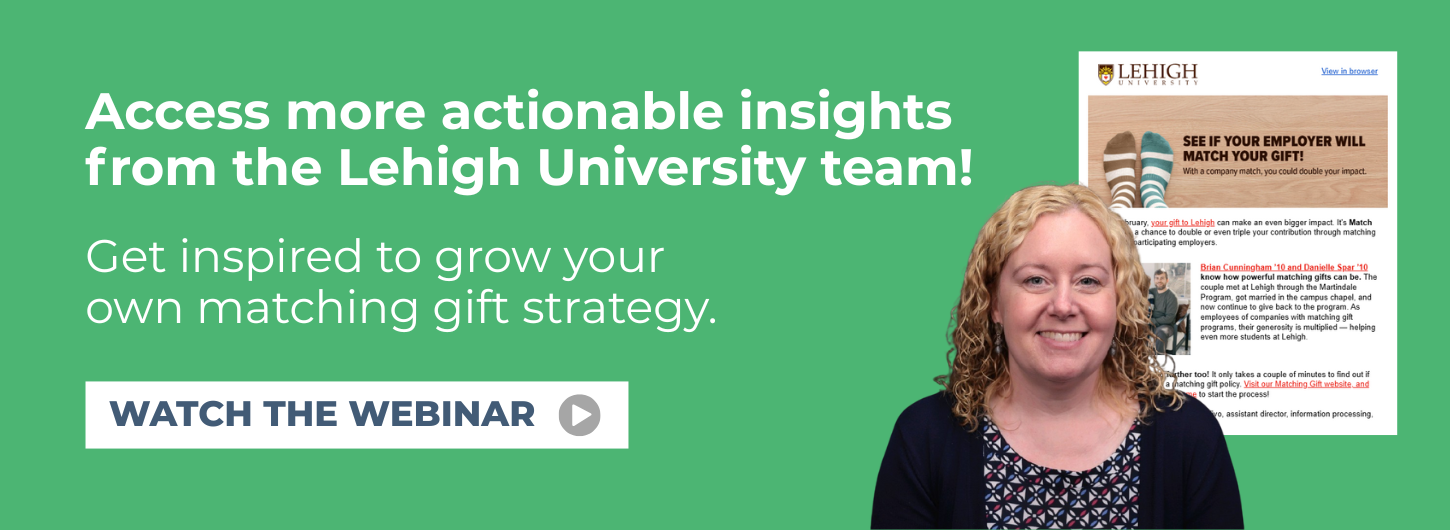
Access the on-demand webinar replay to hear directly from the Lehigh University development team about their strategy success!
The Strategic Pivot to a “Matching Gift Month” Campaign
Many nonprofits and universities treat matching gifts as a passive revenue stream. They might include a subtle link on their donation form or a line in a confirmation email, hoping donors will take the initiative to research their employer’s program. Lehigh University, however, decided to take a proactive stance. Instead of waiting for matches to trickle in, they leveraged a major industry opportunity: “Matching Gift Month.”
For several years now, February has been widely recognized in the nonprofit sector as Matching Gift Month. While many institutions let this observance pass without fanfare, the Lehigh team made the calculated decision to fully capitalize on it. Sitting between the high-volume end-of-year giving season and the spring fundraising push, the existing designation of February as a time to focus on corporate giving provided the perfect anchor for their strategy. By aligning their internal goals with this engaging event, Lehigh University transformed a quiet time of year into a vibrant campaign centered on maximizing impact.
Leveraging the existing “Match Month” concept does two things psychologically for the donor:
- First, it educates them; highlighting a specific month dedicated to the practice signals that this is a standard, important part of philanthropy, not an obscure administrative process.
- Second, it creates a “bandwagon effect.” When donors see a coordinated push across social media, email, and direct mail tied to a broader movement, they feel a greater sense of urgency to participate.
Lehigh’s strategy involved more than just asking for money. It involved a comprehensive audit of their past performance and a willingness to expand their reach. In previous years, their average email audience for such campaigns was around 2,200 recipients. For this push, they significantly expanded their scope, targeting over 9,000 recipients. This boldness in expanding the funnel was the first step toward their record-breaking results.
Did You Know?
According to matching gift statistics, an estimated $4 to $7 billion in matching gift funds goes unclaimed every year. By creating a dedicated campaign like Lehigh’s, organizations can capture a significant portion of this left-on-the-table revenue.
The Incredible Impact of Human-Centric Storytelling
Data and dollars are important, but they rarely open wallets on their own. Rather, people give to people. One of the most effective tactics Lehigh University employed was shifting from generic solicitations to emotionally resonant storytelling. For their February matching gift month push, they didn’t just explain how matching gifts work; they showed matching gifts in action through the lives of their alumni.
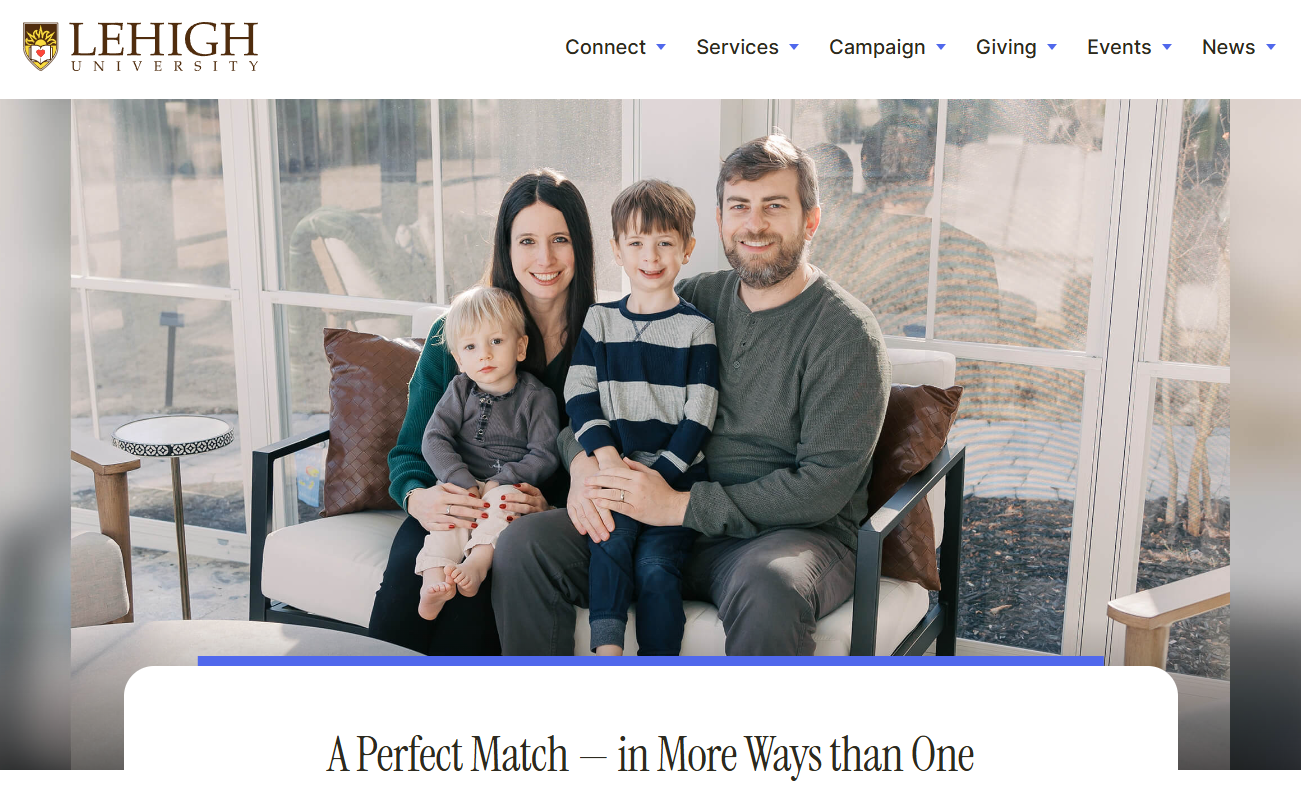
The centerpiece of this content strategy was a feature story titled “A Perfect Match — in More Ways than One.” This narrative approach transformed a largely transactional process into a powerfully relational one.
Meet Danielle and Brian
The story featured Danielle Spar ’10 and Brian Cunningham ’10, a couple whose lives were inextricably linked by their time at Lehigh University. They met at the school, which set in motion a series of “perfect matches:” the perfect school, a life-changing honors program, rewarding careers, and eventually, marriage and family.
The narrative was brilliant in the way that it highlighted the “why” before the “how.” It detailed their gratitude for the Martindale Student Associates Honors Program and the professors who toasted to the donors who came before them. This established a legacy of giving; Danielle and Brian wanted to honor that legacy.
Crucially, the story explained that because they work for companies with generous matching gift programs (specifically Goldman Sachs and Bank of America), the generous donors could easily triple their impact for their alma mater. Brian noted, “It’s a very powerful thing to do, especially if it’s done year after year.”
By centering the campaign around a relatable, human story, Lehigh made the concept of matching gifts tangible. Instead of just asking for money, they showed alumni how their peers were maximizing their impact without digging deeper into their own pockets.
Successful Storytelling Metrics
The results of this content-first strategy were undeniable. In the world of digital marketing, engagement is the precursor to conversion. The web traffic stats for February paint a clear picture of what donors prefer:
- Generic Page Performance: The general university matching gift information page received 76 views.
- Story Page Performance: The “Perfect Match” story page received 428 views (a 463% increase!).
This massive disparity proves that donors are far more likely to engage with content that connects a technical fundraising mechanism (like matching gifts) to a personal narrative (like Brian and Danielle’s). The story served as the “hook,” and the matching gift information was the “sinker.”
Implementing a Successful Multi-Channel Marketing Strategy
A great story is useless if no one reads it, and Lehigh University understood that modern donors are distracted and fragmented across various media platforms. To cut through the noise, they executed a robust, multi-channel marketing strategy. They didn’t rely on a single email blast. Rather, they created an ecosystem of communication that reached donors where they were.
Email Marketing Mastery
Email remains the workhorse of nonprofit fundraising, but “batch and blast” techniques are becoming less and less effective. Luckily, Lehigh used smart segmentation and consistent branding to drive results.
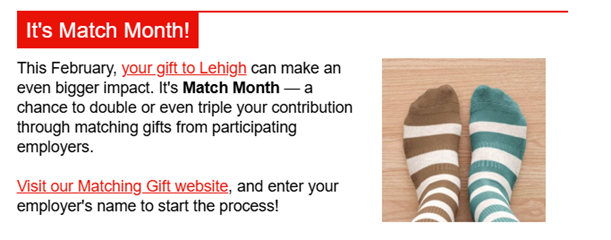
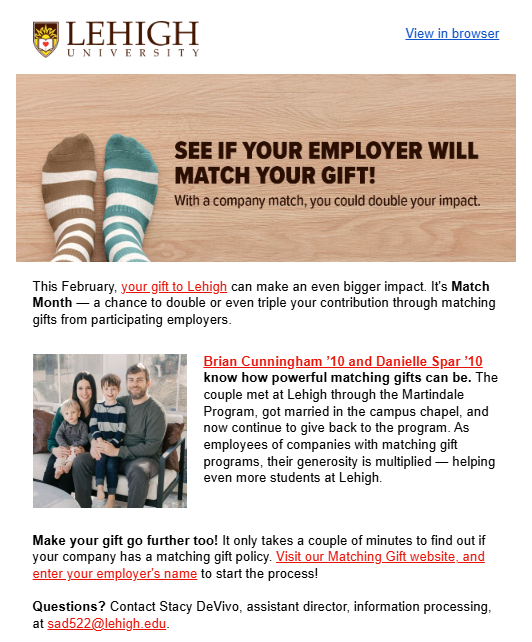
First, they ensured consistency. For the entire month of February, the development office included a specific matching gift snippet at the bottom of every email sent out, regardless of the primary topic (see the example below). This technique, known as “piggybacking,” ensures that even if a donor opens an email about an alumni event or a more general newsletter, they are still reminded of the matching gift opportunity. It builds subconscious awareness over time.
Second, their specific “Matching Gift Month” email campaign was particularly aggressive in its reach. As mentioned, they targeted 9,100 recipients, a significant jump from previous averages. This audience included current-year donors as well as those who had given last year (LYBUNTs). The performance metrics were outstanding:
- Open Rate: The primary email achieved a 56% open rate. To put this in perspective, the industry average for nonprofit emails often hovers around 25-30%. Lehigh more than doubled the standard.
- Click-Throughs: More than 86 individuals clicked through to the website, the highest recorded number for a matching gift email at the university (boasting a 330% increase compared to the previous peak of 20 clicks).
Bridging the Gap with Direct Mail
In an increasingly digital world, physical mail has a unique power, especially for older demographics or high-net-worth individuals who may not be glued to their smartphones. For this reason, Lehigh did not abandon traditional mail; they optimized it.
The school’s development team designed a monthly solicitation letter specifically for donors who were known to work for matching gift companies and who had made a gift the prior month. This is a highly qualified segment: they have already shown intent to give, and they are match-eligible. The letter wasn’t a generic “dear friend” note; it was a targeted tool to drive engagement.
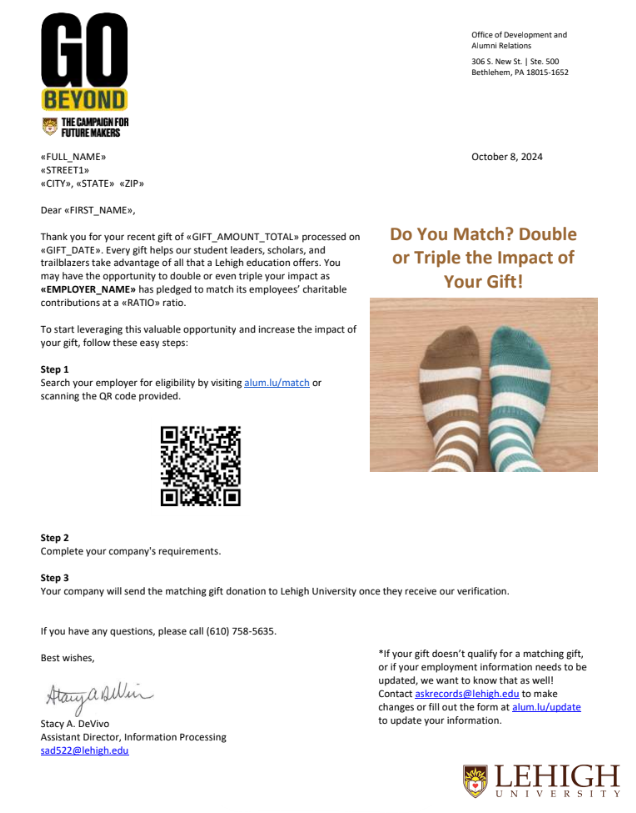
To bridge the offline-to-online gap, Lehigh included an easily scannable QR code in the letter (pictured above). This tool enabled recipients to scan the paper with their phone and be taken directly to the matching gift webpage. Over four months, this QR code generated a total of 26 scans. While this number is lower than email clicks, these are high-value interactions. A donor who takes the time to scan a physical letter is often highly motivated.
Social Media Engagement
To further round out the strategy, Lehigh University’s marketing team designed a suite of vibrant, eye-catching banners and social graphics. These weren’t static; they were rotated weekly to keep the content fresh. The channels included:
- Instagram Stories
- Facebook Stories
- Facebook Feed
- LinkedIn Feed
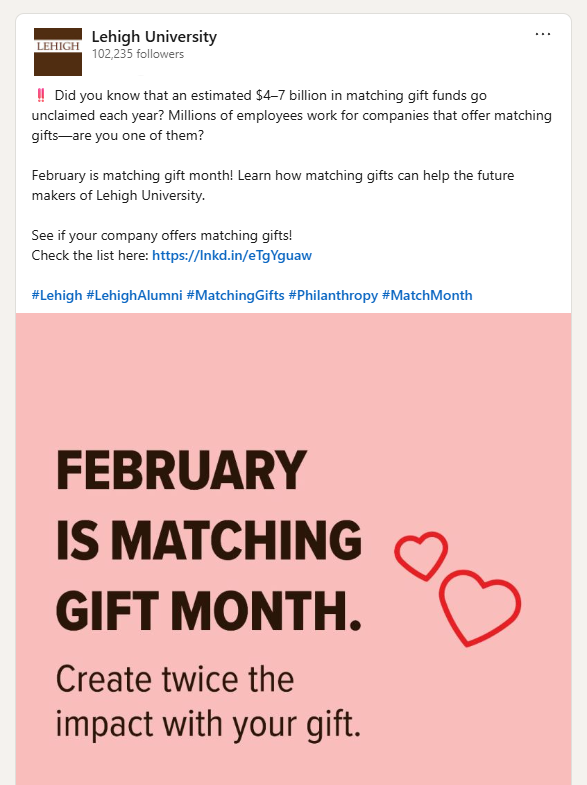
Interestingly enough, but perhaps unsurprisingly for a professional giving topic, LinkedIn proved to be the most powerful driver. Since matching gifts are tied to employment, promoting them on a professional networking site is a natural fit. The LinkedIn posts generated the majority of social traffic to the school’s matching gift content online. Check out the example post below!
Quick Tip
Don’t just post on your main feed! Use “Stories” on Facebook and Instagram for time-sensitive campaigns like a matching gift month push. The ephemeral nature of Stories establishes a sense of urgency, and the swipe-up (or link sticker) feature reduces friction for mobile users.
The Role of Fundraising Software in Lehigh’s Matching Gift Month Push
Strategic marketing drives traffic, but the right infrastructure captures revenue. Fortunately, Lehigh’s ability to identify match-eligible donors and process these requests was powered by a significant investment in fundraising technology. On October 1, prior to the February push, Lehigh implemented Double the Donation’s fundraising software.
Before this implementation, the process of uncovering matching gifts was likely manual and reactive. Staff would have to rely on donors self-reporting their eligibility or checking employer lists on their own. This creates friction and “drop-off” in which a donor intends to match but ultimately gets lost in the paperwork.
Here’s how a built-out software toolkit helps.
Reducing Donor Friction
The new software integrated directly into Lehigh’s existing fundraising ecosystem, the key feature being the streamlined search tool. When a donor is on the giving page or the dedicated matching gift page (pictured below), they can simply type their employer’s name into an embedded search bar.
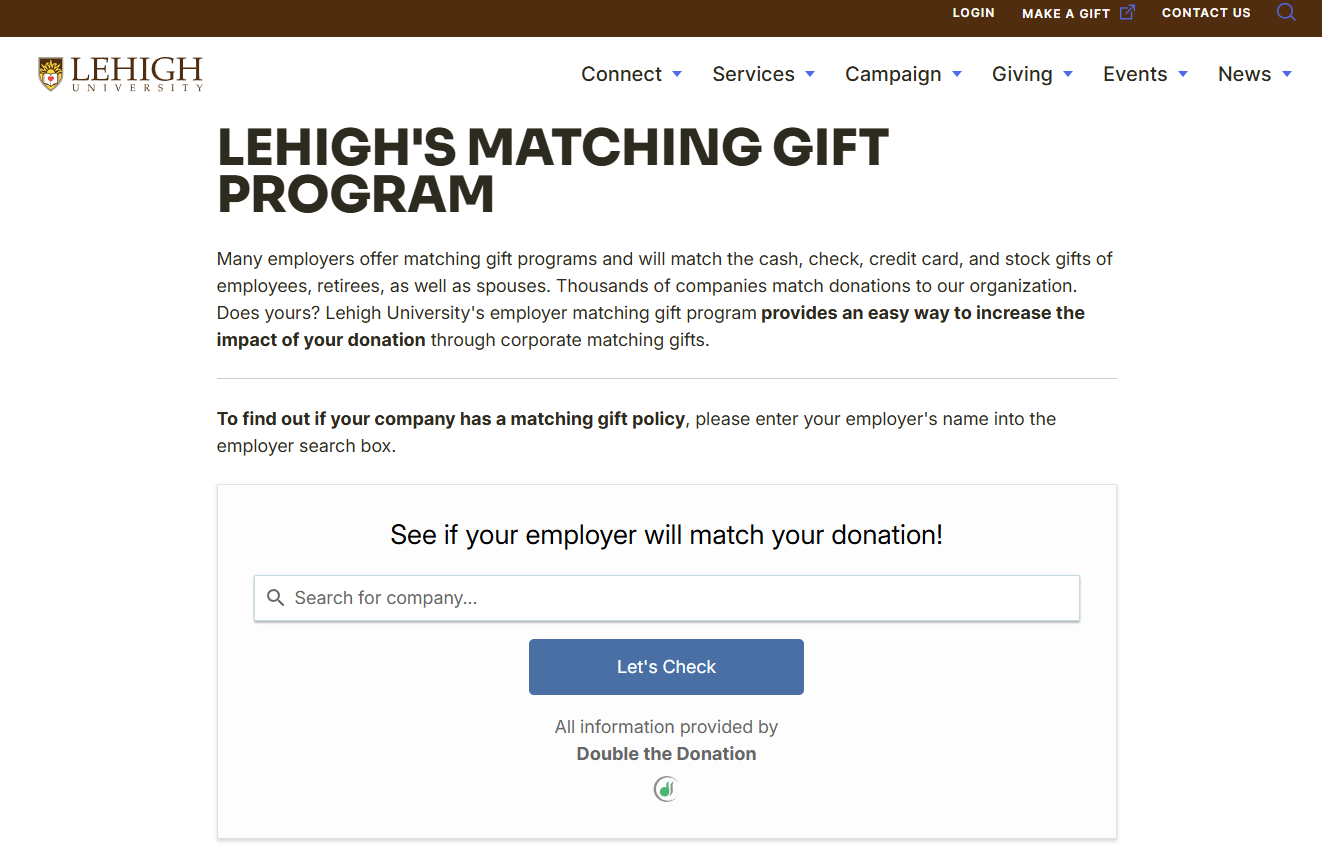
The database instantly recognizes the company and provides the specific forms, guidelines, and next steps required by that employer in real time. In many cases, it provides a direct link to the company’s employee portal, ultimately removing the guesswork. A donor like Brian or Danielle doesn’t need to call their HR. Instead, the information is presented to them directly at the moment of giving.
Lehigh redesigned its matching gift webpage in the spring of 2024 to center this search tool. This page became the “hub” for all the marketing spokes. A combination of QR codes, email links, and social media posts all directed traffic to this central, automated hub.
Analyzing the Fundraising Campaign’s Matching Gift Results
Did the investment in a dedicated month, professional storytelling, and matching gift database software pay off? The numbers speak for themselves.
Lehigh University ran the numbers after its fiscal year close-out, but even the preliminary data from the February push showed massive ROI. When comparing the period from October 1 (the software implementation date) through February against the exact same timeframe the previous year, the growth was substantial.
Financial Impact
The university reported a more than $37,000 increase in matching gift revenue year-over-year for that period. For a mid-sized development program, an extra $37,000 in unrestricted or designated funds is a major win. This is revenue that requires no additional stewardship events, galas, or major gift officer travel. It is efficiency at its finest. Just think of all the extra students that can be supported with that funding!
Volume Impact
Beyond the dollar amount, the volume of participation increased. Lehigh saw almost 100 additional matching gift donations compared to the previous year. This metric is perhaps even more important than the revenue figure because it indicates a behavioral shift in the donor base.
Once a donor submits a matching gift request, they are highly likely to do it again in future years. Lehigh hasn’t just captured $37k in one-time cash. They have cultivated 100 donors who now understand the process and are conditioned to double their impact on an annual basis.
FAQ: Lehigh University’s Matching Gift Month Wins
Lehigh University’s record-breaking matching gift month push was the result of careful planning, cross-departmental collaboration, and strategic execution. To help you better understand the finer details of their approach and how you can apply these lessons to your own organization, we’ve compiled answers to some of the most frequently asked questions about their campaign.
Q: What is the best time to host a “Matching Gift Month” push?
A: “Matching Gift Month” is traditionally observed in February of each year. However, your organization can choose to promote matching gifts whenever it fits best into your fundraising calendar. The ideal time for a dedicated matching gift month push is simply whenever you can devote the resources to a sustained, 30-day push without competing with other major asks.
Q: Beyond Match Month, what are some other opportunities to promote matching gifts?
A: While Lehigh University’s success proves the power of a concentrated matching gift campaign in February, a robust matching gift marketing strategy should not be limited to a single month. Here are some key opportunities to keep the momentum going:
- Start-of-Year Follow-Ups (January): The beginning of the year is a “golden window” for retroactive matching. Many donors who gave during the busy holiday season may not have submitted their match requests yet. Crucially, many major corporations (such as Home Depot and Best Buy) offer a grace period, allowing employees to submit matches for donations made in the previous calendar year through January 31st or later.
- Match Madness (March): Piggybacking on the excitement of college basketball, “Match Madness” campaigns are an excellent way to gamify matching gift fundraising. This is particularly effective for universities like Lehigh, but it can work well for just about any nonprofit.
- Seasonal Reminders (Spring & Summer): Don’t let the middle of the year become a dead zone. Spring is a time for “cleaning up” loose ends. Therefore, remind donors to check their eligibility. Summer, typically a slower fundraising season, is a great time to engage donors with lighter, fun messaging, such as “Make a splash this summer by doubling your gift.”
- End-of-Year & Giving Tuesday (Nov-Dec): The end-of-year giving season is the most critical time for nonprofits. As donors rush to make tax-deductible contributions, you must ensure matching gifts are part of the conversation. Companies like CVS Health and 3M have strict end-of-year deadlines, adding a layer of natural urgency.
- Affinity Dates: Finally, align matching gift messaging with dates that matter to your specific mission. If you are an environmental group, push for corporate matches on Earth Day. If you are an LGBTQ+ advocacy group, focus on Pride Month. This creates a natural connection between the donor’s values, the corporate partner’s goals, and your overall mission.
For even more actionable and timely campaign ideas, check out our Matching Gift Content Calendar guide!
Q: How do we find donor stories like Danielle and Brian’s?
A: Look at your fundraising data! Run a report of donors who have successfully matched their gifts in the past few years. Then, reach out to them and ask, “Why did you choose to match your gift?” Most donors are flattered to be asked and eager for a chance to share their stories to inspire others.
Q: Do we need specific software to replicate this success?
A: While you can run a marketing campaign without dedicated software, processing the influx of requests can become difficult on your own. For this reason, tools that automate identification and submission (like Double the Donation) are essential for scaling. Without software to streamline your efforts, your team may drown in paperwork, or donors may give up due to complex employer requirements or a lack of guidance through the process.
Wrapping Up & Next Steps
Lehigh University’s success offers a tangible blueprint for higher education and nonprofit fundraising. By humanizing the impact of matching gifts through storytelling, utilizing a multi-channel promotion strategy, and investing in the right tools, the school transformed its matching gift performance from passive to proactive.
Looking ahead, the Lehigh team plans to expand its strategy even further. They are currently attending conferences to learn how to incorporate volunteer grants into their fundraising efforts. Additionally, they plan to integrate “Matching Wednesday” into their platform next November, continuing to look for new angles to engage their alumni base.
The work is never finished, but with a solid foundation of data and technology, the future looks bright.
Ready to boost your matching gift revenue? Request a demo of Double the Donation to see how our tools can help you identify more match-eligible donors and drive revenue growth just like Lehigh University.