What Are Corporate Grants for Nonprofits? Guide + Examples
Corporate grants are non-repayable funds provided by companies to nonprofits, often to support specific missions, projects, or initiatives. These grants are generally awarded based on a nonprofit’s alignment with a company’s social responsibility goals and community impact objectives.
Securing funding is a top priority for fundraising organizations, and corporate grants for nonprofits can be a game-changer. According to recent Giving USA reports, annual corporate charitable funding grew to over $44 billion. From powering community programs to supporting innovative solutions for societal challenges, these dollars provide critical resources to help nonprofits achieve their missions. But what exactly are corporate grants, and how can nonprofits tap into this valuable funding source?
In this guide, we’ll break down the basics, including how they work, which companies tend to offer them, and the different types available. We’ll also share actionable tips for nonprofits to enhance their grant application strategies. And we’ll do so by answering the following frequently asked questions:
- What are corporate grants?
- What companies offer corporate grants for nonprofits?
- How do nonprofits and companies benefit from corporate grants?
- How can organizations obtain corporate grants?
Whether you’re new to the grant-seeking process or are simply looking to refine your approach, this resource is designed to help your organization secure impactful partnerships with corporate funders. Let’s dive in!
What are corporate grants?
Corporate grants for nonprofits are financial contributions made by companies to support charitable organizations, initiatives, or projects that align with the company’s philanthropic goals or Corporate Social Responsibility (CSR) efforts. These grants can be one-time donations or part of an ongoing partnership and typically aim to address specific social issues or community needs.
While there’s no one-size-fits-all structure, it’s essential to recognize that corporate grants can take various forms. These include:
- Direct Grants: Cash or funding provided to nonprofit organizations to support a particular program or project.
- Matching Grants: Companies match employees’ donations to qualified nonprofits, often on a dollar-for-dollar basis.
- In-kind Grants: Non-cash support, such as product donations, services, or resources, which can assist nonprofits in their operations or programs.
- Challenge Grants: A type of grant where the company pledges to contribute funds only if the nonprofit can raise a certain amount from other sources.
All in all, corporate grants offer nonprofits a significant source of funding and can also strengthen relationships between businesses and the communities they serve.
What companies offer corporate grants for nonprofits?
Many companies offer corporate grants to nonprofits, especially those with robust Corporate Social Responsibility programs. Below are some examples of companies known for providing generous grants.
Feel free to make note of their focus areas and determine which ones might be a good fit for your cause!
Bank of America
Bank of America provides cash grants and resources via its Charitable Foundation to foster long-term social and economic progress.
- Focus Areas: Economic mobility, workforce development, education, and health
- Other Programs: Matching gifts, Volunteer grants & VTO
The Google for Nonprofits program empowers organizations through access to technology, education, and sustainability initiatives.
- Focus Areas: Technology access, education, sustainability, and social challenges
- Other Programs: Matching gifts, Volunteer grants & VTO
Target
The Target Foundation supports communities by creating opportunities for underserved populations through education and social equity.
- Focus Areas: Education, arts and culture, social services, and environmental sustainability
- Other Programs: Volunteer grants
Microsoft
Microsoft Philanthropies aims to reduce the digital divide by supporting nonprofits that expand access to technology and build skills.
- Focus Areas: Education, technology access, and economic development
- Other Programs: Matching gifts, Volunteer grants & VTO
Nordstrom
Nordstrom focuses on community-based programs that provide young people with essential life skills, leadership development, and career readiness.
- Focus Areas: Youth development, education, and workforce development
- Other Programs: Matching gifts, Volunteer grants
Coca-Cola
The Coca-Cola Foundation supports global issues with a heavy emphasis on water conservation and community well-being.
- Focus Areas: Water access, community development, education, and healthy living
- Other Programs: Matching gifts
State Farm Insurance
The State Farm Foundation supports nonprofits that enhance public safety and provide essential educational opportunities.
- Focus Areas: Community development, education, and safety initiatives
- Other Programs: Matching gifts, Volunteer grants & VTO
Best Buy
The Best Buy Foundation empowers the next generation of innovators by increasing access to technology and digital literacy.
- Focus Areas: Youth, education, and access to technology
- Other Programs: Matching gifts, Volunteer grants
General Motors
The GM Foundation supports educational access and career readiness to help communities thrive through innovation.
- Focus Areas: STEM education, community development, and sustainability
- Other Programs: Matching gifts, Volunteer grants
Verizon
The Verizon Foundation leverages technology-driven solutions to promote digital literacy and enhance access to healthcare.
- Focus Areas: Education, healthcare, and community empowerment
- Other Programs: Matching gifts, Volunteer grants & VTO
American Express
The American Express Foundation revitalizes underserved communities through support for historic preservation and access to the arts.
- Focus Areas: Historic preservation, arts, culture, and community development
- Other Programs: Matching gifts, Volunteer grants
Cigna Group
Cigna Group’s philanthropic initiatives aim to create healthier societies by addressing health disparities and access.
- Focus Areas: Health, well-being, and community resilience
- Other Programs: Matching gifts, Volunteer grants & VTO
Patagonia
Patagonia supports grassroots organizations that lead efforts to protect natural resources and advocate for climate action.
- Focus Areas: Environmental conservation, climate change, and social activism
- Other Programs: Matching gifts, VTO
How do nonprofits and companies benefit from corporate grants?
Corporate grants are what we like to call a “win-win” situation. Both the company contributing and the nonprofit receiving the grant can unlock significant benefits and scale progress toward their existing goals. Let’s take a closer look!
The fundraiser’s perspective: advantages of corporate grants for nonprofits
Corporate grants provide fundraising organizations with additional, often much-needed revenue. But the advantages don’t stop there! Check out the following benefits offered by corporate grants for nonprofits:
- Financial support. Corporate grants provide nonprofits with the funding they need to support their programs, operations, or special projects. This financial support enables nonprofits to advance their missions, expand their initiatives, and make a greater impact in the communities they serve.
- Increased visibility and credibility. Often, receiving a corporate grant elevates a nonprofit’s visibility and credibility. Being associated with well-known, reputable companies can build trust with donors, volunteers, and the general public. It signals that the organization is trustworthy and capable of managing significant funding.
- Access to new resources. Beyond financial support, corporate grants sometimes include in-kind donations of goods or services (such as technology, office supplies, expertise, or even employee volunteers). These additional assets can help nonprofits reduce costs, improve efficiency, and enhance their capacity to serve beneficiaries.
- Opportunities for long-term partnerships. Corporate grants can lead to long-term relationships and partnerships with businesses. These partnerships may evolve to include joint campaigns, co-branded initiatives, or additional financial support over time.
In summary, corporate grants provide nonprofits with the financial support and resources necessary to grow their programs, increase visibility, and build long-term, beneficial relationships with businesses. These grants help strengthen the nonprofit’s overall impact and sustainability.
The corporate perspective: how companies benefit from offering grants
There are several reasons a company might offer a grant to a nonprofit. While altruism certainly plays a role in things, other corporate benefits offered by grant-making include:
- Enhanced corporate reputation. Supporting nonprofits through grants can enhance a company’s public image and reputation. Companies that contribute to community well-being are often viewed more positively by customers, investors, and employees. As a result, philanthropy can build trust, loyalty, and goodwill, ultimately benefiting the company’s brand.
- Growth in employee engagement. Companies often provide grants as part of broader employee engagement strategies. This funding, especially matching gifts or volunteer grants, can encourage employees to donate to causes they care about, fostering a sense of pride in the company. Offering grants can improve employee morale and loyalty while fostering a culture of giving within the workplace.
- Deepened community relations. By supporting nonprofits, companies can deepen their ties to the communities in which they operate. Doing so can improve relationships with local stakeholders, including government entities, customers, and community leaders. It can also help companies better understand and respond to community needs.
- Annual tax benefits. Grant-making can offer tax advantages for companies. In many regions, businesses can deduct charitable contributions from their taxable income, which reduces their overall tax liability. These benefits can make corporate giving a financially beneficial strategy, in addition to being socially responsible.
Overall, corporate grants serve both as a tool to enhance a company’s reputation and as a means to create a meaningful, lasting impact on society. And recent research from the Association of Corporate Citizenship Professionals indicates that many companies are looking to increase their giving budgets this year!
How can organizations obtain corporate grants?
Now that you better understand the corporate giving opportunity, how can you solicit and secure the best grants for your nonprofit? It doesn’t have to be complicated! Obtaining corporate grants is a dedicated process that generally includes the following steps:
1. Identifying Corporate Grant Makers
To begin locating grant opportunities, research companies that offer grants or support the work your organization prioritizes. Doing so can involve:
- Browsing company websites: Many companies have dedicated CSR or philanthropy pages that outline their grant programs, eligibility requirements, and application processes.
- Implementing networking and outreach: Attend corporate philanthropy events, industry conferences, or other professional groups to learn about potential corporate grant opportunities.
- Utilizing donor employment information: Check whether your donors’ employers offer grants for nonprofits. You already have an opportunity to get your foot in the door: employee interest!
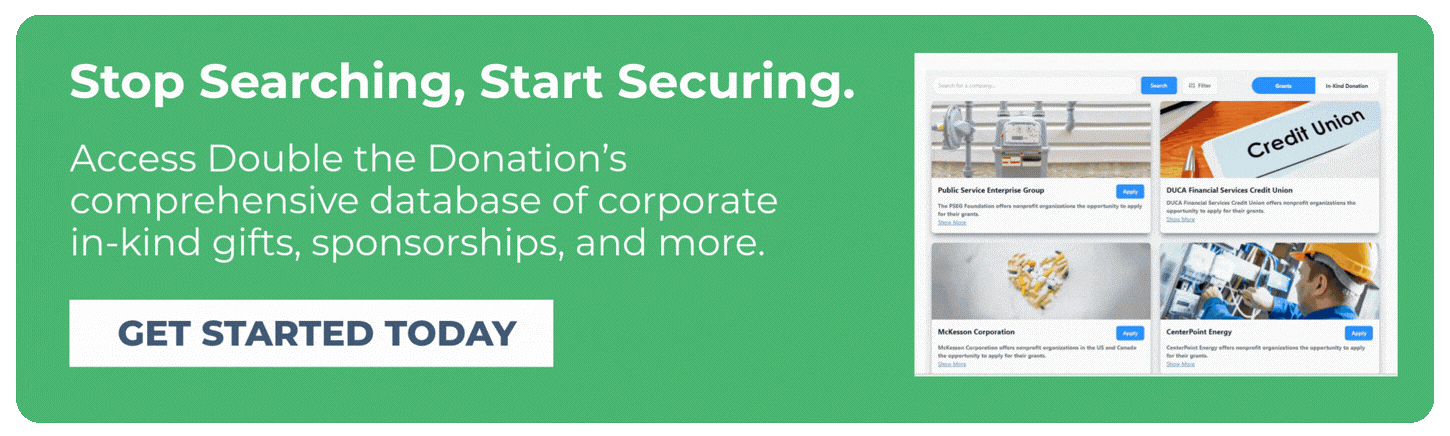
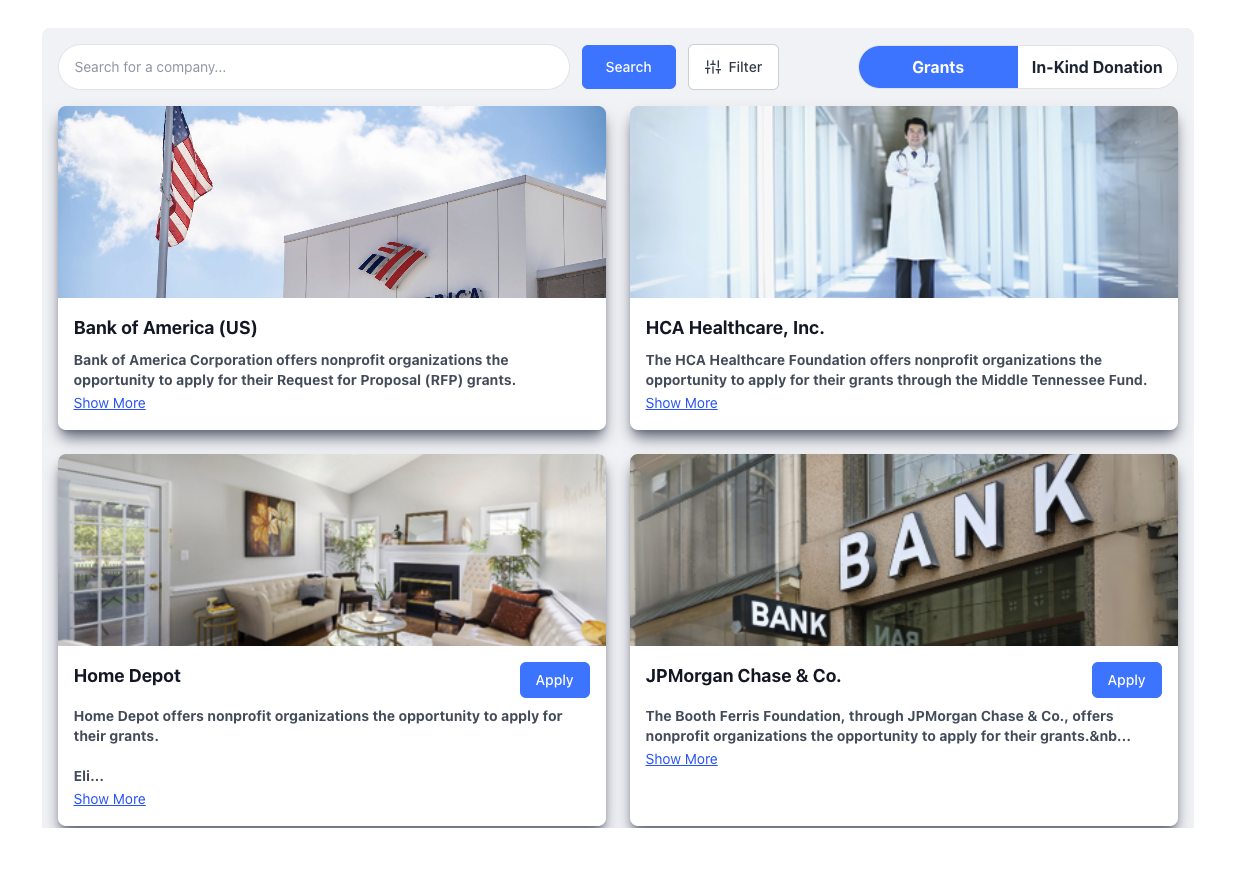
- Leveraging grant databases: Platforms like Foundation Center, GrantStation, Guidestar, or Double the Donation (pictured below) provide searchable databases that include corporate giving opportunities. This makes it quick and easy to access available grants, eligibility criteria, and application links!
2. Ensuring Corporate Mission Alignment
Corporate grants are often aligned with a company’s values, mission, or CSR focus areas. To ensure available grants align well with their own organization’s efforts, nonprofits should start by researching the company’s CSR strategy. From there, they can identify if their giving aligns with the nonprofit’s work (e.g., education, healthcare, or environmental sustainability).
You may also want to take a look at corporate giving patterns. For example, some companies prefer supporting local causes, employee-driven initiatives, or specific social issues, while others may have a broader national or international scope.
3. Researching Corporate Grant Criteria
Corporate grants often have specific application processes, guidelines, and deadlines. For the best results, it’s a good idea for your team to:
- Review the eligibility criteria: Ensure your nonprofit meets the company’s qualifications (e.g., tax-exempt status, geographic location, project type).
- Understand the funding process: Companies may request proposals, impact reports, or specific documentation. Be prepared to meet the requirements.
- Track deadlines: Many companies implement annual grant cycles, so it’s integral that your team stays on top of when applications are due.
Luckily, tools like Double the Donation’s corporate sponsorships database can help with this step, too!
4. Building Relationships with Corporate Partners
Establishing connections with companies can increase the likelihood of securing grants. To do so effectively, nonprofits should…
- Leverage existing connections: Engage with companies whose employees or leadership are already involved with or passionate about the nonprofit’s mission.
- Attend networking events and conferences: Companies often attend events to connect with nonprofits, so it’s a good idea to participate and build relationships with corporate representatives.
- Reach out directly: Contact the company’s CSR or community relations department to inquire about available funding opportunities and to introduce the nonprofit’s work.
A recent poll of nonprofit fundraising professionals indicated that 1 in 3 organizations engages with their corporate partners less than once a quarter. But that’s not nearly enough to keep them up to date with your initiatives, impact updates, and more. For the best results, we recommend aiming for a monthly cadence to nurture long-term trust and keep your organization top-of-mind for future funding opportunities.
5. Crafting a Compelling Grant Proposal
A strong, clear, well-structured grant proposal is essential for securing corporate funding. As you begin crafting grant proposals, you’ll want to:
- Clearly outline your nonprofit’s mission: Explain the organization’s mission, values, and the work being done in your community.
- Detail the specific project or program: Provide a clear description of the project or program that will benefit from the grant. This should include goals, target outcomes, and how it aligns with the company’s CSR objectives.
- Show measurable impact: Include metrics that demonstrate how the grant will contribute to tangible results and how success will be measured.
- Provide a budget: Include a detailed budget that explains how the funds will be spent and how they will support the project’s goals.
- Include a sustainability plan: Highlight how the nonprofit plans to sustain the project after the corporate grant is exhausted.
Here’s a helpful template you can use to get started:
Subject: [Company] + [Nonprofit] partnership inquiry
Dear [CSR Contact or “Community Relations Team”],
My name is [Name] and I am the [Title] at [Nonprofit]. We have long admired [Company]’s commitment to [specific CSR initiative, e.g., “expanding educational access” or “sustainability efforts”] in our local community.
[Nonprofit] is devoted to [brief mission statement]. We are currently planning a new project, [Project], that directly aligns with [Company]’s values by [connection to CSR focus]. Our goals for this initiative include [Primary Goal (e.g., serve 500 students)] and [Secondary Goal (e.g., increase graduation readiness by 20%)].
The requested grant of $[Amount] will be used specifically for [2-3 major budget categories, e.g., “workshop materials” and “program implementation staffing”], ensuring that every dollar directly supports participants’ outcomes.
I’ve attached the project proposal and financial documentation for your review. Thank you for considering the opportunity to partner with [Company] to create lasting change.
Best,
[Name]
[Website Link]
6. Submitting the Grant Application
It’s vital that you properly submit your grant application in order to ensure it makes its way to corporate leadership for decision-making. After completing a corporate grant proposal, it’s critical that you:
- Adhere to submission guidelines: Pay close attention to the company’s preferred submission method, such as online portals, email, or mail.
- Provide any required documentation: Ensure all requested materials (e.g., tax-exempt status, financial statements, board of directors list) are included with the application.
This ensures that your application avoids administrative delays, demonstrates your organization’s professionalism, and enables your proposal to put its best foot forward, increasing the chance of being thoroughly reviewed (and approved!) by the company’s decision-making committee.
7. Following Up and Staying Engaged
Don’t forget about a grant once you’ve completed your application! Instead, the art of following up well is essential.
After submitting a corporate grant proposal, it’s important to:
- Send a thank-you note: Acknowledge the company’s consideration of the grant request and express appreciation for their time and attention.
- Keep in touch: Even if the nonprofit isn’t selected for a grant, maintaining communication with corporate grantmakers can build a relationship for future funding opportunities.
- Stay engaged with the company’s initiatives: Participate in corporate social responsibility events or initiatives the company hosts to deepen the nonprofit’s relationship with the company.
Doing so thoughtfully allows you to transform a one-time application into a lasting professional relationship, positioning your nonprofit as a proactive, reliable partner.
8. Reporting on Grant Impact
Finally, many corporate grantmakers require (or otherwise appreciate) progress or impact reports to track how their contributions are being used. In order to maintain compliance and build goodwill with the funder, organizations should:
- Keep detailed records: Track how the grant is spent and document the outcomes.
- Provide regular updates: Share reports, photos, or stories on the funded project’s progress and impact.
- Acknowledge the company: Highlight their support on social media, in newsletters, or at events, recognizing their contribution and further fostering the relationship. (Hint: This can also be a great way to encourage other companies to get involved!)
By implementing these actionable steps, nonprofits can increase their odds of securing corporate grants and building long-term partnerships with businesses aligned with their mission.
Wrapping up & additional resources
Corporate grants offer nonprofits a unique opportunity to gain financial support while building meaningful relationships with companies that share their vision. By understanding the types of grants available and crafting strong, strategic proposals, nonprofits can position themselves as valuable partners in corporate philanthropy initiatives.
As you pursue this type of grant, remember that the process is not just about funding. It’s about creating a long-term partnership with a company that believes in your mission. Start exploring corporate grant opportunities today and unlock new possibilities for your organization’s growth and success.
Ready to learn more about corporate giving opportunities for your organization? Check out the following resources to keep reading:
- Corporate Sponsors: 65+ Companies That Donate to Nonprofits. Check out this list of companies known for their generous support of nonprofits like yours. Find some of the best corporate sponsors here!
- How to Identify Corporate Partnerships [With Double the Donation]. Find out how your organization’s existing workplace fundraising software can help your team uncover broader corporate partnerships.
- Free Download: How to Secure Corporate Grants & In-Kind Giving. Explore even more tips and tricks for obtaining corporate support through grants and in-kind gifts with our free downloadable ebook.