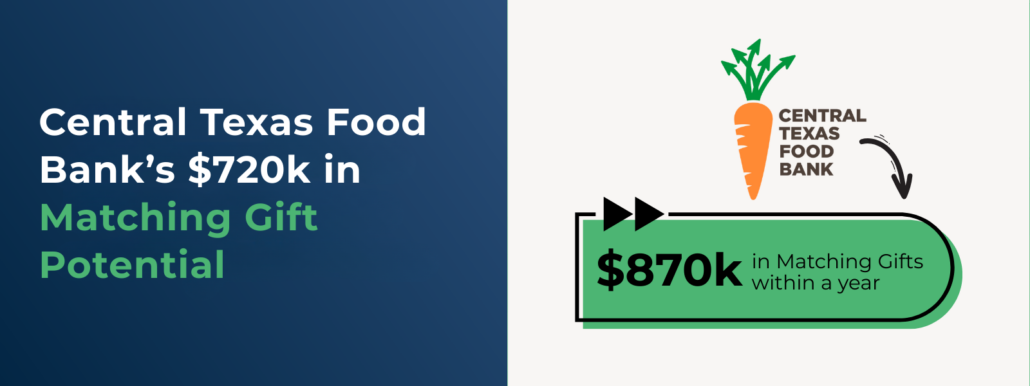
Central Texas Food Bank’s $720k in Matching Gift Potential
Introduction: Feeding a Community in Need
The Central Texas Food Bank (or CTFB) is a lifeline for thousands of families. As the largest food bank in the region, its mission is simple but profound: to nourish hungry people and lead the community in the fight against hunger. In a service area that covers 21 counties (an area twice the size of the state of Massachusetts), CTFB is often the only thing standing between a family and an empty table.
The scale of the problem is immense, and so is the operation required to address it. CTFB relies on a massive network of donors, volunteers, and partners to distribute millions of pounds of food every year. In this environment, fundraising efficiency is paramount. Every dollar raised translates directly into purchasing power for food. In fact, due to their bulk purchasing power and partnerships, food banks can often stretch a dollar much further than a consumer at a grocery store. This means that a lost dollar in fundraising is not just a lost dollar; it is multiple lost meals.
Despite their success in traditional fundraising, CTFB identified a significant untapped resource: donation matching. They knew that many of their donors worked for major employers in the Austin area, a tech hub home to companies like Dell, Apple, and IBM, all of which have generous corporate philanthropy programs. However, without a systematic way to identify these donors and guide them through the matching process, this revenue was being left on the table.
By pivoting to an automated, data-driven approach, CTFB transformed its fundraising strategy. They moved from passively accepting matching gifts to actively pursuing them. The result was the identification of over $720,000 in match revenue in a single year: a sum that translates into hundreds of thousands of meals for neighbors in need.
The Challenge: Capturing the “Low-Hanging Fruit”
The concept of “low-hanging fruit” appears explicitly in the Central Texas Food Bank’s strategy. In nonprofit fundraising terms, this refers to revenue that is readily available and requires minimal effort to secure, if you have the right tools.
The Awareness Gap
For CTFB, the “fruit” was the corporate matching dollars already allocated by employers for their employees’ charitable giving. The problem was that the employees (the donors) often didn’t know these funds existed, or they didn’t know how to access them.
- The Donor’s Perspective: A donor might give $100 to feed a family. They feel good about their gift. They don’t realize that their employer would have turned that $100 into $200 with a simple form submission.
- The Organization’s Perspective: CTFB knew these matches existed but had no feasible way to tell which of their thousands of donors were eligible. Manually researching every donor’s employer is impossible for a nonprofit operating at this scale.
The Goal: Incremental Revenue
The objective was to “generate incremental revenue.” This is critical for nonprofits. Finding new donors is expensive and time-consuming. Getting existing donors to double their impact costs almost nothing in comparison. CTFB wanted to maximize the value of the donors they already had by ensuring every eligible gift was matched.
The Solution: Integrating Donation Matching into the Flow
To capture this revenue, Central Texas Food Bank implemented Double the Donation’s automated platform. The core of the solution was integration, making matching gifts a seamless part of the donation experience rather than an awkward afterthought.
1. Integration into the Donation Process
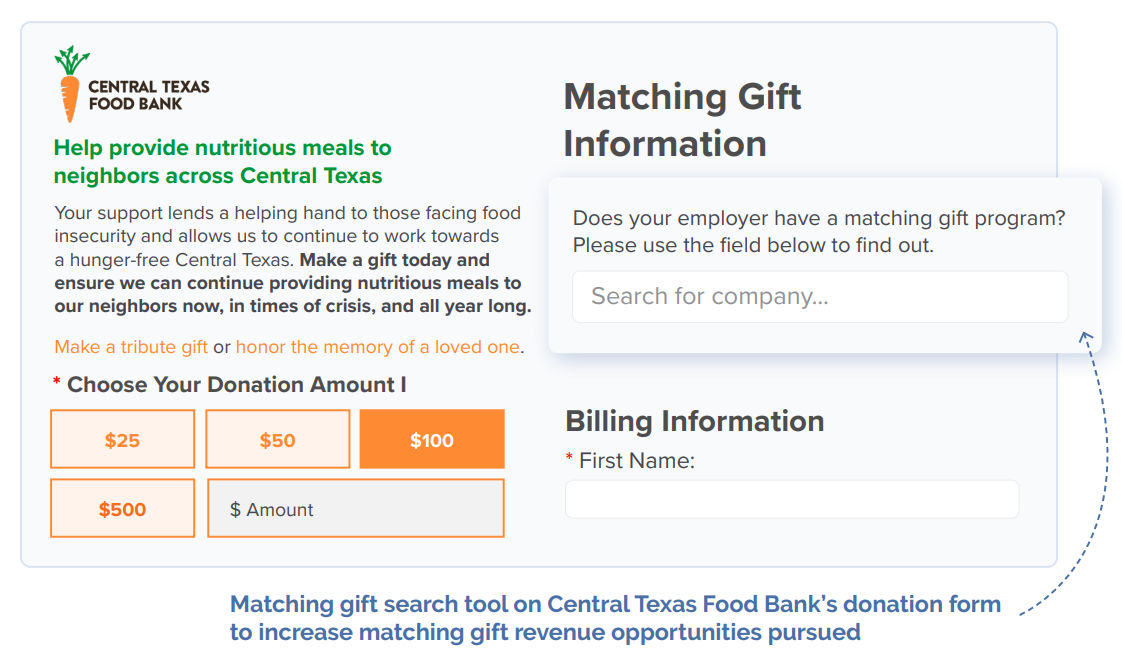
CTFB “integrated matching gifts directly into the donation process.”
- Real-Time Discovery: By placing the search tool on the donation form itself, CTFB prompted donors to identify their employer while they were giving money. This capitalizes on the moment of highest intent.
- Streamlined Search: The “streamlined search field” allowed donors to quickly type in their company name (e.g., “Dell” or “Google”) and instantly see if they were eligible.
2. Automated Reminders
Recognizing that not all donors would complete the match immediately, CTFB set up “automated reminders.”
- The Safety Net: These emails acted as a safety net. If a donor rushed through the donation form, the automated email arrived in their inbox later, providing a second chance to double their impact.
- Scale: The system allowed CTFB to send over 73,000 emails. Sending this volume of personalized, employer-specific emails manually would have required a dedicated team of staff members working around the clock. Automation made it instant and effortless.
3. The Confirmation Page Plugin
The solution also included a “confirmation page plugin.”
- Immediate Action: As soon as the transaction was approved, the confirmation page presented the donor with “matching gift next steps.” This is the most effective time to ask for a match; the donor feels generous and has just completed a financial transaction. The plugin provided the specific links and forms needed to complete the match right then and there.
The Results: $720,000 in Meals
The impact of this automated strategy was profound. The data from the case study paints a picture of a donor base that was ready and willing to help; they just needed to be asked.
Financial Impact: $720,000 Identified
In a 12-month period, the system identified over $720,000 in match revenue.
- Context: In the world of food banking, where every dollar can provide multiple meals, $720,000 is a staggering figure. It represents a massive influx of purchasing power that can be used to acquire fresh produce, protein, and pantry staples for Central Texas families.
- Efficiency: This revenue did not require a new capital campaign or a gala. It was “found money” uncovered by simply asking the right question at the right time.
Donor Engagement: 51% Action Rate
The metrics show that donors engaged deeply with the tools.
- 51% Action Rate: The data reveals that 51% of donors “accessed matching gift forms or guidelines.” This means that more than half of the donors who were presented with the opportunity took a concrete step toward securing the match. This high conversion rate validates the user-friendly nature of the integration.
- High Volume: The tools were used by a massive number of supporters, with 73,000+ emails sent. This volume demonstrates that the solution scales perfectly to meet the needs of a large regional organization.
Email Performance: 40% Open Rate
The automated emails achieved a 40% open rate.
- Industry Context: While slightly lower than some smaller organizations, a 40% open rate on a volume of 73,000 emails is exceptionally strong. It is roughly double the nonprofit industry average. This suggests that the messaging was relevant and that CTFB’s donors are highly engaged with the mission.
Strategic Deep Dive: Data-Driven Fundraising
One of the key benefits highlighted in the case study is access to data. By integrating the tool, CTFB gained access to “far more engagement and detailed data at the aggregate and donor level.”
The Power of Aggregate Data
The “matching gift dashboard” provided the Central Texas Food Bank with a bird’s-eye view of its corporate fundraising landscape.
- Employer Insights: They could see exactly which companies were employing their donors. If the data showed that 500 donors worked for Apple and 300 worked for Dell, that information could be used by the corporate partnership team to start conversations about deeper collaboration, such as food drives or volunteer days.
- Forecasting: Knowing that $720,000 in potential matches exists allows the finance team to forecast revenue more accurately and plan budgets with greater confidence.
The Power of Donor-Level Data
At the individual level, the system flagged “match eligible donors” as they gave.
- Prospect Research: This data is gold for prospect research. A donor who gives $100 and works for a matching company is a prime candidate for future upgrades. The development team can target these individuals with specific messaging about how their employer supports the community, deepening the relationship.
Conclusion: A Recipe for Success
The Central Texas Food Bank case study is a testament to the power of operational efficiency in the nonprofit sector. By identifying donation matching as a key area for growth and implementing an automated solution to address it, the organization turned a manual bottleneck into a revenue engine.
The results speak for themselves:
- $720,000+ in match revenue identified.
- 73,000+ emails sent to engage donors.
- 51% of donors taking action to double their impact.
For an organization dedicated to feeding the hungry, this efficiency is not just about numbers; it is about mission. Every dollar matched is another meal on a table in Central Texas. By maximizing the value of every gift, CTFB ensures that it is doing everything in its power to fight hunger in its community.
Download the full case study compilation here to uncover even more successful strategies.