How to Make Your Org’s Corporate Grant Application Stand Out
When it comes to the competitive landscape of nonprofit funding, corporate grants represent a unique and powerful opportunity. Businesses typically view grant-making through the lens of Corporate Social Responsibility (CSR), brand alignment, and stakeholder value. Understanding this viewpoint can aid your organization in developing a corporate grant application that stands out from the rest of the pile.
In this guide, we’ll cover expert-proven tips on how your nonprofit can transform its proposal from a standard request into a compelling business proposition:
- Start with a compelling Executive Summary.
- Speak the “business language.”
- Align with the corporate grant-maker’s values.
- Quantify your audience.
- Be specific about deliverables.
- Use existing employee support as leverage.
- Offer engagement beyond the check.
- Project future outcomes.
- Focus on long-term sustainability.
- Incorporate high-impact visuals.
When a business reviews a corporate grant application, it isn’t just looking for a worthy cause; it’s seeking a high-performing investment. To win its support, you cannot simply copy and paste a generic proposal. Rather, you must pivot your approach to treat the company as a strategic partner.
Let’s dive in to see how your team can accomplish this!
1) Start with a compelling Executive Summary.
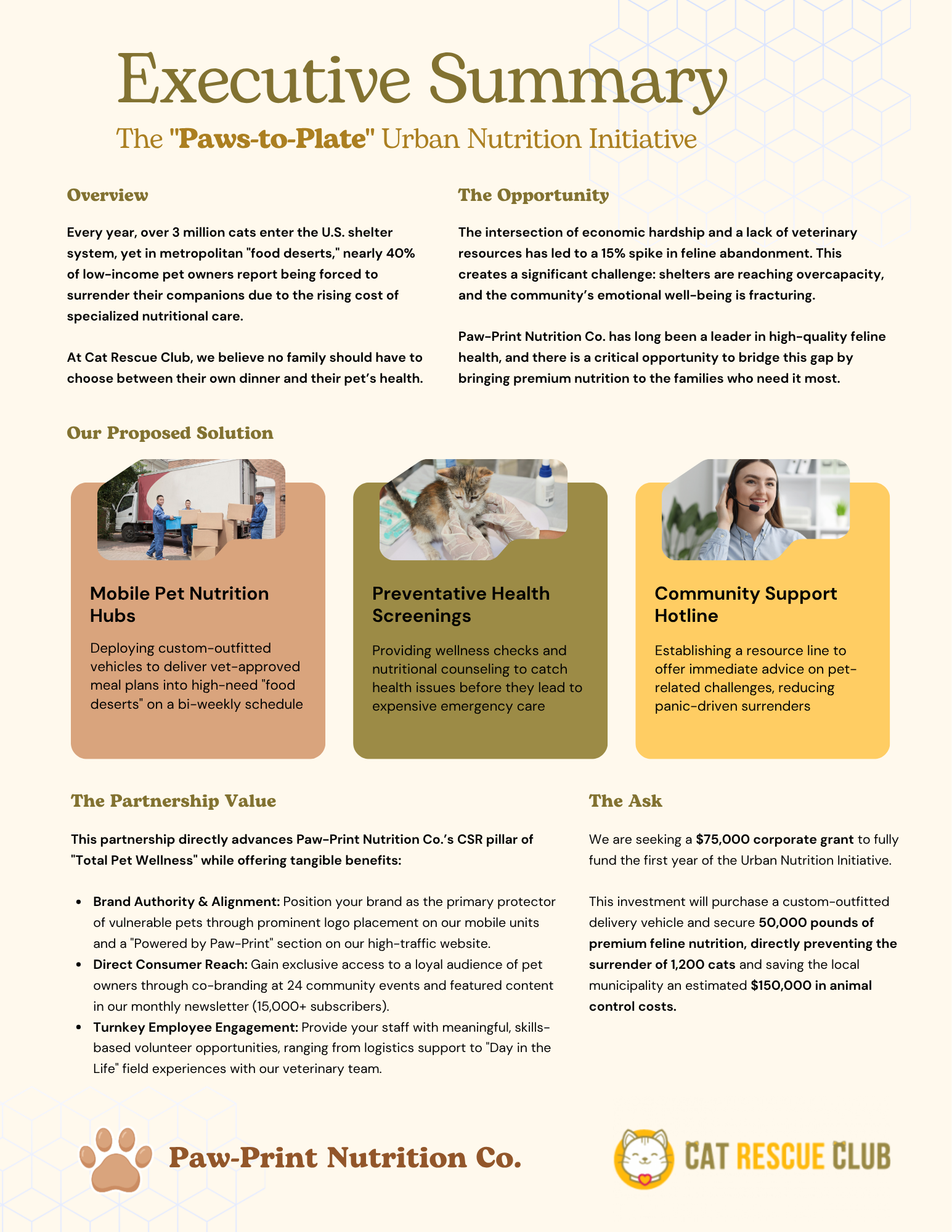
An Executive Summary is a high-level overview that distills the essence of your proposal into a single page (or less). It is not just an introduction; it’s a pitch that outlines the problem, your unique solution, the required investment, and the expected mutual benefit.
The Executive Summary is arguably the most critical component of your corporate grant application. In the corporate world, time is the most precious commodity. Decision-makers (often busy CSR managers or even C-suite executives) may only spend a few minutes reviewing each proposal. If your summary doesn’t hook them, the rest of your 30-page application might never be read.
The Winning Format
To make your summary stand out, use a structured, professional format that mirrors a business brief. This should include:
- The Hook: Start with a startling statistic or a brief, powerful mission statement.
- The Problem/Opportunity: Clearly define the social challenge you are addressing within the corporation’s focus area.
- The Solution: Describe your program and why your organization is uniquely qualified to execute it.
- The Partnership Value: Briefly state how this specific grant will help the corporation meet its CSR goals.
- The Ask: State the specific dollar amount and the primary outcome it will purchase.
By providing this asset upfront, you demonstrate that you value the grant-maker’s time and possess the professional clarity necessary to manage a corporate partnership.
2) Speak the “business language.”
One of the biggest mistakes nonprofits make is using overly academic or purely emotional language in a corporate setting. While “heartstrings” pull in individual donors, “bottom lines” pull in corporate grants. To make your application stand out, you must demonstrate that you understand the business case for corporate giving.
In a corporate context, ROI (or return on investment) isn’t always about dollars returned; it’s about social impact per dollar spent. For the best results, incorporate terms like these in your grant proposal:
- Social Return on Investment: Quantify how much “social value” is created for every dollar the company invests in your cause.
- Scalability: Can your program grow? Businesses love to invest in models that can be replicated or expanded to other markets.
- Key Performance Indicators (KPIs): Don’t just talk about doing good. Discuss the specific metrics you use to track success.
Be sure to acknowledge that a corporate grant is an investment in the company’s brand. Explain how your nonprofit can provide valuable engagement that drives business value, such as positive PR, improved brand sentiment among consumers, and enhanced employee engagement through meaningful volunteer opportunities.
When you speak the language of a partner rather than a supplicant, you immediately earn the respect of corporate reviewers.
3) Align with the corporate grant-maker’s values.
Corporate giving is rarely blind. Most companies have specific pillars of giving, including areas such as environmental sustainability, STEM education, and hunger relief. If your nonprofit’s mission doesn’t closely align with a company’s existing giving pillars, your application is largely dead on arrival.
Research and Customization
Before writing a single word, take a deep dive into the company’s annual CSR report. What are they bragging about to their shareholders? What types of initiatives have they funded in the past?
If a bank is focused on “Financial Literacy for Underserved Youth,” don’t send them a proposal for a general arts program unless you can explicitly link it to career readiness or economic empowerment.
Top Tip: When using a corporate grant database like Double the Donation, try filtering results to identify companies that give to organizations with missions similar to your own.
The Power of Shared Vision
For the best results, look for (and prioritize) companies whose core business values mirror your own. For example, a tech company that values innovation will be much more likely to fund a nonprofit piloting a new, high-tech solution to homelessness than one using traditional, legacy methods.
Explicitly state in your application: “Because [Company] values [Mission], and our organization operates on the principle of [Mission], this partnership is a natural extension of our shared values.”
4) Quantify your audience.
In the corporate world, marketing and social impact often overlap. Companies want to know who is seeing their name. This is where audience alignment becomes a key competitive advantage for your nonprofit.
Demographics and Psychographics
If your nonprofit’s core audience (including your donors, volunteers, and social media followers) aligns with the company’s target consumer, you have a massive leverage point at hand.
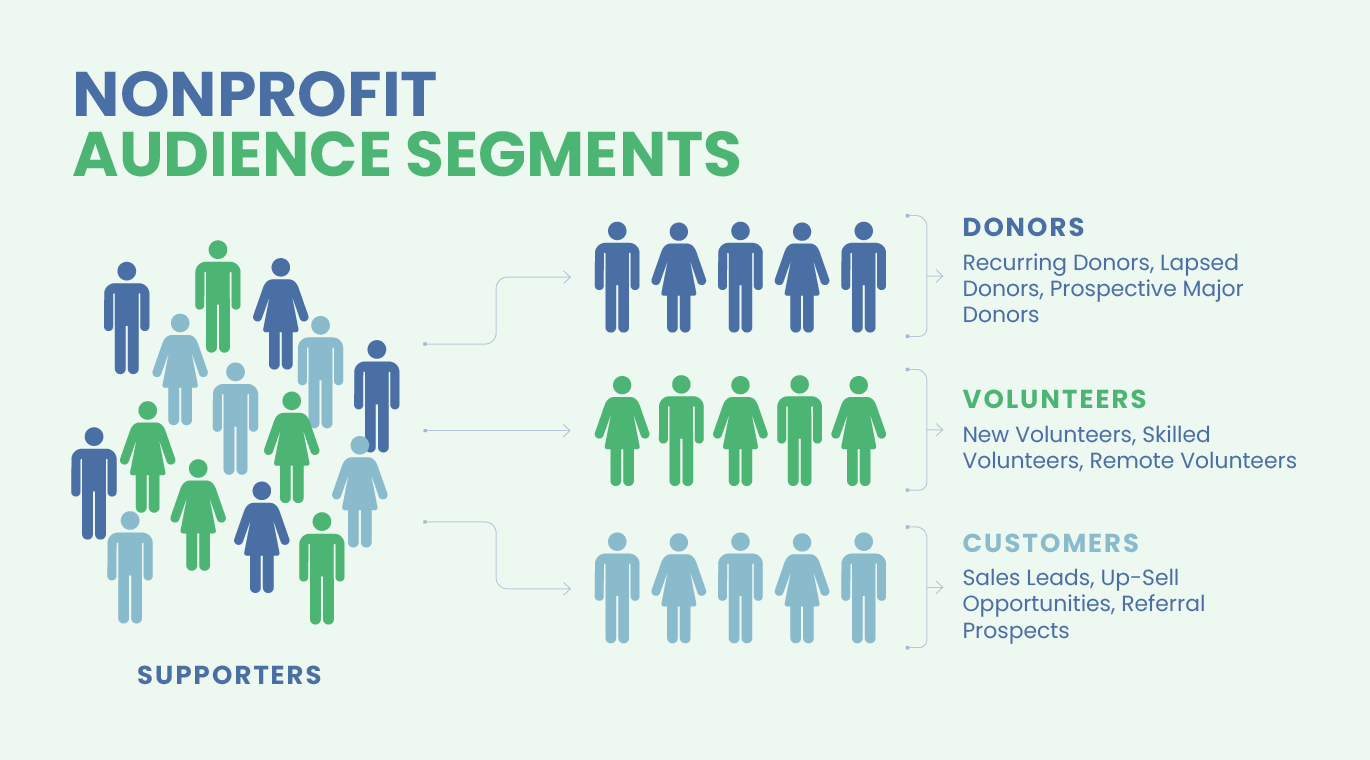
Here’s an example: If you’re applying for a grant from a retail brand that targets women aged 35 to 50, and your donor database is 70% women in that exact age bracket, you must highlight this in your application.
Why? It shows the company that by supporting you, they are building brand loyalty with the very people they are trying to sell to.
Leveraging Data-Backed Engagement
Make your proposal stand out by highlighting real metrics. For example, how many people attend your annual gala? What is your email open rate? How many monthly visitors does your website get?
Showing that you have an existing “marketing reach” that matches their customer profile turns a corporate grant into a co-branded opportunity that is often too good to pass up.
5) Be specific about deliverables.
Vague promises like “we will recognize your support” are the hallmarks of a weak grant application. Corporations need to know exactly what assets they are buying with their grant money. Therefore, treat the recognition section of your application as a professional marketing menu.
Here are a few examples to consider:
- Digital Recognition: “Logo placement on three targeted email blasts to 15,000 subscribers with a direct click-through link to your company’s website.”
- Social Media: “Four ‘Partner Spotlight’ posts across LinkedIn, Instagram, and X, reaching a combined audience of 50,000.”
- Physical Presence: “Prominent signage at our regional headquarters and a dedicated booth at our annual community fair, which boasts an average attendance of 40,000 guests.”
- Content Creation: “A featured blog post on our website highlighting the impact of your grant, suitable for your company’s internal newsletter or annual report.”
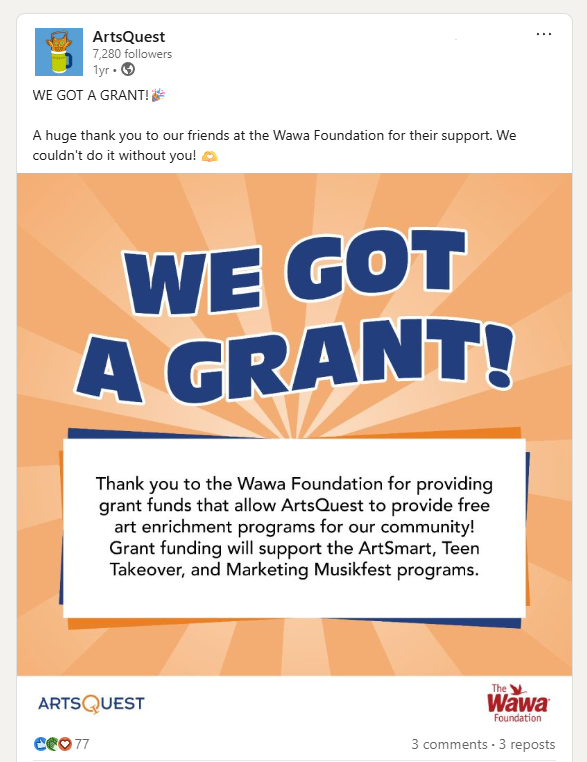
By being specific in the deliverables you can offer, you remove the guesswork for the CSR manager and provide them with a ready-made win they can present to their marketing department.
6) Use existing employee support as leverage.
One of the most overlooked assets in a corporate grant application is the existing relationship between the company’s employees and your nonprofit. If five employees at Company X already volunteer at your food bank or donate through payroll deductions (bonus points if they’re getting their gifts matched to your cause, too), you are no longer a cold applicant. You are a preferred partner.
The “Bottom-Up” Strategy
Companies are increasingly focused on maintaining high levels of employee engagement. They want to support the causes their workforce cares about because doing so boosts morale and reduces turnover (thereby saving costs).
Here’s how you can use this idea: Identify these existing supporters through your donor database or using a tool like Double the Donation’s Leading Companies report.
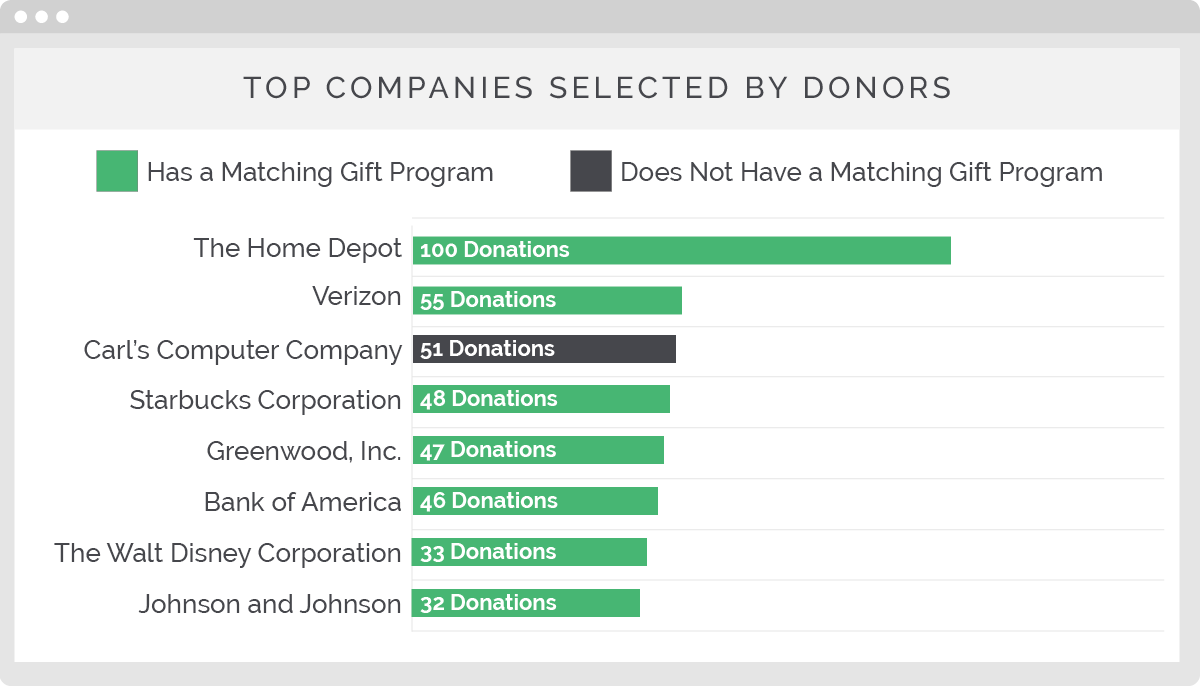
In your grant application, be sure to mention: “We are proud to already have a relationship with your team; last year, [Number] of your employees dedicated [Number] hours and [Dollars] to our cause. Let’s bring this relationship to the next level by ironing out a formal partnership!”
This signals to the grant-making committee that a “test run” has already occurred. The employees already like you and your mission, which makes the company’s investment in a larger grant much lower risk.
7) Offer engagement beyond the check.
In the modern philanthropic landscape, checkbook philanthropy is continuously fading. Instead, today’s corporations want to be increasingly hands-on. They are looking for ways to integrate their workforce into the mission.
For this reason, we recommend taking a “Menu” approach. In other words, provide a list of actionable engagement opportunities directly within your application.
This could include:
- Team-building volunteer days: Host a dedicated “day of service” where a specific department or team can work together on a tangible project. Whether it’s sorting donations or revitalizing a community garden, these high-energy events foster internal bonding while providing your nonprofit with a surge of manual labor to complete large-scale tasks.
- Skills-based volunteering opportunities: While traditional volunteering activities, such as painting a school, are great, skills-based volunteering is even more beneficial. Therefore, offer opportunities for employees to use their professional expertise (and expand upon professional development) to help your nonprofit. This could include asking a company’s IT team to help with your cybersecurity, or its HR department to provide mock interviews for job-training participants.
- Seats on your Associate Board: Invite a company’s rising stars and mid-level managers to join your associate or “young professionals” board. This gives the company’s emerging leaders a platform to develop governance skills and a deeper emotional investment in your success, often leading to more stable, long-term corporate advocacy.
- A “Day in the Life” tour for company executives: Offer a curated, “behind-the-scenes” experience for the company’s leadership team to see your programs in real-time. By walking through your facilities or meeting the beneficiaries of your work, executives can witness the direct impact of their capital, making it much easier for them to greenlight future funding cycles.
By offering these valuable touchpoints, you move the relationship from a one-time transaction to a multidimensional partnership that benefits every level of the corporation.
8) Project future outcomes.
Corporate leaders are forward-thinking. They aren’t just interested in what you did last year; they are interested in what their money will create next. Your application needs to paint a vivid picture of the future. Here are a few ways you can do this:
- Use “The Power of If”: Explain exactly what will change the moment the funds hit your account.
- Be Specific: Instead of saying “this grant will help us feed more children,” say: “With this $50,000 grant, we will launch a mobile pantry initiative that will deliver 200,000 pounds of fresh produce to 5,000 families in food deserts over the next 12 months.”
- Provide timelines: Share a high-level project timeline. Show them that you have a plan for Months 1, 6, and 12. This level of foresight demonstrates operational excellence, which is a key trait corporations look for in their nonprofit partners.
Ultimately, projecting future outcomes is about more than just optimism; it is about building trust through a shared vision of success. When you move away from vague aspirations and toward concrete, time-bound objectives, you reassure corporate partners that their grant is a catalyst for tangible change rather than just a contribution to the status quo.
By providing a clear roadmap of what lies ahead, you transform your application into a blueprint for impact that any forward-thinking leader would be proud to fund.
9) Focus on long-term sustainability.
A major fear for corporate donors is “funding a cliff.” They don’t want to be the only thing keeping a program alive, only for it to collapse the moment their grant expires. This looks like a poor investment for their bottom line.
Your application must explain how the program will be sustained in Year 2, Year 3, and beyond.
- Diversified Funding: Mention other revenue streams (individual donors, government contracts, earned income).
- The “Multiplier Effect”: Explain how their initial grant might act as “seed funding” to attract other donors or how it will build internal capacity that reduces costs over time.
- Operational Health: Briefly mention your organization’s reserves or your history of clean audits. Showing that you are a “stable ship” makes it much easier for a corporation to trust you with its capital.
Business leaders want to know that their contribution is establishing a lasting legacy, not just providing a temporary fix for a recurring problem. Demonstrating that you have an actionable plan for operational longevity proves that your nonprofit is a professional, well-managed entity capable of delivering a sustained social return on its investment for years to come.
By emphasizing your organization’s long-term sustainability, you are essentially de-risking the investment for the corporation.
10) Incorporate high-impact visuals.
You’ve heard it before: “A picture’s worth a thousand words.” And when it comes to corporate grant proposals, it’s just as true!
Text-heavy applications are exhausting to consume. In a stack of 100 requests, the one with a compelling infographic or a heart-stirring photo will always be remembered. It helps the corporate grant-maker to better visualize the impact and even place themselves at the center of your mission.
Here are a few ideas to consider as you craft your application:
- The Impact Photo: Instead of a generic stock photo, use a high-resolution image of your mission in action. A photo of a smiling child receiving a book or a clean riverbed speaks louder than three paragraphs of text.
- The Partner Visualization: Include a mockup of how their logo would look on your materials. Seeing their brand next to yours makes the partnership feel “real” and immediate.
- The Data-Driven Infographic: Use charts to show your growth or the scale of the problem. A simple bar chart comparing “Gap in Services” and “Potential Impact with Funding” can clarify a complex issue in seconds.
Visuals aren’t just fluff. They are tangible tools for clarity that help corporate leadership more concretely picture their role in your success.
Wrapping up
Standing out in the world of corporate grant applications requires a strategic shift in mindset. You are no longer just a nonprofit asking for help; you are a social-impact organization offering a high-value partnership.
By integrating our top tips throughout your proposal, you demonstrate professionalism that resonates with the corporate world. Remember, corporations have a choice in where they invest their social capital. To win their support, you must prove that your organization is not just a worthy cause but a strategic asset.
Don’t shy away from the hard data. Use the right tools to track your metrics, quantify your audience, and project your future outcomes. When you combine the heart of your mission with the precision of an intelligent business proposal, your application will be undeniable.
See how Double the Donation’s fundraising tools can help provide the numbers, connections, and other resources to make your corporate grant applications stand out. Request a demo today to get started!