6 DTD Users Optimizing Their Workplace Giving Emails
In my role as a Client Success Manager at Double the Donation, I spend my days deep in the weeds with hundreds of nonprofits, looking for that lightbulb moment. Usually, it happens right after a major campaign ends. A partner will reach out, thrilled with their initial fundraising total, but then the conversation shifts: “Kyra, we have thousands of dollars in match-eligible gifts sitting in our dashboard. How do we get our donors to actually hit ‘submit’ on those requests?”
The answer is almost always waiting in their email outreach.
While social media trends come and go, email remains the most direct line to your supporters. But through my work with our clients, I’ve realized that a generic “one-and-done” blast isn’t enough to bridge the awareness gap. The organizations seeing the highest ROI are those that treat matching gifts as a narrative, not a footnote, building strategic, data-driven email streams that guide a donor from the first “Thank You” to the final match confirmation.
To celebrate the innovation I see in our community every day, I want to highlight six organizations (including our 2026 User Conference winner!) that I believe are setting the gold standard for matching gift email marketing.
These six standout examples are proving that the right message at the right time doesn’t just raise money; it builds donor loyalty:
- Phillips Exeter Academy
- Breakthrough T1D
- Kalamazoo College
- BEDS Plus
- Lehigh University
- FIRST Inspires
From surgical precision in targeting to heart-tugging donor spotlights, these strategies offer a roadmap for any nonprofit looking to turn “Send” into “Success.”
Let’s get started.
1) Phillips Exeter Academy (2026 User Conference Winner!🏆)
In today’s digital age, timing and personalization are the twin pillars of effective fundraising. Phillips Exeter Academy demonstrated this perfectly with its fall appeal strategy. Before their physical appeal ever hit a mailbox, the Academy launched a sophisticated series of targeted emails.
Moving away from the traditional “one-size-fits-all” outreach, they instead launched a series of highly targeted messages sent to alumni who worked at companies known for robust matching gift programs.
The Strategy: Pre-Emptive Personalization
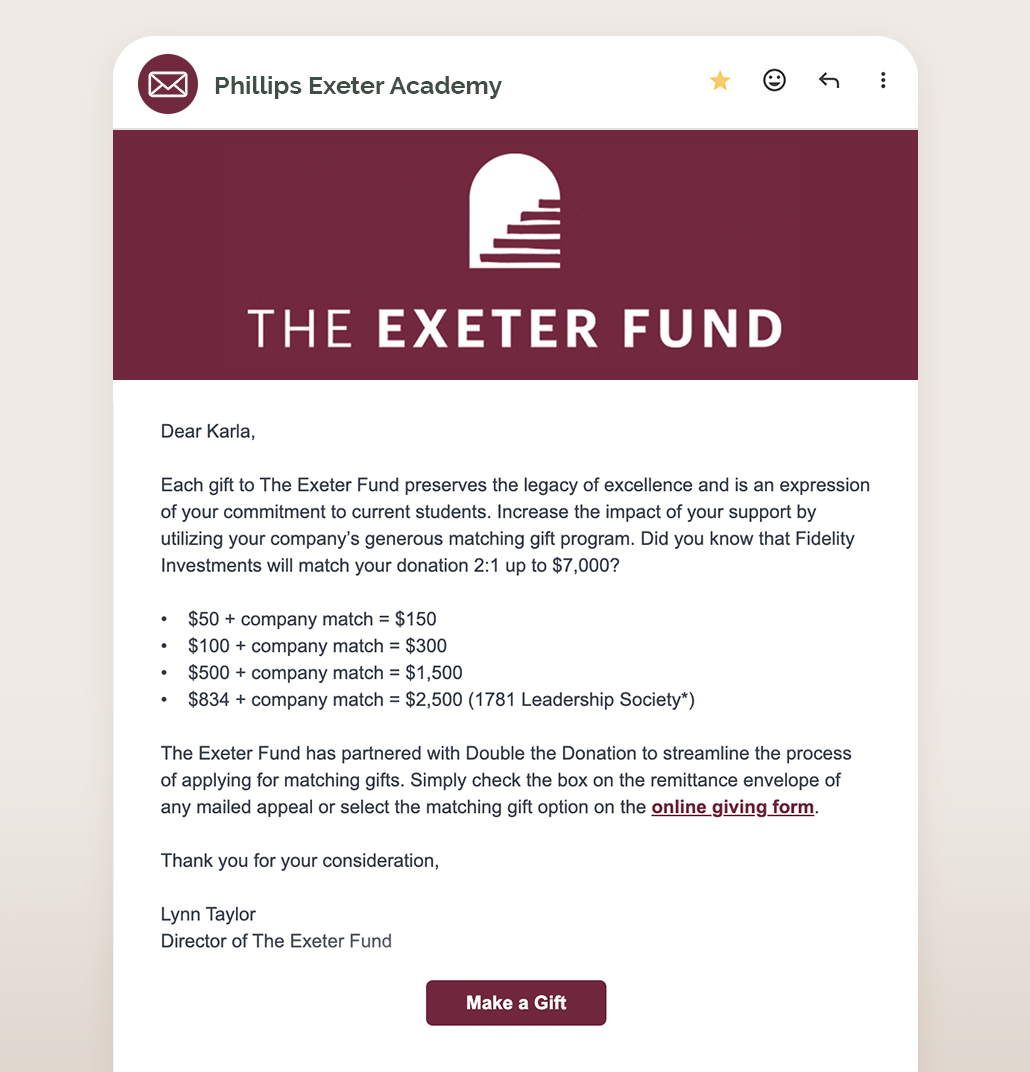
Exeter’s brilliance lay largely in the campaign’s timing. The school sent this email series ahead of its mailed fall appeal, priming its audience with digital touchpoints before the physical envelope reached the donor’s home. By segmenting its list based on employment data, the school was able to provide company-specific program insights directly in the email body.
For example, for an alum working at Fidelity Investments, the email didn’t just mention matching in general. Rather, it highlighted that Fidelity would match donations at a 2:1 ratio up to $7,000. This immediately reframed the donation in the donor’s mind. Instead of a $50 gift, the donor saw a $150 impact. Instead of $834, they saw a path to the 1781 Leadership Society with a total impact of more than $2,500.
Why This Strategy Won
Imagine receiving an email that doesn’t just ask for a gift, but shows you exactly how your specific employer participates. This strategy succeeds in part because Exeter’s emails laid out the math clearly, thereby reducing the cognitive load on the donor.
After all, most supporters find the process of looking up corporate policy tedious. By providing those specific numbers upfront, Exeter turns a financial transaction into a strategic opportunity. Furthermore, by linking the match specifically to their particular Leadership Society tiers, they used the matching gift as a “level-up” tool, encouraging donors to give more personally because the corporate match would carry them over the threshold into an elite giving circle.
The Lesson: By showing the donor the “new total” of their impact under their employer’s rules, Exeter transformed a simple request into a strategic opportunity for the donor to maximize their legacy. This level of personalization makes the donor feel seen and valued, significantly increasing the likelihood of a donation and matching gift follow-through.
2) Breakthrough T1D (Automated Donation Follow-Ups)
In nonprofit fundraising and matching gifts, the biggest hurdle isn’t a lack of donor generosity; it’s a lack of convenience. When a supporter has to hunt down their company’s HR portal, the match often falls through the cracks. Breakthrough T1D solved this issue by transforming their email follow-ups into a concierge service for their donors.
The results? Since launching a robust, automated communication stream and integrating the tool directly into their donation process, the organization has seen a five times increase in match-eligible gifts.
The Power of “Serving It Up”
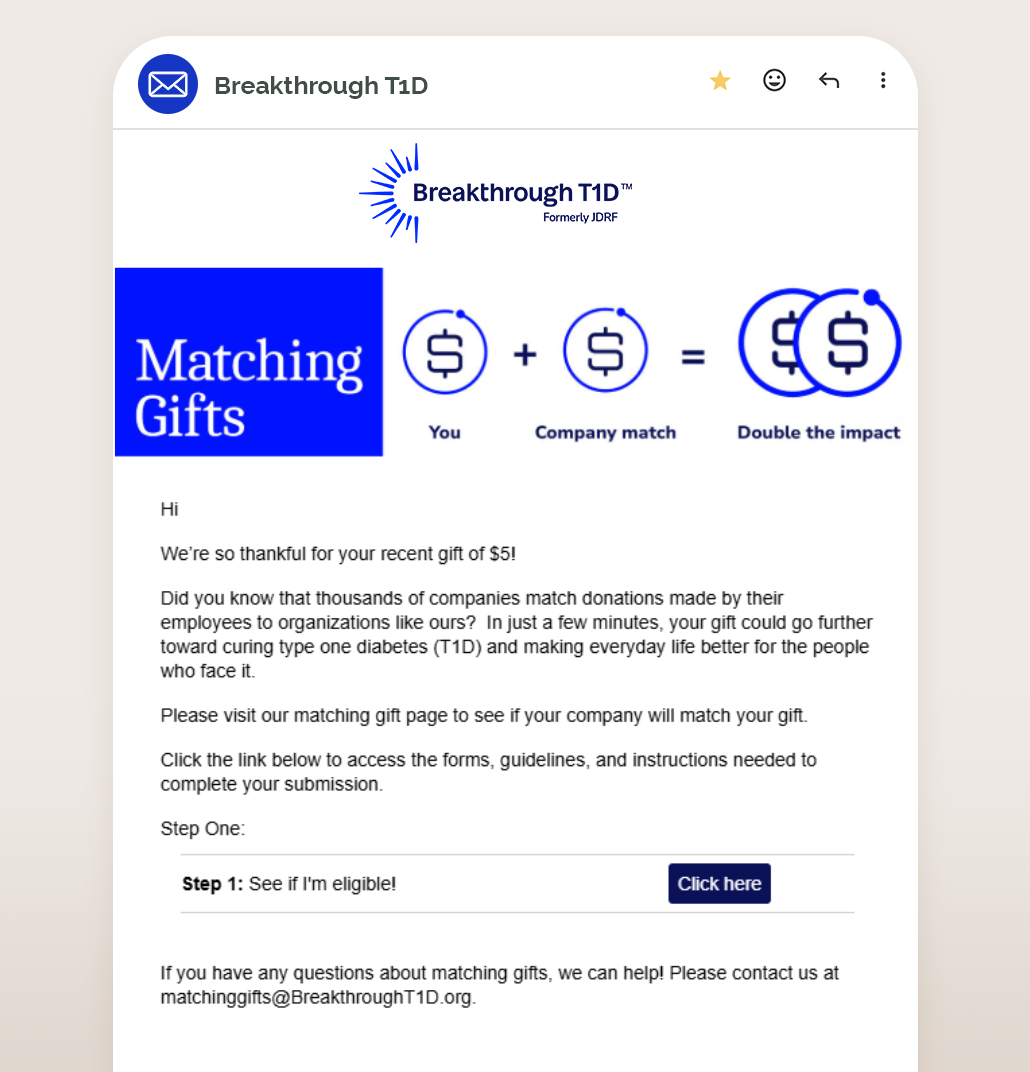
The philosophy at Breakthrough T1D is simple: make it impossible for the donor to procrastinate the match. As they noted in a recent User Conference session, “when you serve up the exact company match program and the specific intranet link to a donor, you make it as easy as possible for them to take immediate action.”
To achieve this, the team’s automated email cadence is strategically timed to catch donors while the mission is still top-of-mind:
- Immediate Follow-Up: A tailored email is sent just one hour after a donation is made.
- Three-Day Reminder: A second touchpoint is delivered to those who haven’t yet initiated a match.
- 30-Day Check-In: A final nudge sent a month later if no action has been taken.
Personalized and Professional
These aren’t generic reminders. Each email is populated with the recipient’s specific donation and company information, creating a tailored outreach opportunity that drives results.
Crucially, Breakthrough T1D configures these automated emails to come directly from their organization’s email address rather than a third-party domain. This ensures the messages appear to come directly from the nonprofit, helping them bypass spam filters and reach the donor’s inbox with a high level of trust.
The Lesson: Persistence pays off when it’s paired with personalization. By automating a multi-touchpoint journey that provides the donor with every tool they need to succeed, you move from asking for a favor to providing a service that maximizes their personal impact.
To hear more about Breakthrough T1D’s matching gift email strategy, click here to watch the full session replay (and access insights from United Way Bay Area and Colorado Symphony, too!).
3) Kalamazoo College (Giving Tuesday Promotion)
Kalamazoo College provides a masterclass in how small-scale, high-accuracy efforts can outperform massive, unrefined campaigns. In other words, the school’s development team proved that you don’t need a list of 10,000 names to raise significant funds; you just need the right names.
Their approach to Giving Tuesday (or “Giving ZooDay,” as they call it) focused on a deep dive into their local corporate landscape.
The Stryker Strategy
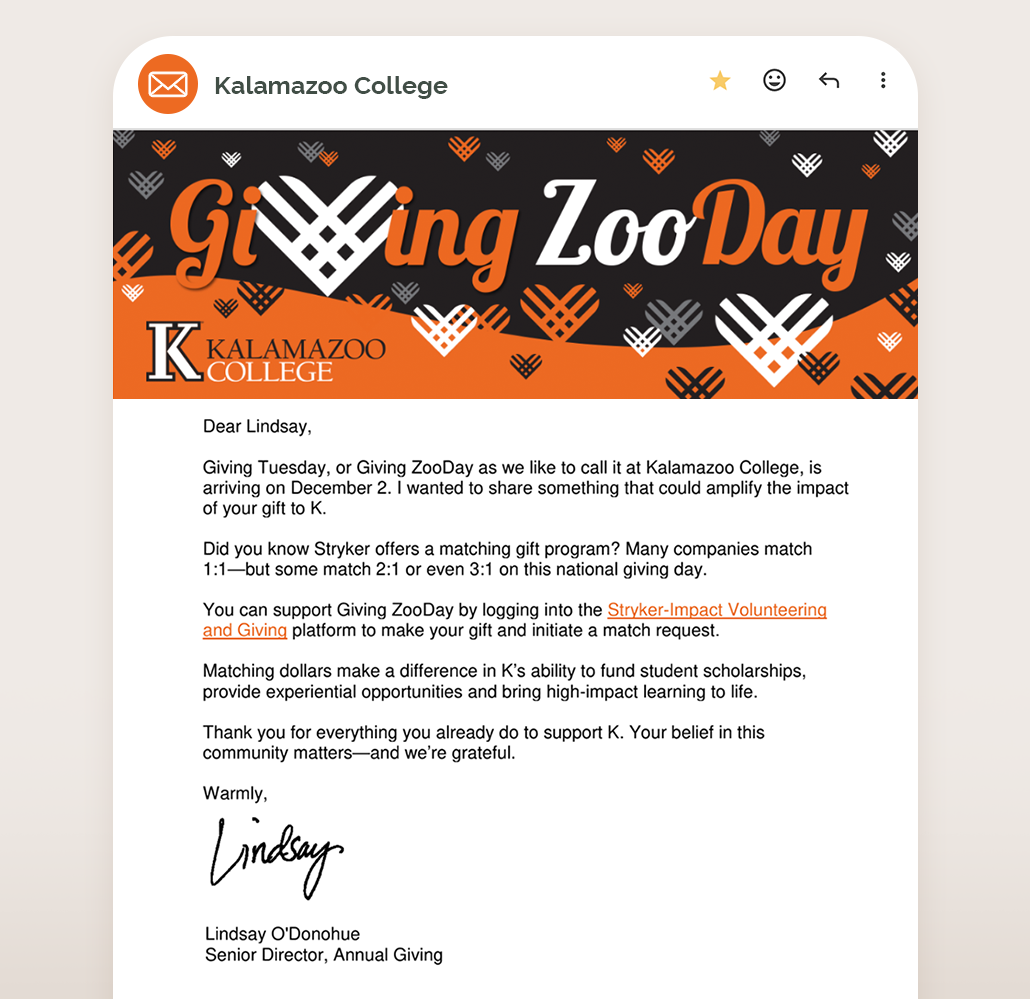
Kalamazoo, Michigan, is the headquarters of Stryker, a global medical technology giant known for its highly generous matching gift program. Kalamazoo College, based in the same city, recognized that it had a high concentration of alumni and parents working there. However, they also knew that employment data is notoriously “perishable” (it goes out of date quickly) and that their own donor records were likely outdated.
To combat this issue, the college’s prospect development team partnered with a student worker to manually verify and update Stryker-affiliated email addresses. The resulting list was small (only about 42 emails), but those 42 individuals were the highest-probability leads for a match, and the resulting engagement was staggering.
Analyzing the Impact
The results were a testament to the power of prospect hygiene.
- 43% Open Rate: An incredible figure for cold or semi-cold outreach, this is nearly double the industry average for nonprofit emails. It proves that when a subject line is relevant (“Did you know Stryker offers a matching gift program?”), donors listen.
- Estimated $40,000 Impact: From just a few dozen emails, the college saw a significant return in both gifts and matches, raising approximately $40,000 in combined individual and corporate contributions.
- Anecdotal Success: Even while waiting for official corporate portal confirmations, the college confirmed that more than a half-dozen donors gave specifically because of this targeted prompt.
The Lesson: A small, highly accurate list will always outperform a large, messy one, especially when you have knowledge of corporate clusters within your network. All it takes is clean records, a local focus, and a direct reminder of the specific corporate benefit the donor already earns through their hard work.
4) BEDS Plus (Matching Gift & Volunteer Grant Integration)
BEDS Plus provides a masterclass in Total Supporter Engagement. For many nonprofits, “donors” and “volunteers” are managed by different teams in different silos. But this organization understands that the person giving $50 today is often the same person who will give 5 hours of service tomorrow. As a result, the team opted to break down those walls by integrating matching gifts (money) and volunteer grants (time) into a single, cohesive email stream.
The Corporate Multiplier Effect
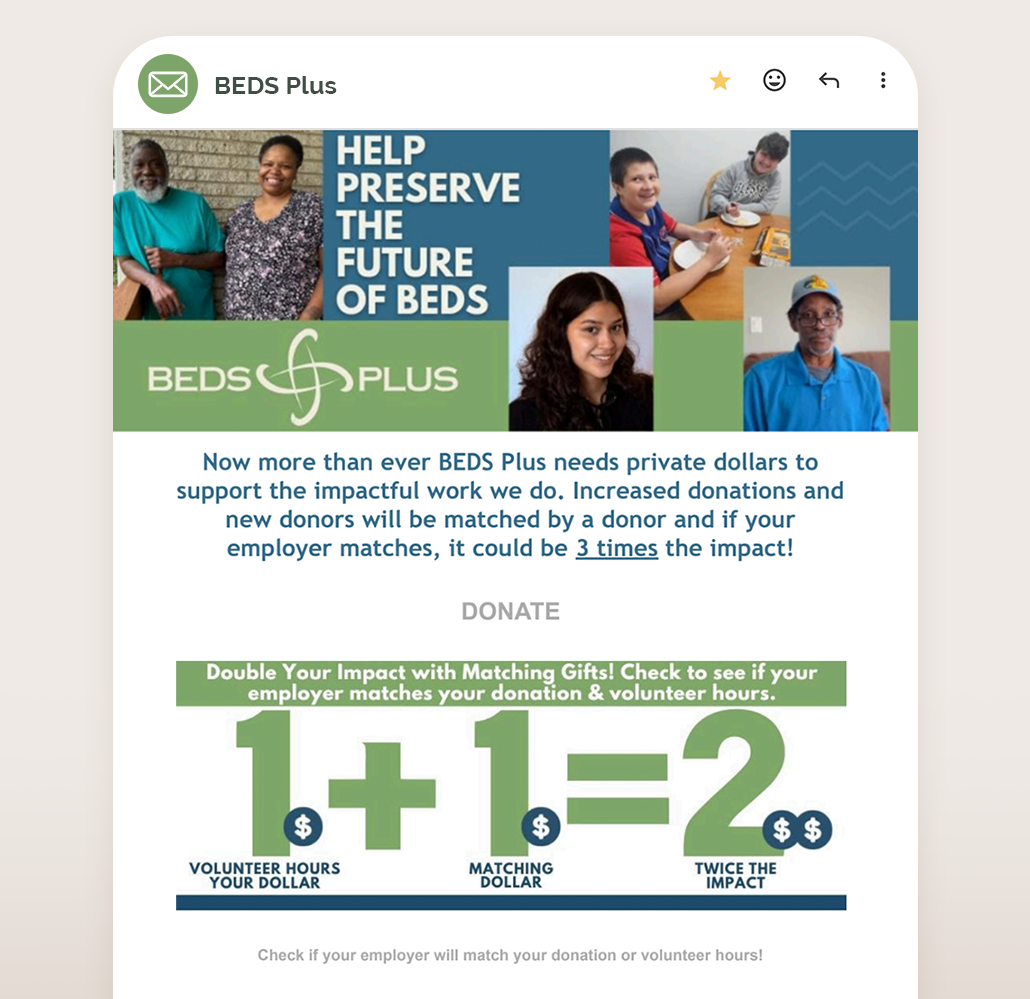
In its fundraising appeals, BEDS Plus doesn’t just ask for a check. Rather, it urges supporters to consider their company’s workplace giving programs as a whole. The team uses powerful visual cues that visually integrate matching gifts and volunteer grants, such as a graphic showing that 1 (Volunteer Hour/Donor Dollar) + 1 (Matching Dollar) = 2 (Twice the Impact).
This is particularly effective because it appeals to the donor’s sense of efficiency while making workplace giving accessible at a glance. BEDS Plus explicitly notes that if an employer matches, a contribution could go twice or even three times as far. By mentioning volunteer hours in the same breath as financial donations, the organization reaches the dedicated supporter who may be “cash poor” but “time rich,” showing them that their employer might effectively pay the nonprofit for the hours they volunteer.
Why the Strategy Resonates
This holistic approach acknowledges the full spectrum of a supporter’s contribution. It tells the volunteer that their physical labor has a hidden monetary value, and it tells the donor that their financial gift is just the beginning of the story.
By providing a clear call to action (“Check to see if your employer will match your donation or volunteer hours”), they maximize every touchpoint and ensure no revenue stream is left unexplored.
The Lesson: Donors and volunteers are often the same people, yet many organizations fail to bridge the gap between financial giving and service. By integrating matching gifts and volunteer grants into a single, cohesive communication stream, you empower supporters to maximize their impact, whether they give money or time.
5) Lehigh University (Matching Gift Donor Spotlight)
Lehigh University holds the record for one of the most successful volume-based campaigns in our network, proving that storytelling can scale and demonstrating that volume doesn’t have to come at the expense of engagement.
In 2025, the Lehigh team launched a massive “Matching Gift Month” campaign in February, achieving ground-breaking metrics for the institution.
The 9.1K Reach
Lehigh’s development office sent this specific matching gift email to its largest audience yet: over 9,100 recipients. For context, its average reach since 2021 had hovered around 2,200. Despite the massive increase in volume (more than 4x!), their engagement metrics didn’t just hold steady; they actually improved.
Over the span of this campaign, the school saw:
- A 56% Open Rate, outperforming its historical average of 54%.
- Over 86 Unique Clicks: This was the highest recorded click-through volume for a Lehigh matching gift email, quadrupling previous peaks.
The “Snippet” Strategy
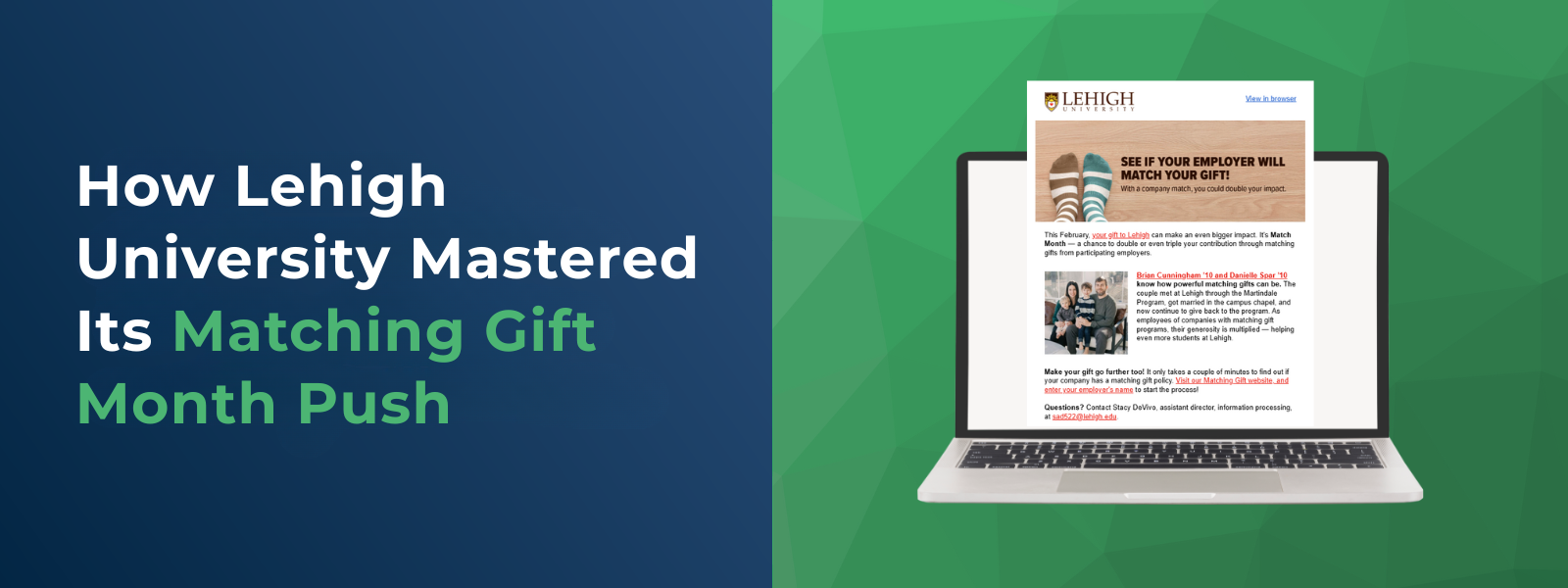
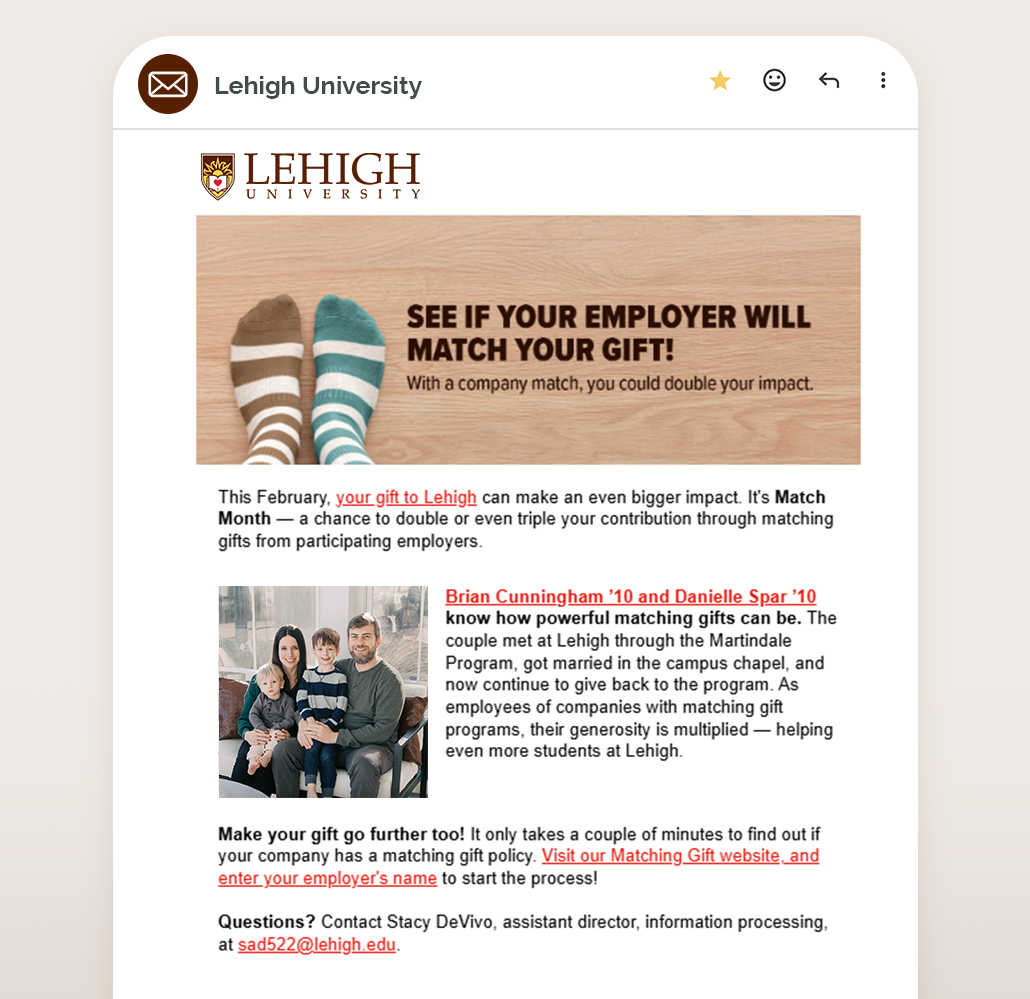
Lehigh’s secret weapon was the “Perfect Match Story.” They featured real-life donors, Brian Cunningham ’10 and Danielle Spar ’10, who shared how their corporate matches multiplied their ability to give back to the programs that shaped their lives and ultimately helped more students than would have been otherwise possible.
But the university didn’t stop at just one email about the couple. They included a small snippet of this story at the bottom of every single email sent by the Development department throughout the month of February. This consistent, low-pressure exposure served as a constant reminder, driving steady traffic to their Matching Gift web page, where supporters could access more information.
This was then bolstered by a deep-dive feature in the March issue of their Alumni Relations newsletter.
In-Depth Analysis
The university’s engagement strategy works through repetition and social proof. By showcasing peers (e.g., the Cunninghams) successfully using a matching gift to grow their impact, other alumni are inspired to do the same.
By including the featured “snippet” in all outgoing development emails, Lehigh University ensured that even donors who weren’t actively seeking matching gift information were constantly exposed to the concept in a low-pressure, high-frequency way.
The Lesson: Successful matching gift marketing relies on the dual power of storytelling and persistent visibility to transform a technical benefit into a relatable donor experience.
6) FIRST Inspires (New Donor Nurture Series)
While the previous examples focused on targeted campaigns or specific appeals, FIRST Inspires focused on optimizing its automated donor journey.
Why? The organization recognized that one of the most critical times to educate a donor about matching gifts is the moment immediately following their first gift.
Catching Them at the Peak of Engagement
The most likely time a donor will take a second action for your nonprofit is immediately after they’ve taken the first one. FIRST Inspires capitalizes on this opportunity by including matching gift prompts within its New Donor Nurture email series.
The Seamless Transition
Instead of waiting six months to ask for a match, FIRST introduces the concept as a seamless “next step” in the relationship. When a new donor contributes to the organization, they receive a nurture series designed to welcome them into the community with ways to stay involved.
This email:
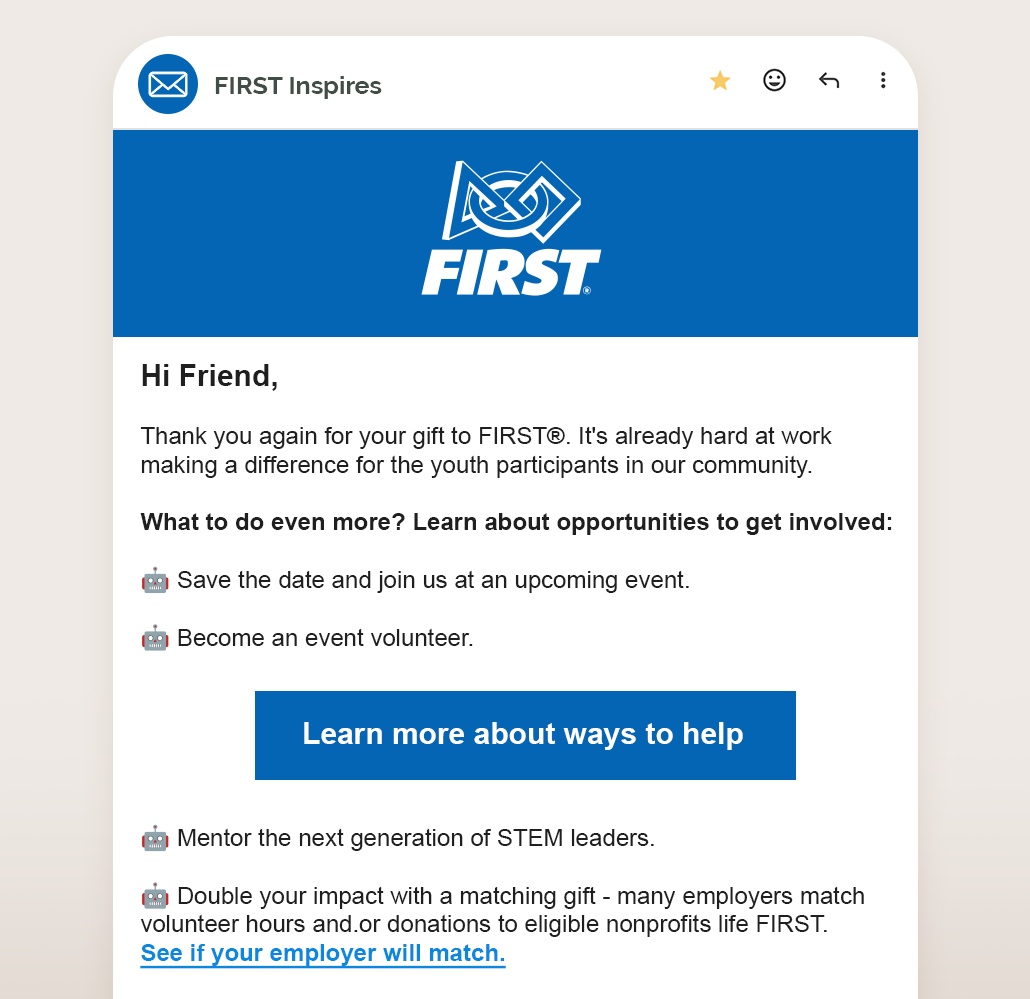
- Validates the initial gift: “Thank you again… it’s already hard at work”.
- Offers a menu of engagement: Including options for mentoring, volunteering, or attending events.
- Supplies the “Impact Multiplier”: A clear call to “Double your impact with a matching gift,” with a direct link to their dedicated match page.
By making matching gifts a standard part of their “welcome wagon,” FIRST Inspires ensures that every new supporter is aware of this benefit from the very beginning of their journey.
Standout UX Integration
The nurture series email doesn’t make the donor work to find the matching gift tool. Rather, it explicitly states that “many employers match volunteer hours and/or donations” and provides a prominently placed link to access recommended next steps: “See if your employer will match.”
This link then brings the supporter to a dedicated matching gift page where Double the Donation’s company search tool is ready and waiting.
Analysis of the Nurture Approach
By featuring the matching gift opportunity throughout the “Welcome” series, FIRST Inspires builds workplace giving into the very foundation of the donor’s relationship with the organization. It isn’t an afterthought; it is a core expectation of being a FIRST supporter. This ensures that the donor’s very first gift has the maximum potential to be doubled!
The Lesson: Making the corporate match a seamless “next step” in the donor journey establishes a standard of high-impact philanthropy that can sustain the relationship for years to come.
Final Thoughts & Additional Resources
The common thread among these five organizations is intentionality. These fundraisers aren’t just sending emails; they’re engineering experiences.
By analyzing the success of teams like Exeter Academy, Breakthrough T1D, Kalamazoo College, and more, it becomes clear that a combination of data-driven targeting and emotive storytelling can go a long way. Whether a nonprofit is utilizing high-level personalization to show tailored guidelines or leveraging the peak engagement period of a new donor’s journey, the goal remains the same: to empower supporters to maximize their impact.
“We’ve seen 3.5x more corporate matches in 8 months after implementing Double the Donation. Some of this growth I can attribute to other sources, but most of it is just having the Double the Donation emails on!”
— CEO, Letters to a Pre-Scientist
Want to see how your own matching gift email streams compare? Check out these additional Double the Donation resources below:
- Sending Impactful Matching Gift Emails: The Complete Guide. Master the art of the inbox with this deep dive into email best practices. Spanning everything from high-conversion subject lines to timing for follow-up reminders, this post guarantees your matching gift appeals stand out and drive action.
- Marketing Matching Gifts In Your Digital Communications. Create a cohesive presence for matching gifts across all your online channels! This guide provides tips for integrating workplace giving into your social media, texts, newsletters, and more to ensure donors receive impactful messaging.
- Free Download: The Ultimate Guide to Marketing Matching Gifts. This comprehensive toolkit is the definitive resource for nonprofits looking to scale their revenue. It includes practical templates, helpful examples, and a step-by-step roadmap for closing the awareness gap.
Plus, if you’re interested in learning more about incorporating matching gifts into your email marketing (or submitting your team’s examples for our next round of awards), be sure to register for the upcoming Workplace Fundraising + Volunteering Summit!