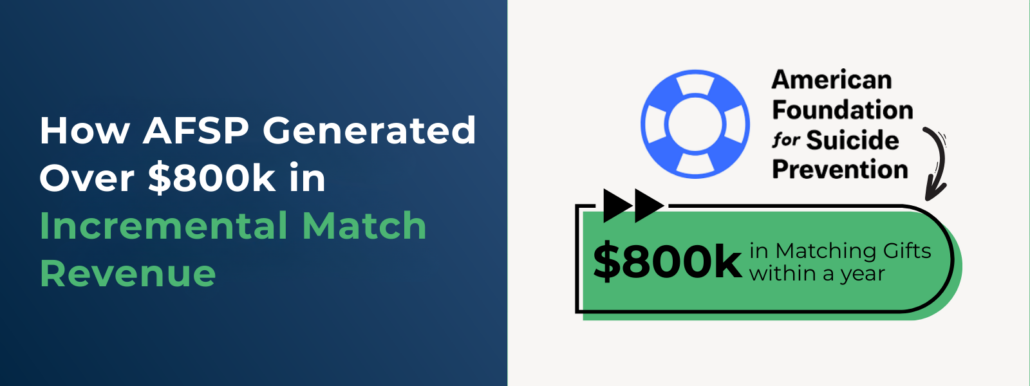
How AFSP Generated Over $800k in Incremental Match Revenue
Introduction: Saving Lives Through Scalable Fundraising
The American Foundation for Suicide Prevention (AFSP) is an organization driven by a critical and urgent mission: “saving lives and bringing hope to those affected by suicide.” As a leader in the fight against suicide, AFSP funds research, creates educational programs, advocates for public policy, and supports survivors of suicide loss.
In the world of nonprofit fundraising, organizations with such broad, life-saving mandates face constant pressure to scale. To fund research and support networks across the country, AFSP relies on the generosity of hundreds of thousands of individual donors. However, managing such a large volume of supporters presents a unique challenge: how do you maximize the value of every single transaction without requiring a massive increase in administrative staff?
AFSP recognized that they were sitting on a goldmine of potential revenue, often referred to in the industry as “low-hanging fruit.” This untapped resource was corporate matching gifts. Many of AFSP’s donors worked for companies that would match their charitable contributions, but without a systematic way to identify these donors and encourage them to submit requests, the revenue remained uncollected.
By shifting its focus to matching gift marketing and leveraging advanced automation technology, AFSP transformed its fundraising operations. In just 12 months, the foundation identified over $800,000 in matching gift eligible revenue. This strategic pivot demonstrates how large nonprofits can use automation to turn small, individual interactions into massive, aggregate revenue streams.

The Challenge: Capturing the “Low-Hanging Fruit”
The concept of “low-hanging fruit” in fundraising refers to revenue that is easily accessible with minimal effort, yet often overlooked. For AFSP, matching gifts perfectly fit this description. The donors had already given; the corporate funds were already allocated by employers; the only missing link was the submission of the match request.
The Scale of the Problem
The magnitude of AFSP’s operations made manual tracking impossible. The case study reveals that over 380,000 donors utilized the fundraising tools during the period analyzed.
- Volume: With hundreds of thousands of transactions, no human team could manually research the employer eligibility of every donor.
- Complexity: Different companies have different forms, deadlines, and guidelines. Managing this complexity for 380,000 people requires a technological solution, not a manual one.
The Goal: Incremental Revenue
AFSP’s goal was specific: they wanted to “generate incremental match revenue.” “Incremental” is the keyword here; this is revenue that comes on top of the initial donation. It is funding that costs the donor nothing extra but doubles the impact of their gift. To capture this, AFSP needed a way to market matching gifts effectively to its massive donor base without disrupting the user experience.
The Solution: A Proactive, Integrated Approach
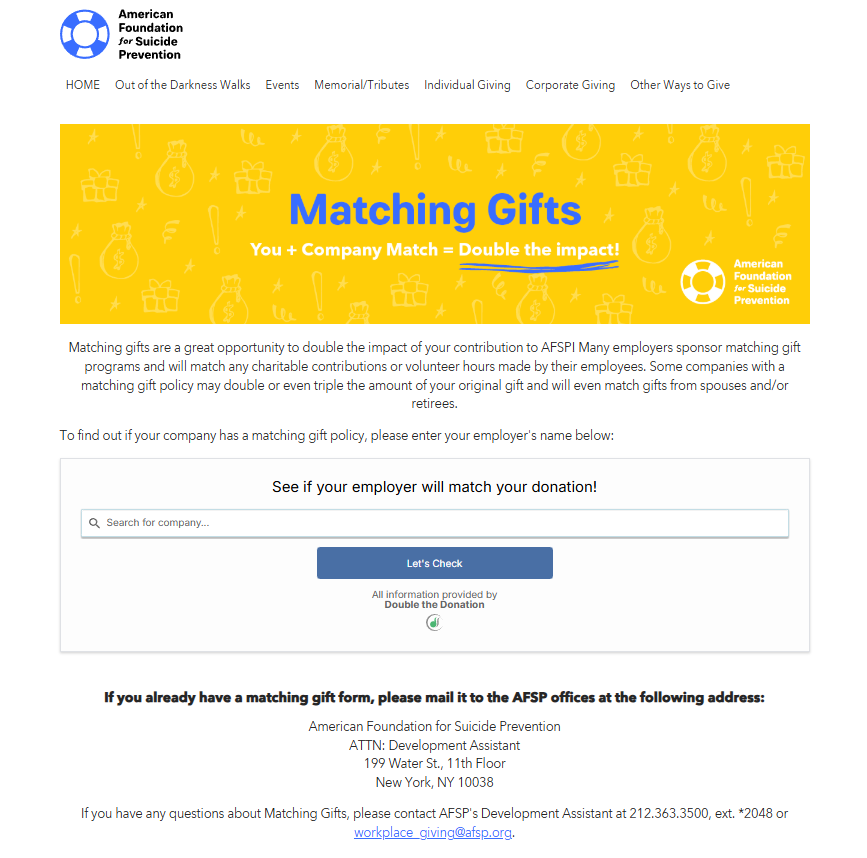
To solve the challenge of scale and capture this lost revenue, AFSP implemented Double the Donation Matching. The core of their strategy was a “proactive approach to matching gift fundraising.” Instead of waiting for donors to ask about matching gifts, AFSP integrated the conversation directly into the donation process.
This strategy relied on seamlessly integrating the software with their donation forms and CRMs. This technical integration allowed AFSP to do three things automatically:
- Identify: “Automatically identify match eligible donors as they give.”
- Integrate: Place the matching gift search tools directly into the donation flow.
- Drive Action: Use automated reminders to encourage donors to submit their requests.
By automating these steps, AFSP ensured that every one of their 380,000+ donors was screened for eligibility, ensuring no “low-hanging fruit” was left on the vine.
Implementation: The Mechanics of Matching Gift Marketing
AFSP’s success was built on specific features of the Double the Donation platform. The case study outlines the core components that drove their results.
1. The Streamlined Search Field
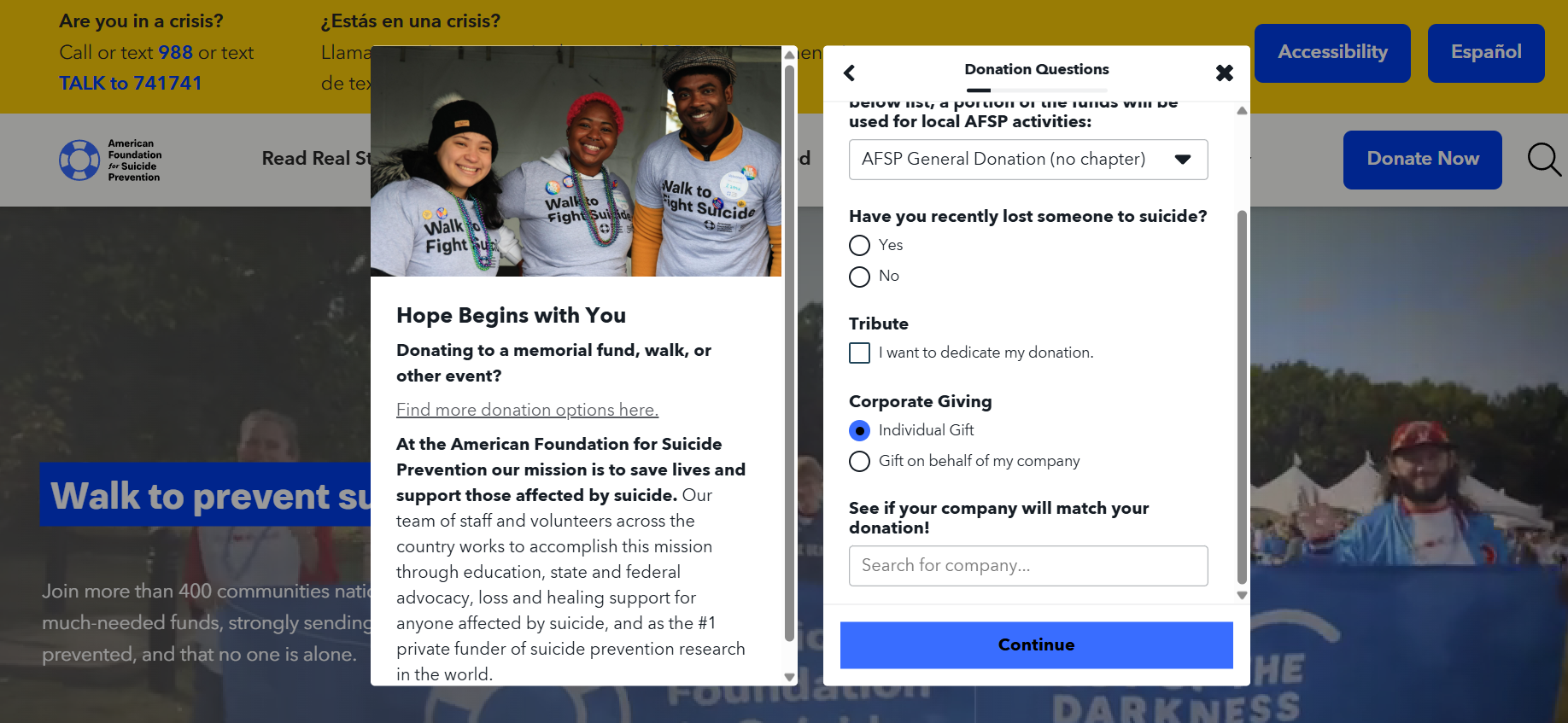
The first line of defense in capturing matching gifts is identification. AFSP utilized a “streamlined search field on [the] donation form.”
- Function: This tool “determines donor match eligibility” in real-time.
- Strategy: By placing this field on the donation form itself, AFSP captured employment data at the moment of highest intent. Donors didn’t have to go to a separate page to check their status; they could do it while entering their payment information.
2. The Confirmation Page Plugin
Once a donation is complete, the immediate next step is crucial. AFSP employed a “confirmation page plugin.”
- Function: This plugin “provides donors matching gift next steps” right after the transaction.
- Strategy: This creates an immediate call to action. The donor has just finished giving money; the confirmation page capitalizes on that momentum by showing them exactly how to double that gift instantly.
3. Automated Matching Gift Emails
Perhaps the most robust part of AFSP’s strategy was the email automation. The organization sent “automated matching gift emails… to all donors.”
- Scale: The sheer volume here is staggering. AFSP sent 500,000+ emails as part of this campaign.
- Purpose: These emails serve as a reminder and a guide. If a donor missed the search tool on the form or closed the confirmation page quickly, the email ensured they still received the necessary information.
- Content: The platform allows fundraisers to “send donors a direct link to their employer-specific matching gift request form,” removing barriers to completion.
4. The Matching Gift Dashboard
To manage a campaign of this size, data visibility is essential. AFSP utilized a “matching gift dashboard” that “outlines actionable metrics.” This allowed the team to track the aggregate data and understand donor behavior at a granular level.
The Results: Analyzing the $800,000 Impact
The results of AFSP’s proactive strategy were massive, reflecting the sheer size of their donor base and the effectiveness of the automation.
Financial Impact: $800,000 Identified
In a period of less than 12 months, AFSP identified over $800,000 in match-eligible dollars. This figure represents a significant infusion of funds for suicide prevention research and support programs. It validates the “low-hanging fruit” hypothesis: the revenue was there, waiting to be identified by the right tool.
Donor Engagement: The Power of 380,000
The scale of adoption is a key takeaway. Over 380,000 donors used the Double the Donation tools. This metric highlights the reliability of the software. Processing nearly 400,000 interactions without manual intervention is a feat that would be impossible for a human team. It demonstrates that the integration was smooth and user-friendly enough that hundreds of thousands of people engaged with it effortlessly.
Email Marketing Success: 53% Open Rate
Sending half a million emails is impressive; getting people to read them is even harder. AFSP achieved a 53% open rate on the 500,000+ emails sent.
In the nonprofit sector, email open rates often struggle to break 20%. A 53% open rate on a volume of half a million emails is exceptional. It suggests that AFSP’s donors are highly engaged and that the messaging, focused on maximizing the impact of their gift, resonated deeply with the audience.
Conversion Intent: 58% Action Rate
Open rates are good, but action is better. The case study notes that 58% of donors took a specific action: they “accessed matching gift forms or guidelines or opened multiple emails.” This statistic proves that the tools drove behavior. The majority of donors didn’t just glance at the email; they clicked through to find forms or guidelines, moving one step closer to securing the match.
Strategic Deep Dive: Why “Marketing” Matters in Fundraising
The title of this case study analysis highlights “Matching Gift Marketing,” and AFSP’s success illustrates why this framing is important. Often, nonprofits view matching gifts as an administrative task, processing forms and verifying checks.
AFSP viewed it as a marketing task. They focused on “matching gift marketing in efforts to take advantage of low-hanging fruit.”
- Promotion: They promoted the opportunity on the donation form.
- Education: They educated donors via confirmation pages.
- Nurturing: They nurtured the lead via automated emails.
By treating matching gifts as a marketing campaign rather than a back-office function, they achieved high engagement rates (53% open, 58% access) that rival top-tier commercial marketing campaigns.
The Role of Data in Scaling
The ability to capture “detailed data at the aggregate and donor level” was a crucial benefit of the solution. For an organization as large as AFSP, aggregate data helps in forecasting revenue and planning budgets.
Knowing that $800,000 in potential matches exists allows the finance and development teams to predict future cash flows more accurately. Furthermore, identifying “match eligible donors as they give” builds a database of employment information that can be used for future corporate partnerships or workplace giving campaigns.
Conclusion: A Model for Large-Scale Nonprofits
The American Foundation for Suicide Prevention case study serves as a benchmark for large-scale nonprofit fundraising. It demonstrates that as an organization grows, its systems must evolve from manual processing to automated marketing.
By acknowledging that they had a massive untapped resource in their existing donor base (the “low-hanging fruit” of matching gifts). AFSP implemented a strategy to capture it efficiently. The integration of Double the Donation’s automated platform allowed them to:
- Process 380,000+ donor interactions.
- Send 500,000+ emails with high engagement.
- Identify $800,000+ in revenue.
For other large organizations, the lesson is clear: meaningful revenue growth doesn’t always require finding new donors. Sometimes, it simply requires using the right technology to maximize the value of the donors you already have. Through matching gift marketing, AFSP has secured vital resources to continue its life-saving work, bringing hope to those affected by suicide.
Download the full case study compilation here to uncover even more successful strategies.