How One University Found $48k via Donor Match Automation
Introduction: The Efficiency Imperative for Liberal Arts Colleges
The University of Lynchburg, a small liberal arts institution in Virginia, operates with a clear mission: to provide better opportunities and experiences for its students. Like many institutions of its size, the university’s development office is the engine that powers this mission. Raising funds is not just about keeping the lights on; it is about funding scholarships, enhancing campus facilities, and ensuring that the student experience remains top-tier.
However, small advancement shops often face a distinct set of challenges. Unlike massive state universities with sprawling development teams, smaller institutions must often achieve ambitious goals with leaner staff and limited resources. In this environment, efficiency is not just a “nice to have.” It is a strategic necessity. Every hour a development officer spends on administrative data entry is an hour not spent cultivating relationships with major donors or planning the next capital campaign.
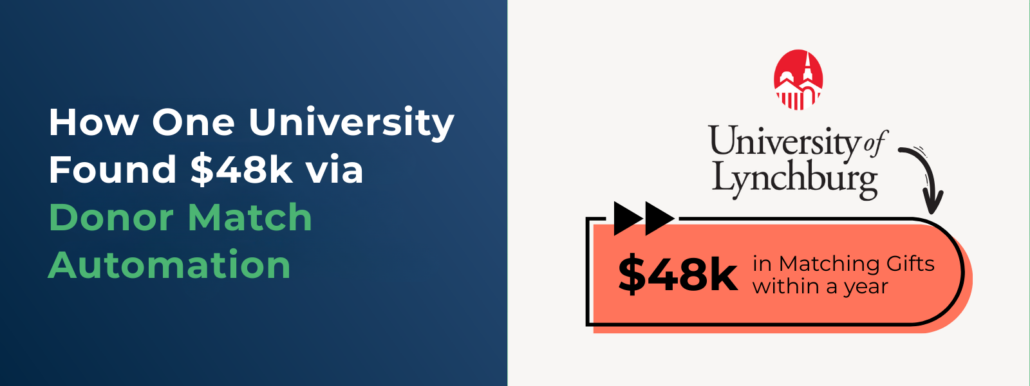
Despite the hard work of the team, the University of Lynchburg identified a bottleneck in its operations. They knew that corporate matching gifts represented a significant source of “free money,” but their ability to capture these funds was limited by their manual processes. They were leaving money on the table (specifically, over $48,000 in potential matches), simply because they lacked the infrastructure to identify and pursue them at scale.
By embracing automation, the University of Lynchburg transformed its approach to donor match opportunities. They moved from a reactive, time-intensive model to a proactive, automated system that works in the background 24/7. The results were immediate and transformative, offering a roadmap for other higher education institutions looking to maximize their fundraising ROI.
The Challenge: The Bottleneck of Manual Outreach
Before implementing a dedicated solution, the University of Lynchburg’s approach to matching gifts was defined by manual effort and limited reach. The case study notes that the university “only promoted matching gifts to their donors through one-on-one interactions.”
The Limitations of One-on-One Outreach
While personal interaction is the gold standard for major gifts, it is an inefficient strategy for mass-market fundraising channels like annual giving. The team found that to increase donor awareness, they had to “individually suggest to donors that they contact their human resources department for information on the matching gift process.”
Consider the logistics of this approach:
- Identification Friction: A staff member would likely need to manually review a donation, recognize the donor’s employer, and remember if that employer had a matching program.
- Outreach Latency: The staff member would then need to draft a personal email or make a phone call to suggest the match. This might happen days or weeks after the initial gift, by which time the donor’s enthusiasm may have waned.
- The “Ask” Burden: The burden was placed heavily on the development officer to make the suggestion and on the donor to go find the information.
The team frankly realized that this “manual approach was time-intensive.” More importantly, they realized the opportunity cost: they “may be overlooking some valuable opportunities” simply because human bandwidth is finite. If a donor gave $50 online at 8:00 PM on a Saturday, there was no one there to tell them their gift could be doubled. That opportunity would likely slip through the cracks.
The Solution: Scaling Up with Automation
To solve this problem, the University of Lynchburg turned to automation. They adopted Double the Donation’s tools to “scale their efforts and take a more proactive approach to matching gifts.”
The shift to automation changed the fundamental dynamic of their fundraising operations. Instead of relying on a staff member to notice a match opportunity, the system handles the process instantly and automatically.
1. Instantaneous Donor Awareness
Now, the workflow is seamless. “As soon as donors contribute, they are alerted to their match eligibility.” This immediacy is critical. When a donor has just made a financial commitment, they are at their peak level of engagement. By alerting them to the donor match opportunity at that exact moment, the university capitalizes on the “warm glow” of giving.
2. Guided Submission Process
Awareness is only half the battle; the other half is execution. The new system doesn’t just tell donors they might match; it “guided [them] to the proper form to submit that request.” This removes the friction of the donor having to Google their HR department’s phone number or search an intranet for a PDF form. The path to doubling the gift is laid out clearly in front of them.
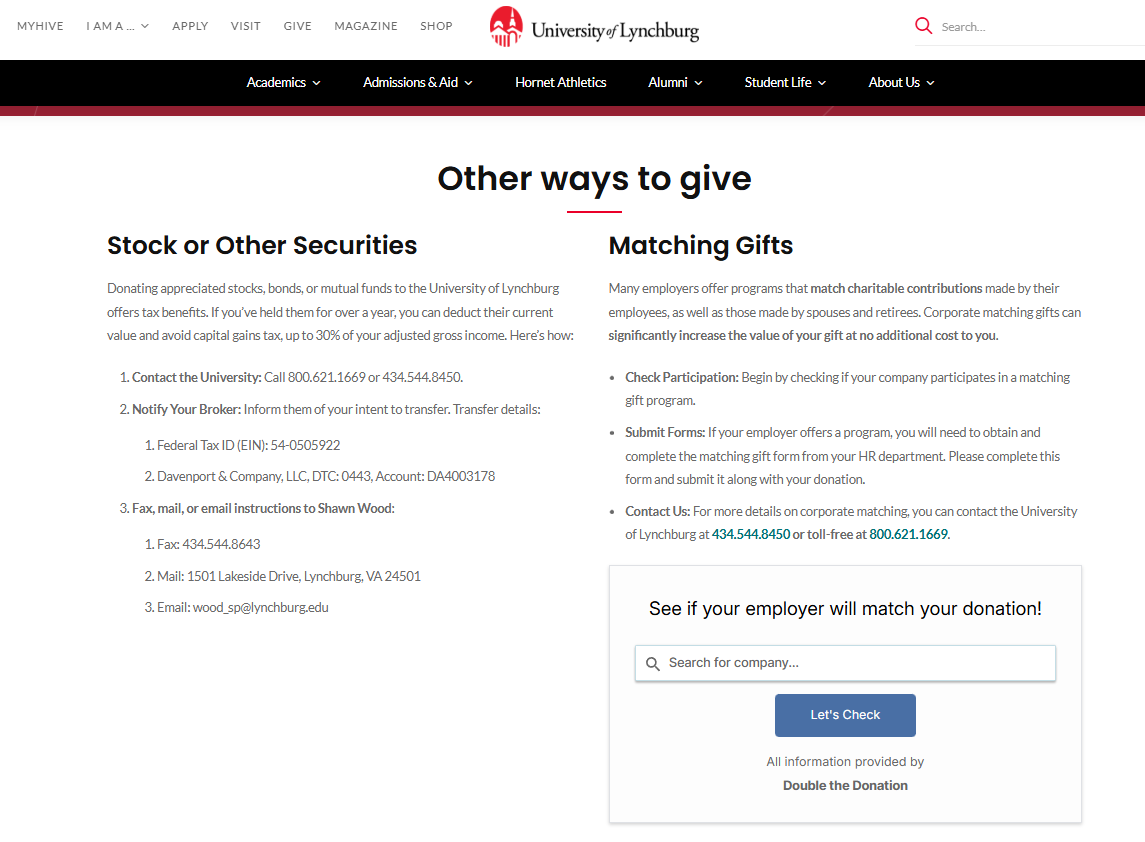
3. Automated Follow-Up
Perhaps the most valuable feature for the “small advancement shop” was the automated follow-up. The system sends emails to donors to remind them to complete the process. This “automated follow-up also makes it easy for the University of Lynchburg team to drive additional matching gift revenue without all of the hassle.” The software acts as an additional staff member who never sleeps, ensuring that every eligible donor receives a personalized nudge.
The Results: Breaking Industry Records
The impact of this strategic pivot was quantifiable and impressive. By removing the manual bottleneck, the University of Lynchburg achieved results that significantly outperformed industry averages.
Financial Impact: $48,000 Identified
In just one year of usage, the university identified over $48,000 in matches. For a small liberal arts institution, this is a substantial sum. To put it in perspective, $48,000 could fund a scholarship, equip a lab, or support a student organization for an entire year. This revenue was generated without hiring new staff or launching a new capital campaign; it was simply “uncovered” from the existing donor base.
The 81% Open Rate
The most startling statistic from the case study is the email open rate. The automated matching gift emails sent by the University of Lynchburg achieved an 81% email open rate. The case study notes that the industry average is approximately 20%. This means Lynchburg’s emails were opened at a rate four times higher than the standard.
What drives such an incredible open rate?
- Relevance: The emails are triggered by a donor’s recent action (making a gift). They are timely and relevant to something the donor cares about.
- Value: The emails offer a way for the donor to increase their impact without spending more money. It is a “value-add” communication, not just another ask.
- Trust: The emails come from the institution the donor just supported, ensuring high deliverability and trust.
High Donor Engagement
The engagement didn’t stop at opening the email. The metrics showed that 53% of donors had moderate to high engagement with the matching gift tools. This indicates that the majority of donors who interacted with the system found it useful and took steps toward submitting a match.
Strategic Analysis: The “Small Shop” Advantage
The University of Lynchburg case study provides a specific lesson for smaller development teams. Often, small shops feel they cannot afford sophisticated technology, or that automation is only for large universities. Lynchburg’s experience proves the opposite: automation is most valuable for small shops because it multiplies their limited human resources.
Shawn Wood, Assistant Vice President of Development at the University of Lynchburg, articulated this benefit clearly: “Double the Donation has saved an incredible amount of time for our small advancement shop and is consistently dependable on the messaging and the follow-up process that happens.”
Dependability and Consistency
Wood’s point about “dependability” is crucial. Manual processes are inherently inconsistent; staff get sick, go on vacation, or get overwhelmed during busy seasons. Automation is “consistently dependable.” It ensures that a donor giving on Christmas Eve gets the same level of service and follow-up as a donor giving on a Tuesday in March.
Meeting Annual Goals
Ultimately, the goal of any tool is to help the organization reach its targets. Wood noted that the “increased matching gift funds have greatly helped us reach many of the annual goals that we have set over the last couple of years.” The $48,000 in identified matches became a reliable revenue stream that the development office could count on to close the gap on its annual fundraising targets.
The Donor Experience: Making Giving Easy
From the donor’s perspective, the shift to automation is a significant upgrade in service. Instead of a disjointed process where they have to hunt for information, they are presented with a “seamless” experience.
The case study highlights that “Double the Donation allows the University of Lynchburg to scale its efforts.” For the donor, this scaling feels like personalization. They receive a specific prompt about their employer and their gift. This personalized attention reinforces the donor’s decision to give and strengthens their connection to the university.
By “providing donors with their matching gift next steps” directly, the university empowers its alumni and friends to be better stewards of their own philanthropy. They are given the tools to maximize their giving, which fosters a sense of partnership between the donor and the institution.
Conclusion: A Blueprint for Higher Ed Success
The University of Lynchburg’s journey from manual, one-on-one outreach to fully automated donor match discovery is a blueprint for success in higher education fundraising.
By acknowledging the limitations of their manual approach, the university was able to implement a solution that solved the problem at its root. The results speak for themselves: $48,000 in identified revenue, an 81% email open rate, and a saved “incredible amount of time” for the staff.
For other institutions looking to replicate this success, the takeaways are clear:
- Automate Early: Capture the donor’s attention immediately after the gift is made.
- Guide the Way: Don’t just ask for a match; provide the specific forms and links needed to complete it.
- Trust the Metrics: Use the dashboard to track your success and prove the ROI to leadership.
By increasing matching gift funds, the University of Lynchburg ensures it can continue to “provide the best student experiences possible.”
Download the full case study compilation here to uncover even more successful strategies.