Using Wealth Screening to Identify Challenge Match Donors
Challenge matches rely on securing a significant financial pledge that is contingent on raising matching funds from your broader supporter base to create urgency, generate excitement, and establish a powerful financial incentive for other supporters to give. The difficult part of this equation is rarely defining the strategy itself; rather, it is finding the right individual to anchor it. You need a partner who has not only the financial capacity to write a large check but also the philanthropic leadership to leverage that check to inspire others. This is where using wealth screening to identify challenge match donors becomes an essential practice for modern nonprofit development teams.
Wealth screening allows you to look far beyond surface-level interactions, such as event attendance or open rates, and understand the true financial capacity and philanthropic inclination of your database. Instead of guessing who might be willing (and able!) to lead your next campaign, you can use data to pinpoint individuals who have the means to make a transformational gift and the affinity to support your cause publicly.
When you combine this hard financial data with employment insights and giving history, you unlock a roadmap to your next successful campaign. In this comprehensive guide, we will explore exactly how to leverage wealth data to find these hidden champions. Specifically, we’ll cover:
- Understanding the Power of Challenge Matches
- Why Wealth Screening is Essential for Identifying Prospects
- The Three Pillars of Prospect Identification
- Key Wealth Indicators to Analyze
- Leveraging Employment Data for Greater Insight
- How to Approach a Prospect About a Challenge Match
- Integrating Corporate Giving Opportunities
Finding the right major donor is not about luck or happenstance. It is about strategy, data integrity, and utilizing the right tools to uncover opportunity. Let’s explore how you can find the perfect partner to launch your next challenge match.
Understanding the Power of Challenge Matches
Before diving into the data analysis required to find the right donor, it is critical to understand why this specific fundraising vehicle is so effective. A challenge match is a psychological trigger that motivates your entire donor base. When a mid-level supporter sees that their fifty-dollar donation will effectively become one hundred dollars (or more) thanks to a challenger, the barrier to giving is significantly reduced. They no longer feel like a drop in the bucket; they feel like a vital partner in a larger movement.
This multiplier effect is backed by significant industry data. According to recent research, 84% of donors say they’re more likely to donate if a match is offered. Furthermore, 1 in 3 donors indicates they’d give a larger base gift if matching is applied. These statistics highlight the immense leverage a challenge donor provides to your organization. For the major donor providing the initial funds, this offers a unique return on their investment. Their gift does not just fund a program; it inspires hundreds of others to join the mission, effectively doubling or tripling the value of their contribution.
The Psychology of Leverage
High-net-worth individuals often view their philanthropy through the lens of investment. They are accustomed to analyzing business deals and investment portfolios and want to know that their philanthropic capital is used efficiently. When you pitch a challenge match, you are offering them financial leverage. You are telling them that their twenty-five-thousand-dollar gift will result in a fifty-thousand-dollar impact for the organization. This appeals directly to the entrepreneurial mindset common among major donors.
Furthermore, challenge matches create a necessary deadline. Unlike a standard capital campaign, which might drag on for months or years, a challenge match usually has a strict time constraint (e.g., “Match every gift made in December”). This urgency compels mid-level and smaller donors to act now rather than later, knowing that the matching funds might run out or expire.
Why Wealth Screening is Essential for Identifying Prospects
Many nonprofits make the critical mistake of assuming their wealthiest donor is automatically their best challenge match prospect. While financial capacity is a necessary component, it is not sufficient on its own. A donor might have millions in assets but no history of charitable giving to your sector. Alternatively, they might be incredibly generous but prefer to remain strictly anonymous, making them a poor fit for a public-facing challenge campaign that relies on social proof.
Using wealth screening tools allows you to look deeper than just a bank account balance. These tools aggregate data from public records (such as property assessments, SEC filings, and political contributions) to create a comprehensive profile of a donor’s financial health and philanthropic behavior. This data-driven approach prevents your development team from wasting valuable time chasing leads who might have the money but lack the motivation.
Moving Beyond the Annual Fund
Your annual fund donors are the lifeblood of your organization, but a challenge match requires a different tier of support. You are typically looking for someone who can write a check that is five, ten, or even fifty times larger than your average gift. Manual research is simply too slow and prone to error to identify these individuals effectively, especially within a large database.
Lucky for you, wealth screening automates the gathering of “hard assets” data. It looks at real estate ownership, stock holdings, business affiliations, and political contributions. When you have this data at your fingertips, you can segment your database to find the hidden gems, such as the long-time volunteers who happen to own successful businesses, or the mid-level donors who just sold a tech startup. By identifying these individuals early, you can begin the specific cultivation steps required to ask for a challenge match.
The Three Pillars of Prospect Identification
When using wealth screening to identify challenge match donors, you should be scoring your prospects against three specific criteria. Fundraising experts often refer to these as the “Three Pillars” of prospect research: Capacity, Propensity, and Affinity. Let’s dive into each one in more detail here.
1. Capacity
First off, capacity refers to the financial ability of the donor to make a large gift. This is the most objective metric provided by wealth screening software. Does the individual have the liquid assets or wealth structures in place to pledge a significant amount without jeopardizing their financial security? Here are a few criteria to consider:
- Real Estate: Ownership of properties worth $2 million or more is a strong indicator of wealth.
- Business Revenue: Ownership or executive stakes in profitable private companies.
- Stock Holdings: Significant shares in public corporations (SEC insiders).
2. Propensity
Meanwhile, propensity measures the donor’s inclination to give to nonprofit causes in general. A person can be wealthy but not philanthropic. Wealth screening tools often pull data on charitable gifts made to other organizations to help determine this. This can include:
- Giving History: Have they given major gifts to universities, hospitals, or other charities?
- Political Giving: Large political contributions often correlate with high disposable income and a willingness to financially support causes they believe in.
- Board Service: Do they sit on the boards of other foundations or nonprofits?
3. Affinity
Finally, affinity is the connection the donor has specifically to your organization. This is internal data that you must combine with external wealth data to get the full picture. Consider the individual’s:
- Recency: When was their last gift to you? Active donors are more likely to respond to a challenge proposal.
- Frequency: Have they been giving consistently for five years or more? Consistency suggests loyalty.
- Engagement: Do they attend your galas? Do they open your newsletters? Do they volunteer?
If a donor scores highly in all three of the above areas, they are a prime candidate for a conversation about a major gift (or, more specifically, a challenge match opportunity).
Key Wealth Indicators to Analyze
When reviewing the results of your screening, certain markers serve as “green lights” for moving a prospect into a major gift portfolio. Understanding these indicators will help you craft a more personalized and effective ask.
Real Estate Ownership
Real estate is one of the most reliable indicators of wealth because it is a public record and difficult to hide. However, sophisticated fundraisers look beyond the primary residence. Ownership of additional properties, such as vacation homes, rental properties, or commercial real estate, indicates substantial assets. If a donor owns property in affluent neighborhoods or multiple states, it provides a strong baseline for their net worth and liquidity.
Stock Transactions and Holdings
Donors who hold significant stock portfolios are often looking for tax-savvy ways to give. Donating appreciated stock is one of the most tax-efficient ways to support a nonprofit because it allows the donor to avoid capital gains tax while claiming a charitable deduction for the full fair market value. If your screening reveals a prospect with large stock holdings, you should tailor your pitch to highlight the financial benefits of funding a challenge match through a stock transfer rather than cash.
Political Contributions
Political giving is a surprisingly strong predictor of philanthropic capacity. Individuals who give large sums to political campaigns are demonstrating two things: they have disposable income, and they are comfortable writing checks to support their values. While the cause is different, the behavior—supporting a mission with cash—is the same. High-level political donors are often accustomed to being solicited for large amounts and understand the mechanics of fundraising.
Business Affiliations
Knowing that a prospect is a C-level executive or a business owner changes how you approach them. Business owners understand ROI and leverage better than anyone. They are often the most receptive audience for the concept of a challenge match because they see it as a business strategy applied to philanthropy. This also opens the door to corporate sponsorships, where the business itself funds a portion of the match in exchange for branding and visibility during the campaign.
Leveraging Employment Data for Greater Insight
Wealth is inextricably linked to employment, yet many nonprofits suffer from incomplete employment records within their donor database. This is a significant missed opportunity. Knowing where a donor works can reveal their earning potential, their professional network, and their access to corporate resources.
If your database is missing this key information, you should consider using employer appends. This data enrichment process takes your existing donor contact information (names, emails, addresses) and matches it against third-party databases to identify their current employer and job title.
Unlocking Corporate Connections
Once you identify a donor’s employer, you open the door to additional revenue streams beyond the individual’s personal checkbook. The intersection of personal wealth and corporate influence is a sweet spot for challenge match fundraising.
Corporate Grants and Matching
If your challenge match prospect works for a major corporation, their personal gift might be eligible for a match from their employer. For example, if a donor gives $25,000 to start a challenge fund, and their employer offers a 1:1 match, you suddenly have $50,000 in the pot before you even launch the public campaign. You should also check for corporate grants that might be accessible through your donor’s influence or recommendation.
Payroll Giving Opportunities
High-level executives can also be champions for instituting payroll giving programs within their companies. While this might not fund the challenge match directly, it creates a long-term recurring revenue stream that complements the major gift.
Volunteer Grants
Don’t forget about volunteer grants, either. If your major donor also spends time serving on your board or helping with events, their employer might provide monetary grants based on those hours tracked. 40% of Fortune 500 companies offer volunteer grant programs, making this a widely available but often overlooked revenue source.
Determining Matching Gift Eligibility
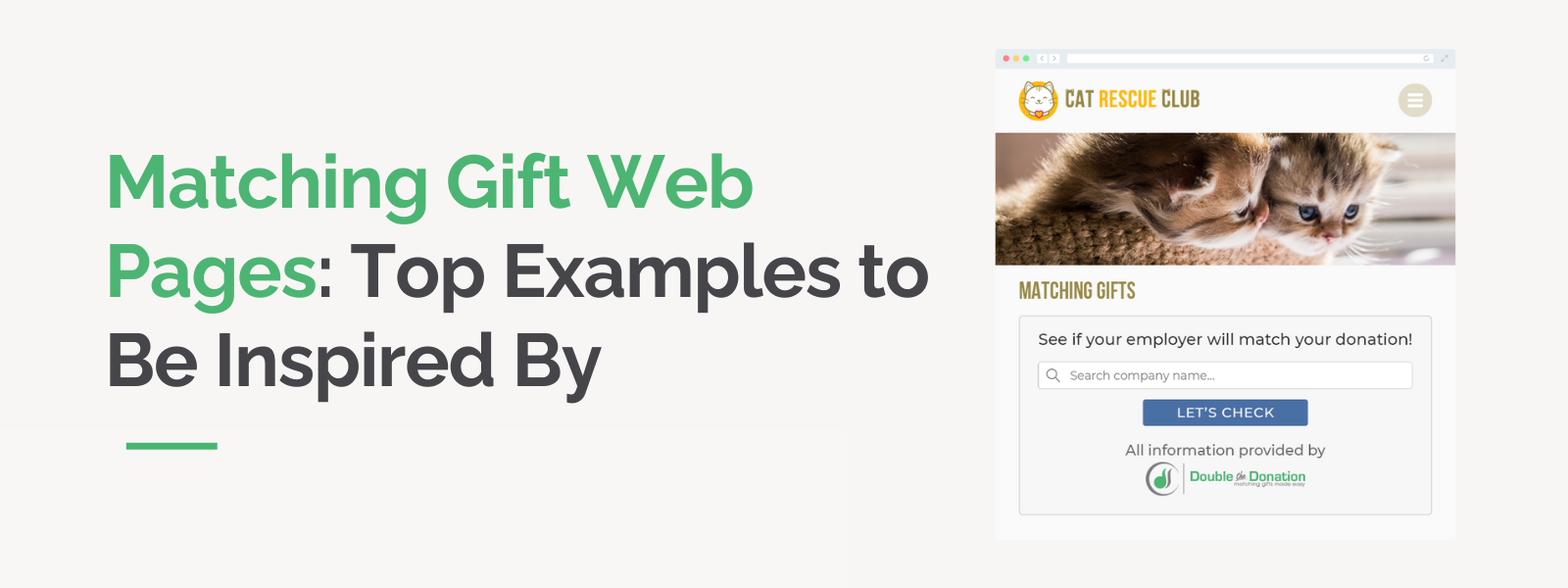
One of the most immediate applications of employment data is verifying eligibility for matching gifts. Before you ask a donor for a challenge gift, run their employer through a matching gift database tool like Double the Donation. If you know their company has a generous cap (say, $10,000 or more), you can factor that into your proposal and show them how to maximize their contribution effortlessly.
How to Approach a Prospect About a Challenge Match
Once you have identified your top prospects using wealth screening and data enrichment, the next step is the solicitation itself. Asking for a challenge match is fundamentally different from a standard major gift solicitation. You are not just asking for money; you are asking for partnership and leadership.
1. The Pre-Discovery Phase
Before you make the ask, you need to validate your data. Invite the prospect to a non-solicitation meeting. Update them on the organization’s impact and future goals. Listen for cues about their financial situation and their enthusiasm for specific programs. This is where you confirm that the affinity suggested by your data is both real and current.
2. Framing the Conversation
When you are ready to make the proposal, frame the conversation around leadership and leverage. Do not just ask for $25,000 to “keep the lights on.” Ask for an investment that creates growth.
- The Pitch: “We are looking for a partner to lead our next major campaign. We believe your leadership could transform our fundraising this year. We are asking for a gift of $25,000, but we want to use it as a challenge match opportunity. This means your gift wouldn’t just fund our new program; it would challenge our community to match it, effectively turning your contribution into $50,000 of impact.”
3. Highlight the Multiplier Effect
Data-driven donors love efficiency. Therefore, show them the math. Explain that their name and their generosity will serve as a catalyst, motivating hundreds of smaller donors who might otherwise sit on the sidelines. Use past campaign data to show how challenge gifts have spiked donation volume in previous years. Remind them that mentioning matching gifts in appeals results in a 71% increase in response rate and a 51% increase in the average donation amount.
4. Discuss Recognition Options
Some challenge donors want their name in lights to inspire others, while others prefer anonymity. Be prepared to offer flexible recognition options for your upcoming challenge match. This could include:
- Public Challenge: “The Smith Family Challenge Match.”
- Anonymous Challenge: “An anonymous donor will match all gifts up to $25,000.”
If the donor runs a business, this could also be an opportunity to discuss visibility for their company within the challenge campaign. This blends philanthropy with marketing, which can be very attractive to entrepreneurs looking to boost their corporate social responsibility profile.
Integrating Corporate Giving Opportunities
Once you have secured a challenge match donor, the work isn’t done. You must ensure that the campaign maximizes every possible revenue source. This is where corporate volunteerism and matching gifts come into play for the individual supporters—the smaller donors responding to the challenge.
When you market the challenge match to your broader list, explicitly mention that their gifts can also be matched by their employers. This creates a powerful “triple match” effect. For example:
- A donor gives $100.
- The challenge fund adds $100.
- The donor’s employer matches the initial $100.
The total impact? $300 from a $100 gift. Talk about a win-win-win!
Wrapping Up & Next Steps
Using wealth screening to identify challenge match donors allows your nonprofit to work smarter, not just harder. By combining wealth indicators with employment data and giving history, you can pinpoint the supporters who are ready to make a transformational impact.
After all, a challenge match is one of the most effective tools in a fundraiser’s toolkit. It energizes your base, acquires new donors, and maximizes the value of a major gift. With the right data and a strategic approach, you can find the perfect partner to help you reach your goals.
Ready to boost your revenue?
- Audit your data: Run a health check on your donor database to see where you are missing employment or wealth information.
- Invest in fundraising software: Utilize tools like Double the Donation to automate data collection and uncover matching gift opportunities.
- Start screening: Begin the process of wealth screening your top tier of donors to find your next challenge match leader.
- Identify corporate opportunities: Look for corporate giving connections within your donor base to expand your reach.
By taking these steps, you are not just raising money today; you are building a sustainable pipeline of major donors for the future.
Ready to see how Double the Donation’s fundraising platform can help? Request a personalized demo to get started with better data, increased workplace giving participation, and even more challenge match opportunities.