Corporate Volunteering Summit Recap: Top 5 Takeaways
At the recent Corporate Volunteering Summit for Nonprofits, industry experts, seasoned volunteer managers, and corporate leaders gathered to share the secret behind scaling impact. From the tactical use of AI in outreach to the logistical genius of stacking benefits, the summit provided an actionable roadmap for any organization looking to turn its volunteer program into a powerhouse of engagement and funding.
If you missed the live sessions, don’t worry. We’ve synthesized hours of expert dialogue into the top five actionable takeaways that you can begin implementing today. These include:
- Building a Company-Specific Landing Page
- Prioritizing Mission-Aligned Partners
- “Stacking” Your Corporate Benefits
- Avoiding Busy Work; Focusing on Real Results
- Creating a “Spotify Wrapped” Style Impact Report
Each of these ideas represents a fundamental shift in how your team approaches corporate engagement. By integrating these expert-backed strategies, you’ll not only save your staff hours of manual work but also create the kind of transformational impact that keeps corporate partners coming back year after year.
Let’s dive in to see how you can put these lessons into practice.

1. Build a Company-Specific Landing Page.
One of the most common complaints among nonprofit staff is the sheer amount of time spent on the administrative dance of corporate inquiries. A company reaches out with a vague interest in helping; the nonprofit responds with a long list of options; the company asks for specific dates; the nonprofit checks the calendar. This back-and-forth can take weeks, often resulting in inconsistent volunteers who show up once and disappear.
The solution, according to summit experts, is to move the “choose your own adventure” process to your digital front door. By creating a dedicated landing page specifically for corporate groups, you provide immediate value while protecting your staff’s time.
In a recent session, Joni Celiz, Director of Volunteer Engagement at Martha’s Table, shared how this shift transformed their operations.
“[Building a company-specific landing page] saves us time so we can maximize and get the folks we really think can jump in with us on a long-term partnership to come in for those deeper conversations.” — Joni Celiz (Martha’s Table)
Take a look at this company-facing resource the organization shares online:
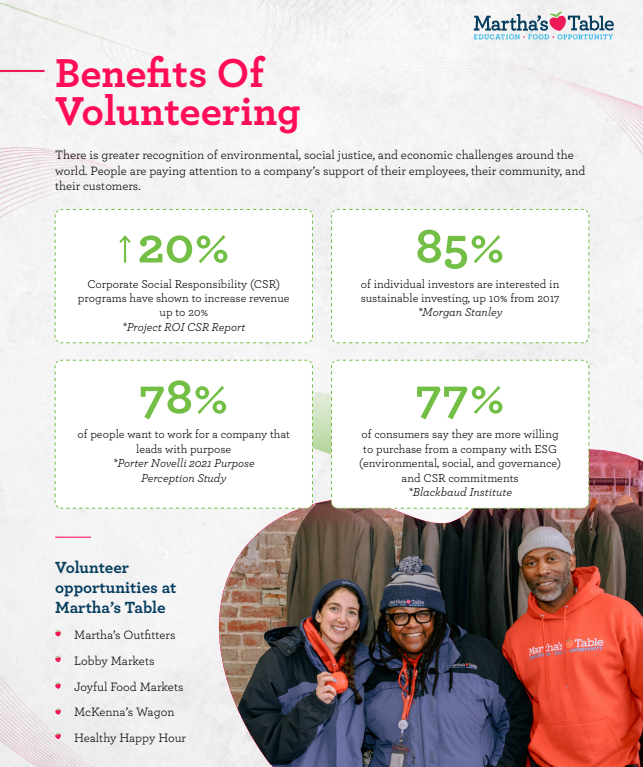
Here’s why this works:
- Empowering Self-Selection: It allows companies to see your specific needs (e.g., “We need 10 people for food sorting” or “We need a pro-bono marketing audit”) and decide where they fit before they ever pick up the phone.
- Increasing Professionalism: It signals to a corporate partner that you are a well-oiled machine. Corporations value efficiency; seeing a structured, easy-to-navigate portal makes them more likely to trust your organization with their employees.
- Offering Tiered Engagement Opportunities: You can host a variety of entry points on this page, from low-lift activities like sandwich-making kits to high-impact Business Advisory Council roles.
By automating the “low-touch” logistics, your team can focus on the “high-touch” relationship-building that turns a volunteer into a donor.
2. Prioritize Mission-Aligned Partners.
Not all corporate partners are created equal. The summit speakers were clear: stop cold-calling every large company in your zip code and start looking for the mission-market fit.
Ben Bunn, Deputy Executive Director of Warrior Rising, emphasized that the most powerful partnerships occur when the nonprofit’s mission bridges a gap the corporation is already seeking to address. For example, if your nonprofit focuses on financial literacy, your natural partners aren’t just “anyone with money.” They are banks and lending institutions whose business models rely on a financially literate public.
“If you have a nonprofit that exists specifically to deliver this thing… You have an opportunity to more broadly serve the community… I have to find partners that marry well with those gaps.” — Ben Bunn (Warrior Rising)
But how do you find these aligned partners without spending dozens of hours on manual research? The summit touched on a modern solution: AI-driven research. Mackenzie Burckbuchler, Marketing Manager at Double the Donation, pointed out that the barrier to doing your homework has never been lower.
“Maybe using AI to prompt ChatGPT and ask it to give you recent updates about the company. And to then compare that to your mission statement so that you can really quickly send something that gives the company a hook.” — Mackenzie Burckbuchler (Double the Donation)
By using AI to identify a company’s recent ESG (Environmental, Social, and Governance) report or a CEO’s recent LinkedIn post about a specific cause, you can craft an outreach email that feels personal and strategic rather than generic and transactional.
3. “Stack” Your Corporate Benefits.
Revenue diversification is a popular buzzword, but in the context of corporate volunteering, it has a very specific application: The Stack.
Too often, nonprofits treat a volunteer group and a corporate donor as two separate entities. In reality, a single volunteer event can (and should) trigger multiple revenue streams. Rebecca Kelley, Chief Development Officer of the YMCA of Greater Cincinnati, explained how to strategically coordinate individual volunteer actions to meet a larger funding goal.
“Can we get 10 volunteers who can each then apply in a coordinated fashion, and then that creates a $10,000 budget for that particular program or supply?” — Rebecca Kelley (YMCA of Greater Cincinnati)
This refers to the power of volunteer grants. If a company pays $25 per hour for an employee to volunteer, then ten employees volunteering for four hours each don’t just offer forty hours of labor; they unlock a $1,000 grant. When you “stack” these grants on top of a hard ask for event sponsorship, the financial impact of a single day of service skyrockets.
The “hard ask” is often where nonprofit teams hesitate. We feel that since the company is already giving us their time, we shouldn’t ask for their money, too. Mackenzie Burckbuchler challenged this mindset directly.
“I know that I’ve brought this up before… like, maybe it feels a little bit cringey to ask a company to pay to have their employees come help you. But I think you need to kind of remember that by offering this volunteer day, you are providing a really high-value team-building opportunity to them as well.” — Mackenzie Burckbuchler (Double the Donation)
When a company participates in a volunteer event for your cause, you supply them with heightened employee engagement, improved morale, and high-quality “social proof” content for their marketing. That is a service that has a market value.
4. Avoid Busy Work; Focus on Real Results.
Perhaps the most sobering takeaway from the summit came from the corporate perspective. Gary Levante, Chief Communications and Sustainability Officer at Berkshire Bank, offered a candid look at what happens when a nonprofit invents work just to keep a group busy.
Nonprofits often feel pressured to say yes to every group, even if they don’t have a task that fits. This leads to the “painting the same wall twice” syndrome. According to Levante, this is a recipe for a failed partnership.
“Do not commit to any any type of volunteer event that isn’t aligned with an actual need to have and that you really can’t support. The employees arrive. They know. They can tell, plus, this doesn’t seem like it’s adding value. They don’t feel that their time was well spent.” — Gary Levante (Berkshire Bank)
Instead of busy work, look for skills-based opportunities. A corporate team of accountants might be willing to pull weeds, but they are increasingly impactful when they help you with a financial audit. A team of tech professionals might be happy to sort clothes, but they are transformational when they help you optimize your CRM.
When you focus on real results, the volunteers leave feeling a sense of efficacy. They don’t just feel like they helped out; they feel like they solved a problem. That feeling is what brings them back for year two, year three, and beyond.
5. Create a “Spotify Wrapped” Style Impact Report.
Data is the language of the corporate world. If you want to speak to a CSR manager in a way that resonates, you cannot rely solely on heartfelt stories. You need metrics. However, numbers on a spreadsheet alone are boring.
Ariana Contreras, Associate Director of Volunteer Partnerships at Women’s Money Matters, shared a brilliant strategy: the Wrap Report. Taking a cue from Spotify’s viral “Wrapped” campaign, her team creates high-visual, data-driven summaries of a company’s impact over the year.
“I do a wrap report at the end of the calendar year… Being able to interpret the data, share the data, and highlight the data that will make people feel good, feel engaged, and feel a part of our community is also very important.” — Ariana Contreras (Women’s Money Matters)
Here are a few items you could include:
- Total Value: Total volunteer hours converted into their economic value (using Independent Sector’s current rate, often around $30+/hour) plus the value of the company’s event sponsorship, if applicable.
- Mission Milestones: Communicate exactly what you achieved! “Because of your 100 hours, we were able to serve 500 more meals than the previous year.”
- Employee Sentiment: Insert a few notable quotes from the company’s own employees that demonstrate how the experience changed their perspective or what they loved about engaging with your cause.
This type of report isn’t just a “thank you.” It is a tool for the CSR manager to present to their boss to justify next year’s budget. By giving them the data in an attractive and shareable format, you are making them the hero of their own internal narrative.
Final Thoughts
Corporate volunteering is no longer a “nice to have” or a favor done for a nonprofit. Rather, it’s a sophisticated exchange of value that benefits each party greatly. When you build the right infrastructure, target the right partners, maximize the revenue, ensure the work is meaningful, and report back with precision, you move from being a charity to a strategic corporate partner.
The nonprofits that master this shift won’t just survive the coming years. They will thrive, fueled by deep relationships and sustainable revenue.
Interested in hearing the full presentations? Watch the replays here!