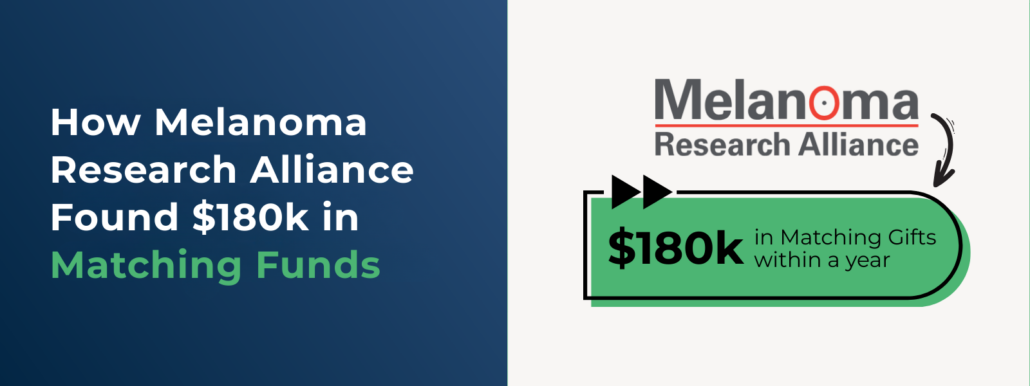
How Melanoma Research Alliance Found $180k in Matching Funds
Introduction: The Fight Against Melanoma Requires Maximum Resources
The Melanoma Research Alliance (or MRA for short) stands as the largest non-profit funder of melanoma research in the world. Since its founding, MRA-funded research has fueled a revolution in immune checkpoint and targeted therapies, helping to further advance prevention and cures for the disease.
One of the most compelling aspects of the MRA’s operational model is its commitment to financial efficiency. Thanks to the generosity of their founders, Debra and Leon Black, 100% of every donation goes directly to research, with no administration or development expenses incurred on donations. This “100% model” is a powerful motivator for supporters, as they know their entire contributions are used to drive research forward.
However, even with such a highly efficient model, leaving potential revenue on the table is not an option. In the high-stakes world of medical research, every additional dollar can bring scientists closer to a cure. MRA realized that while they were maximizing individual donor contributions, they were missing out on a “hidden” revenue stream: corporate matching funds.
By upgrading its technical infrastructure to better identify these opportunities, MRA was able to identify over $180,000 in match-eligible dollars in less than 12 months. This strategic pivot demonstrates how medical research organizations can leverage automation to scale their impact without increasing their administrative burden.

The Challenge: The Limitations of a “Passive” Fundraising Approach
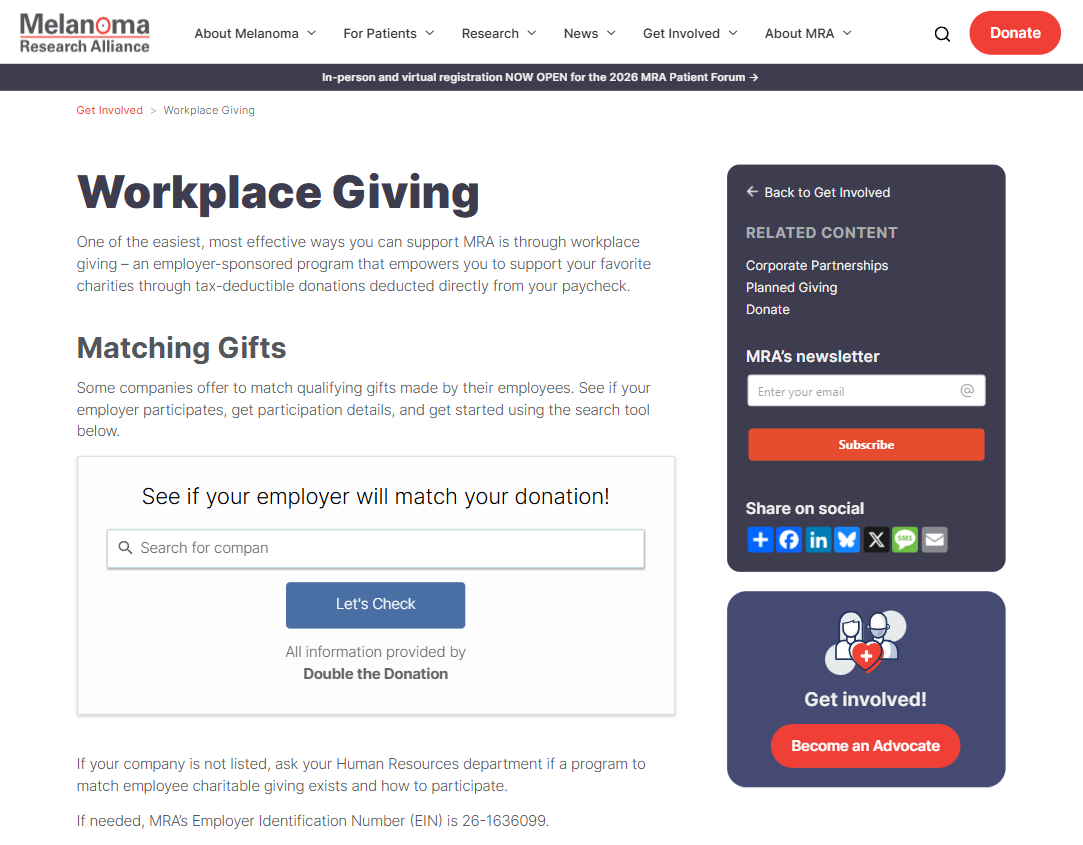
Before achieving these significant results, the Melanoma Research Alliance relied on a common, yet often insufficient, method for securing matching gifts. Initially, MRA used Double the Donation’s standalone search tool to give donors access to a searchable matching gift database.
The Problem with Standalone Tools
While a standalone tool provides a necessary resource (a database where donors can look up their eligibility), it inherently relies on a “passive” or “reactive” strategy. In this model, the burden of action is placed entirely on the donor.
For a match to be identified and submitted, the donor must:
- Know that matching gifts exist.
- Navigate to the specific page on the non-profit’s website where the search tool is located.
- Search for their employer.
- Navigate to their employer’s portal to submit the request.
For an organization like MRA, which focuses on driving research forward, relying on donors to jump through these administrative hoops resulted in missed opportunities. The team recognized that simply providing the database was not enough to capture the full volume of available matching funds. They realized that to truly maximize their revenue potential, they needed to remove the friction from the process.
The Increasing Need for Proactivity
The organization decided to upgrade to a fully automated system, investing in Double the Donation Matching for a “more proactive approach” to fundraising matching gift revenue. The goal was to shift the dynamic: instead of waiting for donors to ask about matching gifts, MRA would proactively present the opportunity to them at the precise moment of highest engagement.
The Strategic Pivot: Implementing a Fully Automated System
To execute this proactive strategy, MRA integrated Double the Donation Matching (a complete automation platform) into its existing fundraising operations. This upgrade allowed them to access “groundbreaking technology” that streamlined the identification and follow-up process.
The strategy relied on three core pillars of automation: identification, communication, and measurement.
1. Identification: Streamlining the Donation Form
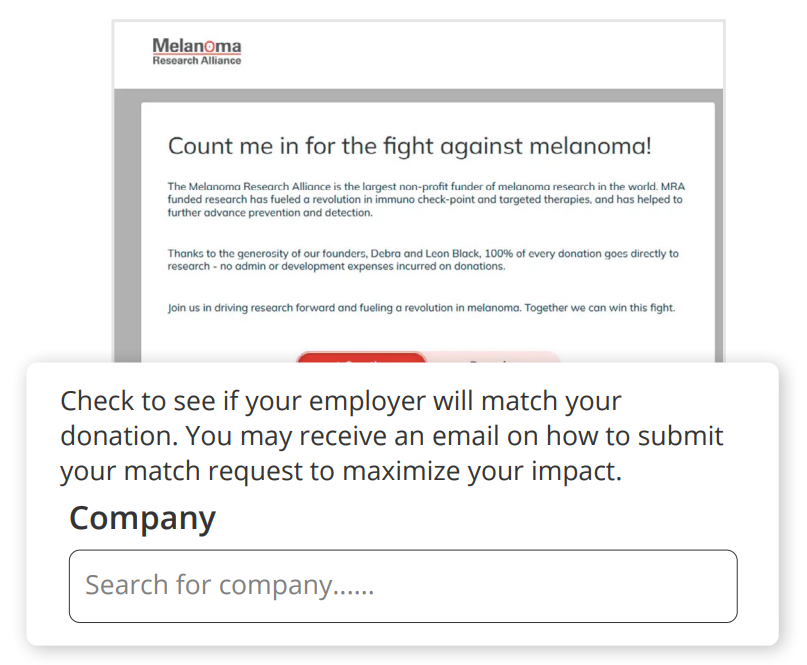
The first step in the new strategy was to capture employment data before the donor even left the donation page. To do this, MRA implemented a streamlined search field directly on their donation form.
By embedding the search tool into the donation flow, the system could determine donor match eligibility in real-time. This integration serves two critical functions:
- Data Capture: It captures the donor’s employer information while they are already engaged in entering their personal and payment details.
- Immediate Awareness: It plants the seed of “matching gifts” in the donor’s mind before the transaction is even complete, validating that their employer helps maximize their impact.
2. Activation: The Confirmation Page Plugin
Once a donation is made, the window for donor engagement begins to close rapidly. To capitalize on the momentum of the gift, MRA utilized a confirmation page plugin.
This feature provides donors with the next steps for a matching gift immediately after the transaction. Instead of leaving the donor to wonder “what next?”, the confirmation page explicitly guides them on how to submit their request. This immediate call to action significantly reduces the friction that often prevents donors from following through on a match.
3. Retention: Automated Email Follow-Up
Perhaps the most critical component of the proactive strategy was the implementation of automated matching gift emails sent to all donors.
Even with the best on-page experience, some donors will inevitably close the browser tab without submitting a match request. MRA’s use of email automation ensured that these opportunities were not lost. The system sends personalized emails to donors, informing or reminding them of their eligibility and providing direct links to their employer’s submission forms.
The results of this email strategy were highly effective, achieving an astounding 60% open rate. This metric is particularly impressive when compared to industry standards of ~28%, suggesting that MRA’s donors are highly motivated to amplify their contributions when given clear, easy-to-follow instructions.
The Standout Results: Unlocking $180k for Research
The transition from a standalone tool to a fully automated system produced immediate and tangible financial results for the Melanoma Research Alliance.
Financial Impact
In less than 12 months, MRA identified over $180,000 in match-eligible dollars. For an organization where 100% of donations go directly to research, this sum represents a significant amount of funding for scientific trials and therapy development. This is revenue that was likely available within the donor base previously but remained untapped due to the limitations of the passive search tool.
Donor Engagement Metrics
Beyond the top-line revenue, the engagement metrics reveal a donor base that is eager to participate in matching funds programs when the process is simplified.
- Donor Usage: Over 2,300 donors utilized the Double the Donation tools.
- High Engagement: 33% of donors accessed matching gift forms, guidelines, or opened multiple emails.
- Email Performance: The automated emails sent to donors achieved a 60% open rate.
These statistics validate the hypothesis that donors want to match their gifts; they just need the organization to make it easy for them to do so. By providing a “streamlined search field” and “actionable metrics,” MRA successfully bridged the gap between donor intent and completed action.
Analyzing the “100% Model” and Matching Gifts
The Melanoma Research Alliance’s success offers a broader lesson for non-profits operating with high-efficiency models. MRA prides itself on the fact that founders Debra and Leon Black cover all administrative and development expenses, ensuring 100% of public donations go to research.
In this context, matching funds become even more valuable. Because the administrative overhead of the organization is already covered, every single dollar matched by a corporation goes directly to the fight against melanoma. This creates a compelling narrative for donors: “Your $100 donation becomes $200 of pure research funding.”
By automating the matching gift process, MRA aligned its fundraising operations with its overall philosophy of efficiency. The automated system requires minimal staff intervention, allowing the organization to scale revenue without increasing the development expenses its founders work so hard to cover. The dashboard allows them to track actionable metrics without needing a large team to compile spreadsheets, keeping their operations lean and focused on the mission.
Conclusion: A Blueprint for Medical Research Fundraising
The Melanoma Research Alliance case study illustrates the immense potential of proactive fundraising technology. By recognizing that a standalone search tool was insufficient for their ambitious goals, MRA pivoted to a strategy that integrated matching funds directly into the donor journey.
Through the use of embedded search fields, confirmation plugins, and automated emails, MRA identified over $180,000 in additional revenue in less than a year. For other organizations looking to replicate this success, the key takeaways are clear:
- Don’t rely on donor memory: Capture employment data during the donation process.
- Automate the ask: Use high-open-rate emails to drive submissions post-donation.
- Track the data: Use dashboards to monitor engagement and identify “match-eligible dollars.”
By making the most of groundbreaking technology, the Melanoma Research Alliance continues to drive research forward, proving that the cure for melanoma is closer when we work and fundraise together.
Download the full case study compilation here to uncover even more successful strategies.