Using Fundraising Software to Unlock 5 Corporate Giving Streams
Every nonprofit fundraising professional knows the sinking feeling of leaving money on the table. You work incredibly hard to secure individual donations, host events, and build relationships, yet the administrative burden of chasing down corporate matches or researching grant eligibility often feels like an impossible task. This is where modern fundraising software steps in to revolutionize your strategy.
It is no longer just about processing credit cards or sending automated thank-you emails. Today’s tools are designed to actively identify, track, and secure corporate revenue streams that would otherwise go unnoticed. And we’re here to help guide your way!
In this comprehensive guide, our team will explore how to use these advanced tools to:
- Maximize matching gifts
- Secure volunteer grants
- Increase payroll giving
- Identify in-kind donations
- Apply for corporate grants
By leveraging the right technology, your organization can move from a reactive, manual fundraising approach to a proactive, automated strategy that taps into the billions of dollars available in corporate philanthropy funds. Let’s get started with the basics.
The Role of Fundraising Software for the Modern Nonprofit
For decades, nonprofit development relied heavily on manual processes. Gift officers managed relationships via spreadsheets, checks were logged by hand, and corporate giving opportunities were pursued only when a donor explicitly mentioned them. However, the landscape has since shifted. Today, fundraising software is not just a tool for processing transactions; it is the backbone of a proactive, scalable revenue strategy.
The modern nonprofit faces increased competition for donor attention and limited internal resources. To bridge this gap, organizations must leverage technology that does more than store data. The right software should act as an extension of your team, automating administrative tasks and uncovering opportunities that human eyes might miss. By integrating these tools into your daily operations, you transform your fundraising from a reactive scramble into a data-driven machine.
Moving From Data Entry to Fundraising Strategy
One of the most significant advantages of modern technology is the ability to turn raw data into actionable insights. In the past, a donor record might have contained only a name, an email address, and a donation history. Now, sophisticated platforms can enrich these records to provide a 360-degree view of your supporters. This shift allows development directors to focus on strategy rather than data entry.
For instance, many organizations now utilize employer appends to automatically scan their donor lists and identify where their supporters work. This process fills in missing employment data without requiring the donor to self-report. With this information, a nonprofit can instantly segment its list to find employees of companies with generous matching gift or volunteer grant programs. Instead of sending a generic appeal to everyone, you can trigger highly targeted messages to the donors most likely to qualify for corporate funding.
Did You Know?
Data hygiene is critical for fundraising success. Records with missing employment information are the primary reason billions in corporate matching gift revenue go unclaimed each year. Lucky for you, automated appending tools can increase the number of match-eligible records in your database by identifying the employers of your existing donors.
Enhancing the Donor Journey
Beyond internal efficiency, fundraising software also plays a pivotal role in shaping the donor experience. Supporters today expect the same seamless digital interactions they encounter with major e-commerce brands. If a donation form is clunky or if follow-up communication feels generic, donors are less likely to engage long-term.
For this reason, modern software ensures that every touchpoint is optimized for conversion and retention. By streamlining thank-you emails, tax receipts, and matching gift reminders, you ensure that no donor is ever forgotten. This consistency builds trust and encourages repeat giving. When a donor sees that your organization is organized, professional, and tech-savvy, they feel more confident that their contribution is being used effectively to further your mission.
1) Using Fundraising Software to Increase Matching Gifts
Matching gifts are perhaps the most well-known form of corporate giving, yet they remain one of the most underutilized revenue sources in the nonprofit sector. The concept is straightforward: an individual makes a donation to your organization, and their employer matches it with the same amount (or sometimes double or triple that amount) to the same cause. It sounds like free money, but the gap between donor eligibility and actual submission is massive.
According to recent matching gift statistics, approximately $4 to $7 billion in matching gift funds go unclaimed every year. This discrepancy occurs primarily because donors either do not know their employer offers a program or, if they do, are unsure how to navigate the submission process. For a busy development team, manually tracking every donor’s employer and researching their benefits is nearly impossible. This is why specialized fundraising software is essential for bridging the gap.
How Automation Makes a Difference
Advanced fundraising tools solve the awareness and submission problems through seamless automation. Today, the process begins the moment a donor engages with your organization. When an individual makes a gift through your online form, the software can immediately scan a matching gift database to determine eligibility based on their employer. This happens in real-time, often using a simple search tool embedded directly into the donation flow.
If a match is found, the system triggers an automated email sequence to the donor. These follow-ups provide specific forms, guidelines, and instructions that the donor needs to complete their request. Instead of your team having to chase down forms weeks after the gift is made, the software identifies and encourages the donor instantly while they are still engaged.
Did You Know? Research shows that 84% of donors say they are more likely to donate if a match is offered, and 1 in 3 say they would give a larger gift if matching is applied. Leveraging this psychology can boost your immediate fundraising totals with ease!
Furthermore, this type of software also allows you to track the status of these matches. You can see which donors have opened the emails, which have clicked the links, and even where they are in the submission process. This data allows your team to send targeted follow-ups only to those who may need an extra nudge, saving valuable staff time for high-value relationship building.
2) How Fundraising Software Helps Secure Volunteer Grants
While matching gifts focus on monetary donations, volunteer grants monetize the time and energy your supporters give to your cause. Frequently referred to as “Dollars for Doers,” these corporate programs allow companies to donate to nonprofits where their employees volunteer regularly.
However, despite being a powerful revenue source, these grants are often overlooked because volunteers rarely know they exist. Your dedicated supporters might be clocking in dozens of hours helping at events, organizing drives, or providing administrative support without realizing that their time could result in a significant check for your organization. Fundraising software helps you close this gap by capturing employment data during the volunteer registration process.
Integrating Employment Data
Modern volunteer management platforms allow you to integrate employer search fields directly into your volunteer sign-up forms. As volunteers register for upcoming shifts, they can easily check if their company offers a grant program. The system then provides them with the necessary guidelines to submit their hours for verification. This turns a standard registration form into a revenue-generating tool.
For example, if a volunteer from Verizon logs 50 hours with your organization, a fundraising software integration can automatically alert them of their eligibility for a $750 grant. Without the right tools to flag this, that revenue would likely be lost.
Fun Fact: Currently, 40% of Fortune 500 companies offer volunteer grant programs, and the rates are often generous.
Additionally, some companies offer corporate volunteerism grants for group engagement. If a team of employees from the same company volunteers together, the software can identify this group activity and prompt the organizers to apply for a team grant. This allows you to turn a single day of service into a substantial financial contribution.
3) Increasing Payroll Giving with the Right Fundraising Tools
Payroll giving is one of the most reliable sources of unrestricted funding for nonprofits. It allows employees to donate a portion of their regular paychecks to a nonprofit directly, often before taxes are taken out. This “set it and forget it” method leads to high retention rates and consistent monthly revenue your organization can rely on to cover operational costs.
However, getting into these programs can be difficult if you do not know which companies offer them or how to navigate their specific portals. Fundraising software helps here by aggregating data on companies with established workplace giving programs. This allows your team to target specific donors with information on how they can set up a recurring gift through their employer’s system.
Targeting Eligible Employees
Using a tool like Double the Donation, you can prompt donors to check for payroll giving eligibility during the donation process or in follow-up communications. If their employer participates, the software can direct them to the correct internal portal (such as Benevity, CyberGrants, or YourCause) to set up their deduction.
This automated guidance is crucial because navigating corporate intranets can be confusing for employees. By providing a direct link or clear instructions through your software, you remove the friction and make it easy for them to become sustaining donors. This turns a one-time donor into a lifetime supporter with minimal ongoing effort from your team.
4) How Fundraising Software Helps Identify In-Kind Donations
Cash isn’t the only way companies support nonprofits, either! In-kind donations for nonprofits (such as goods, services, or technology) can be just as valuable as financial support. This might look like a law firm providing pro bono legal work, a tech company donating software licenses, a marketing agency offering design services, or a retailer providing supplies for an event.
However, the challenge lies in identifying which companies offer these programs and their specific focus areas. Trying to research this manually for every corporate partner is inefficient and often leads to dead ends. Fundraising software simplifies this process by providing a searchable database of corporate giving profiles.
Strategic Corporate Asks
You can use these tools to filter companies by the type of support they offer. If you need auction items for an upcoming gala or technology upgrades for your office, you can quickly identify businesses that have a history of in-kind giving. This targeted approach saves your team hours of research and increases the likelihood of a “yes” by pitching to companies that already have established programs for these types of gifts.
For example, rather than sending a generic letter to every business in your city asking for in-kind donations, you can use your software to identify local branches of major corporations that specifically donate products to community events. This precision allows you to tailor your ask, referencing their specific guidelines and showing that you have done your homework.
5) Winning Corporate Grants with Leading Fundraising Technology
Corporate grants for nonprofits are often distinct from government or private foundation grants. They are typically tied to the company’s Corporate Social Responsibility (CSR) goals, such as sustainability, education, or community development. And because these grants are often linked to employee engagement, they can be easier to secure if you already have donors or volunteers from that company.
Fundraising software provides the insights you need to make these connections visible. By analyzing your supporter data, the software can highlight companies where you have a strong base of employee support. This data is crucial when writing a grant proposal, as it demonstrates that the company’s workforce is already invested in your mission.
Leveraging Your Data for Compelling Proposals
When you use software to track employer data, you can approach a corporation with compelling stats. Imagine being able to say, “50 of your employees donated to us last year,” or “Your staff volunteered over 200 hours with our organization in the past six months.” This proof of engagement makes your grant application stand out significantly against others that lack a direct connection to the workforce.
Additionally, corporate philanthropy is increasingly driven by employee preference. Many companies offer “employee choice” grants where staff vote on which nonprofits to fund. Using software to surface these connections ensures you are focusing your grant-seeking efforts on the companies where you already have internal champions who can advocate for your cause.
The Role of Comprehensive Fundraising Tools for Nonprofits
Building a successful fundraising strategy is a lot like building a house. You cannot do it with just a hammer. Instead, you need a full set of specialized tools working together. For the modern nonprofit, this means utilizing a “tech stack” or a collection of software platforms that handle different parts of your operations. While fundraising software is a broad term, it encompasses several key components that every organization should have in place.
Essential Components of a Complete Fundraising Tech Stack
To operate efficiently, most nonprofits rely on four main types of technology, each serving a distinct purpose in the donor lifecycle. These include:
- Donation Forms: This is your digital collection plate. Effective donation software ensures that the giving process is fast, secure, and mobile-friendly. It is the frontline where money actually changes hands.
- CRMs (Constituent Relationship Management): If donation forms are the hands, the CRM (or donor database) is the brain. This system stores all your donor information, giving history, and contact details. It allows you to track relationships over time rather than just single transactions.
- Marketing Tools: These platforms handle your outreach. From email newsletters to social media scheduling, nonprofit marketing tools ensure your message reaches the right people at the right time.
- Volunteer Management: For organizations that rely on people power, this software tracks shifts, hours, and volunteer details, replacing messy spreadsheets and sign-up sheets.
The Power of Seamless Software Integrations
Having these tools is a great start, but the real magic happens when they can communicate with one another. If your systems are siloed, your team ends up doing double the work moving data around. This is especially critical when it comes to corporate giving.
Luckily, specialized tools like Double the Donation are designed to integrate directly with the platforms you already use, creating a seamless experience for both your staff and your supporters.
For the best results, your corporate fundraising strategy should not live on an island. Instead, it should be woven into your existing tech stack through integration:
- On Your Donation Forms: Capture employment data the moment a gift is made! This allows you to identify workplace giving eligibility immediately without asking the donor to navigate to a separate page.
- Inside Your CRM: The integration flows transaction data from your database into your corporate fundraising platform to power your automation strategies. By syncing offline gifts and other donor records, you ensure that supporters who give via check or phone still receive personalized outreach encouraging them to submit matching gifts or volunteer grants.
- Within Volunteer Management: For volunteer grants, the software plugs into your registration forms. This allows you to flag eligible volunteers as they sign up for shifts, ensuring you never miss an opportunity to monetize their time.
By choosing a comprehensive set of tools that integrate with each other, you create a fundraising ecosystem that works 24/7 to identify and secure revenue for your mission. Furthermore, using the right software improves donor retention. When supporters see that you are helping them maximize their impact through their employer, they feel more connected to your mission. This improved donor experience leads to stronger long-term relationships and increased lifetime value.
Making the Most of Your Fundraising Software: Frequently Asked Questions
Adopting new technology often comes with questions about implementation, cost, and expected results. To help you understand how these tools fit into your existing operations, we’ve provided answers to some of the most common inquiries nonprofits have about utilizing fundraising software to automate corporate giving and beyond.
-
Will the software integrate with our existing fundraising tools?
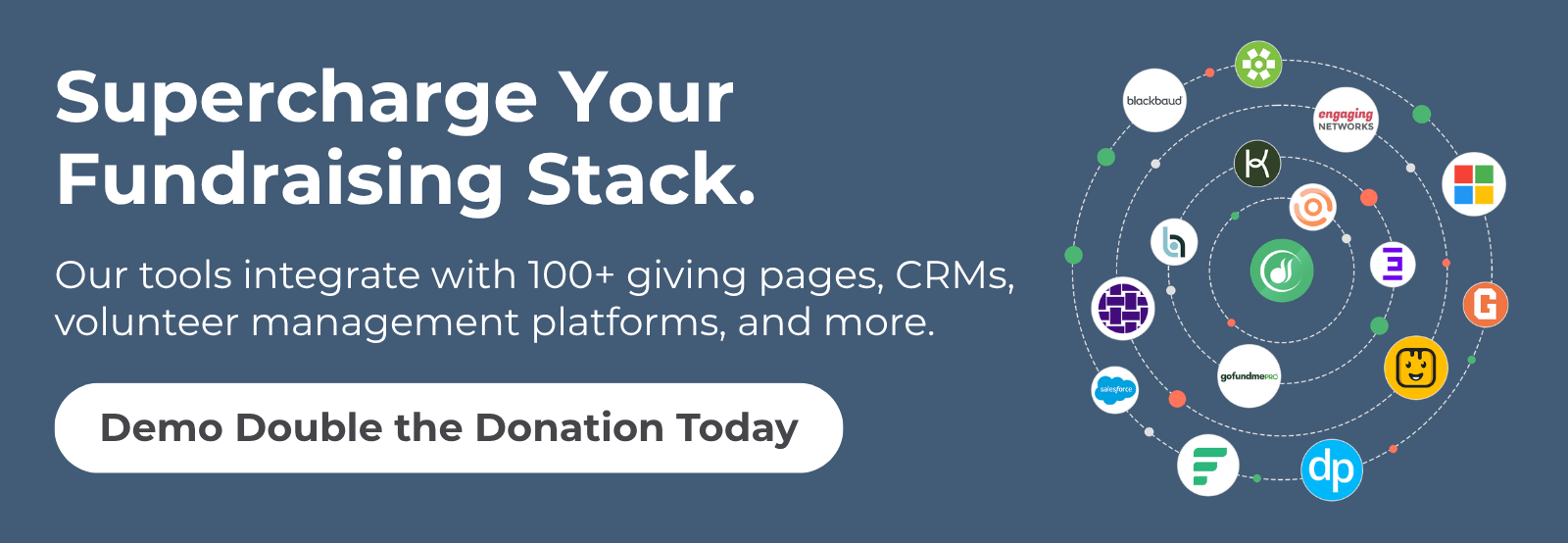
Yes! Leading fundraising software, such as Double the Donation, integrates directly with many of the tools you already use. In fact, it currently partners with over 90 different donation platforms, CRMs, and peer-to-peer software. In most cases, activating the feature is as simple as turning on an API key, requiring little to no technical expertise or custom coding from your team.
-
Is automation worth the investment for small nonprofits?
Absolutely. In fact, small teams often see the highest ROI from automation because they lack the staff to perform manual corporate research. By automating the identification and follow-up process, a small nonprofit can process thousands of donations and uncover hidden revenue with the efficiency of a large enterprise, essentially acting as an additional staff member (or even an entire team!).
-
How does automation impact the donor experience?
Automation significantly enhances the donor journey by making it easier for supporters to maximize their impact. Donors want to help your cause, but they often find corporate forms confusing or time-consuming. Luckily, the right software removes this friction by delivering the exact forms and instructions they need directly to their inbox, making the process of doubling their donation feel helpful rather than burdensome.
-
How quickly can we expect to see an increase in revenue?
Many organizations begin identifying new opportunities immediately upon implementation. Once the search tool is active on your donation forms, you start capturing employment data instantly. While the speed at which the actual check is received depends on the corporation’s disbursement schedule, the pipeline of identified revenue typically begins to grow within the first 24 hours after launching the software.
Wrapping Up & Next Steps
Corporate giving is a vast ecosystem that goes far beyond a simple check. By using powerful fundraising software (such as Double the Donation) to streamline operations, your nonprofit can tap into matching gifts, volunteer grants, payroll giving, in-kind donations, and corporate grants with greater efficiency and precision. The technology exists to do the heavy lifting, allowing your team to focus on building relationships and delivering on your mission.
Don’t let these opportunities slip through the cracks. Equip your team with the data and automation they need to capture the full value of your donor network.
Ready to see how our fundraising software can help your team uncover these revenue streams? Explore Double the Donation today.