
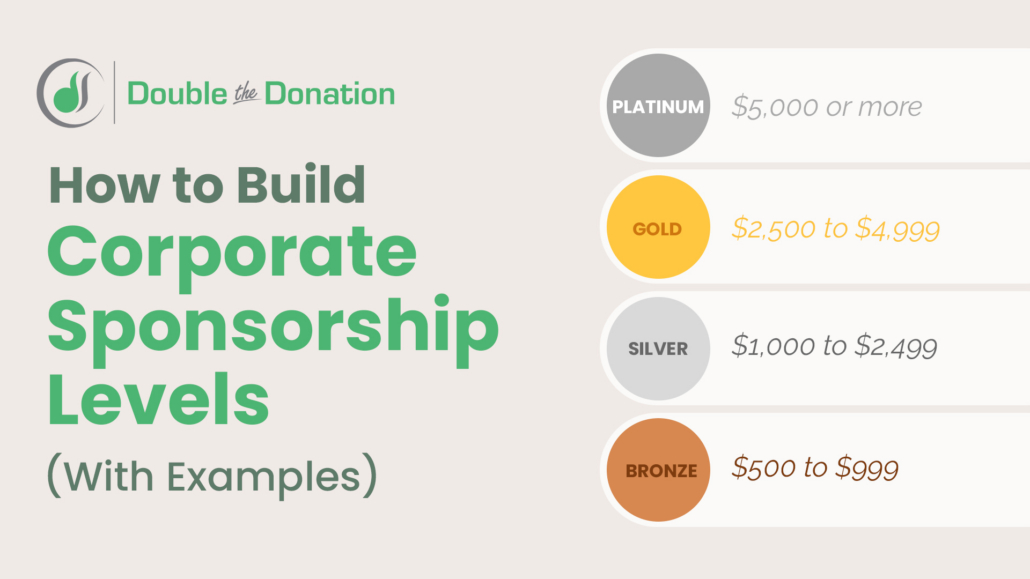
How to Build Corporate Sponsorship Levels (With Examples)
For many nonprofits, corporate sponsorships are the engine that drives large-scale impact. A well-structured partnership can provide a massive influx of capital, resources, and visibility needed to scale a nonprofit program or event. However, if you approach a business without a clear structure, you risk leaving money on the table. This is where corporate sponsorship levels come into play.
By organizing your opportunities into a tiered approach, you can create a professional, scalable framework that allows businesses of all sizes to see exactly how they fit into your mission. In this guide, we’ll dive deep into building a sponsorship program that attracts high-value partners and maximizes your nonprofit’s revenue. We’ll cover:
- What are corporate sponsorship levels? Understanding the basics
- How to build corporate sponsorship levels step-by-step: The technical process of creating your tiers
- Successful examples of nonprofits’ sponsorship levels: Real-world inspiration from industry leaders
Let’s start by defining exactly what we mean by corporate sponsorship levels and why this structure is the gold standard for workplace fundraising.
What are corporate sponsorship levels?
Corporate sponsorship levels are predefined sets of partnership packages that offer specific benefits for companies in exchange for varying amounts of financial or in-kind support they are willing to provide.
Think of it as a menu for your corporate partners. Instead of a vague request for help, sponsorship levels provide a clear value proposition: “If you invest $X, your brand receives Y exposure and Z impact.”
Common tiers include:
- Title (Presenting) Sponsor: This is your top-tier partner. Their name is often integrated into the event or program title (e.g., “The [Company Name] Annual Gala”). They receive the most logo prominence, speaking opportunities, and exclusive media mentions.
- Platinum (Premier) Sponsor: These are your anchor partners. They receive significant branding across all platforms but may not have the exclusive “title” naming rights.
- Gold Sponsor: A mid-to-high level tier that usually includes social media shout-outs, a table at an event, and large logo placement on marketing materials.
- Silver Sponsor: A standard entry point for mid-sized businesses. Benefits usually include logo placement on the website and event signage.
- Bronze (Supporting) Sponsor: The most accessible level, often used by small local businesses. Benefits are typically limited to a name mention or a small logo on a group “thank you” banner.
- Category (Component) Sponsor: These are specialized sponsorships. Examples may include a Media Sponsor (providing free advertising), a Technology Sponsor (supplying the event app), or a Beverage Sponsor.
Meanwhile, some nonprofits are moving away from precious metals, opting instead for mission-based titles, such as “Impact Partner,” “Education Advocate,” or “Community Champion,” to align sponsorships more closely with their causes.
The sponsorship structure is beneficial because it creates a sense of exclusivity and prestige, while also simplifying the decision-making process for corporate social responsibility managers who need to justify their spending to their own stakeholders.
How to build corporate sponsorship levels step-by-step
Building your levels isn’t just about picking numbers out of a hat. To attract a savvy corporate partner, your sponsorship tiers must be grounded in market realities and deliver genuine ROI (or Return on Investment).
Let’s walk through the five-step process for building a professional sponsorship deck.
1. Identify your sellable assets.
Before you can ask for money, you need to know what exactly you are selling. In the world of nonprofit sponsorships, you aren’t just providing a good feeling of altruism. You’re facilitating access and visibility for corporate partners.
To get started, audit your organization to find everything a company might find valuable. Common assets include:
- Digital Reach: Website traffic, email list size, and social media followers
- Event Access: Speaking slots, VIP tickets, and booth space
- Content Opportunities: Opportunities for the company CEO to be interviewed in your newsletter or featured in a video
- Data and Impact: The ability for a company to say, “Our $10,000 provided 5,000 meals.”
- Branding: Logo placement on t-shirts, banners, step-and-repeats, and program books
- Naming Rights: Enabling a company to name your new building or program
Consider the unique “white space” your nonprofit occupies. If you run an animal shelter, could a local pet supply store sponsor a “Cat Cafe” in your lobby? If you’re an environmental group, could a tech company sponsor a live stream of a restored wetland? You might even offer social media takeovers in which a partner shares their sustainability story directly with your followers.
By matching your organization’s specific activities with a sponsor’s brand identity, you can create high-value assets that a generic package could never replicate.
2. Research your market value.
Once you have your list of assets, you need to price them appropriately. If you were a marketing agency, what would it cost a company to reach 10,000 people via Facebook ads? That is your baseline.
However, nonprofit sponsorship has a “halo effect” as well, or the added value of a company being associated with a good cause. Research what similarly sized nonprofits in your area charge for sponsorship opportunities. If your local competitor’s “Gold” sponsorship level is $5,000, you should likely be in that same ballpark unless you can prove your audience is significantly larger or more engaged.
3. Establish 3-5 distinct tiers.
When building your sponsorship levels, you generally move from the highest level of investment (and visibility) down to more accessible entry points. These might include:
- The “Reach” Tier: Your Title/Platinum level. Price this high; higher than you think. There is often one company in your network looking for a major branding play.
- The “Sweet Spot” Tiers: These are going to be your Gold and Silver levels, and it’s where most of your partners will land. Price these to be accessible to mid-sized local businesses.
- The “Entry” Tier: Your Bronze or Community level. This should be priced so that a local Mom-and-Pop shop can participate and feel involved in the community.
Offering too many choices often leads to analysis paralysis. Ideally, you want between three and five sponsorship levels, which will allow you to target different budget ranges without overwhelming potential partners.
4. Name your levels (and be creative!).
While Gold, Silver, and Bronze are classic and easy to understand, they can feel a bit dated. Creative nomenclature can help your proposal stand out and reinforce your mission. Here are a few examples:
- For an environmental nonprofit: Seedling, Sapling, Oak, Forest.
- For a literacy program: Reader, Author, Editor, Publisher.
- For a medical charity: Caregiver, Healer, Lifesaver, Hero.
Inventive names make the partnership feel more like a collaboration and less like a transaction. Just ensure the hierarchy remains clear; everyone should intuitively know that a Forest sponsor is at a higher level than a Seedling.
5. Implement an online sponsorship hub.
Don’t hide your sponsorship opportunities in an outdated PDF attached to an email. Rather, establish an easily accessible “Corporate Partnerships” landing page on your website.
For the best results, this online hub should include:
- An overview of your organization’s mission and impact
- Audience demographics (who will see the company’s logo?)
- Detailed descriptions of each sponsorship level that is available
- A “Contact Us” form or a direct link to purchase a sponsorship package online
- Logos and/or testimonials of current corporate sponsors (for social proof)
Check out some standout corporate sponsorship web pages to inspire your efforts here!
Successful examples of nonprofits’ sponsorship levels
Ready to see these best practices in action? Examining how the “pros” do it can provide an actionable roadmap for your own partnership strategy. Let’s take a look at five organizations that have mastered the art of corporate sponsorship levels.
1. Team Rubicon
Team Rubicon utilizes a highly professional approach to partnerships. They categorize partners not just by dollar amount but by function, distinguishing between “National Partners,” “Mission Partners,” and beyond. This tactic demonstrates how the organization tailors its giving levels to the type of support a company provides.
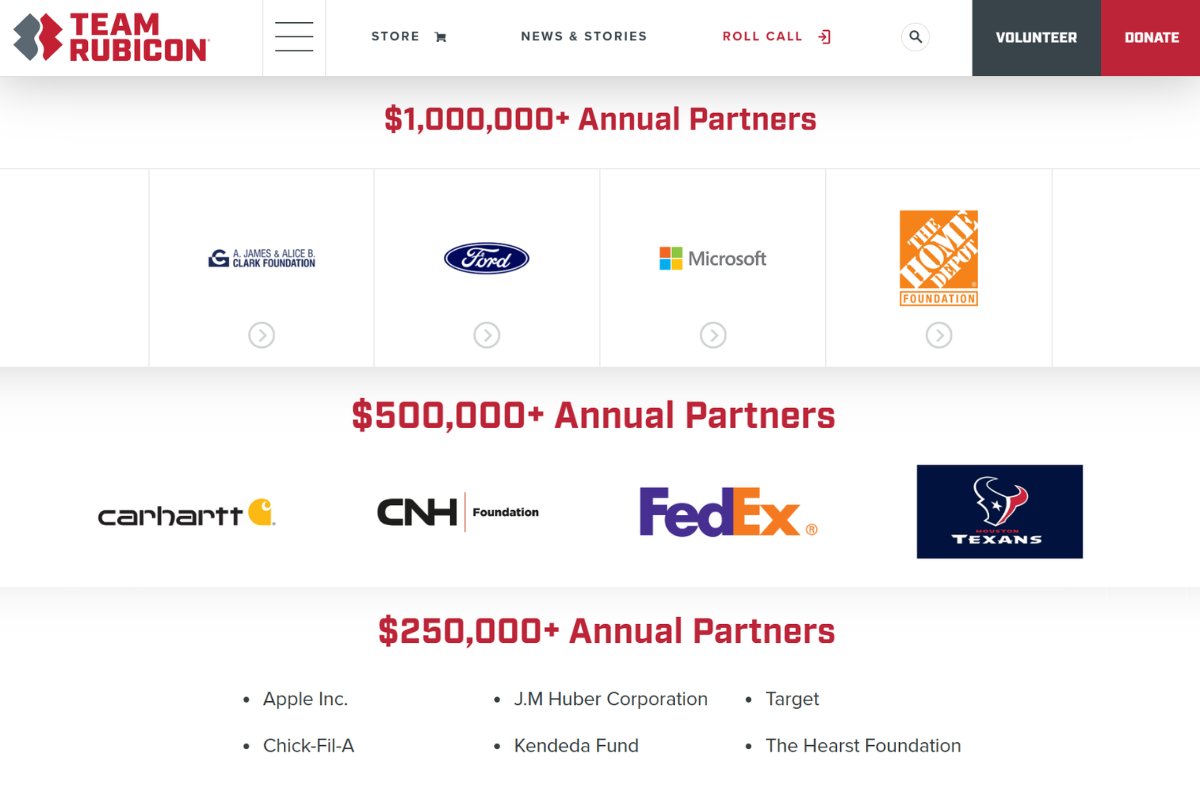
Team Rubicon also provides a masterclass in visual hierarchy for distinguishing its partnership tiers. The highest-level partners receive a large, clickable logo spot that invites users to learn more about the company. As you move down to the $500,000+ tier, the logos remain but lose the interactive click-through feature. By the time you reach the $250,000+ level, logos are removed in favor of a clean, bulleted list of company names.
This clearly communicates that while every partner is valued, the greatest digital real estate is reserved for those making the most significant investments.
Explore Team Rubicon’s corporate sponsorship levels here.
2. The Trevor Project
The Trevor Project does an excellent job of showing the breadth of its partnerships. Their sponsorships page serves as a gallery of trust; by seeing brands like Coca-Cola and Abercrombie & Fitch, potential new partners feel confident that The Trevor Project is a high-ROI organization with a professional management style.
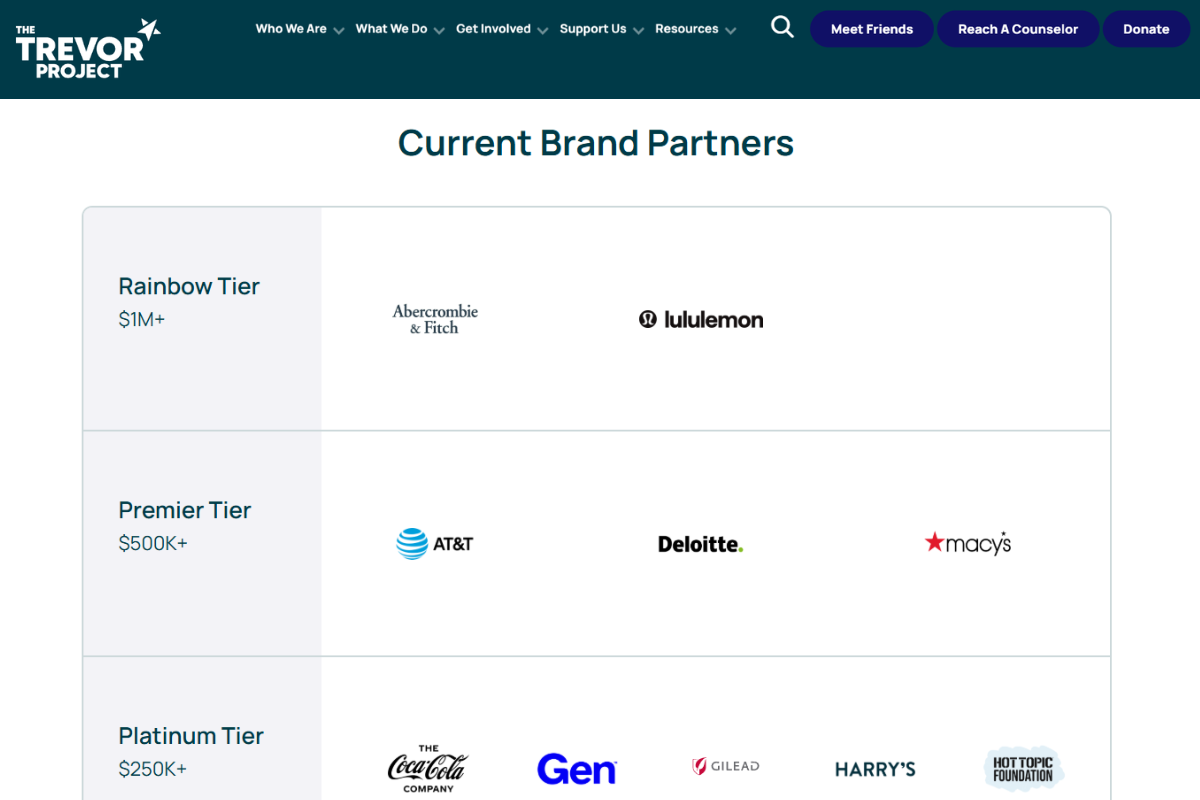
Notably, The Trevor Project also excels at mission-aligned naming. Their team uses the “Rainbow Tier” to designate their $1M+ partners, which immediately connects the sponsorship to the LGBTQ+ community the organization serves. This makes the partnership feel more like a shared identity than a financial transaction.
Explore The Trevor Project’s corporate sponsorship levels here.
3. Feeding San Diego
Feeding San Diego excels at localized corporate engagement. Their partnerships page offers clear pathways for “Corporate Philanthropy,” “Event Sponsorship,” and “Employee Engagement.” This is a great example for mid-sized nonprofits. Show potential sponsors that they can give money, but they can also bring their team to volunteer, creating a holistic partnership that goes beyond a single check.
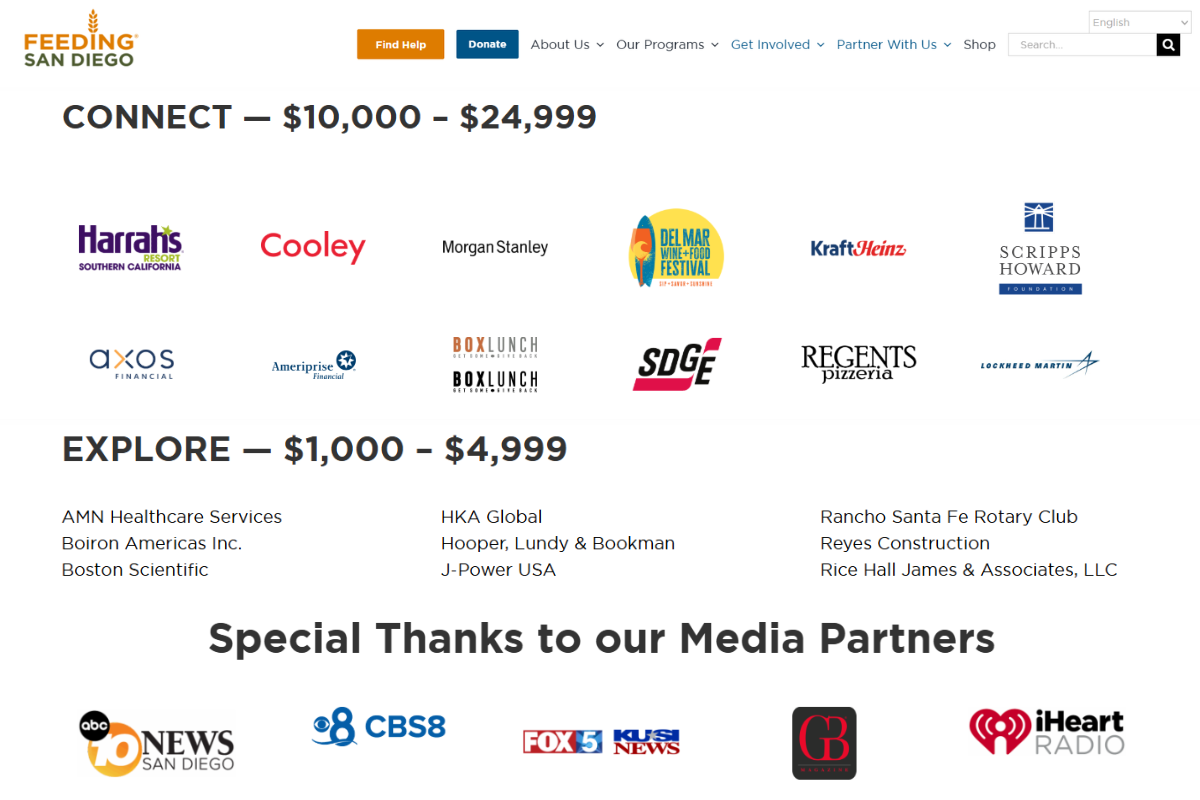
This organization also demonstrates how to properly acknowledge specialized support. While they categorize financial partners under action-oriented headings such as “Connect” and “Explore,” Feeding San Diego concludes with a dedicated section offering special thanks to its media partners.
By giving outlets like ABC 10 News and iHeart Radio their own branded space, the nonprofit acknowledges that visibility is a two-way street. These partners provide the megaphone for the mission, and in return, they receive specialized recognition that doesn’t compete with the cash-donor tiers.
Explore Feeding San Diego’s corporate sponsorship levels here.
4. The Salvation Army
The Salvation Army provides an excellent example of flexibility in corporate partnership types. The organization’s online sponsorship hub features an expandable accordion menu that clearly outlines the requirements for achieving Platinum, Gold, or Silver status (based on cumulative annual giving).
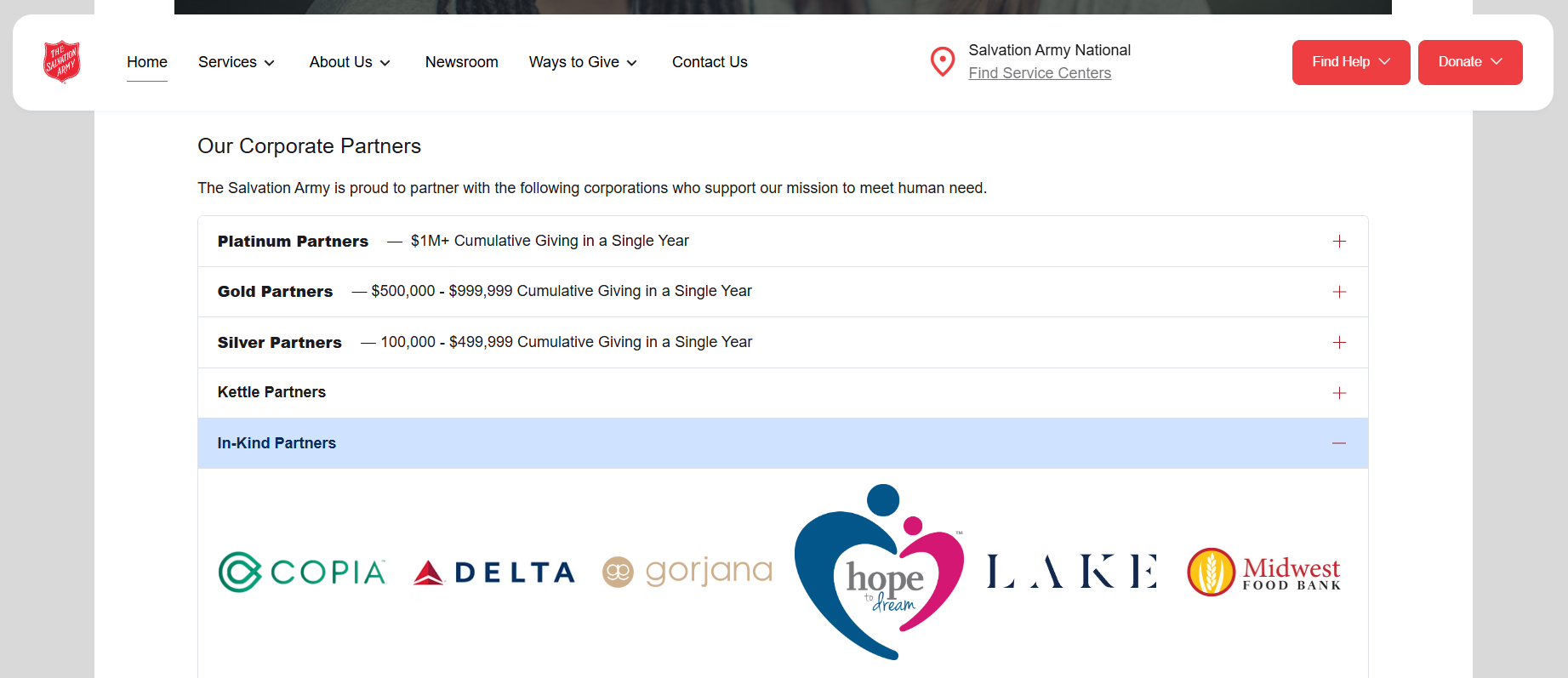
They also include a specific tier for in-kind partners, which is crucial for nonprofits that rely on donated goods or services. By giving in-kind donors their own category, they ensure that a company providing $100,000 worth of logistics or food is celebrated just as prominently as one that writes a check.
Explore The Salvation Army’s corporate sponsorship levels here.
5. St. Jude Children’s Research Hospital
St. Jude is the gold standard for mission-aligned branding. The research hospital provides a massive directory of existing sponsors. This demonstrates to a prospect that companies like theirs are already finding success with St. Jude partnerships.
It turns their sponsorship hub into a directory of industry leaders, making the sponsorship feel like an elite club.
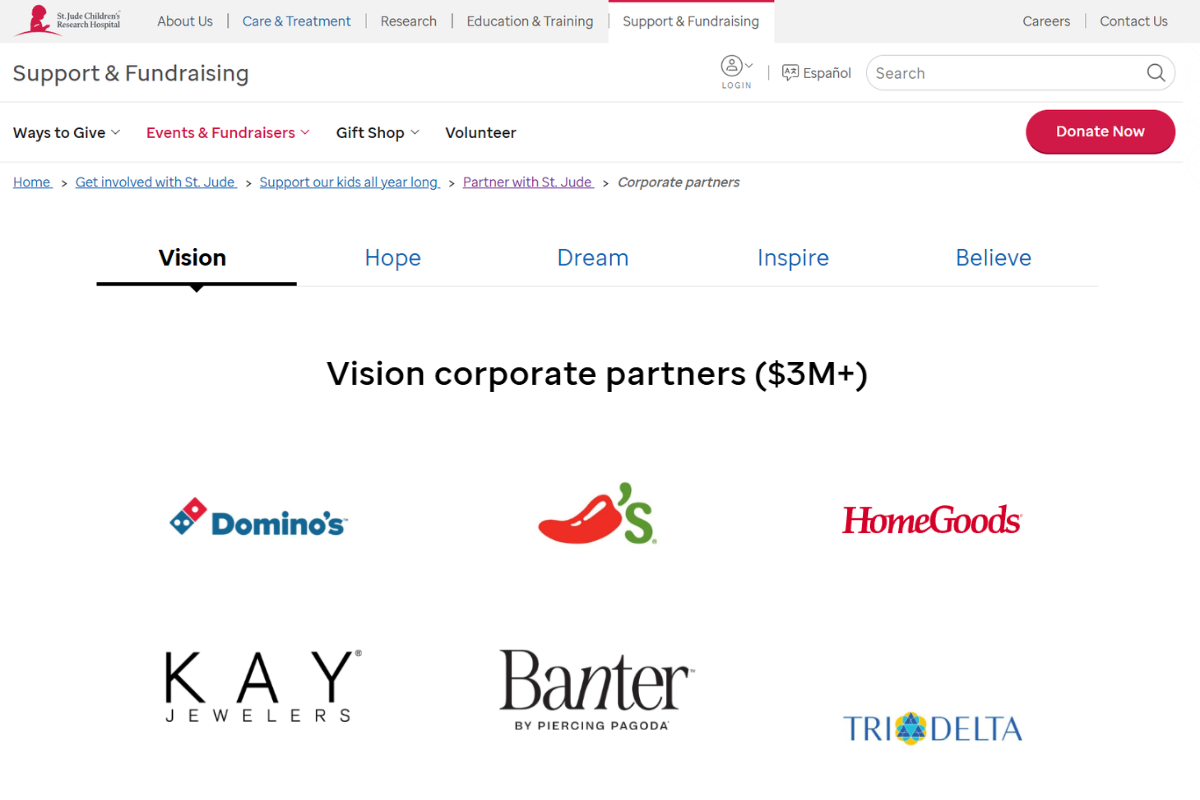
St. Jude also uses aspirational tier names that reflect the emotional core of their mission. Their core sponsorship levels (Vision, Hope, Dream, Inspire, and Believe) guide the donor through a narrative of impact.
Explore St. Jude’s corporate sponsorship levels here.
Final thoughts on corporate sponsorship levels
Building corporate sponsorship levels is about more than just organizing your fundraising; it’s about speaking the language of business. When you present a company with a clear, tiered structure, you show them that you value their time, understand their need for ROI, and have a professional plan for their investment.
Remember that these levels are not set in stone. As your nonprofit grows and your reach expands, your assets become more valuable. Review your levels annually to ensure they still reflect the market value of the exposure you provide.
Don’t leave your corporate strategy to chance. Build your levels, define your value, and start turning local businesses into lifelong mission partners today.