Marketing Volunteer Time Off Internally to Boost Support
Volunteer Time Off (VTO) is rapidly becoming a staple in corporate benefits packages. Companies ranging from tech giants to local banks are now paying their employees to step away from their desks and spend time supporting nonprofits like yours. For a volunteer coordinator struggling to fill daytime shifts, this sounds like a dream come true. Yet, despite the prevalence of VTO (with 66% of employers offering some form of paid release time), many nonprofits fail to capitalize on it.
The disconnect often isn’t with the companies; it is internal. If your volunteer coordinator doesn’t know which companies offer VTO, they can’t suggest it to a supporter struggling to find time. If your development director doesn’t see VTO as a cultivation tool, they miss the chance to deepen corporate partnerships. To unlock the full potential of these corporate programs, you must treat marketing volunteer time off internally as a strategic priority.
Getting your staff, leadership, and existing volunteer base aligned on the value of VTO is the first step toward a more sustainable, high-capacity volunteer program. When your internal team understands that VTO is the key to securing reliable, skilled, daytime support (and the financial grants that often accompany it), they become active agents in your recruitment strategy.
In this guide, we’ll cover:
- Why Internal Buy-In is Crucial for VTO Success
- Identifying Key Internal Stakeholders
- Strategy 1: Educating Your Staff on VTO Mechanics
- Strategy 2: Integrating VTO into Volunteer Onboarding
- Strategy 3: Gamifying the Search for Eligible Volunteers
- Strategy 4: Sharing Success Stories to Build Culture
- Leveraging Technology to Automate the Process
By focusing on marketing volunteer time off internally, you transform your organization from one that passively accepts volunteers to one that strategically leverages corporate benefits to fuel your mission.
Why Internal Buy-In is Crucial for VTO Success
The primary barrier to utilizing VTO is rarely the corporate policy itself; it is the “knowledge gap.” Employees often forget they have the benefit, or they assume it can only be used for company-sponsored days of service. On the nonprofit side, staff members are often so focused on executing programs that they forget to ask about the volunteer’s employment.
When you invest in marketing volunteer time off internally, you close this gap. You empower your staff to act as consultants for your volunteers, reminding them of benefits they may have overlooked.
The Benefits of Alignment:
- Daytime Availability: Most volunteers work 9-5, making them available only on weekends. VTO unlocks the workweek, providing you with coverage during critical business hours.
- Skilled Labor: VTO often attracts professionals who want to use their specific skills (accounting, marketing, IT) for good.
- Financial Impact: VTO is a gateway to Volunteer Grants (financial donations for hours served). If a staff member encourages a volunteer to use VTO, they are often simultaneously securing a monetary grant for the organization.
Key Stakeholders: Who Needs to Know What?
To market VTO effectively within your organization, you need to tailor the message. Different team members care about different metrics.
1. Volunteer Managers
What they need to know: Which local companies offer VTO and how to help volunteers request it.
The Incentive: VTO solves their biggest headache: shift coverage. It provides a pool of reliable, background-checked individuals who are being paid to be there, meaning they are less likely to flake than casual volunteers.
2. Development & Fundraising Team
What they need to know: Which volunteers are using VTO.
The Incentive: A volunteer using VTO is a “warm lead” for corporate partnership. If a company is paying an employee to be at your facility, they are already invested. This is the perfect opening for a sponsorship or grant conversation.
3. Marketing & Communications
What they need to know: How to talk about VTO in newsletters and social media.
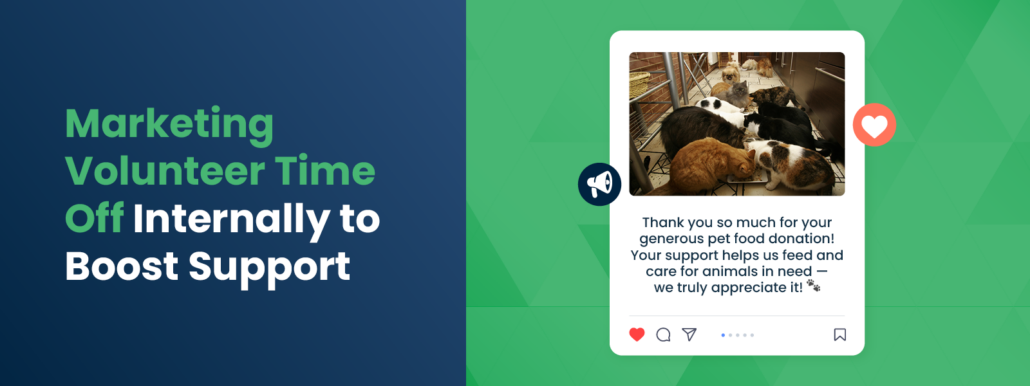
The Incentive: It gives them powerful content. “Thank you to [Company] for sending [Employee] to help us today!” is a great social media post that drives engagement and visibility.
Strategy 1: Educating Your Staff on VTO Mechanics
You cannot market what you do not understand. The first step in marketing volunteer time off internally is training your staff on how these programs work. Many nonprofit professionals are vaguely aware of “corporate volunteering” but don’t know the specifics of VTO.
Host a “Lunch and Learn.” Dedicate a staff meeting to Corporate Philanthropy 101. Explain the difference between:
- Volunteer Grants: Cash for hours.
- VTO: Paid time off for hours.
- Team Service Days: Organized group events.
- And more!
Create a “VTO Cheat Sheet.” Don’t expect your staff to memorize every corporate policy. Create a simple, one-page reference guide that lists the top 10-20 employers in your area that offer VTO.
Example: “Thomson Reuters: 16 hours/year. Contact: HR Portal.”
Example: “Patagonia: 18 hours/year. Contact: Store Manager.”
Post this cheat sheet in the volunteer check-in area and save it to your internal shared drive. When a volunteer coordinator sees a supporter wearing a company polo or using a corporate email address, they can quickly check the list.
Quick Tip: Frame VTO as a benefit for the volunteer. Train your staff to say, “Did you know your company might pay you to be here today? You shouldn’t have to use a vacation day to support us!” This positions your nonprofit as looking out for the volunteer’s well-being.
Strategy 2: Integrating VTO into Volunteer Onboarding
The best time to market VTO is when a volunteer is most eager: the moment they join your team. Your internal marketing strategy should focus on embedding VTO messaging into every step of the onboarding process.
Update the Handbook: Include a section on “Corporate Benefits” in your volunteer handbook. Explain that your organization welcomes VTO use and is happy to sign any verification forms required by employers.
Script the Orientation: Give your volunteer trainers a script. During orientation, they should explicitly ask: “Raise your hand if you work for [Major Local Employer 1], [Major Local Employer 2], or [Major Local Employer 3]. Did you know they offer paid time off to volunteer here? We can help you set that up.”
The “Employer” Field: Ensure your volunteer registration forms include a mandatory field for “Employer.” This data is the fuel for your VTO strategy. Without it, you are flying blind.
Strategy 3: Gamifying the Search for Eligible Volunteers
Data collection can be tedious. To make internal marketing of volunteer time off engaging, turn it into a friendly competition.
The “VTO Scavenger Hunt”: Challenge your program staff to identify as many VTO-eligible volunteers as possible in one month.
The Goal: “Identify 20 volunteers who work for companies with VTO policies.”
The Method: Staff can ask volunteers during shifts, check email domains (e.g., @deloitte.com), or review LinkedIn profiles.
The Prize: The staff member who uncovers the most potential VTO hours wins a gift card or an extra half-day of PTO.
This gamification trains your team to be observant. They stop seeing “a volunteer” and start seeing “a Microsoft employee with 20 hours of unused VTO.”
Strategy 4: Sharing Success Stories to Build Culture
Nothing drives adoption like social proof. When a volunteer successfully uses VTO, celebrate it internally.
The “Win of the Week”: In your weekly staff email, highlight a VTO success story. For example, “Shout out to our volunteer coordinator, Sarah! She noticed a volunteer wearing a Salesforce t-shirt, asked about VTO, and now that volunteer has committed to 7 full days of service (56 hours) using their VTO benefit!”
Visual Reminders: Create a “Corporate Impact Wall” in your office. Post logos of companies whose employees have used VTO to support you. This serves as a constant visual reminder to staff that corporate partnerships are vital to your ecosystem.
Leveraging Technology to Support Your Team
Manual tracking is the enemy of sustainability. If marketing volunteer time off internally requires your staff to spend hours Googling corporate policies, they will eventually stop doing it. You need to equip them with the right tools.
Employer Search Tools: Invest in a corporate giving database, such as Double the Donation. These tools can be embedded directly into your volunteer forms.
How it helps: When a volunteer enters their employer’s name, the tool instantly tells them (and your staff) whether the company offers VTO or volunteer grants. This removes the guesswork and provides immediate verification.
Automated Nudges: Use your CRM to automate the “ask.” If a volunteer registers with a corporate email address known to offer VTO, set up an automated email that says: “We see you work for [Company]. They offer 20 hours of VTO! Here is a link to the form you need to submit to get paid for your time with us.”
By automating the outreach, you ensure that every opportunity is captured, even when your staff gets busy.
Wrapping Up & Next Steps
Marketing volunteer time off internally is about shifting your organizational mindset. It requires moving away from the idea that volunteers are just “free help” and recognizing them as valuable assets with corporate backing. When your entire team—from the front desk to the executive suite—understands the power of VTO, you create a culture that maximizes every hour given to your cause.
By training your staff, integrating VTO into onboarding, and leveraging technology, you can turn your volunteer program into a robust engine for corporate engagement and financial sustainability.
Ready to get your team on board?
- Audit Your Data: Check your current volunteer list. What percentage has employer info listed?
- Create the Cheat Sheet: Build the one-page resource of local VTO companies this week.
- Host the Training: Schedule a 30-minute session to teach your staff how to ask the “VTO question.”
Don’t let these corporate benefits go to waste. Start the conversation internally today, and watch your volunteer capacity grow. Plus, see how tools like Double the Donation Volunteering can help!