Maximizing Volunteer Time Off Requests for Nonprofits
The most valuable resource a nonprofit has is its people. Volunteers power events, drive programs, and provide the essential manpower needed to fulfill your mission. Yet, for many dedicated supporters, the desire to help is often hampered by the constraints of a traditional work schedule. This is where corporate philanthropy steps in to bridge the gap. Through Volunteer Time Off (VTO) programs, companies pay their employees to step away from their desks and into their communities. However, accessing this benefit requires navigating a specific administrative hurdle: Volunteer Time Off Requests.
For nonprofits, understanding how these requests work is not just administrative trivia; it is a strategic necessity. When you demystify the request process for your supporters, you remove the barriers standing between your organization and hundreds of hours of skilled, reliable, and “free” labor. Furthermore, because VTO programs are often tied to volunteer grants (in which companies donate money for hours served), facilitating these requests can directly increase revenue.
In this guide, we’ll cover:
- The strategic value of VTO for your organization
- The anatomy of a standard VTO request
- A step-by-step guide to the request and approval lifecycle
- Top companies with generous VTO policies
- How to market VTO opportunities to your supporters
- Tools to streamline and automate the process
By mastering the mechanics of Volunteer Time Off Requests, your nonprofit can transform corporate policies into tangible impact, ensuring that your volunteers can afford to give you the time you so desperately need.
The Strategic Value of Volunteer Time Off
Volunteer Time Off (VTO) is a type of employee benefit where team members receive a designated number of hours to volunteer with nonprofit organizations above and beyond their existing paid time off. Essentially, it is a mechanism through which employees partake in volunteer activities during work hours for regular pay.
For nonprofits, the rise of VTO is a game-changer. It provides operational support without added costs and produces a larger pool of supporters to engage with by removing financial and logistical barriers. When supporters are compensated by their employers for the time they spend with you, they are more likely to get involved and continue their support over time.
Moreover, the prevalence of these programs is skyrocketing. The number of companies offering VTO has increased by two in three over the last decade. With 66% of employers providing some sort of paid time off program for volunteering, the potential for your nonprofit to tap into this resource is massive.
Did You Know? Lack of time is the primary barrier to volunteerism. 49% of individuals state that work commitments are their biggest obstacle to volunteering. However, 62% of individuals report that the ability to volunteer during business hours would be the top factor for a positive experience. Promoting Volunteer Time Off Requests directly solves this problem.
The Anatomy of a Volunteer Time Off Request
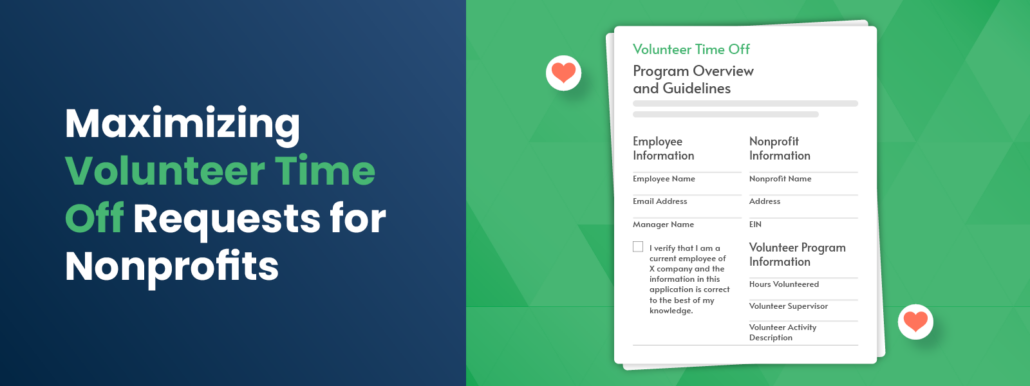
To help your volunteers utilize their benefits, you must understand what they are required to submit to their employers. While every company has a slightly different portal or policy, a standard Volunteer Time Off Request generally requires specific data points to ensure the time is being used for legitimate charitable purposes.
This request is the formal internal process an employee must complete to get paid for their time away. It typically includes three main categories of information:
1. Employee and Policy Information
The company needs to verify that the requester is eligible for the benefit.
Employee Eligibility: Not all staff members may qualify. The request often cross-references the employee’s status (full-time vs. part-time) against the company’s guidelines.
Accrued Hours: The form will check the VTO hours the employee has accrued or is allotted for the year. For example, companies with paid VTO programs offer an average of 20 hours per year.
2. Nonprofit Information
The employer must verify that your organization is a valid charity.
Eligible Organizations: The request will ask for your nonprofit’s name and likely your tax ID or 501(c)(3) status to ensure you meet the company’s philanthropic criteria.
Contact Details: You may need to provide a contact name or email at your organization who can verify the volunteer’s attendance.
3. Volunteer Activity Information
This section details what the employee will actually be doing.
Qualifying Activities: The employee must describe the activity to ensure it aligns with the company’s values and VTO policy.
Date and Duration: The specific date of the shift and the number of hours requested are crucial for payroll giving purposes.
Quick Tip: Create a “VTO Cheat Sheet” for your volunteers. This simple PDF or webpage should list your organization’s legal name, Tax ID/EIN, a brief description of volunteer duties, and the contact info for your volunteer coordinator. When a volunteer opens their corporate portal to submit a Volunteer Time Off Request, having this info ready makes the process frictionless.
The Lifecycle of a VTO Request
Navigating the corporate bureaucracy can be intimidating for volunteers. By understanding the lifecycle of a request, your nonprofit can guide supporters through each stage, ensuring they don’t drop out of the process due to confusion.
Step 1: Identification and Registration
The process begins when a supporter registers for an event or shift with your nonprofit. At this stage, it is critical to identify where they work. If you know their employer, you can inform them of their VTO eligibility immediately.
Step 2: Submission of the Request
Before the volunteer shift occurs, the employee must log into their company’s HR or CSR portal to submit the formal request. They will input the dates, times, and your organization’s details. This acts as a request for time off, similar to asking for a vacation day, but coded specifically as volunteer service.
Step 3: The Approval Process
Once submitted, the request enters an internal approval process. This usually involves the employee’s direct manager approving the time away from work to ensure it doesn’t interfere with business operations. It may also involve the CSR department verifying that your nonprofit is an eligible 501(c)(3).
Step 4: Completing the Service
The volunteer completes their shift with your organization. This is the most important part! Ensure they sign in and out so you have an accurate record of their hours.
Step 5: Verification and Follow-Up
After the event, the employee may need to provide proof of service to their employer to finalize the VTO claim. Furthermore, this is the perfect moment to encourage the volunteer to check if their company also offers a volunteer grant (a monetary donation for hours served). 40% of Fortune 500 companies offer volunteer grant programs, so a VTO request often opens the door to further funding.
Top Companies with Standout VTO Programs
Familiarizing yourself with companies that offer generous VTO policies helps you target your outreach. If you see volunteers registering with email addresses from these domains, you should immediately encourage them to submit a Volunteer Time Off Request.
Patagonia
Patagonia is a leader in corporate activism. Their program offers up to 18 paid volunteer hours per year. Furthermore, they offer an environmental internship program where employees can take up to two months of paid time away from work to volunteer with an environmental group.
Thomson Reuters
This major information conglomerate offers two paid days (16 hours) of volunteer time each year. Their program is inclusive of company-sponsored volunteer activities and focuses on local community investment.
GM Financial
GM Financial structures their VTO to encourage regular engagement. They offer 8 hours of VTO per quarter for full-time staff and 4 hours per quarter for part-time staff, focusing on strengthening communities.
Microsoft
A giant in corporate philanthropy, Microsoft is known for its high matching gift limits, but they also support volunteerism vigorously. While they focus heavily on pro bono services, they are a prime example of a company that integrates volunteering into its culture.
Sentinel Group
Sentinel Group offers two paid days of service (16 hours) each year, focusing on education, communities, and health and wellness.
Did You Know? Professional services, information technology, and financial services companies are the most likely to offer paid VTO programs. If your nonprofit is located near hubs for these industries, your VTO potential is likely very high.
Marketing Strategies to Drive Requests
Your volunteers likely don’t know they have VTO available, or they don’t know how to use it. It is up to your nonprofit to market the opportunity. Here are several strategies to promote Volunteer Time Off Requests to your supporter base.
1. Dedicate a Page on Your Website
Create a centralized “Volunteers” page on your website. If you already have one, update it to include specific information about paid volunteer time off programs. Explain that volunteering during the workday is a valid and encouraged way to support the organization and link to resources that explain the request process.
2. Leverage Social Media
Social media is an excellent tool for inspiring action. Share information about VTO programs on your channels. Use engaging visuals and testimonials from volunteers who have successfully used their VTO days to “take a day off to do good”. This social proof can be the nudge other supporters need to submit their own requests.
3. Identify Opportunities with Employer Data
Your supporters’ employment data contains a wealth of information about available engagement opportunities. If you already know where a volunteer works, look into the company’s volunteer incentive programs. If you don’t have this data, consider using a corporate giving database tool or an employer append service to fill in the gaps.
4. Implement Personalized Outreach
Once you identify supporters who work for companies with VTO programs, initiate tailored communications. Don’t just reach out to current volunteers; engage donors who work for VTO companies as well. Focus your outreach on the benefits of paid volunteerism—a meaningful experience and a fun day out of the office.
5. Encourage Group Events
If you have existing supporters who work for companies with paid VTO policies, see if they would be willing to rally their colleagues. Encouraging a single volunteer to organize a group activity can expand your reach significantly. Corporate teams often look for VTO opportunities that accommodate groups, so positioning your nonprofit as “VTO-friendly” for groups is a smart strategy.
Leveraging Technology to Automate Requests
Managing the nuances of different corporate policies can be time-consuming. Fortunately, technology can streamline the Volunteer Time Off Request process, ensuring you capture every available hour without overburdening your staff.
Seamless Integration
Tools like Double the Donation integrate directly with your volunteer management software. When a volunteer registers for a shift, the system can prompt them to search for their employer. This captures employment data at the moment of highest intent.
Actionable Insights
Once the employer is identified, the database connects eligible supporters to volunteer grant and VTO opportunities. The system can provide the volunteer with their specific company’s guidelines, forms, and instructions, effectively automating the “how-to” portion of the request.
Automated Follow-Up
You can set up automated email streams to drive supporters to claim volunteer grants and VTO. For example, if a volunteer from Thomson Reuters signs up for a shift, the system can automatically send them an email reminding them that they have 16 hours of paid volunteer time available and linking them to the portal where they can submit their request.
Wrapping Up & Next Steps
Volunteer Time Off Requests represent a massive, underutilized opportunity for nonprofits to increase their capacity and deepen relationships with corporate partners. By shifting the perspective of volunteerism from a “nights and weekends” activity to a part of the professional work week, you open the door to a new demographic of skilled, energetic supporters.
The key to success lies in education and facilitation. Your volunteers want to help, but they need you to show them how to navigate the corporate process. By providing the right information, marketing the opportunity effectively, and leveraging technology to automate the nudges, you can turn corporate VTO policies into real-world impact for your mission.
Ready to start maximizing your corporate volunteer support?
- Audit your forms: Ensure you are asking for employer information on your volunteer registration pages.
- Create a guide: Build a simple VTO instruction sheet for your volunteers with your nonprofit’s tax ID and contact info.
- Get the right tools: Explore Double the Donation to see how automation can help you identify and mobilize VTO-eligible supporters.
Don’t let these valuable hours go to waste. Start guiding your supporters through the VTO process today. Plus, find out how Double the Donation Volunteering can help!