
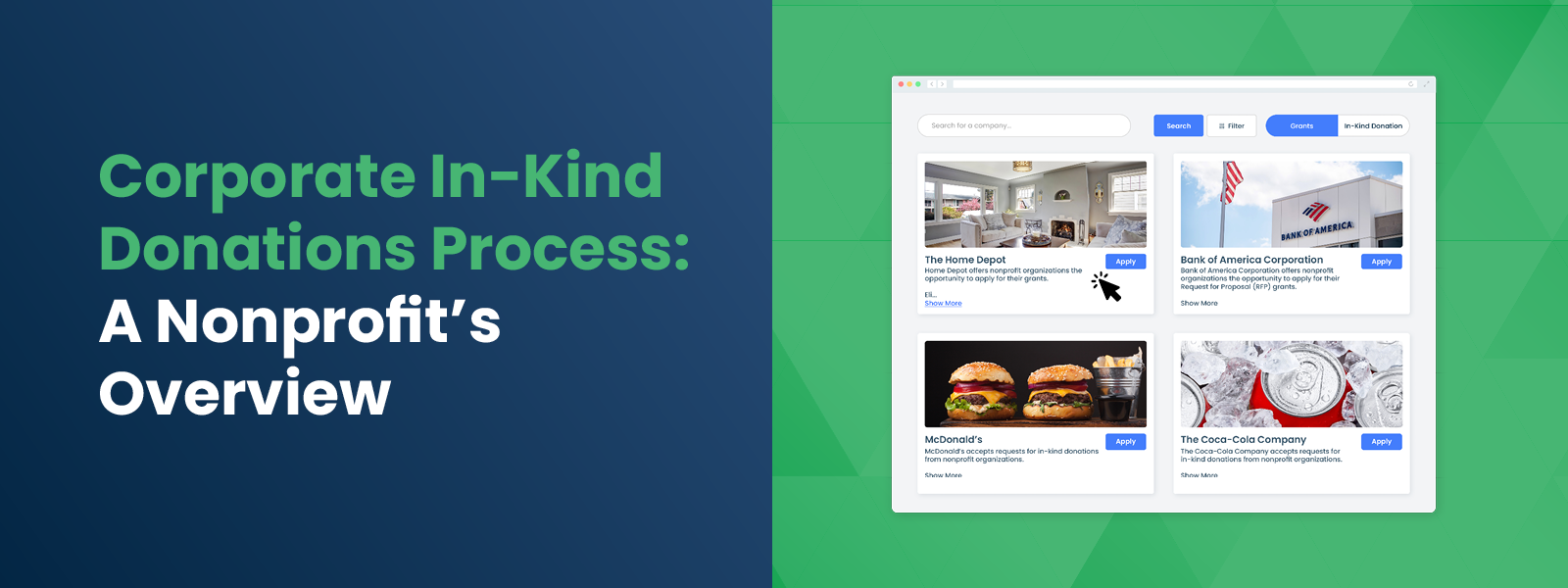
Corporate In-Kind Donations Process-A Nonprofit’s Overview

Corporate In-Kind Donations Process: A Nonprofit’s Overview
Cash is king in the nonprofit world, but it isn’t the only currency that fuels mission-driven work. Imagine freeing up thousands of dollars in your operating budget by receiving donated laptops, professional legal services, or event space completely free of charge. This is the power of corporate in-kind donations for nonprofits, a vital but often underutilized resource that can dramatically expand your organization’s capacity without touching your bank account.

While many development directors are comfortable asking for monetary gifts, the Corporate In-Kind Donations process can feel like uncharted territory. It requires a different approach to prospecting, valuation, and stewardship. Yet, when mastered, it transforms businesses from passive funders into active, hands-on partners. By understanding how to identify the right opportunities and navigate the specific workflows of corporate giving programs, you can unlock a treasure trove of goods and services that propel your mission forward.

In this guide, we’ll cover:

Ready to turn corporate generosity into tangible resources? Let’s dive into the step-by-step process of securing non-monetary support that makes a monetary difference.

The Strategic Value of In-Kind Giving

Before diving into how to get these donations, it is crucial to understand why they should be a pillar of your fundraising strategy. In-kind donations are non-monetary contributions of goods, services, or expertise. For a nonprofit, these gifts offer “budget relief”—every dollar you don’t spend on office supplies, software, or consulting is a dollar you can allocate to direct program services.

Furthermore, in-kind giving is often the “foot in the door” for deeper corporate relationships. A local business that starts by donating auction items or catering for an event is far more likely to consider a cash corporate sponsorship or employee volunteer day in the future. It allows companies to use their existing assets (excess inventory, specialized skills, or facilities) to do good, making it a lower-barrier ask than a direct cash grant.

Did You Know? In-kind services can be just as valuable as physical goods. “Intangible” donations like legal counsel, graphic design, or IT support utilize a company’s core competencies to solve complex nonprofit challenges that would otherwise require significant funding to address.

Step 1: Defining Needs and Creating an Acceptance Policy

The Corporate In-Kind Donations process begins internally. Before you ask for a single item, you must know exactly what you need—and what you don’t need. Soliciting random items can turn your office into a storage unit for unusable goods, creating a logistical headache rather than a benefit.

Create a Targeted Wishlist

Work with your program staff to compile a specific list of goods and services that would immediately aid your operations. Be precise. Instead of asking for “office supplies,” ask for “20 reams of printer paper” or “5 standing desks.” This “wishlist” becomes a public-facing tool that guides donors to make useful contributions.

Establish a Gift Acceptance Policy

To protect your organization, you need a policy that defines what you will decline. This might include expired goods, damaged items, or property that comes with burdensome restrictions. A clear policy allows you to politely say “no” to donations that would cost you more to store or dispose of than they are worth.

Quick Tip: Publish your acceptance policy on your website. This transparency helps donors self-screen their contributions, ensuring you receive high-quality items while saving your team from having to reject gifts face-to-face.

Step 2: Prospecting and Identifying Corporate Partners

Once you know what you need, the next phase of the Corporate In-Kind Donations process is finding the right partner to fulfill it.

Leverage Your Existing Network

Your best prospects are often hiding in plain sight. Screen your current donor database to see where your supporters work. An individual donor employed by a tech company might be your bridge to securing donated software or hardware. Using a corporate giving database can help you quickly identify which of these employers have established in-kind programs.

Target Local Businesses

Local businesses are frequently the most responsive to in-kind requests because they want to see a tangible impact in their immediate community. A local bakery might donate refreshments for a volunteer orientation, or a nearby print shop could offer pro bono printing for your annual report.

Research Major Corporations

For larger needs (like airline tickets for a raffle or bulk product donations), look toward major corporations. Many national brands, such as Google, Southwest Airlines, and Home Depot, have formal application portals specifically for these types of requests.

Step 3: The Application and Proposal Workflow

With your targets identified, it is time to make the ask. This step in the Corporate In-Kind Donations process varies depending on the size of the company.

Large corporations typically require you to submit a request through an online grant portal. You will need to provide your 501(c)(3) determination letter, a description of your mission, and specific details about the event or program the donation will support. These portals often have strict deadlines, so track these carefully.

Crafting a Proposal for Local Partners

For local businesses without a formal portal, a personalized proposal is key. Your pitch should clearly state what you need, how it will be used, and—crucially—how the donation will benefit the business (e.g., brand visibility at an event, social media shoutouts). Treat this as a partnership proposal, not just a plea for free stuff.

Did You Know? Timing matters. Retailers are often more likely to donate excess inventory at the end of a season or fiscal quarter when they are looking to clear stock. Aligning your request with their business cycle can increase your chances of a “yes”.

Step 4: Fulfillment, Valuation, and Stewardship

Congratulations, your request was approved! But the Corporate In-Kind Donations process isn’t over yet. The final phase involves logistics, accounting, and relationship building.

Logistics and Intake

Have a plan for receiving the items. Will you need a truck to pick up furniture? Do you have the refrigerator space for donated food? Clarify delivery details immediately to avoid burdening the donor.

Valuation and Receipting

You must provide a written acknowledgment for any in-kind gift worth $250 or more. While the donor is responsible for determining the specific tax-deductible value of the item, your receipt should include a detailed description of the goods or services received. For your own internal records, estimate the “fair market value” so you can track how much budget these gifts have saved you.

Stewardship and Reporting

Don’t just send a receipt; send a story. Report back to the company on the impact of their gift. If a company donated books, send a photo of children reading them. If a firm donated legal services, share how much money they saved you; money that went directly to your beneficiaries. This “impact reporting” is the secret sauce that turns a one-time donor into a recurring partner.

Top Companies with Generous In-Kind Programs

Looking for a place to start? These industry giants are known for their robust in-kind giving programs.

  • Google: Through Google for Nonprofits, the tech giant offers immense in-kind value, including $10,000 per month in free search advertising (Google Ad Grants) and free access to the Google Workspace suite of productivity tools.
  • Southwest Airlines: A favorite for charity auctions, Southwest Airlines donates round-trip tickets to eligible nonprofit organizations to help them fundraise. These are highly coveted items that can drive significant bidding at fundraising galas.
  • Home Depot: The Home Depot Foundation focuses on improving the homes and lives of U.S. veterans and their families. They offer product donations and gift cards to nonprofits that align with this mission, helping organizations fix up facilities or build housing.
  • Whole Foods Market: Local Whole Foods stores have the autonomy to make in-kind donations of food and products to community nonprofits. This is an excellent source for event refreshments or items for community pantries.
  • Crayola: Perfect for education-focused nonprofits, Crayola provides in-kind product donations to organizations focusing on arts and education, ensuring schools and programs have the creative tools they need.

While these household names provide incredible support, they are just the tip of the iceberg, and because they are so well-known, competition for their resources can be fierce. To truly scale your in-kind strategy, consider investing in a dedicated corporate giving database tool. These platforms allow you to look beyond the ‘usual suspects’ to uncover thousands of mid-sized companies and niche manufacturers that aren’t on every nonprofit’s radar.

By using a database to filter for existing corporate programs, you can find the hidden gems that align perfectly with your specific mission, increasing your success rate and diversifying your support.

Measuring the Impact of Your In-Kind Strategy

To prove the ROI of your Corporate In-Kind Donations process, you need to track more than just the number of items received. Monitoring specific metrics helps you refine your strategy and demonstrate value to your board and stakeholders.

  • Total Fair Market Value (FMV): Track the estimated dollar value of all goods and services received. This shows exactly how much “revenue” your in-kind program generated.
  • Budget Relief: Calculate the amount of cash your organization didn’t have to spend because of these donations. This is a powerful metric for finance committees.
  • Donor Acquisition Cost: Compare the time/effort spent soliciting in-kind gifts versus the value received. In-kind prospecting often has a lower acquisition cost than cash fundraising.
  • Conversion Rate: Track how many in-kind donors eventually become cash donors or volunteers. This measures your success in deepening corporate relationships.

Moving beyond simple item counts to these robust KPIs allows you to tell a much more compelling story about your organization’s efficiency. When you can clearly articulate how a donation of laptops relieved the IT budget or how a corporate volunteer day led to a major cash gift, you transform in-kind donations from a logistical afterthought into a strategic revenue stream.

By consistently reviewing these metrics, you empower your team to focus its energy on the partnerships that drive genuine, sustainable impact.


Wrapping Up & Next Steps

Mastering the Corporate In-Kind Donations process is about seeing opportunity where others see obstacles. It transforms your fundraising strategy from a singular pursuit of cash into a diversified approach that leverages every available resource, from software and services to supplies and space. By defining your needs, professionally pitching corporate partners, and stewarding those gifts with care, you can build a sustainable pipeline of support that directly relieves your budget and amplifies your impact.

Don’t let valuable resources go unclaimed. Start by creating your wishlist today, then look at your donor list to find the corporate connections that can make it a reality.

Ready to find your next corporate partner?

  • Audit your needs: What line items in your budget could be covered by an in-kind gift?
  • Build your list: Use tools like Double the Donation to identify companies with established giving programs.
  • Make the ask: Reach out to a local business partner this week with a specific, tangible request.

Start maximizing your mission’s potential by tapping into the full spectrum of corporate philanthropy today. Get started with Double the Donation’s corporate giving tools to supercharge your strategy. Request a personalized demo today!

Better Understanding the Corporate Sponsorships Process
Better Understanding the Corporate Sponsorships Process

Corporate sponsorships are often the “white whale” of nonprofit fundraising: highly sought after, incredibly valuable, but sometimes elusive to secure. For many organizations, a single sponsorship can underwrite an entire event, fund a new community program, or provide the essential technology needed to scale operations. However, treating corporate partners like ATMs (or simply hoping a business will notice your good work) is rarely a winning strategy. Success requires navigating the Corporate Sponsorships process with intention, professionalism, and a clear value proposition.

Unlike individual donations, which are often driven by emotion and altruism, corporate sponsorships are business transactions rooted in mutual benefit. Companies want to know what they get in return, whether it is brand visibility, access to new audiences, or alignment with Corporate Social Responsibility (CSR) goals. To unlock this revenue stream, nonprofits must move beyond passive fundraising and adopt a proactive, step-by-step approach to identifying, pitching, and stewarding corporate partners.

In this guide, we will cover:

By mastering the technical and relational steps of the Corporate Sponsorships process, your organization can build a sustainable pipeline of support that goes far beyond a one-time check. It is time to stop guessing and start executing a strategy that turns local businesses and major corporations into your most reliable allies.

The Strategic Value of Corporate Sponsorships

Before diving into the logistics of the process, it is vital to understand what distinguishes a sponsorship from other forms of giving. While corporate grants for nonprofits are typically philanthropic gifts restricted to specific programs or general operating support, sponsorships are often marketing agreements. The company provides funding or in-kind resources, and in exchange, the nonprofit provides marketing assets: logos on event signage, shout-outs on social media, or speaking opportunities.

This distinction is important because it opens up different budgets within a company. A grant might come from the corporate foundation, but a sponsorship often comes from the marketing or advertising budget. This allows nonprofits to tap into varied revenue streams. Furthermore, securing in-kind sponsorships—such as technology, office supplies, or event space—can significantly reduce overhead costs, allowing more cash revenue to flow directly to your mission.

Did You Know? Corporate giving benefits the company just as much as the nonprofit. Businesses that engage in philanthropy report enhanced brand reputation, stronger employee engagement and retention, and increased customer loyalty among socially conscious consumers. When you pitch a sponsorship, you aren’t just asking for help; you are offering a business solution.

Step 1: Prospecting and Identifying the Right Partners

The Corporate Sponsorships process begins with research. A “spray and pray” approach—sending generic letters to every company in the phone book—is inefficient and rarely effective. To maximize your success rate, you must identify prospects whose business goals and brand values align with your mission.

Leveraging Local and Mission Alignment

Start by looking at your immediate community. Companies with a strong presence in your service area are often the most motivated to support local causes because it builds goodwill with their specific customer base. Additionally, look for mission alignment. For example, a local hospital system is a natural fit for a health-focused nonprofit, while a tech firm might be interested in sponsoring STEM education programs.

Analyzing Your Existing Network

Your best prospects are often already in your orbit. Analyze your donor database to see where your current supporters work. If a board member or a major donor is an executive at a local firm, you have a warm introduction that bypasses the cold call phase. Prioritize companies where you already have a connection, such as current donors’, volunteers’, or board members’ employers, to significantly increase your chances of success.

Determining the Type of Support

During the prospecting phase, determine what kind of support you actually need. Are you looking for cash to fund an event? Or could in-kind donations be equally valuable? Many companies have specific programs for product donations, such as Big Lots, which donates overstock furniture and household items, or Crayola, which provides art supplies to educational organizations. Knowing exactly what you need helps you target the right companies.

Step 2: Crafting and Submitting the Proposal

Once you have a list of targets, the next phase of the Corporate Sponsorships process is the “ask.” This is where you formally request support. Depending on the company size, this might involve an online application portal or a bespoke sponsorship proposal document.

Large corporations often manage their giving through structured online portals. For instance, companies like Coca-Cola or Bank of America have specific systems where nonprofits must register and submit requests. In these scenarios, it is critical to follow the guidelines precisely. You will likely need to provide your organization’s IRS 501(c)(3) letter, a program budget, and a clear description of how the funds will be used.

Writing a Winning Proposal

For companies without rigid portals, or when seeking higher-level event sponsorships, you will need to craft a proposal. This document should be tailored to the company’s interests, not just your needs.

A strong proposal includes:

  • The Opportunity: Clearly define the event or program.
  • Audience Demographics: Tell the sponsor who they will reach (e.g., “Our gala is attended by 500 local business leaders”).
  • Deliverables: Be specific about what the sponsor gets. Will their logo be on the website? Will they get a booth at the event?
  • Impact: Show how their partnership will make a tangible difference in the community.

Quick Tip: When applying for sponsorships or grants, clarity is king. Ensure your proposal includes measurable goals and outcomes. Companies want to see a return on investment (ROI), whether that is measured in social impact or brand impressions.

Step 3: The Corporate Review and Follow-Up Phase

After you hit “submit,” the Corporate Sponsorships process enters the review phase. For the nonprofit, this is often the “waiting game,” but it shouldn’t be a passive period. The timeline for approval can vary wildly; some companies review requests on a rolling basis, while others have quarterly or annual cycles.

Tracking Your Applications

Organization is essential here. Create a tracking system or spreadsheet to monitor your submission dates, key contacts at the company, and expected notification timelines. If you applied through a portal, check your status regularly. If you emailed a proposal, mark your calendar for a follow-up.

The Art of the Follow-Up

If you haven’t heard back within the expected window (typically 2-3 weeks for smaller requests, longer for major grants), it is appropriate to send a polite follow-up. Keep it brief and professional. Reiterate your excitement about the potential partnership and offer to provide any additional information they might need.

This persistence demonstrates professionalism. Even if the answer is “no,” how you handle the rejection matters. Always ask for feedback on your proposal and thank them for considering your organization. This keeps the door open for future opportunities.

Step 4: Securing Funds and Delivering ROI

Congratulations! The sponsor said “yes.” Now the Corporate Sponsorships process moves into the fulfillment and stewardship phase. This is arguably the most critical step because it determines whether the sponsor will renew their support next year.

Formalizing the Agreement

Upon approval, you may need to sign a sponsorship agreement or contract. This document outlines the payment schedule (or delivery date for in-kind goods) and the specific marketing benefits you promised. Ensure you have the vector files of their logos and any specific brand guidelines they require for your marketing materials.

Delivering on Promises (Fulfillment)

If you promised the sponsor a logo on the event banner, ensure it is there. If you promised social media posts, schedule them. This is the “transactional” part of the relationship, where you deliver the marketing value the company paid for.

Stewardship and Reporting

After the event or program concludes, don’t just send a receipt. Send a comprehensive impact report. Did the event sell out? How many people saw their logo? If it were a programmatic grant, share specific metrics on how many people were helped. Acknowledge the gift promptly with a formal thank-you letter, and look for public ways to celebrate the partnership.

Did You Know? In-kind donations for nonprofits can be a gateway to cash sponsorships. Companies like Marriott provide food and beverage donations or meeting space, while tech giants like Cisco offer hardware and software. Establishing a relationship through an in-kind gift allows you to prove your value as a partner, making it easier to ask for financial support later.

One of the biggest hurdles in the Corporate Sponsorships process is simply knowing who gives to what. Manually scouring corporate “About Us” pages is time-consuming and inefficient. This is where technology bridges the gap.

Comprehensive corporate giving databases, like the one offered by Double the Donation, aggregate data on thousands of companies. These tools allow nonprofits to search for companies based on specific criteria, instantly revealing:

  • Which companies offer matching gift programs.
  • Details on corporate grant opportunities and application links.
  • Information on in-kind donation initiatives.
  • Employee volunteer incentives.

By using a centralized database, your team can skip the hours of research and go straight to the application phase. For example, a quick search might reveal that Bank of America offers grants for workforce development, or that Home Depot has a specific portal for community product donations. Accessing accurate, up-to-date guidelines and forms ensures you never waste time applying to a company that doesn’t fund your type of mission.

Measuring the Success of Your Sponsorship Strategy

To refine your Corporate Sponsorships process, you must treat it like any other business strategy: track, analyze, and optimize. It is not enough to just count the dollars raised; you need to understand the cost of acquisition and your partners’ retention rate.

Key Performance Indicators (KPIs)

Consider tracking the following metrics to gauge the health of your sponsorship program:

  • Total Revenue: The aggregate cash and in-kind value generated.
  • Conversion Rate: The percentage of proposals submitted that result in a sponsorship. If this is low, you may need to refine your prospecting or your pitch.
  • Retention Rate: How many sponsors come back year over year? High retention indicates you are delivering good ROI.
  • Fulfillment Cost: How much time and money did it take to deliver the sponsorship benefits (e.g., printing banners, hosting VIP receptions)?
  • In-Kind Value: Don’t ignore non-cash gifts. Track the estimated market value of donated goods and services.

Regularly reviewing these figures helps you identify trends. Perhaps you have great success with local banks but struggle with national retailers. Or maybe your in-kind donations are high, but cash revenue is lagging. Use this data to adjust your efforts and focus resources on the highest-yield activities.


Wrapping Up & Next Steps

The Corporate Sponsorships process is a journey of relationship building, strategic alignment, and professional execution. It transforms the way nonprofits view funding, shifting the perspective from “charity” to “partnership.” By rigorously identifying the right prospects, crafting value-driven proposals, and delivering on your promises, you elevate your organization’s standing in the business community.

While the process requires upfront effort (researching guidelines, writing proposals, and managing deliverables), the payoff is substantial. Corporate partners provide the stability, resources, and visibility that allow nonprofits to dream bigger and reach further.

Ready to supercharge your corporate fundraising?

  • Audit your assets: What can you offer a sponsor? (Event visibility, social media reach, volunteer opportunities).
  • Build your list: Use tools like Double the Donation to identify companies with established giving programs.
  • Start small: Pitch a local business on a small in-kind donation to build your confidence and portfolio.

Don’t leave corporate money on the table. Start actively managing your sponsorship pipeline today and watch your mission grow. Plus, request a personalized demo to see how solutions like Double the Donation can help your team navigate the process effectively.

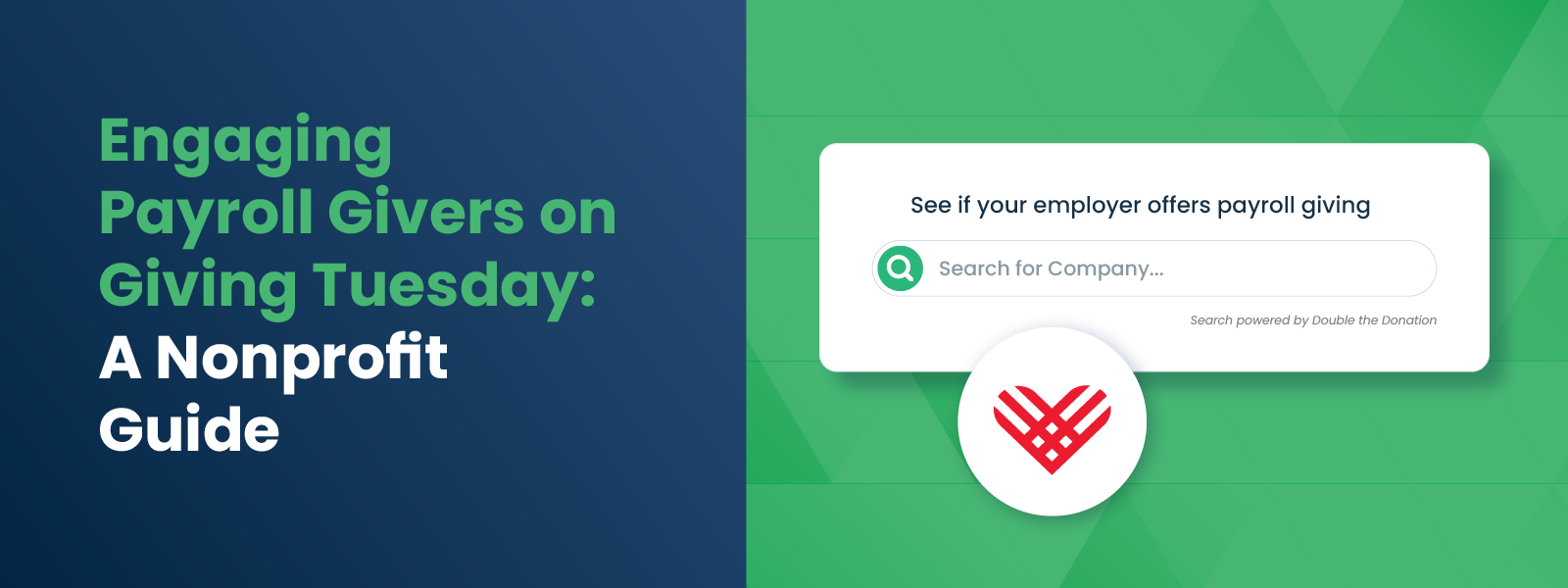
Engaging Payroll Givers on Giving Tuesday-A Nonprofit Guide

Engaging Payroll Givers on Giving Tuesday: A Nonprofit Guide
Giving Tuesday is widely recognized as the single most powerful day in the philanthropic calendar. For twenty-four hours, the world turns its attention to generosity, resulting in a massive influx of donations, social media buzz, and volunteer sign-ups. For many nonprofits, this day provides a critical injection of cash that helps close out the annual budget. However, there is a hidden opportunity within this frenzy that often goes overlooked. While securing one-time cash gifts is essential, engaging payroll givers on Giving Tuesday can transform a single day of generosity into a sustainable year-round revenue stream.

The challenge with Giving Tuesday is often the “sugar crash” that follows the initial rush. Donors give once and then disengage until the next holiday season. By shifting your strategy to focus on payroll giving (a mechanism in which employees donate a portion of their paycheck to your nonprofit automatically), you can turn that momentary enthusiasm into a long-term commitment. Payroll giving is one of the most underutilized forms of corporate philanthropy, yet it offers unmatched retention rates and financial predictability.

In this guide, we’ll cover:

By implementing these strategies, you can use the visibility of Giving Tuesday not just to hit a daily fundraising goal, but to build a foundation of recurring revenue that supports your mission all year long.

The Strategic Value of Payroll Giving on Giving Tuesday

To effectively advocate for this funding stream, you must first understand why it is worth prioritizing during your busiest time of year. Payroll giving allows employees to donate to registered nonprofits directly from their salary, often on a pre-tax basis. This method transforms a donor’s relationship with your organization from transactional to relational.

  • Predictable, Recurring Income: While Giving Tuesday donations are often sporadic one-time gifts, payroll giving ensures a steady cash flow. This predictability improves financial planning and program continuity, allowing your nonprofit to rely on a consistent baseline of support rather than crossing your fingers for a successful holiday campaign.
  • Higher Donor Retention: One of the most compelling reasons to focus on engaging payroll givers on Giving Tuesday is retention. Payroll donors tend to donate longer than one-time or online givers. Because the deduction happens automatically and often pre-tax, the donor effectively “doesn’t miss” the money, making them less likely to cancel the recurring gift during belt-tightening periods.
  • Lower Administrative Overhead: Processing thousands of individual credit card transactions on Giving Tuesday incurs significant fees and administrative work. In contrast, payroll donations are managed through platforms or employers, reducing time and costs for your team. This efficiency allows you to direct more of the raised funds toward your actual mission.

Did You Know? Payroll giving offers a unique “win-win-win” scenario. Nonprofits gain lower administrative overhead and sustainable income; donors enjoy tax-efficient, effortless giving; and employers boost their Corporate Social Responsibility (CSR) profile and employee engagement.

Strategy 1: The “Set It and Forget It” Pitch

Giving Tuesday falls during a chaotic time of year. Between holiday shopping, end-of-year work deadlines, and family obligations, donors are often looking for simplicity. You can leverage this desire for convenience to pitch payroll giving.

Positioning Automation as a Benefit: Market payroll giving as the ultimate time-saver. Explain that by setting up a payroll deduction now, they can support their favorite cause all year long without having to remember to write a check or enter credit card information again.
Key Message: “Make your Giving Tuesday impact last 365 days. Sign up for payroll giving today and support us automatically with every paycheck.”

The “Budget-Friendly” Angle: Small, regular deductions are easier for donors to manage than large one-off gifts. A donor might hesitate to give $250 on Giving Tuesday, but they might happily agree to a $10 deduction per paycheck. Over a year, that small deduction adds up to $260—a higher total value with less financial strain on the donor.

Strategy 2: Leveraging the Year-End Tax Incentive

Giving Tuesday is perfectly timed to capitalize on year-end tax planning. Donors are looking for ways to maximize their charitable deductions before December 31st.

Educating on Pre-Tax Benefits: Payroll donations are often deducted from the employee’s salary before tax is calculated. This means that a donation costs the employee less in real terms than a standard post-tax donation.
Example: A $100 donation might only reduce their take-home pay by $70 (depending on their tax bracket), yet the nonprofit receives the full $100.

The “Give More for Less” Message: Use this tax efficiency as a core part of your Giving Tuesday messaging. “Did you know you can give more to [Nonprofit Name] without it costing you more? Payroll giving allows you to donate pre-tax, amplifying your impact instantly”.

Strategy 3: The Corporate Match Multiplier

Giving Tuesday is synonymous with matching challenges. Many nonprofits secure a matching grant from a major donor for the day. You can apply this same excitement to payroll giving by highlighting corporate matching gift programs.

Double the Recurring Impact: Many companies match payroll gifts, doubling the value of contributions. This is a powerful incentive. If a donor signs up for a $20 monthly deduction, and their employer matches it, they are effectively generating $480 a year for your cause.

Promoting the “Double Match”: If you have a Giving Tuesday match secured, ask your sponsor if it can apply to the annualized value of new payroll sign-ups.
Pitch: “Sign up for payroll giving today! Our Giving Tuesday sponsor will match your first year of donations, AND your employer might match them too. That’s a triple impact!”

Quick Tip: Use a matching gift search tool on your dedicated Giving Tuesday landing page. This allows donors to instantly check if their employer offers payroll giving or matching gifts, removing the guesswork and driving immediate action.

Strategy 4: Streamlining the Enrollment Process

The biggest barrier to engaging payroll givers on Giving Tuesday is friction. If the process is confusing, donors will abandon it for a simple one-time credit card donation. You must make enrollment as seamless as possible.

  • Provide Direct Links: Many companies manage their payroll giving through third-party platforms like Benevity, Blackbaud, or CyberGrants. Wherever possible, provide direct links to your organization’s profile within these portals.
  • Create a “How-To” Guide: Create a simple, downloadable PDF or a dedicated web page that walks donors through the enrollment process for major local employers. List the steps clearly: Log in to your HR portal > Select “Charitable Giving” > Search for [Nonprofit Name] > Enter your deduction amount > Click Submit.
  • Capture Data Upfront: Include an optional “Employer” field on your Giving Tuesday donation forms. This allows you to screen your donors using employer appends and identify those who work for companies with payroll giving programs. You can then send targeted follow-up emails with specific instructions for their company.

Templates for Giving Tuesday Outreach

To help you execute these strategies, here are ready-to-use templates designed to convert Giving Tuesday excitement into payroll giving enrollment.

Website Blurb: The Landing Page Hook

Header: Make Your Giving Tuesday Last All Year
Body: Thank you for visiting us this Giving Tuesday! You have the power to make a difference that lasts beyond today. By signing up for payroll giving, you can support our mission automatically with every paycheck. It is tax-efficient, budget-friendly, and often matched by employers.
Call to Action: Check if your employer offers payroll giving and sign up in minutes! [Insert Search Widget]

Email Template: The Morning Appeal

Subject: Don’t just give today; give forever (automatically!)
Body:

Dear [Donor Name],

Happy Giving Tuesday! Today, millions of people are coming together to support the causes they love. We are so grateful you are part of our community. This year, we are inviting you to make a different kind of gift. Instead of a one-time donation, consider signing up for payroll giving. It allows you to donate a small amount from each paycheck, providing us with the steady support we need to plan for the future.

Payroll giving is…

  • Easy: No credit cards to update.
  • Smart: Donations are often pre-tax.
  • Powerful: Small gifts add up to massive impact.

Check your eligibility here: [Link to Double the Donation Search Tool]
Thank you for helping us build a sustainable future.

Social Media Post: The “Set and Forget”

“Happy #GivingTuesday! 💙 Want to support [Nonprofit Name] without having to remember to donate? Sign up for payroll giving! 💼 It’s the set-it-and-forget-it way to change the world. 🌍 Check if your company participates: [Link] #PayrollGiving #SustainableImpact”

Social Media Post: The Tax Tip

“Did you know payroll giving can lower your taxes? 📉 By donating directly from your paycheck, you often give pre-tax dollars, making your donation go further for you AND us. 💸 Make the smart move this #GivingTuesday. [Link] #TaxTips #CorporateGiving”

Best Practices for Retaining Payroll Givers

Once you have successfully engaged payroll givers on Giving Tuesday, the work isn’t over. You must steward these donors to ensure they remain enrolled.

  • The “Invisible Donor” Acknowledgement: Because payroll deductions happen automatically, donors often forget they are giving. Combat this by sending a specialized welcome series immediately after they sign up. Acknowledge the unique nature of their gift and thank them for becoming a sustaining partner.
  • Regular Impact Reporting: Since these donors don’t receive a monthly transaction receipt, you must proactively remind them of their impact. Send quarterly updates specifically for payroll donors. Show them exactly what their sustained support is achieving, such as “Your payroll gifts funded 500 meals this quarter”.
  • Milestone Recognition: Recognize the longevity of their support. When a donor hits their one-year anniversary of payroll giving, celebrate it. “Happy Anniversary! You have been supporting us through your paycheck for one year. Thank you for sticking with us.” This recognition reinforces their decision and reduces churn.

Quick Tip: Implement a “Corporate Champion” program. Encourage your new payroll donors to share their Giving Tuesday decision with colleagues. Peer validation is a powerful tool for driving further enrollment within a specific company.


Wrapping Up & Next Steps

Engaging payroll givers on Giving Tuesday is a strategic move that pays dividends long after the holiday season ends. By shifting your focus from one-time transactions to recurring payroll deductions, you build a foundation of financial stability that allows your nonprofit to dream bigger and plan further ahead.

To get started, audit your Giving Tuesday campaign materials. Are you mentioning payroll giving? Do you have a search tool available for donors to check their eligibility? By integrating these messages and tools, you can turn the year’s biggest giving day into a catalyst for sustainable growth.

Ready to take your corporate fundraising to the next level? Request a demo with Double the Donation to see how our automation tools can help you identify eligible donors, promote payroll giving, and maximize your revenue with minimal effort.

Strategies For Retaining Payroll Giving Donors Successfully

Strategies For Retaining Payroll Giving Donors Successfully

Acquiring a new donor is a victory, but securing a donor who commits to an automatic, recurring deduction from their paycheck is a game-changer for nonprofit sustainability. Finding a supporter who works for a company with a payroll giving program offers a unique financial advantage. However, keeping that donor engaged, active, and consistently enrolled in the program year over year? That is the key to true sustainable growth. Retaining payroll giving donors is one of the most effective ways to build a reliable pipeline of unrestricted revenue while simultaneously strengthening your community of advocates.

Many nonprofits view payroll giving as a passive activity. An employee signs up, the deductions start, and the organization simply watches the deposits roll in. This “set and forget” mindset leaves money on the table and risks donor attrition. When a supporter realizes that their consistent contributions are fueling tangible change, they feel a deeper sense of purpose and commitment. If you can nurture that feeling, you transform a passive participant into an active, long-term partner in your mission.

The challenge lies in the mechanics. Because the donation happens automatically, often without the donor taking an active step each month, they can easily feel disconnected from the impact of their gift. In this guide, we’ll cover:

Success in this arena does not require a massive overhaul of your current operations. Instead, it requires a shift in perspective and the application of a few key strategies. By treating payroll giving donors with the same rigor as major gifts or active volunteers, you can build a sustainable pipeline of corporate support that fuels your impact for years to come.

The Value of the Payroll Giving Donor

To understand why retention is so critical, you must first understand the financial weight these individuals carry. Payroll giving programs enable employees to donate to nonprofit organizations directly from their paychecks. This mechanism creates a steady stream of unrestricted funds that is essential for operational stability.

The financial impact is significant. Currently, more than $173 million is donated through payroll giving each year, with over 6 million U.S. employees contributing. For the nonprofit, the primary benefit is the creation of a consistent cash flow. Unlike sporadic one-time gifts, payroll donations provide a steady baseline of income, enabling better financial planning and program continuity.

When you retain a payroll giving donor, you are essentially retaining a high-value recurring supporter. Because the deduction happens automatically and often pre-tax, the donor effectively “doesn’t miss” the money, making them less likely to cancel the recurring gift during belt-tightening periods. This leads to significantly higher lifetime value (LTV) for each supporter acquired through this channel. If you retain a donor giving $50 per paycheck for five years, that relationship is worth thousands in unrestricted funds, often with lower administrative overhead than processing individual credit card transactions.

Did You Know? Payroll donors tend to donate for longer periods than those who give via other channels. This high retention rate signals strong engagement and program “stickiness,” making these donors some of your most reliable assets.

Payroll Giving as a Retention Tool

Interestingly, the relationship between giving and retention works both ways. Not only does retaining donors lead to more revenue, but the mechanism of payroll giving actually helps retain the donor’s attention and loyalty to your cause.

  • Donors stay when they feel their contribution matters and when the process is frictionless. Payroll giving is effortless and convenient; once enrolled, donations happen automatically with no need to manage monthly payments. This convenience removes the friction that often leads to lapsed giving, such as expired credit cards or forgotten logins.
  • Contributing through work can increase a sense of shared purpose and team spirit. When an employee sees their colleagues participating in a workplace giving campaign, it fosters a sense of community. By facilitating this connection, you become a partner in their professional environment, making them more likely to stick with your organization over others.

Strategy 1: The “Invisible Donor” Acknowledgement

Stewardship is the cornerstone of retention. For payroll giving donors, standard acknowledgement is often missed because the transaction is automated. You need a strategy that ensures these “invisible” donors feel seen and valued.

The Welcome Series: When a new payroll donor signs up, they should receive an immediate, specialized welcome series. Do not just send a generic tax receipt. Send a welcome email that acknowledges the unique nature of their gift.
Example: “Welcome to our workplace giving community! By choosing to give through your paycheck, you are providing the steady fuel we need to plan for the future. Thank you for making us a part of your professional life.”

Regular Impact Updates: Because they don’t see the transaction happening every month, you must remind them of the impact. Send quarterly updates specifically for payroll donors that show exactly what their sustained support is achieving.
Example: “Thanks to the consistent support of payroll donors like you, we were able to keep our shelter open during the recent storm without interruption.”

This consistent acknowledgement reinforces the behavior you want to see. It closes the loop and confirms to the donor that their silent contribution is making a loud impact.

Strategy 2: Data-Driven Segmentation

You cannot retain what you do not track. To effectively retain payroll giving donors, you need to know who they are and where they work. One of the most critical steps is to collect employment information as supporters engage with you.

Capture Data Early: Include an optional “Employer” field on all donation forms and sign-up sheets. This allows you to screen for eligibility and identify which donors are giving through their workplace. If you know a donor works for a company with a strong giving culture, you can tailor your retention plan to align with their corporate calendar.

Segment Your Lists: Do not send generic appeals to your high-value corporate donors. Create a segment in your CRM for “Payroll Donors.” Communications to this group should acknowledge their current method of giving.
Generic email: “Please consider making a donation today.”
Targeted email: “Thank you for your ongoing support through your paycheck! Because of you, we are ready to tackle this new challenge. Here is an exclusive update on the project you are funding.”

By segmenting your lists, you avoid asking them for money in a way that ignores their current generosity, which is a common frustration for recurring donors.

Strategy 3: The “Annual Renewal” Campaign

While payroll giving is often indefinite, some corporate platforms require annual renewal or re-enrollment. A major reason for donor attrition is simply forgetting to re-enroll during the open season.

The Open Enrollment Push: In the fall, typically during open enrollment periods, run a campaign specifically targeting existing payroll donors. Remind them to re-select your nonprofit for the coming year.
Message: “It’s open enrollment time! Please remember to keep [Nonprofit Name] as your charity of choice for the upcoming year. Your sustained support allows us to dream bigger.”

The New Year Kickoff: In January, send a “Welcome Back” message. Remind your supporters that their contributions are active and appreciated for the new year.
Message: “New Year, Same Mission. Thank you for continuing your payroll contributions in 2025. We have big plans, and you are making them possible.”

Quick Tip: Use deadlines to your advantage. If you know a specific major employer has a deadline for setting up payroll deductions, send a targeted countdown email to donors from that company.

Strategy 4: Incentivize and Gamify

Retaining payroll giving donors requires keeping them engaged over the long haul. Gamification using milestones, badges, and progress bars can be highly effective in maintaining interest.

Milestone Recognition: Recognize the longevity of their support. When a donor hits their one-year anniversary of payroll giving, celebrate it.
Update: “Happy Anniversary! You have been supporting us through your paycheck for one year. That is 24 pay periods of impact. Thank you for sticking with us.”

Exclusive Perks: Consider creating a special club or designation for payroll donors. Offer incentives such as welcome gifts (stickers, mugs), digital badges they can share on LinkedIn, or access to exclusive donor-only webinars and events. When they feel like an integral part of an exclusive group, they are far less likely to churn.

Strategy 5: Leverage Corporate Communities

People are more likely to stay engaged if they feel part of a community. Workplace giving is inherently social, and you can leverage this to improve retention.

  • The Corporate Champion: Encourage your existing payroll donors to become advocates within their company. If you have a retained donor from a specific firm, ask them to share their experience with colleagues. Peer validation is a powerful retention tool because it creates social accountability.
  • Foster Healthy Competition: If you have clusters of donors from different major employers, create a friendly challenge. “Which corporate partner has the highest retention rate this quarter?” This taps into company pride and keeps donors enrolled to ensure their team maintains its standing.

Strategy 6: Upsell to “Double Impact”

Retention is about maximizing value. Many companies that offer payroll giving also offer matching gifts. By helping a donor access both, you deepen their impact and their emotional investment in your organization.

The Match Pitch: Many companies match payroll gifts, doubling the value of contributions. When a donor signs up for payroll giving, follow up with information about matching gifts.
Message: “Thank you for your payroll gift! Did you know your company might also match that donation dollar for dollar? Check here to see if you can double your impact.”

Celebrating the Full Contribution: When you recognize these donors, celebrate the total value they provided: the payroll deduction plus the corporate match. “Thanks to Sarah’s payroll gift and her company’s match, she provided $100 in funding this month.” This recognition reinforces the behavior and encourages repeat performance.

Did You Know? Mentioning matching gifts in fundraising appeals results in a 71% increase in the response rate and a 51% increase in the average donation amount. Applying this logic to retention communications can boost donor loyalty.

Strategy 7: Simplify with Technology

The number one enemy of retention is friction. If managing a recurring gift is difficult, donors might cancel. Investing in the right technology becomes an essential best practice.

  • Easy Access to Portals: Provide direct links to the payroll giving platforms used by major employers. Don’t just tell them to “check their portal.” Provide the URL to Benevity, CyberGrants, or their specific intranet page if you have it.
  • Automated Reminders: Use automation to send the right message at the right time. If a donor’s giving stops (perhaps due to a job change), your system should automatically trigger a re-engagement email: “We noticed your payroll gift stopped. If you’ve changed jobs, here is how you can set up a new gift or continue supporting us directly.”
  • Tracking and Reporting: Dedicated software provides robust dashboards that help you track the status of payroll gifts and identify revenue trends. Knowing which companies have the highest donor retention rates allows you to focus your relationship-building efforts where they will yield the highest return.

Wrapping Up & Next Steps

Retaining payroll giving donors is not a passive activity. It requires a deliberate strategy that combines data collection, personalized communication, and a culture of gratitude. By shifting your focus from simply acquiring new sign-ups to nurturing your existing corporate advocates, you unlock a sustainable source of revenue that grows alongside your donor base.

Remember, every paycheck deduction is a vote of confidence in your mission. Don’t let that confidence go unnoticed.

To get started, audit your current donor list. Identify who is giving through payroll using your CRM data. Then, implement the “Invisible Donor Acknowledgement” strategy immediately to ensure they know their support is seen and valued.

Ready to take your corporate fundraising to the next level? Request a demo with Double the Donation to see how our automation tools can help you identify, track, and retain your most valuable payroll giving supporters today.

Payroll Giving Blurbs-Templates For Sustainable Growth

Payroll Giving Blurbs: Templates For Sustainable Growth
In the pursuit of financial stability, nonprofits are constantly seeking the “holy grail” of fundraising: unrestricted, recurring revenue. While major gifts and grants provide essential influxes of capital, they often lack the consistency required for confident long-term planning. This is where payroll giving enters the conversation as a transformative solution. Often overshadowed by other forms of corporate philanthropy, such as matching gifts and payroll giving, is a powerful mechanism that allows employees to donate to charities directly from their salaries, often on a pre-tax basis. It creates a “set and forget” donation stream that reduces administrative friction and increases donor retention.

Despite the clear financial advantages, many organizations struggle to capitalize on this opportunity due to a significant awareness gap. Billions of dollars in corporate philanthropy go unclaimed or unrealized simply because donors do not know these programs exist or how to access them. To bridge this gap, nonprofits must actively market these opportunities using clear, persuasive communication. One of the most effective ways to do this is by incorporating payroll giving blurbs into your existing communication channels.

By using pre-written, strategic copy across your website, emails, and social media, you can educate your supporters and drive significant revenue without adding a heavy lift to your development team. In this guide, we will provide you with the templates and strategies you need to turn passive interest into active, long-term support.

In this guide, we’ll cover:

By implementing these communication strategies, you can integrate payroll giving into your core fundraising efforts and secure a steady flow of support that grows with every paycheck.

The Strategic Value of Payroll Giving

Before deploying these templates, it is essential to understand the unique value proposition of payroll giving. Unlike one-time donations that require constant re-solicitation, payroll giving automates the philanthropic impulse. Once an employee opts in, the donation is deducted automatically from their salary during each pay cycle. This automation eliminates the need for monthly credit card entries or manual check writing, drastically reducing the friction that leads to donor churn.

The statistics surrounding this fundraising channel highlight its potential. Currently, more than $173 million is donated through payroll giving each year, with over 6 million U.S. employees contributing. However, with approximately 18% of individuals qualifying for payroll giving through their employers, there remains significant untapped potential.

  • Predictable Revenue Streams: For nonprofits, the primary benefit is the creation of a consistent cash flow. Payroll donations provide a steady baseline of income, enabling better financial planning and program continuity. This predictability is essential for budgeting and scaling operations with confidence.
  • Higher Donor Retention: Payroll donors tend to donate for longer periods than those who give via other channels. Because the deduction happens automatically and often pre-tax, the donor effectively “doesn’t miss” the money, making them less likely to cancel the recurring gift during belt-tightening periods. This leads to significantly higher lifetime value (LTV) for each supporter acquired through this channel.
  • Tax Efficiency for Donors: It is important to articulate the financial benefits to the donor as well. Donations made through payroll giving are often deducted from gross pay before tax is calculated. This tax-efficient giving method means that a donation costs the employee less in real terms than a standard post-tax donation, allowing them to give more to your cause without significantly impacting their take-home pay.

Did You Know? Payroll giving offers a unique “win-win-win” scenario. Nonprofits gain lower administrative overhead and sustainable income; donors enjoy tax-efficient, effortless giving; and employers boost their Corporate Social Responsibility (CSR) profile and employee engagement.

Website Blurbs: Your Education Hub

Your website is the first place potential donors go to learn how they can support your mission. It is essential to plant the seed of payroll giving right where they are looking for ways to give. Integrating payroll giving blurbs into key pages ensures that visitors are immediately informed about this seamless giving option.

The “Ways to Give” Page

This is the most logical place to house detailed information. You want to catch donors when they are already in a mindset to contribute.

Template 1: The “Set and Forget” Hook
Header: Make an Impact with Every Paycheck
Body: Did you know you can support [Nonprofit Name] directly through your salary? Payroll giving is an easy, tax-efficient way to make a lasting difference. By setting up a recurring deduction from your paycheck, you provide us with the steady support we need to plan for the future—all without having to manage monthly payments.
Call to Action: Check if your employer offers payroll giving today!

Template 2: The Tax-Smart Appeal
Header: Give Smarter, Not Harder
Body: Maximize your donation with payroll giving! Because donations are often deducted before tax, it costs you less to give more. Your regular contributions add up to a significant impact over the year, helping us [insert brief mission impact, e.g., feed families, rescue animals]. Plus, it’s automatic, so you never have to worry about updating credit card details.
Call to Action: Search for your employer below to see if you are eligible.

The Donation Confirmation Page

While typically reserved for matching gifts, this page is also prime real estate for payroll giving. If a donor has just given money, they are highly engaged. Reminding them that they can automate this support in the future can transition a one-time donor into a recurring supporter.

Template 3: The Recurring Conversion
Header: Want to make this automatic?
Body: Thank you for your generous gift! If you want to support us year-round without the hassle, check if your employer offers payroll giving. It allows you to donate small amounts from each paycheck that add up to a massive impact.
Call to Action: See if your company participates.

Quick Tip: For the best results, use a short, memorable, and easy-to-type URL, such as yourcharity.org/payrollgiving, for your dedicated landing page. This makes it easier to share within offline materials and presentations.

Email Blurbs: Direct to Inbox

Email remains one of the most effective channels for donor communication. It allows you to be direct, personal, and timely. Weaving payroll giving blurbs into your regular email flows keeps the opportunity top-of-mind and normalizes workplace giving as a standard way to support your cause.

The Newsletter Feature

Include a recurring section in your monthly newsletter. Since your list grows and changes, repeating this message ensures new subscribers see it and reminds long-time supporters who may have changed jobs.

Template 4: The General Awareness Blurb
Subject: A simple way to support us year-round
Header: Support [Nonprofit Name] on Autopilot
Body: Dear [Donor Name], We know life gets busy. That’s why we love payroll giving—it lets you support the causes you care about without adding another to-do to your list. By signing up for payroll giving through your employer, you can make automatic, tax-efficient donations directly from your paycheck. It’s a small change for you that makes a huge difference for us.
Action: Check with your HR department or visit our workplace giving page to learn more.

The “Company Specific” Email

If you have collected employment data during registration or through a matching gift search tool, you can send highly targeted emails to donors who work for known payroll giving companies.

Template 5: The Targeted Ask
Subject: [Donor Name], maximize your impact with [Company Name]
Body: Dear [Donor Name], Because you work at [Company Name], you have access to a fantastic benefit: payroll giving. This program allows you to donate to [Nonprofit Name] directly from your salary, often with a corporate match included! We noticed you have supported us in the past, and we wanted to ensure you knew about this easy way to continue your impact.
Next Step: Log in to your employee portal to set up your gift today.

The Year-End Appeal

During the busy year-end fundraising season, donors are looking for ways to give that are financially savvy.

Template 6: The Financial Planning Angle
Subject: Plan your giving for next year
Body: As we look ahead to the new year, consider setting up a payroll gift to [Nonprofit Name]. It is one of the most tax-efficient ways to give, allowing you to lower your taxable income while sustaining our mission.
Action: Enroll now to start your support with your first paycheck of the year.

Social Media Blurbs: Broadening the Reach

Social media is ideal for raising general awareness and reaching professionals where they network. Use these platforms to normalize giving through work. LinkedIn is particularly effective for this type of content, as your audience is already in a professional mindset.

LinkedIn

This is the most effective channel for corporate giving content, as the platform tends to engage a corporate-focused audience.

Template 7: The Professional Development Angle
“Did you know? 6 million U.S. employees contribute to charity through payroll giving. It’s a simple, seamless way to support the causes you love directly from your paycheck. 💼❤️ Check with your HR team to see if you can support [Nonprofit Name] through your workplace giving program today! #CorporateSocialResponsibility #PayrollGiving #SocialImpact”

Template 8: The “Did You Know” Graphic (Pair with an image of a pay stub or workplace setting)
“Turn your paycheck into purpose! 💸 Payroll giving allows you to donate pre-tax, meaning your dollar goes further for [Nonprofit Name]. See if your company offers this benefit: [Link to Website].”

Twitter/X & Instagram

Keep it punchy and visual. Use hashtags like #GiveThroughWork to increase discoverability.

Template 9: The Short & Sweet
“Support [Nonprofit Name] on autopilot! ✈️ Sign up for payroll giving to make small contributions from each paycheck that add up to big change. Check your eligibility here: [Link] #PayrollGiving #NonprofitTech”

Template 10: The Impact Focus
“What can $10 a paycheck do? Over a year, it provides [Specific Impact, e.g., 50 meals for families]. Sign up for payroll giving today and make a sustainable difference. [Link]”

Registration and Intake Blurbs

The best time to capture employment data and plant the seed about payroll giving is right when a supporter is signing up or donating. By incorporating payroll giving blurbs into your intake forms, you can immediately identify eligible donors.

The Donation Form Field

Include an optional “Employer” field and a brief blurb explaining why you are asking.

Template 11: The Intake Prompt
Header: Workplace Giving
Body: Many companies offer payroll giving or matching gift programs. Please enter your employer’s name so we can help you maximize your impact!
Field: [Search for Company]
Result: (If eligible) “Great news! [Company Name] offers a payroll giving program. You can set up a recurring donation directly through your employee portal.”

The Confirmation Screen

After they hit submit, use the confirmation screen to reinforce the message.

Template 12: The Confirmation Nudge
Header: Thank you for your gift!
Body: You’ve taken a great step today. Want to keep the momentum going? Check if your employer offers payroll giving to make your support automatic and ongoing.
Action: [Link to Double the Donation Search Tool]

Quick Tip: When asking for employment information, always explain why. A simple note saying “See if your employer will match your donation or offers payroll giving” increases the likelihood that a donor will provide the information.

Best Practices for Implementing These Blurbs

Writing the copy is only the first step. To truly maximize the revenue potential of payroll giving, you need to deploy these blurbs strategically.

  1. Leverage Technology for Eligibility: The most effective way to solve the eligibility puzzle is by integrating an employer search tool directly into your fundraising infrastructure. Tools like Double the Donation’s payroll giving widget allow donors to enter their company name and instantly see whether their employer offers payroll giving, matching gifts, or more. This removes the guesswork and provides immediate, company-specific instructions.
  2. Streamline the Path to Enrollment: Once a donor knows they are eligible, the next obstacle is the enrollment process itself. Generic instructions like “ask your HR department” can kill conversion rates. Instead, provide detailed, step-by-step guides for major employers. If possible, provide direct links to your organization’s profile within third-party platforms like Benevity or YourCause.
  3. Incentivize Participation: People are more likely to take action when they feel recognized and valued. Consider creating a special club or designation for payroll donors. Offer incentives such as welcome gifts (stickers, mugs) or digital badges they can share on LinkedIn. You can also frame incentives as appreciation, showing how much their sustained support means to the organization.
  4. Track and Steward: Don’t let payroll donors feel like an ATM. Because the giving happens automatically, it is easy to forget to thank them. Send exclusive updates that show exactly how their sustained support is making a difference. Regularly monitor key metrics such as the number of active payroll donors and total revenue to refine your strategy over time.

Wrapping Up & Next Steps

Integrating payroll giving blurbs into your communications strategy is a low-effort, high-reward way to build sustainable revenue. By educating your supporters about the benefits sitting in their employee handbooks, you unlock a new stream of funding that provides stability and growth for your mission. Whether through a LinkedIn post, a newsletter segment, or a simple question on a donation form, every mention helps normalize the concept of workplace giving.

Start by auditing your current donor touchpoints. Are you asking about employment? Do you have a dedicated webpage explaining payroll giving? Once you identify these gaps, paste in the templates above to start the conversation.

Ready to take your corporate fundraising to the next level? Request a demo with Double the Donation to see how our automation tools can help you identify eligible donors, promote payroll giving and matching gifts, and maximize your impact with minimal effort.

Master These Payroll Giving Best Practices-Helpful Tips

Master These Payroll Giving Best Practices: Helpful Tips
Securing a reliable stream of unrestricted revenue is the “holy grail” for nonprofit development teams. While major gifts and grants provide significant influxes of capital, they often lack the consistency required for long-term operational stability. This is where payroll giving emerges as a transformative solution. Often overshadowed by its more famous cousin, matching gifts, payroll giving is a powerful mechanism that allows employees to donate to charities directly from their salary, often on a pre-tax basis. It is a gateway to predictable, recurring income that builds a foundation of financial security for your organization.

Despite the clear financial advantages, many nonprofits struggle to capitalize on this opportunity. The barrier is rarely a lack of donor interest; rather, it is the friction associated with the process. Donors often do not know if they are eligible, or they find the enrollment process through their corporate portals too cumbersome to navigate. To unlock this potential, organizations must adopt specific payroll giving best practices that prioritize user experience and education. By making it effortless for supporters to determine their eligibility and providing them with direct pathways to enroll, you can turn passive interest into active, long-term support.

In this guide, we’ll cover:

Success in payroll giving does not happen by accident. It requires a deliberate strategy to remove barriers and guide donors from intent to action. By implementing these best practices, you can integrate payroll giving into your core fundraising efforts and secure a steady flow of support that grows with every paycheck.

Understanding the Strategic Value of Payroll Giving

Before executing a campaign, it is vital to understand why payroll giving is worth the investment. At its core, payroll giving is a “set and forget” donation method. Once an employee opts in, the donation is deducted automatically from their salary during each pay cycle. This automation eliminates the need for monthly credit card entries or manual check writing, drastically reducing the friction that leads to donor churn.

Predictable Revenue Streams: For nonprofits, the primary benefit is the creation of a consistent cash flow. Unlike sporadic one-time gifts, payroll donations provide a steady baseline of income that allows for better financial planning and program continuity. This predictability is essential for budgeting and scaling operations with confidence.

Higher Donor Retention: Payroll donors tend to donate for longer periods than those who give via other channels. Because the deduction happens automatically and often pre-tax, the donor effectively “doesn’t miss” the money, making them less likely to cancel the recurring gift during belt-tightening periods. This leads to significantly higher lifetime value (LTV) for each supporter acquired through this channel.

Tax Efficiency for Donors: It is important to articulate the financial benefits to the donor as well. Donations made through payroll giving are often deducted from gross pay before tax is calculated. This tax-efficient giving method means that a donation costs the employee less in real terms than a standard post-tax donation, allowing them to give more to your cause without significantly impacting their take-home pay.

Did You Know? Payroll giving offers a unique “win-win-win” scenario. Nonprofits gain lower administrative overhead and sustainable income; donors enjoy tax-efficient, effortless giving; and employers boost their Corporate Social Responsibility (CSR) profile and employee engagement.

Best Practice 1: Determine Eligibility with Precision

The first major hurdle in payroll giving is awareness. Many supporters simply do not know that their employer offers a giving program. To overcome this, you must make it incredibly easy for donors to determine their eligibility without forcing them to dig through their own HR handbooks.

  • Leverage Database Search Tools: The most effective way to solve the eligibility puzzle is by integrating an employer search tool directly into your fundraising infrastructure. Tools like Double the Donation’s payroll giving widget allow donors to enter their company name and instantly see whether their employer offers payroll giving, matching gifts, or volunteer grants.
  • Capture Employment Data Early: Don’t wait until a donor has already given to ask about their employer. Incorporate an optional “Company” or “Employer” field into your donation forms, event registrations, and volunteer sign-ups. By collecting this data upfront, you can screen your existing database using employer appends to identify high-value segments of donors who work for companies with established payroll giving programs.
  • Promote Search Functionality: Place your eligibility search tool prominently on your website. It should not be hidden on a sub-page; it should be integrated into your main “Ways to Give” page and your dedicated payroll giving landing page. The goal is to reduce the cognitive load on the donor. If they can type their company name and get an instant “Yes,” they are far more likely to proceed to the next step.

Once a donor knows they are eligible, the next obstacle is the enrollment process itself. Navigating corporate intranets or third-party CSR platforms can be confusing. To maximize conversion, you must provide clear, company-specific instructions that bridge the gap between your website and their payroll system.

  • Provide Company-Specific Instructions: Generic instructions like “ask your HR department” are conversion killers. Instead, provide detailed, step-by-step guides for major employers. For example, if you know a large portion of your donor base works for a specific corporation, outline exactly which portal they need to visit and which forms to fill out.
  • Link to Giving Platforms: Many companies manage their payroll giving through third-party platforms like Benevity, Blackbaud, CyberGrants, or YourCause. If possible, provide direct links to your organization’s profile within these platforms. This allows the donor to click a button on your site, log in to their corporate portal, and land directly on your donation page, minimizing the risk of drop-off.
  • Simplify the Ask: When providing instructions, keep them simple and actionable. Use clear calls to action such as “Enroll Now” or “Go to Employee Portal.” If the process requires filling out a physical form, provide a downloadable PDF of that form pre-filled with your nonprofit’s details (Tax ID, address, etc.) to save the donor time.

Quick Tip: Create a “Cheat Sheet” for your donors. List the top 10-20 employers in your donor base and provide a one-click link or a specific set of instructions for each. This tailored approach demonstrates that you value their time and understand their specific workplace environment.

Best Practice 3: Establish a Dedicated Web Page

Your website is the hub of your fundraising efforts, and payroll giving deserves its own spotlight. A dedicated payroll giving landing page serves as a central resource where you can educate donors, explain the benefits, and guide them through the enrollment process.

  • Educational Content: Use this page to explain what payroll giving is in simple, user-friendly terms. Avoid jargon. Clearly articulate the benefits for the donor, such as tax efficiency and the convenience of automatic deductions.
  • Visual Impact: Incorporate visuals that demonstrate the power of recurring giving. Use an impact calculator or infographic to show how a small deduction per paycheck adds up over a year. For example, show that $10 per pay period provides enough food for a family for a month.
  • Social Proof: Include testimonials from current payroll donors. Stories from peers are powerful motivators. A quote from a donor saying, “I love payroll giving because I don’t even miss the money, but I know I’m making a difference every two weeks,” can be very persuasive.
  • Employer Search Tool: Embed your Double the Donation search widget directly on this page. This allows visitors to immediately check their eligibility and access the specific forms and guidelines they need to participate.

Best Practice 4: Leverage Multi-Channel Marketing

Building the program infrastructure is only half the battle; you must also actively market it. Payroll giving should be woven into your broader nonprofit marketing strategy to normalize it as a standard way to give.

  • Email Campaigns: Email remains a highly effective channel for donor communication. Segment your email lists to target past donors, volunteers, or event attendees who have already expressed interest in your cause. Send targeted campaigns to donors with known employers, explicitly mentioning their company’s program: “Did you know [Company Name] allows you to donate directly from your paycheck?”.
  • Social Media Integration: Use social media to raise awareness. Share short, educational posts explaining how payroll giving works. Create graphics that highlight the ease of the process. You can even run specific campaigns, such as a “Payroll Giving Week,” to create a sense of urgency and focus. Use hashtags like #GiveThroughWork or #PayrollGiving to increase discoverability.
  • Newsletter Features: Include a permanent “Payroll Giving” section or button in your regular newsletters. Even a small P.S. line at the bottom of donation appeals can be effective: “Want to make your donation go further? Sign up for payroll giving and support us every payday”.

Best Practice 5: Incentivize and Steward Donors

People are more likely to take action when they feel recognized and valued. Because payroll giving is often invisible (happening automatically in the background), deliberate stewardship is essential to keep these donors engaged.

  • Offer Exclusive Perks: Consider creating a special club or designation for payroll donors. Offer incentives such as welcome gifts (stickers, mugs), digital badges they can share on LinkedIn, or access to exclusive donor-only webinars and events.
  • Corporate Match Bonuses: If a corporate partner is willing, organize a “match drive” where the company agrees to double or triple payroll donations for a limited time. This creates a powerful incentive for employees to sign up immediately.
  • Regular Impact Reporting: Don’t let payroll donors feel like an ATM. Send them exclusive updates that show exactly how their sustained support is making a difference. Frame these communications as appreciation rather than solicitation. For example: “Thanks to payroll donors like you, we were able to plan ahead and launch this new program”.

Best Practice 6: Measure Success and Optimize

To ensure your payroll giving program grows over time, you must track its performance. Data-driven insights allow you to identify bottlenecks in the enrollment process and refine your marketing strategies.

  • Key Metrics to Track: Establish a baseline and monitor key performance indicators (KPIs). Important metrics include:
    • Number of active payroll donors: Tracks growth and participation trends.
    • Total revenue from payroll giving: The core financial metric for assessing ROI.
    • Donor retention rate: A high retention rate signals strong engagement and program “stickiness”.
    • Employer participation rate: Which companies have the highest number of enrolled employees?.
  • Consolidate Data: Payroll giving data often comes from multiple sources: different corporate portals and your own CRM. Create a centralized tracking system to consolidate this information. Regular reporting reviews will help you spot trends, such as a sudden drop-off in donors from a specific company, allowing you to intervene quickly.
  • Iterate and Improve: Use this data to continuously improve your donor journey. If you see high traffic to your payroll giving page but low conversions, you may need to simplify the instructions or make the search tool more prominent. Regularly solicit feedback from current payroll donors to understand their motivations and pain points.

Wrapping Up & Next Steps

Implementing these payroll giving best practices is a strategic investment in the long-term sustainability of your nonprofit. By shifting your focus from passive acceptance to active promotion, you can unlock a reliable revenue stream that complements your existing fundraising efforts. Payroll giving transforms one-time donors into consistent partners, allowing your mission to grow with every paycheck.

To get started, audit your current website and donation forms. Ensure you are capturing employment data and providing a clear, searchable pathway for donors to check their eligibility. Build a dedicated resource page, and begin segmenting your email communications to target employees at companies with known programs.

Ready to streamline your corporate fundraising? Request a demo with Double the Donation to see how our industry-leading tools can help you identify, track, and secure more workplace giving and matching gift opportunities today.

Advocating For A Payroll Giving Program-A Donor’s Guide

Advocating For A Payroll Giving Program: A Donor’s Guide
Securing sustainable, recurring revenue is the ultimate goal for any development team, yet many organizations overlook one of the most effective channels available. Advocating for a payroll giving program is a powerful strategy that connects your nonprofit with corporate partners and their employees for long-term impact. While matching gifts often steal the spotlight in corporate philanthropy, payroll giving offers a unique advantage by allowing employees to deduct donations directly from their paychecks, often on a pre-tax basis.

This method provides your organization with a steady stream of unrestricted funds while helping companies boost employee engagement and social responsibility. Despite its clear benefits, many companies have not yet implemented these programs, or employees remain unaware of their existence. This creates a prime opportunity for your nonprofit to step in, educate, and advocate for the adoption of these high-value initiatives.

In this guide, we’ll cover:

Success in corporate fundraising requires more than just asking for donations; it requires building partnerships and infrastructure. By understanding the mechanics and benefits of payroll giving, you can position your nonprofit as a strategic partner to businesses looking to enhance their community impact.

The Untapped Potential of Payroll Giving

Before you can effectively advocate for a program, you must deeply understand its value proposition. Payroll giving is not merely a transaction; it is a gateway to predictable, recurring income and higher donor retention rates. Unlike one-time donations that require constant re-solicitation, payroll deductions are “set and forget” mechanisms that turn one-time donors into lifetime supporters.

The statistics surrounding this fundraising channel are compelling. Currently, more than $173 million is donated through payroll giving each year, with over 6 million U.S. employees contributing. However, the potential is far greater. Approximately 18% of individuals qualify for payroll giving through their employers, yet many programs remain underutilized due to a lack of awareness or promotion.

Did You Know? Payroll donors are incredibly valuable to your long-term growth. These donors tend to retain at higher rates than one-time givers because the automated nature of the deduction removes the friction of manual payments. This creates a steady cash flow that improves your ability to plan financially and maintain program continuity.

For the donor, the benefits are equally significant. Payroll giving is often tax-efficient, as donations are deducted pre-tax, meaning a larger portion of their income goes directly to the cause. It also allows donors to make smaller, budget-friendly contributions from each paycheck that add up to a significant annual gift, making philanthropy accessible to employees at all income levels.

Why Companies Should Adopt Payroll Giving

When advocating for a payroll giving program, you are essentially pitching a business solution to corporate leaders. You must articulate how this program benefits them, not just your nonprofit. Companies are increasingly looking for ways to differentiate their brands and appeal to employees who prioritize social impact.

  • Enhancing Corporate Social Responsibility (CSR): A robust payroll giving program demonstrates values-driven leadership to customers, partners, and investors. It is a tangible expression of a company’s commitment to the community. By facilitating employee giving, companies can align their brand with positive social change, which enhances their reputation and public goodwill.
  • Attracting and Retaining Top Talent: The modern workforce, particularly Gen Z and millennial employees, demands more than just a paycheck; they want to work for employers that support their values. Offering a seamless way to give back boosts employee morale and fosters a sense of shared purpose and team spirit within the workplace.
  • Streamlining Administrative Efforts: One of the strongest selling points for corporate leadership is efficiency. Payroll giving programs reduce the administrative burden of processing individual donations and can simplify the administration of matching gift programs when tied to automated platforms. By partnering with a nonprofit or a workplace giving platform, the employer can automate much of the process, making it a low-lift, high-reward initiative.

Identifying the Right Corporate Partners

Not every company is ready to implement a full-scale payroll giving program immediately. To maximize your advocacy efforts, you must identify businesses that are primed for partnership. Start by researching businesses that have a strong presence in your community or service area, as local ties often drive corporate giving decisions.

Look for companies that already support causes similar to your own or have established other forms of corporate philanthropy, such as volunteer grants or matching gifts. A company that already offers a matching gift program is statistically more likely to be open to payroll giving because it has already invested in the concept of employee-led philanthropy.

You can locate these opportunities by reviewing company websites and CSR reports, or by utilizing resources like LinkedIn and local business directories. Additionally, leveraging a corporate giving database can streamline this research by providing detailed information on existing programs.

Quick Tip: Prioritize companies where you already have a connection. Your current donors, volunteers, and board members are your best entry points. If a donor already works at a target company, they can serve as an internal champion to help navigate the corporate hierarchy and advocate for the program from the inside.

Empowering Donors to Advocate from Within

Your donors are your most powerful advocates. Employees have a direct line to HR and CSR departments and can demonstrate internal demand for a payroll giving program. You can empower them to advocate for a payroll giving program by providing them with the necessary tools and language.

  • Educate Your Supporters: Many donors may not realize that they can ask their employer to start a giving program. Use your communication channels to educate them on the benefits of payroll giving and how it amplifies their impact. Explain that this method allows for automatic support that helps your organization plan ahead.
  • Provide Advocacy Templates: Remove the barrier to action by providing email templates or scripts that donors can send to their HR departments. These scripts should highlight employee interest in supporting the nonprofit and request a meeting to discuss implementing a payroll giving structure.
  • Leverage Employee Resource Groups (ERGs): Many companies have employee-led committees focused on community impact or CSR. Payroll donors are often the ones sitting on these committees. Encourage your supporters to bring the idea of payroll giving to these groups. After all, a proposal coming from an organized internal body carries more weight than a request from a single individual.

Structuring Your Pitch to Corporate Leadership

Let’s say you have the opportunity to pitch a payroll giving program directly to corporate leadership. In that case, your presentation should be professional, data-driven, and focused on mutual benefit. Here’s what we recommend:

  • Demonstrate Impact: Don’t just ask for support; show how the partnership will benefit both parties. Use impact stories and data to illustrate how funds raised through payroll giving will be used to solve specific community problems. Companies want to know that their efforts will lead to measurable results.
  • Highlight Ease of Implementation: A major hesitation for companies is the perceived administrative burden. Be prepared to explain how modern payroll giving platforms and software make the process seamless. Explain that the employer enrolls in a scheme, employees opt in voluntarily, donations are deducted pre-tax, and funds are transferred automatically. Emphasize that the “heavy lifting” is handled by the platform, minimizing the workload for their HR team.
  • Showcase Peer Success: Companies are competitive. Showcasing examples of other businesses in their industry or region that have successfully implemented workplace giving programs can be a powerful motivator. Highlight top employers with standout programs to show that payroll giving is a standard best practice for leading companies.

Overcoming Common Objections

Even with a strong pitch, you may encounter resistance. Being prepared to debunk common misconceptions is crucial for successful advocacy.

Objection: “We are too small for a program like this.”
Response: Workplace giving programs are available to organizations of all shapes, sizes, and sectors. Small businesses can implement simple payroll deduction processes without the need for enterprise-level software. In fact, offering these benefits can help small businesses compete for talent against larger corporations.

Objection: “It requires too much administrative work.”
Response: While managing workplace giving requires some effort, software solutions streamline the process significantly. Matching gift management tools and corporate volunteer platforms simplify tracking and processing. This makes it easier than ever to maximize opportunities without overburdening teams. Automation features allow teams to drive engagement without manual intervention.

Objection: “Our employees aren’t interested.”
Response: Research shows that 61% of organizations reported increased participation in employee volunteerism in the last few years. Furthermore, 49% of individuals state that work commitments are their biggest obstacle to volunteering. This suggests that workplace-integrated solutions are exactly what employees need to get involved.

Marketing the Program Once Established

Advocating for the creation of the program is only the first step. Once a company agrees to implement payroll giving, you must actively market it to ensure participation. A clear, compelling marketing strategy is the foundation of your success.

  • Establish a Dedicated Web Page: Create a dedicated payroll giving page on your website to educate donors and explain the benefits. This page should include step-by-step instructions on how to enroll, FAQs, and impact stories from current payroll donors.
  • Integrate Into Email Outreach: Email remains one of the most effective channels for donor communication. Weave payroll giving calls-to-action into your regular email flows, newsletters, and fundraising campaigns. Segment your lists to target past donors or volunteers who are already engaged with your organization.
  • Utilize Social Media: Social media is an ideal channel for raising awareness and normalizing payroll giving as part of everyday generosity. Use short, educational posts, stories, and testimonials to explain what payroll giving is and how to sign up. Tag partner companies in employer spotlights to extend your reach and showcase the collaboration.

Quick Tip: Offer incentives to drive initial enrollment. People are more likely to take action when there is a clear reward. Consider offering welcome gifts like stickers or digital badges, or provide exclusive access to donor-only events and webinars for those who sign up for payroll giving.

Measuring Success and Next Steps

To ensure the longevity of the program, you must track its performance and demonstrate value to your corporate partner. Effective payroll giving programs are monitored, analyzed, and refined over time.

  • Track Key Metrics: Establish a baseline and monitor key metrics such as the number of active payroll donors, the total revenue from payroll giving, and the donor retention rate year over year. Tracking these indicators helps you assess both the financial value and the engagement strength of the program.
  • Share Data with Partners: Regularly report these metrics back to your corporate partner. Show them how many of their employees are participating and the tangible impact their collective donations are achieving. This transparency builds trust and encourages the company to continue promoting the program internally.
  • Expand the Partnership: Payroll giving often marks the beginning of a donor’s workplace engagement journey. Once established, use this foundation to advocate for broader corporate sponsorship opportunities. Payroll donors can serve as a bridge to matching gifts, volunteer grants, and even event sponsorships.

Advocacy in Action: Free Template to Aid in Advocating for a Payroll Giving Program

To make it as easy as possible for your supporters to advocate on your behalf, provide them with a “copy-and-paste” template they can customize and send to their Human Resources or CSR department. This lowers the barrier to entry and ensures the pitch includes the key benefits of workplace giving.

Feel free to host this template on your “Ways to Give” page or include it in your next donor newsletter:

Subject: Proposal: Enhancing our Employee Benefits with Payroll Giving

Dear [Name of HR Director or CSR Lead],

I am proud to work for a company that values community engagement and social responsibility. As we look for ways to strengthen our culture and support our local community, I wanted to suggest implementing a Payroll Giving program.

I am a passionate supporter of [Nonprofit Name], an organization dedicated to [Brief Mission Statement]. I would love the opportunity to support their work directly through a recurring payroll deduction. Many of my colleagues have also expressed interest in easier ways to give back to the causes they care about.

Why Payroll Giving?

  • Employee Satisfaction: It empowers us to support our favorite charities effortlessly, boosting morale and pride in our workplace.
  • Tax Efficiency: Donations are often deducted pre-tax, allowing our contributions to go further.
  • Ease of Administration: Modern platforms make it simple to set up and manage, minimizing the workload for the HR team.

I would appreciate the chance to discuss this further or connect you with the team at [Nonprofit Name] to learn how other companies in our industry are structuring these programs.

Thank you for considering this opportunity to deepen our company’s impact.

Best regards,

[Employee Name]
[Job Title]


Wrapping Up & Next Steps

Advocating for a payroll giving program is a strategic investment in your nonprofit’s future. By securing these programs, you create a reliable revenue stream, deepen relationships with corporate partners, and reduce the administrative lift associated with other forms of fundraising. It transforms passive support into active, consistent engagement, allowing your mission to grow with every paycheck.

To get started, assess your readiness, research potential corporate partners using a corporate giving database, and equip your donors with the tools they need to advocate on your behalf. With a structured plan and persistent advocacy, you can unlock the full potential of corporate philanthropy.

Ready to take your corporate fundraising strategy to the next level? Request a demo with Double the Donation to see how our tools can help you identify and maximize payroll giving and matching gift opportunities.

Get Familiar with Payroll Giving Guidelines-What to Know

Get Familiar with Payroll Giving Guidelines: What to Know
The holy grail of nonprofit fundraising is sustainable, recurring revenue. While one-time donations fuel immediate needs, it is the steady drip of monthly giving that allows organizations to plan for the future with confidence. Payroll giving (also known as workplace giving) is one of the most effective ways to secure this stability. By allowing employees to donate directly from their paychecks, often pre-tax, you create a “set it and forget it” revenue stream that has significantly higher retention rates than credit card-based monthly giving.

However, accessing these funds isn’t as simple as just asking. Just like matching gifts and volunteer grants, payroll giving programs are governed by a specific set of rules known as payroll giving guidelines. These policies, established by corporations and third-party giving platforms, dictate who can give, which organizations can receive funds, and how those funds are processed.

In this guide, we’ll cover:

For a nonprofit development team, understanding these guidelines is the difference between a passive hope for revenue and a proactive strategy to capture it. By mastering the nuances of eligibility and process, you can identify the right donors, craft the right messages, and unlock a consistent flow of unrestricted funding. This resource should serve as a deep dive into the regulatory and operational landscape of workplace giving, equipping your team to navigate corporate policies with expertise.

What Are Payroll Giving Guidelines?

Payroll giving guidelines are the operational frameworks that companies use to manage their employee giving programs. They serve as the rulebook for how deductions are authorized, processed, and distributed. Unlike a direct donation, in which a donor simply writes a check, workplace giving involves a complex three-party relationship among the employee (the donor), the employer (the facilitator), and the nonprofit (the recipient).

Often, there is a fourth party involved, too: the Corporate Social Responsibility (CSR) platform or aggregator, such as Benevity, YourCause, CyberGrants, or America’s Charities. These technology providers manage the logistical flow of funds and data. The guidelines you encounter are often a mix of the specific employer’s internal policies and the platform’s compliance requirements.

These guidelines are designed to serve three main purposes:

  1. Compliance: To ensure that all funds remain tax-deductible and adhere to IRS regulations regarding charitable contributions.
  2. Efficiency: To streamline administrative burdens for the employer so they do not have to cut individual checks to thousands of different charities every pay period.
  3. Vetting: To ensure that the recipient organizations meet the corporation’s standards for ethics, non-discrimination, and financial transparency.

For the nonprofit, these guidelines represent the “filters” you must pass through to access the funds. Understanding them helps you troubleshoot why a donor might be unable to find you in their portal or why a check hasn’t arrived yet.

Nonprofit Eligibility: Does Your Mission Qualify?

The first and most critical hurdle in any payroll giving guideline is organizational eligibility. Before an employee can even search for your name and select you as their charity of choice, your organization must be vetted and approved by the giving platform or the corporation itself.

501(c)(3) Status and Public Charities

The universal baseline for eligibility in the United States is holding an active 501(c)(3) tax-exempt status. If your organization is a registered public charity, school, or private operating foundation, you meet the primary requirement. However, simply having the status isn’t enough; you must be in “good standing” with the IRS. Most platforms automatically pull data from the IRS Publication 78 database. If your status has been revoked due to failure to file Form 990s, you will vanish from these portals immediately.

Open vs. Closed Campaigns

Not all workplace giving campaigns are created equal. Guidelines typically fall into two categories:

  • Open Campaigns: These allow employees to donate to essentially any eligible 501(c)(3) nonprofit. If you are in the IRS database, an employee can find you or “write you in.” This is increasingly common with modern platforms like Benevity.
  • Closed or Curated Campaigns: Some corporations, particularly during special events or disaster relief drives, restrict giving to a specific list of pre-vetted charities. For example, a company might run a “Green Month” campaign where payroll deductions are only enabled for environmental nonprofits. Understanding if a target company runs closed campaigns is vital so you don’t waste time marketing to employees who literally cannot select you.

Mission Restrictions and Exclusions

Even if you are a 501(c)(3), corporate guidelines may exclude you based on your mission or activities. Common exclusions include:

  • Political Organizations: Contributions to political campaigns, lobbying groups, or 501(c)(4) social welfare organizations are almost universally ineligible for payroll deduction due to tax deductibility rules.
  • Religious Organizations: Purely religious activities (like proselytizing or building a house of worship) may be excluded. However, secular community services run by religious groups (such as a church-operated food bank that serves the general public without religious requirements) are often eligible. You may need to provide a separate EIN or program designation to qualify.
  • Discriminatory Groups: Modern CSR policies are strict about non-discrimination. Companies will not facilitate donations to organizations whose policies regarding hiring or service delivery conflict with the corporation’s own DEI (Diversity, Equity, and Inclusion) standards.

The Vetting Process

To appear in the search results of a corporate giving portal, you often need to proactively register with the third-party processor. This is a step many nonprofits miss. You should claim your profiles on GuideStar (Candid), Benevity Causes, and the YourCause NPO Portal. This involves submitting your EIN, mission statement, and Electronic Funds Transfer (EFT) information. Without this, checks may be mailed to an old address or lost entirely.

Employee Eligibility: Who Can Participate?

Just because a company offers payroll giving doesn’t mean every person on the payroll can participate. Guidelines often segment eligibility based on employment status, location, and tenure.

Full-Time Salaried Employees

Standard guidelines typically make payroll giving available to all full-time, salaried employees immediately upon hiring or after a short probationary period (e.g., 90 days). These are your prime prospects for recurring revenue because their paychecks are consistent, making the deduction easy to calculate and process.

Part-Time and Hourly Workers

Inclusivity varies by company. Historically, part-time and hourly workers were excluded from payroll giving because their fluctuating hours made deductions administratively difficult (e.g., what happens if a paycheck is too small to cover the deduction?). However, modern workplace giving software handles this dynamic much better. Many progressive companies now extend eligibility to these workers to boost company-wide engagement. If you are targeting a retail or manufacturing partner, checking this specific guideline is essential.

Retirees: The Hidden Segment

Retirees generally cannot participate in payroll giving because they are no longer on the payroll. However, this is a critical distinction to make: while they can’t donate via paycheck, they are often still eligible for matching gifts on their direct donations. Many companies (like GE, IBM, and others) offer retiree matching programs.

Understanding this nuance allows you to segment your fundraising asks effectively. You wouldn’t ask a retiree to “give from their paycheck,” but you should absolutely ask them to “give and match.” This segmentation prevents confusion and demonstrates that you understand their relationship with their former employer.

The Ecosystem of Corporate Philanthropy

Payroll giving does not exist in a vacuum. It is often part of a broader ecosystem of corporate philanthropy. Understanding the guidelines for payroll giving can often open doors to other types of support.

Connection to Corporate Grants

Many companies use employee participation in payroll giving as a metric to decide where to direct corporate grants for nonprofits. If a company sees that 50 of its employees are donating to your local animal shelter via payroll deduction, it views that as a signal of employee interest. This data can be leveraged by your grant writer to bolster a proposal, using the employee support as “social proof” that your mission aligns with the company’s culture.

Connection to Corporate Sponsorships

Similarly, high participation in payroll giving can lead to corporate sponsorships. If you can demonstrate to a CSR director that their workforce is already financially invested in your cause, they are more likely to sponsor your annual gala or 5K run. The payroll giving guidelines provide the mechanism for building this base of support.

The “Double Dip”: Match Eligibility for Payroll Gifts

One of the most lucrative aspects of payroll giving guidelines is the interaction with matching gift programs. Many donors (and nonprofits) incorrectly assume these are separate silos. In reality, they are often linked, providing an opportunity to double revenue with zero additional cost to the donor.

Guideline Rule: Payroll is Match-Eligible

Most corporate matching gift guidelines explicitly state that donations made via payroll deduction are eligible for matching. In fact, they are often the easiest donations to match because the company already has a record of the transaction. There is no need for the donor to upload a receipt or proof of payment.

Automatic vs. Manual Matching

There are two primary ways this works, depending on the guidelines:

  1. Automatic Matching: In advanced platforms, the employee can tick a box when setting up their deduction to “automatically match my donation.” This creates a seamless, double stream of revenue. This is the gold standard, and you should educate donors to look for this option.
  2. Manual Submission: In other cases, or with older systems, the employee must set up the deduction and then log a separate match request annually or quarterly. This requires more stewardship from the nonprofit to remind the donor to take that second step.

Minimum Thresholds

Check the specific guidelines for minimum amounts. Some companies require a minimum annual donation (e.g., $25) to qualify for a match. If a donor sets up a very small deduction (e.g., $1 per paycheck), they might fall short of the match threshold if they leave the company mid-year. Encourage a minimum deduction (e.g., $5 per paycheck) to ensure match eligibility is always met.

Understanding the Deduction and Disbursement Process

Payroll giving guidelines also dictate when you get paid. Unlike a credit card donation that hits your bank account in days, payroll donations follow a corporate schedule. Managing cash flow expectations is crucial for your finance team.

Deduction Frequency

Donations are deducted according to the company’s pay cycle (bi-weekly, semi-monthly, or monthly). The donor sees this line item on their pay stub immediately.

Disbursement Lag and Aggregation

However, the company does not send you a check every two weeks. Funds are typically aggregated by the third-party processor and disbursed to the nonprofit on a monthly or quarterly basis. This “disbursement lag” can be 30 to 90 days. For example, deductions taken from an employee’s January paychecks might not reach your bank account until March or April.

Why this matters: Understanding this lag helps with financial forecasting. It also informs your stewardship strategy. You shouldn’t expect to thank a donor the day after payday; instead, you should set up a system to thank them when the aggregate report arrives or send an annual “Impact Statement” summarizing their total year-to-date giving.

Administrative Fees

It is important to note that most third-party processors charge a small administrative fee (usually between 2% and 5%) to cover the cost of vetting charities, processing payments, and maintaining the secure portal. Some generous employers cover this fee on behalf of their employees, ensuring 100% of the donation goes to the nonprofit, but many do not. Guidelines will specify who pays this fee.

How to Leverage Guidelines to Target Donors

Knowledge of these guidelines is only useful if you apply them to your fundraising strategy. By understanding who is eligible and how the process works, you can target the right donors with the right message using nonprofit marketing tactics.

1. Target Large Employers with Employer Appends

You cannot market payroll giving if you don’t know where your donors work. Use employer appends services to identify which of your donors work for companies with established payroll giving programs (e.g., the Federal Government’s CFC, Microsoft, United Way campaigns). Once identified, you can segment them into a specific email list.

2. Promote “Pre-Tax” Benefits

Use the guidelines to your advantage in your copy. Remind donors that because payroll giving guidelines often allow for pre-tax deductions, they can actually afford to give more to your nonprofit for the same “take-home” cost. For a donor in a 24% tax bracket, a $100 donation only reduces their take-home pay by $76. This is a compelling selling point for budget-conscious supporters.

3. Update Your “Ways to Give” Page

Explicitly list your EIN, legal name (DBA names can confuse search portals), and instructions for payroll giving on your website. Make it easy for eligible employees to find the information they need to “write you in” or find you in their portal. If you are part of a federation or have a specific CFC code, display it prominently.


Wrapping Up & Next Steps

Navigating payroll giving guidelines allows your nonprofit to speak the language of the corporate donor. It moves you away from generic fundraising appeals and toward sophisticated, donor-centric conversations about tax efficiency, automation, and impact.

By ensuring your organization is eligible, targeting the right employees, and understanding the interaction with matching gifts, you can tap into a revenue stream that is stable, scalable, and sustainable.

Ready to grow your recurring revenue?

  • Audit your eligibility: Ensure your profiles on GuideStar, Benevity, and YourCause are up to date with your current address and banking info.
  • Check your donors: Identify the top employers in your database and research their specific payroll giving guidelines.
  • Update your website: Add a “Workplace Giving” section to your donation page today.

Start leveraging these guidelines today, and turn corporate policy into nonprofit power. See how Double the Donation can help, too! Click here to request a personalized demo and see our complete workplace giving automation platform in action.

Tips for Improving the Donor Journey with Payroll Giving
Tips for Improving the Donor Journey with Payroll Giving

In the high-stakes world of nonprofit fundraising, the donor journey is often visualized as a funnel. You cast a wide net to attract supporters, work tirelessly to convert them into donors, and then fight an uphill battle to retain them. The drop-off at each stage can be discouraging, particularly the “churn” of one-time donors who never return. But what if you could fundamentally alter the mechanics of this journey, transforming a transactional donor into a lifelong partner with a single decision? This is the power of improving the donor journey with payroll giving.

Payroll giving removes the friction of recurring donations by embedding philanthropy directly into a supporter’s livelihood. It offers a “set it and forget it” mechanism that provides nonprofits with stable, unrestricted revenue while offering donors a tax-efficient way to give. Yet, for many organizations, payroll giving is treated as an afterthought—a passive channel rather than a proactive strategy. By integrating payroll giving into every stage of your donor communications and stewardship plans, you can smooth out the bumps in the traditional donor lifecycle, increase lifetime value (LTV), and build a deeper connection with your supporters.

In this guide, we’ll cover:

The donor journey shouldn’t be a mystery. By understanding how workplace giving fits into the modern supporter’s life, you can craft a strategy that not only acquires new donors but keeps them engaged for years.

How Payroll Giving Redefines the Traditional Donor Lifecycle

The traditional donor journey is often fraught with friction. A donor must remember to give, take out their credit card, and manually process a transaction. Even monthly giving programs suffer from credit card expirations and cancellations. Payroll giving bypasses these hurdles entirely. Because the donation is deducted from the employee’s paycheck (often before taxes), it feels less like a monthly bill and more like a lifestyle choice.

When you focus on improving the donor journey with payroll giving, you are essentially shifting the relationship from transactional to relational. The donor makes one decision to support you, and that decision is reinforced every pay period without any further effort on their part. This creates a “sticky” relationship where retention rates are significantly higher than standard recurring giving programs.

However, because the transaction happens within a corporate ecosystem (like a payroll portal or CSR platform) rather than on your website, the donor journey looks different. You have less control over the checkout experience, which means your influence must be exerted earlier (education) and later (stewardship) in the process. Understanding this shift is the first step toward mastering it.

Did You Know? Payroll donors are among the most loyal supporters a nonprofit can have. Because their giving is automated and tied to their employment, they rarely cancel unless they change jobs. This high retention rate makes the initial cost of acquiring a payroll donor an incredibly high-yield investment for your organization.

Stage 1: Awareness and Education for Workplace Giving

The journey begins with awareness. Unlike a viral social media campaign that prompts an impulse gift, payroll giving requires a donor to know that the option exists and understand its benefits. Unfortunately, many employees are unaware that their company offers a workplace giving program, or they don’t realize they can direct those funds to your specific organization.

  • Marketing the Opportunity: To improve the entry point of the journey, you must actively market payroll giving across your communication channels. Do not bury this option in the footer of your website. Create a dedicated “Workplace Giving” page that explains the concept simply. Use language that highlights the benefits to the donor, such as tax efficiency and convenience.
  • Targeted Outreach: Use your existing data to target the right people. If you know a segment of your donors works for a major employer like the Federal Government, Microsoft, or Walmart, send them a targeted email campaign explaining how to find your nonprofit in their specific employee portal. This personalized approach moves the donor from general awareness (“I like this charity”) to specific consideration (“I can support them through my paycheck”).
  • Educational Content: Produce content that demystifies the process. A short video or an infographic showing how a $10 deduction per paycheck adds up to $240 a year can be a powerful motivator. By framing the donation as a small slice of their salary rather than a lump sum, you lower the psychological barrier to entry.

Stage 2: Removing Friction from the Enrollment Process

The “Decision” phase of the donor journey is where most drop-offs occur. In a standard donation flow, you optimize your donation form to reduce clicks. In payroll giving, you cannot optimize the form because it lives on a third-party corporate portal (like Benevity, YourCause, or CyberGrants). However, you can equip the donor with everything they need to navigate that portal quickly.

  • The “Cheat Sheet” Strategy: Create a downloadable or easily accessible “Cheat Sheet” for your donors. This document should contain:
    • Your organization’s legal name (as it appears in IRS records).
    • Your EIN / Tax ID number.
    • Your address.
    • Specific codes for major giving campaigns (like your CFC number for federal employees).
  • Guidance for Write-Ins: If your nonprofit is not listed as a default choice in a corporate portal, educate donors on the “write-in” option. Many platforms allow employees to manually enter a charity. Provide step-by-step screenshots or instructions on your website showing how to do this. By acting as a guide through a system you don’t control, you build trust and show the donor that you value their effort.

Stage 3: The Challenge of Acknowledgment and Immediate Gratification

In a typical online donation, the donor receives an immediate tax receipt and a thank-you email. This instant gratification is a crucial dopamine hit that reinforces the behavior. With payroll giving, there is often a delay. You might receive a lump-sum check from a third-party processor months after the employee signed up, sometimes with limited donor data. This “blind spot” can disrupt the donor journey if not managed carefully.

  • Closing the Gap: To solve this, encourage donors to self-report. On your website’s workplace giving page, include a simple form: “Did you just sign up for payroll giving? Let us know so we can say thanks!” When a donor fills this out, trigger an immediate, automated welcome email welcoming them to your “Workplace Sustainers” circle.
  • The Welcome Packet: Treat new payroll donors like VIPs. Send them a digital or physical welcome packet that outlines the impact of their recurring gift. Since they won’t get a receipt for every individual deduction (it usually appears on their W-2), use this touchpoint to reinforce the emotional connection. Explain that their steady support allows you to plan long-term programs, making them partners in your strategic vision.

Quick Tip: If you receive anonymous payroll donations through a portal, work with the corporate liaison or the platform provider. Sometimes, donor data is available but requires you to download a specific report. Proactively seeking this data allows you to move anonymous donors into your active stewardship pipeline.

Stage 4: Long-Term Stewardship and Impact Reporting

Retention is the name of the game in improving the donor journey with payroll giving. Because the donation is automated, there is a risk that the donor will emotionally disengage, even if they remain financially active. Your stewardship strategy must combat this “set and forget” mentality by keeping the mission front of mind.

  • The “No-Ask” Communication: Payroll donors are already giving. They don’t need monthly appeals. Instead, place them in a communication stream focused purely on impact. Send quarterly updates that say, “Because of your steady support, we achieved X this quarter.” These “no-ask” communications build trust and reinforce the value of their ongoing contribution.
  • Annual Statements: While the donor’s W-2 serves as their tax receipt, sending an annual “Impact Statement” is a best practice. This document should summarize their total giving for the year and translate it into tangible outcomes (e.g., “Your payroll contributions in 2024 provided 300 meals”). This tangible connection between their paycheck and your mission prevents the donation from becoming just another line item on their pay stub.
  • Corporate Recognition: If you have a critical mass of payroll donors from a specific company, recognize that company publicly. A shout-out on social media, tagging the employer, validates the employees’ choice and fosters a sense of pride. It creates a community around the giving behavior, making the donor feel part of a larger movement within their workplace.

Stage 5: Leveraging the Matching Gift Multiplier

The donor journey doesn’t end with the payroll deduction. The final, and perhaps most lucrative, stage is upgrading the donor through matching gifts. Many companies that offer payroll giving also offer matching gift programs. In fact, these two programs often live in the same portal.

  • The Double Ask: When educating donors about payroll giving, always mention matching gifts. Use language like: “While you are setting up your payroll deduction, check the box to request a match!” Many modern CSR platforms allow employees to set up an automatic match for their recurring deductions.
  • Identifying Opportunities: Use employer appends and matching gift databases to identify which of your payroll donors work for matching-eligible companies. If you see a payroll donation coming from a donor at General Electric or Johnson & Johnson, reach out immediately. A simple email saying, “Thank you for your payroll gift! Did you know your company will match that?” can instantly double your revenue from that donor without them spending another dime.

Did You Know? [cite_start]An estimated $4 to $7 billion in matching gift revenue goes unclaimed every year[cite: 16]. By linking payroll giving and matching gifts in your donor journey map, you can capture a significant portion of this funding. It turns a $1,000 annual payroll donor into a $2,000 impact partner.

The Role of Technology in Automating the Journey

Managing the nuances of payroll giving, especially the data delays and platform variations, can be labor-intensive. Therefore, leveraging the right technology is particularly essential for scaling this strategy. Here’s what we recommend:

Corporate Giving Databases: Tools like Double the Donation provide comprehensive databases of corporate giving programs. Embedding a search tool on your “Workplace Giving” page allows donors to instantly check if their employer offers payroll deductions and matching gifts. This self-service tool removes the guesswork and empowers the donor to take action immediately.

CRM Integration: Ensure your donor management system (CRM) can handle payroll giving data. You need to be able to tag donors as “Payroll Givers” and track their employer relationships. This data segmentation allows you to suppress standard appeals (preventing donor fatigue) and send targeted stewardship content relevant to their workplace.

Automated Workflows: Set up email automation for the “self-report” form mentioned in Stage 3. When a donor tells you they have started payroll giving, your system should automatically tag them, send a thank-you, and enter them into a stewardship cadence. This ensures no donor falls through the cracks, even if your development team is busy.


Wrapping Up & Next Steps

Improving the donor journey with payroll giving requires a shift in perspective. You are moving away from the high-adrenaline, high-churn world of transactional fundraising and entering a model built on stability, consistency, and corporate partnership. By guiding your donors through the specific hurdles of workplace giving (from awareness and enrollment to acknowledgment and matching), you create a frictionless experience that benefits everyone.

The donor gets a convenient, tax-smart way to support the cause they love. Your nonprofit gets a reliable, unrestricted revenue stream that allows for bold long-term planning. And the corporate partner gets to engage their workforce in meaningful social impact.

If you are ready to optimize this journey, start by auditing your current web presence. Do you have a dedicated payroll giving page? Do you provide your EIN and CFC codes clearly? Are you cross-promoting matching gifts? Small tweaks to your digital infrastructure can open the floodgates to this sustainable funding source.

Ready to transform your donor journey?

  • Audit Your Data: Identify which of your current donors work for major employers with payroll giving programs.
  • Build the Page: Create a dedicated resource hub on your website with all the “cheat sheet” info a donor needs.
  • Automate the Ask: Integrate corporate giving search tools into your donation forms to catch opportunities in real-time.

Start building the path today, and your donors will follow. Plus, see how Double the Donation’s payroll giving services can help improve the donor journey overall!

Marketing Payroll Giving Internally-Boost Recurring Support

Marketing Payroll Giving Internally: Boost Recurring Support

Most nonprofits know that payroll giving is a potential goldmine. These programs, which allow employees to donate directly from their paychecks, provide a steady, reliable stream of unrestricted revenue—the kind of funding that keeps the lights on and programs running. Yet, despite the potential, many organizations leave these funds on the table. The problem often isn’t a lack of eligible donors; it’s a lack of internal awareness.

If your development team doesn’t prioritize workplace giving, or your volunteer coordinators don’t know how to identify corporate partners, the pipeline breaks. To truly unlock this revenue stream, you need more than just a donor-facing strategy; you need an internal marketing plan.

Getting your staff, leadership, and board aligned on the value of payroll giving is the first and most critical step. When your internal team understands that workplace giving is the key to sustainable, recurring revenue, they become active participants in identifying and securing these funds. This guide will walk you through how to market payroll giving internally, transforming your organizational culture from one that overlooks corporate giving to one that views it as a vital pillar of your financial health.

In this guide, we’ll cover:

By treating your internal team as your primary audience, you empower them to become champions for corporate philanthropy, ensuring no opportunity slips through the cracks.

Why Internal Awareness is the Biggest Barrier to Revenue

The disconnect between general fundraising and workplace giving is a classic nonprofit silo. Major gift officers focus on high-net-worth individuals, event planners focus on ticket sales, and grant writers focus on foundations. Payroll giving often sits in a “passive” bucket, assumed to just happen on its own because it occurs in an external ecosystem—the corporate HR portal.

Without internal education, this revenue stream gets lost in the shuffle. Staff members may view it as “too technical” or assume it belongs solely to the corporate relations department. However, workplace giving is rarely a standalone channel; it overlaps with individual giving, volunteering, and major gifts.

When staff members aren’t educated on payroll giving, they miss simple, organic opportunities. A donor might mention they work for the Federal Government. An informed staff member knows that the Combined Federal Campaign (CFC) is a massive payroll giving opportunity and would immediately provide the nonprofit’s CFC code. An uninformed staff member simply says, “Thank you for your support,” and the moment—and the recurring revenue—is lost.

The Cost of Silence

Failing to market this program internally has tangible costs:

  • Missed Recurring Revenue: Payroll donors have higher retention rates than credit card donors because their gifts don’t expire and aren’t subject to lost or stolen cards. Missing these donors means missing out on years of LTV (Lifetime Value).
  • Weaker Corporate Ties: Every payroll donor is a touchpoint with a local employer. Missing these connections means missing chances to build broader corporate giving partnerships.
  • Lower Match Revenue: Many payroll gifts are match-eligible. If you don’t identify the payroll gift, you likely miss the matching gift, too.

Internal marketing bridges this gap. It shifts the mindset from “payroll giving is a passive bonus” to “payroll giving is a strategic priority.”

Key Stakeholders: Who Needs to Know What?

Not everyone needs the same level of detail. To market payroll giving internally effectively, you need to tailor your message to the specific roles within your organization. Each department interacts with donors differently, and each has a different incentive for caring about workplace giving.

1. Development Directors & Major Gift Officers

The Context: These team members are often focused on the “big ask.” They might overlook a $20/month payroll deduction as insignificant compared to a $10,000 check.

What they need to know: Which donors work for companies with payroll giving programs. This data is not just about the monthly gift; it is a wealth indicator. A donor working at a major tech firm or financial institution likely has high capacity.

The “WIIFM” (What’s in it for them?): Payroll giving is a low-friction way to upgrade annual donors to monthly sustainers, stabilizing cash flow so officers can focus on larger asks. Furthermore, identifying a cluster of employees at one company can be the foot-in-the-door needed to secure corporate grants for nonprofits.

2. Marketing & Communications Staff

The Context: Your marketing team controls the megaphone. They manage the website, the newsletter, social media, and the annual appeal. If they don’t understand the mechanics of payroll giving, they cannot explain it to your audience effectively.

What they need to know: Marketers need to understand the “hooks” that make payroll giving attractive to donors. They need to be fluent in the terminology of “pre-tax benefits” and “set it and forget it” convenience. Crucially, they need to understand the user journey. Unlike a standard donation page, where the user clicks “Give,” payroll giving requires the user to leave the nonprofit’s site and log into a corporate portal (like Benevity or YourCause). If the marketing team doesn’t understand this friction point, they might design campaigns that lead to dead ends.

The “WIIFM”: Payroll giving provides high-quality content that drives high Lifetime Value (LTV). For a marketer, the “set it and forget it” nature of these gifts means their campaigns have a higher ROI over time. It also gives them a diverse message to share during “slump” periods, when donor fatigue sets in for cash appeals, a “give through work” campaign offers a fresh, non-monetary (at the moment) Call to Action.

3. The Board of Directors

The Context: The board focuses on fiscal health, governance, and long-term sustainability.

What they need to know: The high ROI of workplace giving (low cost to acquire, high retention) and the diversification of revenue streams.

The “WIIFM”: It demonstrates fiscal responsibility. Furthermore, board members are often senior executives at major companies. Educating them allows them to champion payroll giving at their own companies, potentially opening up new payroll deduction channels for the nonprofit.

Strategy 1: Training Staff as Frontline Fundraisers

Your staff members are the face of your organization. They have relationships, trust, and daily interactions with supporters. The most effective internal marketing strategy is to empower them with training so they feel confident discussing what can be a technical subject.

Incorporate into Onboarding

Make workplace giving training a standard part of onboarding for new development staff. Do not leave it as an afterthought. Explain the mechanics of payroll deductions, the tax benefits for donors, and how to identify eligible employers. Show them how to look up a company in your matching gift database.

Scripting the Conversation

Staff members often hesitate to ask about employment because they don’t want to seem intrusive. Give your team simple scripts to use during donor calls or events:

  • The “By the Way” Ask: “By the way, does your employer offer a workplace giving program? Many of our supporters find it’s an easy, tax-smart way to give, and we are registered with most major platforms.”
  • The Double Impact Ask: “If you’re setting up a payroll deduction, don’t forget to check if your company matches it! It could double your impact instantly.”
  • The Volunteer Pivot: “Thank you so much for coming out to pack food boxes today! Did you know your company might donate to us just because you spent time here? It’s called a volunteer grant—would you mind checking your portal?”

The Feedback Loop

Establish a clear process for what happens after a staff member identifies a lead. If a donor says, “Yes, I think GE does that,” what should the staff member do? Should they tag a record in the CRM? Email the database manager? Make the handoff seamless so they don’t feel burdened by “extra work.”

Strategy 2: Gamifying Data Collection for Your Team

Data entry is boring. Uncovering hidden revenue is exciting. To get your team excited about collecting employment information, turn it into a challenge. Gamification taps into your fundraisers’ competitive spirit and turns the mundane task of data hygiene into a treasure hunt.

The “Corporate Detective” Campaign

Run a month-long internal campaign to append employment information to as many donor records as possible. This is essential because you cannot market payroll giving without knowing where your donors work.

  • The Method: Encourage staff to use manual research (LinkedIn, email domains) or use employer appends services to fill in blank employment fields.
  • The Goal: “Identify 50 donors who work for companies with payroll giving programs.”
  • The Prize: A team lunch, a half-day off, or a gift card for the staff member who finds the most potential revenue.

Domain Spotting

Train your staff to look at email addresses. If a donor emails from “jane.doe@boeing.com,” that is a guaranteed lead. Boeing has a robust giving program. The staff member who spots this and tags the record as “Payroll Eligible” gets a point on the leaderboard. This simple habit changes how staff view their inbox—from a to-do list to a prospect list.

Strategy 3: Creating a “Cheat Sheet” Resource Hub

Internal marketing fails when the information is hard to find. If a staff member has to dig through five different folders to find your Tax ID or a list of eligible companies, they will burn out. Create a centralized Workplace Giving Resource Hub on your internal drive or intranet.

What to Include in the Hub

  • Top 20 Local Employers: A list of the biggest companies in your area that offer payroll giving (e.g., Federal Government, Microsoft, United Way campaigns, major local banks). Knowing these names helps staff instantly recognize opportunities.
  • The “One-Pager”: A PDF document donors can hand to their HR department. It should include your nonprofit’s EIN, official legal name (for search purposes), mailing address, and mission statement.
  • Platform Guides: Brief instructions on how to find your nonprofit on major platforms like Benevity, YourCause, and CyberGrants. Donors often get lost in these portals; your staff needs to be the GPS.
  • Matching Gift Guidelines: A quick reference for corporate sponsorships and matching ratios for major local employers.

Strategy 4: Celebrating Wins to Build Momentum

Nothing markets a concept better than success. When a payroll distribution check arrives, don’t just deposit it quietly. Celebrating it internally reinforces the behavior you want to see and proves that the effort is paying off.

The “Check of the Month”

In your all-staff meeting, highlight a specific payroll distribution. “Thanks to our new partnership with the local hospital, we just received our first quarterly payroll check for $1,500! This covers the cost of our new supplies for the month.” Concrete numbers make the abstract concept of “workplace giving” real.

Visual Trackers

Put a chart in the office or on the virtual dashboard showing “Recurring Revenue from Workplace Giving.” Watching the baseline revenue grow creates a shared sense of stability. It gamifies the department’s progress and keeps the goal visible.

Impact Stories

Connect the money to the mission. “That steady monthly revenue from the City Employees campaign allowed us to keep the food pantry stocked during the slow summer months when individual donations usually dip.” This helps program staff see payroll giving not as administrative overhead, but as mission insurance.

The Tech Stack: Using Automation to Support Your Staff

Finally, the best way to market payroll giving internally is to make it easy to execute. If your staff has to manually look up every company’s policy, they will burn out. Invest in nonprofit marketing tools that automate the heavy lifting.

Employer Search Tools

Tools like Double the Donation can integrate into your donation forms. When a donor types in “Home Depot,” the system automatically tells them (and your staff) if the company offers payroll giving or matching gifts. This removes the burden of knowledge from the staff member; the system provides the answer.

CRM Integration

Ensure your donor database has a dedicated field for “Employer” and “Workplace Giving Platform.” This allows you to segment lists and automate stewardship emails. For example, you can set up an automated email to go out to anyone identified as working for Microsoft, thanking them and providing the specific link to the Microsoft giving portal.


Wrapping Up & Next Steps

Marketing payroll giving internally is about breaking down silos. It’s about helping your team see that workplace giving is a powerful engine for sustainability. When you align your staff, leadership, and board around the potential of corporate philanthropy, you create a culture where every donor interaction is an opportunity to build long-term value.

This cultural shift turns your entire organization into a fundraising engine. The receptionist knows to ask for the company name; the volunteer coordinator knows to ask for the grant; the major gift officer knows to check for payroll potential before making an ask. Together, these small actions compound into significant, unrestricted revenue.

Ready to get your team on board?

  • Audit your data: How many donor records currently have employer info? (This is your baseline.)
  • Build the “Cheat Sheet”: Create the one-pager resource with your EIN and CFC codes this week.
  • Host a “Lunch & Learn”: Spend 30 minutes training your staff on the basics of payroll giving and fundraising ideas related to corporate matching.

Don’t let internal silence cost you funding. Start the conversation today; request a personalized demo of Double the Donation to see how our payroll giving services can help get your whole team on board!