
Powering Corporate Partnerships: Pinwheel Adds Double the Donation’s Sponsorship Directory
Pinwheel and Double the Donation are excited to share the next step in their partnership: the integration of Double the Donation’s Sponsorship Directory directly into the Pinwheel platform.
This new feature builds on our existing collaboration and extends even more value to nonprofit organizations beyond Matching Gifts. Now, fundraising teams using Pinwheel can access a curated hub of corporate grants and in-kind donation programs—right where they already manage their events. No more toggling between tabs to look for program details or the right contacts. Everything is now consolidated in one place. 

By integrating this powerful resource directly into the Pinwheel workflow, fundraisers can now unlock diverse avenues of corporate funding to amplify their event impact. You can access Double the Donation’s Sponsorship Directory within an event or within organizations by simply looking for the “Sponsor Finder” button. 

Follow our integration guide for more information on the partnership.

“Having Double the Donation’s matching gift automation has been an amazing source of additional funding for our clients,” said Jennifer Speak, Chief Operations Officer at Pinwheel. “At Pinwheel, our goal is to provide clients with the best resources available to make the most out of their fundraisers. Incorporating Double the Donation’s Sponsorship Directory into the Pinwheel experience makes that easy.”

“We are happy to empower Pinwheel clients to capture the growing volume of corporate support available today,” says Adam Weinger, President of Double the Donation. “Corporate grants and in-kind donations represent a massive, often untapped opportunity for nonprofits. This integration removes the barriers, allowing organizations to easily identify and secure these critical resources right from their existing workflow.”

Ready to raise more from corporate giving? Visit Double the Donation today and explore other workplace giving opportunities!


About Pinwheel: Pinwheel.us offers a comprehensive, integrated solution designed for non-profits, enabling seamless management of event/program/camp registrations, fundraisers, donors, volunteers, sponsors, vendors, and communications within a unified platform. Specializing in customized tools for after-school programs, athletic organizations, and small to mid-size non-profits, Pinwheel offers a flexible, intuitive, and affordable system, along with personalized training and exceptional customer service. To learn more, visit https://www.pinwheel.us

About Double the Donation: Increase your event fundraising with Double the Donation’s industry-leading solution. The platform equips nonprofits and educational institutions with valuable tools to uncover workplace giving opportunities. Double the Donation’s Sponsorship Directory seamlessly integrates with event and auction platforms, simplifying the search for in-kind donations and corporate grant programs. With Double the Donation, finding these resources has never been easier. To learn more, visit https://doublethedonation.com/get-a-demo/

BetterUnite and Double the Donation announcement for Powering Corporate Partnerships. Includes two individuals shaking hands.

Fueling Mission Growth: BetterUnite Integrates Double the Donation’s Sponsorship Directory

BetterUnite and Double the Donation are excited to share the next step in their partnership: the integration of Double the Donation’s Sponsorship Directory directly into the BetterUnite platform.

This new feature expands our partnership to deliver even greater value to nonprofits, moving beyond just Matching Gifts. Fundraising teams using BetterUnite can now access a centralized hub of corporate grants and in-kind donation programs directly within the platform they use every day. Say goodbye to endless tab-switching and manual research—now, program details, eligibility requirements, and application next steps are consolidated in one powerful view.

By embedding this powerful resource directly into the BetterUnite ecosystem, fundraisers can now unlock diverse avenues of corporate funding to amplify their impact across events and campaigns. You can access Double the Donation’s Sponsorship Directory by going to “Giving,” selecting “Grants,” then clicking “Find and Apply for Grants”. Check out our integration guide for more information on our partnership.

“Having Double the Donation’s matching gift automation has been a tremendous asset for our clients,” said Leya Simmons, CEO of BetterUnite. “At BetterUnite, our goal is to provide the best resources to help nonprofits maximize their fundraising potential. Incorporating Double the Donation’s Sponsorship Directory into the BetterUnite experience makes accessing corporate support seamless.”

“We are excited to help BetterUnite users unlock the full potential of corporate philanthropy,” says Adam Weinger, President of Double the Donation. “Beyond matching gifts, there is immense value in corporate grants and in-kind donations that often goes overlooked. This integration simplifies the search process, enabling organizations to identify and secure these vital resources without ever leaving their fundraising platform.”

Ready to raise more from corporate giving? Visit Double the Donation today and explore other workplace giving opportunities!


About BetterUnite:  BetterUnite is a modern fundraising and events platform used by over 1,000 organizations globally – including in Canada and Australia – ranging from lean teams to large international networks. Built to replace disjointed software, BetterUnite combines fundraising, events, volunteer and donor management into one comprehensive solution to help you fund faster. It is your one-stop-shop for achieving your mission. For more information on BetterUnite, visit https://www.betterunite.com/

About Double the Donation: Increase your event fundraising with Double the Donation’s industry-leading solution. The platform equips nonprofits and educational institutions with valuable tools to uncover workplace giving opportunities. Double the Donation’s Sponsorship Directory seamlessly integrates with event and auction platforms, simplifying the search for in-kind donations and corporate grant programs. With Double the Donation, finding these resources has never been easier. To learn more, visit https://doublethedonation.com/get-a-demo/

Corporate Sponsorships for Giving Tuesday-A Complete Guide

Corporate Sponsorships for Giving Tuesday: A Complete Guide
Giving Tuesday has evolved from a simple social media hashtag into a global philanthropic phenomenon that fundamentally defines the year-end giving season. For nonprofits, this day represents a critical surge in revenue and donor acquisition. However, relying solely on individual donors during this crowded 24-hour window leaves a massive opportunity on the table: corporate sponsorships.

Securing corporate partners for Giving Tuesday doesn’t just add a logo to your landing page; it supercharges your entire campaign. Whether through a high-stakes matching grant that drives urgency, an employee engagement campaign that activates a new donor pool, or an in-kind media sponsorship that amplifies your message, corporate allies provide the leverage needed to cut through the noise of millions of competing appeals. While individual giving is the heart of the movement, corporate partnership is the muscle that lifts your campaign to new heights.

That’s why, in this comprehensive guide, we will explore:

Treating Giving Tuesday sponsorships like a standard annual gala request is a strategic error. The timeline is faster, the digital stakes are higher, and the value proposition is fundamentally different. This guide will walk you through exactly how to identify, pitch, and secure corporate sponsorships specifically designed for Giving Tuesday success.

Why Giving Tuesday Sponsorships Are Different

For nonprofits, the benefits of corporate backing are obvious: more funding, wider reach, and increased credibility. But to secure these partners, you must understand their motivation. Why would a business want to sponsor a Giving Tuesday campaign instead of a traditional physical event? The answer lies in the unique timing and digital nature of the day. Unlike a physical event where sponsorship visibility is limited to the attendees in the room, Giving Tuesday offers digital ubiquity.

End-of-Year CSR Goals

Many corporations have remaining Corporate Social Responsibility (CSR) budgets they need to allocate before the fiscal year closes on December 31st. Giving Tuesday provides a turnkey, high-visibility solution to hit these targets effectively. Unlike complex program grants that require months of review and outcome measurement, a Giving Tuesday sponsorship is often viewed as a marketing or community engagement expense, making it easier to approve quickly.

Employee Engagement and Morale

The holiday season is a peak time for employee morale initiatives. Partnering with a nonprofit gives companies a tangible way to engage their workforce in a global movement. Through strategies like corporate volunteerism, companies can rally their teams around a shared cause, boosting internal culture during a critical time of year. This is particularly valuable for companies with remote workforces, as digital fundraising campaigns allow employees to participate regardless of their physical location.

Digital Brand Visibility

Giving Tuesday is digital-first. Sponsors gain exposure to your entire email list, social media following, and website traffic during your highest-volume days. For corporate marketing teams, this offers a Cost Per Impression (CPM) that often outperforms traditional advertising. They aren’t just buying a logo placement; they are buying access to a highly engaged, community-minded audience that aligns with their ideal customer profile.

Partnership Model 1: The Matching Grant Challenge

This is widely considered the “gold standard” of Giving Tuesday sponsorships. A corporation pledges a lump sum (e.g., $10,000) that is unlocked only if individual donors match it within the 24-hour window. This model is powerful because it gamifies the giving experience and creates a sense of urgency that drives conversion rates.

The Psychology of the Match
Campaigns that utilize matching tend to raise 3 to 5 times more than those without. The psychological “buy one, get one free” effect motivates individual donors to give more, knowing their impact is doubled. For the sponsor, this means their $10,000 investment helps you raise $20,000 or more, giving them a powerful ROI story to tell their stakeholders. It positions the corporation as the catalyst for community action rather than just a passive donor.

Structuring the Agreement
When pitching this, clarity is key. Will the match be dollar-for-dollar? Does it cap at a certain amount? Does it unlock all at once if the goal is met, or does it release in tiers? Ensure you have a signed Memorandum of Understanding (MOU) that clarifies that the funds are committed regardless of whether the full match is met, or if it is strictly conditional. (Pro Tip: Always try to secure the funds as “committed” so you don’t lose the money if the match falls short—you can frame it as “helping us get as close to the goal as possible”).

Partnership Model 2: In-Kind & Media Sponsorships

Cash isn’t the only currency that matters on Giving Tuesday. In-kind donations for nonprofits can drastically reduce your campaign costs or, more importantly, expand your reach into new audiences.

The Media Sponsorship
One of the biggest challenges on Giving Tuesday is noise. A corporate partner can help you break through by donating their marketing channels. This helps you reach audiences outside of your existing donor database. Examples include:

  • Social Media Takeovers: The partner hands over their Instagram stories or LinkedIn feed to your team for the day to showcase your mission.
  • Dedicated Email Blasts: The partner sends an email to their customer base, encouraging them to support your campaign.
  • Paid Ad Spend: A partner covers the cost of your Facebook or Google ads for the week leading up to the day, ensuring your campaign reaches thousands of potential new donors.

Goods & Services
Consider operational bottlenecks. A printing company could donate direct mail postcards to announce the campaign. A tech firm could provide free software upgrades or server capacity to handle increased transaction volume. These value-in-kind (VIK) partnerships are often easier for companies to approve than cash grants because they utilize existing inventory or capacity.

Partnership Model 3: Employee Engagement Campaigns

Giving Tuesday is an excellent opportunity to activate a company’s workforce. This moves the partnership from a transaction to a transformation of company culture.

Volunteer Grants and “Do-Good” Days
Encourage the company to organize a volunteer day on or around Giving Tuesday. This allows employees to feel personally connected to the mission. Crucially, you should check if the company offers volunteer grants (also known as “Dollars for Doers”). These programs pay your nonprofit a set rate for every hour their employees volunteer. This can turn a free day of service into a significant revenue event without the company needing to approve a separate sponsorship budget.

Volunteer Time Off (VTO)
You can also encourage partners to utilize their volunteer time off policies. Ask the sponsor to explicitly encourage staff to use their VTO hours on Giving Tuesday to support your organization, whether through physical service or skills-based volunteering (like helping you design graphics for the campaign).

Internal Competitions
Suggest that the sponsor hosts an internal fundraising competition between departments (e.g., Sales vs. Marketing), with the company matching the winning team’s donation. This fosters friendly competition and keeps your nonprofit top-of-mind throughout the workday. You can provide a live leaderboard to track their progress, making the experience interactive and fun.

Partnership Model 4: Cause Marketing

Partner with a retailer, restaurant, or e-commerce brand to donate a percentage of sales on Giving Tuesday. This is often referred to as a point-of-sale or cause marketing campaign.

Why it works:
It drives traffic to the business while generating funds for you. It appeals to consumers who want their holiday shopping to have a double impact. The pitch is simple: “Shop for good! 10% of all proceeds on Giving Tuesday go to support [Nonprofit Name].” This aligns perfectly with the start of the holiday shopping season, leveraging the commercial momentum for philanthropic gain.

Implementation Tip:
Ensure the checkout process is seamless. If it’s an online retailer, can they add a “donate at checkout” button? If it’s a physical store, provide them with branded signage and talking points for cashiers to effectively communicate the mission to customers.

The Giving Tuesday Sponsorship Timeline

Securing corporate partners takes time. If you start asking in November, you’re likely too late. A successful Giving Tuesday sponsorship strategy requires a 6-month runway to identify, cultivate, and close partners. Use this timeline to stay on track.

July – August: Identification & Research

Summer is the time for data work. Audit your database to look for donors who work for major local employers. Use tools like employer appends to enrich your donor data with employment information. This reveals hidden connections—if you see 20 donors working at the same bank, that bank is a prime target for a sponsorship pitch. Research their CSR reports to see if they have specific focus areas that align with your Giving Tuesday goals (e.g., hunger relief, education, disaster response).

September: Outreach & Proposals

This is the prime pitching window. Reach out to CSR directors or marketing managers. Avoid generic “To Whom It May Concern” letters. Define your tiers clearly (e.g., “Matching Grant Hero,” “Community Partner”) with specific benefits for each level. Highlight how payroll giving or employee matching could be integrated into the campaign. Be prepared to answer questions about your digital reach and expected donor volume.

October: Finalizing Agreements

By October, you want commitments locked in. Sign MOUs, especially for matching grants. Collect all necessary assets: high-res logos, brand guidelines, and approved quotes for press releases. This is also the time to apply for any corporate grants for nonprofits that might have Q4 deadlines aligning with your campaign. Ensure your technical team is ready to display sponsor logos on your donation page and email templates.

November: Co-Marketing Launch

Start the teaser campaigns. Announce the partnership on social media: “Big news coming soon from our friends at [Company]!” Ensure the sponsor is ready to share your content with their employees and customers. Provide them with a “Sponsorship Toolkit” containing pre-written emails, social posts, and graphics. The easier you make it for them to share, the more visibility you will get.

December (Giving Tuesday): Activation

Go live! Execute the campaign. Tag the sponsor in real-time updates: “We’re 50% of the way to unlocking the [Company] match!” Keep the energy high and ensure the sponsor feels the excitement of the day. Send mid-day updates to your corporate contact so they can share the progress internally with their team.

Crafting the Perfect Pitch

When pitching a Giving Tuesday sponsorship, you must speak the language of business, not just charity. Corporate decision-makers are looking for ROI (Return on Investment) and Impact. Your pitch needs to answer “What’s in it for them?” just as clearly as “What’s in it for the cause?”

The “Why Us, Why Now?” Framework:

  • The Hook: “Giving Tuesday is the world’s largest generosity movement. Last year, our local community raised $X.”
  • The Problem: “However, we are facing a critical gap in funding for [Program X] going into the new year. Without these funds, we risk scaling back services.”
  • The Solution: “Your company can close this gap. By becoming our Matching Grant Sponsor, you will inspire hundreds of local residents to give. Your brand will be the catalyst for community action.”
  • The Benefit: “In exchange, your brand will be featured in 50,000 emails, mentioned in 20+ social posts, and recognized as a leader in [Sector]. We will also provide a volunteer day for your staff.”

Leveraging Data for Credibility
Back up your pitch with data. Use statistics from your matching gift database or CRM to show the company how many of their employees already support you. “Did you know that 15 of your employees donated to us last year? A sponsorship would validate their personal investments.”

Leveraging Technology for Sponsorship Success

In the digital age, managing corporate sponsorships manually is inefficient. To scale your Giving Tuesday results, you need the right tech stack.

Matching Gift Automation

Tools like Double the Donation allow you to automate the matching gift process. When a donor gives on Giving Tuesday, the software automatically identifies if they work for a matching gift company and sends them the forms to double their donation. This is crucial for maximizing the impact of individual employee giving, which can serve as a secondary layer of “sponsorship” from the company.

Prospect Research Tools

Use database tools to identify potential sponsors based on their giving history. If a company has a history of giving fundraising ideas and grants to organizations similar to yours, they are a warmer lead. Look for companies that have recently updated their CSR guidelines to include your mission area.

Activation & Stewardship: Beyond the Day

The day after Giving Tuesday (often called “Welcome Wednesday”) is crucial for turning a one-time sponsor into a long-term partner. Your goal is retention. If you ghost your sponsor after the check clears, you will lose them for next year.

The Impact Report
Within two weeks, send a one-page report detailing the campaign’s success. Include metrics like total raised, number of donors, social media impressions, and specifically how their sponsorship contributed. Did their match unlock? Did their employees volunteer? Show them the data. Include screenshots of social media posts featuring their logo and comments from donors thanking them.

Employee Thank-You
If their employees volunteered or donated, offer to host a “Lunch and Learn” or a virtual coffee chat to thank them personally and share the impact of their work. Acknowledging the workforce builds internal advocates who will champion your cause for the next year. Send a tailored video message from your Executive Director or a beneficiary of your programs.

The Debrief Meeting
Schedule a 15-minute call in January to ask what worked for them. “Did you get the visibility you hoped for? How can we make next year even better?” This conversation sets the stage for annual support, moving them from a transactional Giving Tuesday donor to a strategic partner.


Wrapping Up & Next Steps

Giving Tuesday is a sprint, but your corporate relationships are a marathon. By securing corporate sponsorships, you not only increase your immediate fundraising revenue but also lay the groundwork for year-round support. A company that has a positive experience sponsoring your Giving Tuesday match is a prime candidate for sponsoring your spring gala, funding a capital campaign, or engaging in long-term payroll giving.

By identifying the right prospects early, crafting a pitch that speaks to business goals, and stewarding the relationship with data and gratitude, you can transform Giving Tuesday from a stressful 24-hour dash into a sustainable pillar of your corporate fundraising strategy.

Ready to find your next corporate partner?

  • Audit Your Data: Run an employer append to see where your current donors work.
  • Draft Your Tiers: Create clear, benefits-driven sponsorship packages for Giving Tuesday.
  • Start Outreach: Begin contacting CSR directors in September to secure the budget before Q4 closes.

Double the Donation’s tools don’t just help with matching gifts; they also help you identify where your donors work, uncovering hidden opportunities for corporate grants and sponsorships. Request a personalized demo to see how we can help you build a smarter corporate fundraising strategy today.

Strategies For Retaining Corporate Sponsors’ Ongoing Support
Strategies For Retaining Corporate Sponsors’ Ongoing Support

In the high-stakes world of nonprofit fundraising, landing a new corporate sponsor is often cause for celebration. Whether it is a five-figure grant from a major bank or a critical in-kind donation of technology from a local firm, these infusions of support can be transformative. However, too many organizations view these wins as the finish line. In reality, the moment the check clears, or the goods arrive, is just the starting line. Retaining corporate sponsors is one of the most effective ways to build a reliable pipeline of resources, reducing the constant pressure to hunt for new prospects.

Many nonprofits treat corporate sponsorships as transactional: the company gives money, the nonprofit puts a logo on a banner, and the relationship goes dormant until the next funding cycle. This “one-and-done” mindset leaves money on the table and forces development teams to perpetually reinvent the wheel. When a corporate partner realizes that their contribution is driving tangible, ongoing change—and that your organization is a professional steward of their investment—they feel a deeper sense of alignment. If you can nurture that feeling, you transform a transactional vendor into a strategic partner committed to your long-term success.

The challenge lies in the shift from solicitation to stewardship. Companies have shifting priorities, budget cuts, and turnover in CSR departments. Without a proactive retention strategy, you risk losing not just the funding but the credibility that comes with a strong corporate portfolio.

In this guide, we’ll cover:

Success in this arena requires treating your sponsors not as ATMs, but as investors. By applying the same rigor to retention as you do to acquisition, you can build a sustainable network of corporate allies that fuels your mission for years to come.

The Value of the Retained Corporate Sponsor

To understand why retention is so critical, you must first understand the economics of the relationship. Corporate sponsorships (encompassing both financial grants and in-kind donations) often require significant lead time and relationship-building. The cost of acquiring a new sponsor (research, pitching, meetings, proposal writing) is high. Retaining an existing sponsor removes these acquisition costs, yielding a much higher Return on Investment (ROI) for your development team.

Financial Stability and predictability

Retained sponsors provide a baseline of funding that allows for better planning. A multi-year grant or a recurring in-kind donation of office space allows you to budget with confidence, whereas relying solely on new business creates volatility.

Operational Efficiency

In-kind sponsors are particularly valuable to retain. If a company donates your office supplies, software, or event space every year, that is a line item you can permanently remove from your expense budget. Losing that sponsor doesn’t just mean losing a partner; it means suddenly having to find the cash to cover essential operational costs.

The “Social Proof” Multiplier

Long-term partners serve as a signal to other businesses. When a reputable company supports you year after year, it validates your impact and operational stability. This “social proof” makes it significantly easier to attract new sponsors, as the risk of association is perceived to be lower.

Did You Know? Corporate giving creates a powerful “win-win-win” scenario. Nonprofits gain resources; companies strengthen their social impact; and the ultimate beneficiaries (meaning the communities served) receive better access to essential services. Retaining these partners ensures this cycle continues uninterrupted.

Sponsorship as a Mutual Retention Tool

Interestingly, the relationship between retention and value works both ways. Not only does retaining sponsors help your nonprofit, but a strong partnership helps the company retain its own stakeholders.

Employee Retention for the Sponsor

Companies are increasingly driven by Corporate Social Responsibility (CSR) goals because their employees demand it. Employees value working for companies that support causes they care about. By providing a meaningful, well-managed partnership, you help the company demonstrate its values to its workforce. This strengthens employee engagement and retention for the sponsor, making them less likely to cut ties with you.

Brand Reputation and Loyalty

Sponsorships enhance brand reputation and public goodwill. When a company is seen consistently supporting a local cause, it builds deep ties with the community. If they stop sponsoring you, they risk losing that accrued goodwill. By helping them tell this story consistently, you become a guardian of their brand reputation in the social sector.

Strategy 1: The “Double Thank You” Approach

Stewardship is the cornerstone of retention. For corporate sponsors, a generic tax receipt is insufficient. You need a strategy that recognizes both the corporate entity and the human beings behind the decision.

The Immediate Acknowledgement

When a grant is awarded or an in-kind delivery arrives, acknowledgement must be immediate. This confirms receipt and professionalism.

Action: Send a formal letter to the key contact, but also pick up the phone. A personal call to the CSR director or the local branch manager humanizes the transaction.

The Impact Acknowledgement

Don’t wait until the end of the year to say thank you again. Send a second, distinct acknowledgement when the funds or goods are used.

Example: “We just launched the after-school program funded by your grant! Here is a photo of the first class. We couldn’t have opened the doors today without [Company Name].”

Celebrating the Partnership

Public recognition is a key deliverable for most sponsors. Ensure you celebrate the partnership on social media, in newsletters, and on your website immediately. This public “thank you” validates their decision to support you and gives them assets to share internally.

Strategy 2: Data-Driven Stewardship

You cannot retain what you do not track. Corporate relationships are complex, often involving multiple contacts, specific reporting deadlines, and restricted funding guidelines. One of the most critical corporate sponsorship best practices is to maintain impeccable data.

Track Key Milestones

Use your CRM to track not just the donation date, but the reporting dates. If a grant requires a 6-month progress report, set a reminder 30 days out. Missing a reporting deadline is the fastest way to lose a corporate sponsor.

Metrics to Monitor: Submission dates, approval timelines, and required reports.

Record Preferences and Goals

Do they prefer email updates or quarterly Zoom calls? Are they interested in hearing about your environmental impact or your educational outcomes? Tailor your stewardship to their stated CSR pillars. If a sponsor cares about “workforce development,” frame your updates around that specific metric, even if your program covers other areas.

Document the Relationship History

Turnover in corporate roles is common. If your contact at the company leaves, you need a documented history of the partnership to present to their successor. A well-maintained record allows you to onboard a new CSR director quickly: “Welcome! Here is a summary of what [Company] and [Nonprofit] have achieved together over the last three years.”

Strategy 3: The “Return on Objective” (ROO) Report

Corporations speak the language of ROI (Return on Investment). In the nonprofit world, we often translate this to ROO (Return on Objective). To retain a sponsor, you must prove that their investment yielded the specific results they were looking for.

Customized Impact Reports

Do not send a generic annual report to a major sponsor. Create a customized one-pager that specifically addresses the goals outlined in their grant proposal.

Example: “Your $10,000 grant was designated for our computer lab. Here are the results: 50 new laptops purchased, 200 students trained, and a 20% increase in digital literacy scores.”

Visual Evidence

In-kind donations often have highly visible impacts. If a construction company donated lumber, send photos of the completed structure. If a tech company donated software, send screenshots of the new efficiency workflows or testimonials from staff who are saving time. Tangible proof of use builds immense trust.

Feedback Loops

Ask for feedback on your report. “Did this data provide what you need for your internal stakeholders?” This shows that you care about helping them look good to their bosses, reinforcing the partnership dynamic.

Strategy 4: Gamification and Recognition

Retaining corporate sponsors requires keeping them engaged and feeling special. Just as you might gamify individual giving, you can create structures that encourage companies to maintain or upgrade their status.

Sponsorship Tiers

Create clear tiers (e.g., Bronze, Silver, Gold, Platinum) with escalating benefits. If a sponsor is currently at the Silver level, show them exactly what additional visibility or engagement they would unlock at Gold. This gives them a roadmap for growth rather than a reason to stagnate or leave.

“Sponsor of the Month”

Feature a specific partner in your newsletter or on social media. Rotate this recognition so that loyal partners get a moment in the spotlight. This provides them with fresh marketing content and reinforces their association with your good work.

Exclusive Access

Offer retained sponsors “first dibs” on high-profile opportunities. “As a returning partner, we wanted to offer you the Presenting Sponsorship for our Gala before we open it to the public.” This exclusivity makes them feel valued and creates a fear of missing out (FOMO) if they delay their renewal.

Strategy 5: Leverage Employee Engagement

The “sticky” factor in many corporate partnerships is employee involvement. A check is easy to cut (and easy to cut off), but relationships with employees are harder to sever.

Volunteer Integration

Encourage your sponsors to engage their employees in volunteering. If a bank sponsors your financial literacy program, invite their tellers to teach a workshop. If a tech firm donates software, ask their staff to help implement it. 96% of employees who volunteer report a better company culture; by providing that outlet, you become essential to their HR strategy.

Board and Committee Service

Invite leadership from your sponsoring companies to sit on your board of directors or advisory committees. This deepens the personal investment of the company’s decision-makers in your success. It transforms the relationship from “donor” to “governing partner.”

In-Kind Drives

Organize product drives that employees can participate in physically (e.g., a toy drive or food drive). This gives the general workforce a tangible connection to your nonprofit, creating a groundswell of internal support for maintaining the corporate sponsorship.

Strategy 6: Simplify the Renewal Process

Friction is the enemy of retention. If renewing a sponsorship requires filling out a 20-page application every year, you risk being dropped when the contact gets busy.

The “Express” Renewal

For recurring grantors, ask if you can submit a streamlined “renewal request” rather than a full new proposal. “Since our goals and metrics remain consistent with last year’s successful program, can we provide a brief update letter to process this year’s funding?”

Multi-Year Agreements

Whenever possible, advocate for multi-year commitments. “Would you consider a 3-year partnership? This would ensure stability for the program and lock in your sponsorship benefits at current rates.” This secures long-term revenue and reduces the administrative burden for both parties.

Direct Links to Portals

If the company uses a portal (like Benevity or CyberGrants), keep the direct link handy. When it’s time to renew, send the link to your contact with a note: “Here is the direct link to our profile to make the renewal easy.”.

Strategy 7: Continuous Stewardship

Retention is a year-round activity, not just a scramble before the grant deadline. You must stay in touch when you aren’t asking for money.

Non-Ask Touchpoints

Send relevant news articles, updates on the issue area you serve, or simple holiday greetings. “Saw this article on housing trends and thought of our partnership.” This positions you as a thought leader and a resource, not just a solicitor.

Executive-to-Executive Connection

Have your CEO or Board Chair reach out to their counterpart at the sponsoring company once a year, just to say thank you. Peer-to-peer validation is incredibly powerful in the corporate world.

Surprise and Delight

Send a small, meaningful token of appreciation that isn’t tied to a specific request. A framed photo of the project they funded or a handwritten card from a beneficiary can sit on a desk for years, serving as a permanent reminder of the partnership.


Wrapping Up & Next Steps

Retaining corporate sponsors is a strategic discipline that pays dividends in stability, credibility, and growth. By shifting your focus from “landing the grant” to “nurturing the partner,” you unlock a sustainable revenue stream that grows alongside your organization.

Remember, every corporate sponsor is also a collection of people. They want to feel effective, appreciated, and smart for choosing to invest in you. When you provide data that proves their impact, engage their employees in meaningful work, and steward the relationship with professionalism, you make it easy for them to say “yes” year after year.

To get started, audit your current list of corporate partners. Identify which ones are up for renewal in the next 6 months. Create a customized impact report for each, and schedule a “partnership review” meeting (not a solicitation meeting) to discuss what you’ve achieved together.

Ready to take your corporate fundraising to the next level? Request a demo with Double the Donation to see how our tools can help you identify corporate sponsorship opportunities and more to fuel your retention strategy today.

Corporate Sponsorship Blurbs-Templates For Success

Corporate Sponsorship Blurbs: Templates For Success
In the competitive landscape of nonprofit fundraising, relying solely on individual donations is rarely enough to sustain long-term growth. To truly scale operations and maximize impact, organizations must look toward the business sector. Corporate sponsorships are a powerful revenue stream, yet many nonprofits struggle to articulate their needs effectively to potential partners. Whether you are seeking financial contributions through corporate grants or tangible resources via in-kind giving, the way you frame your request can make the difference between a polite rejection and a transformative partnership.

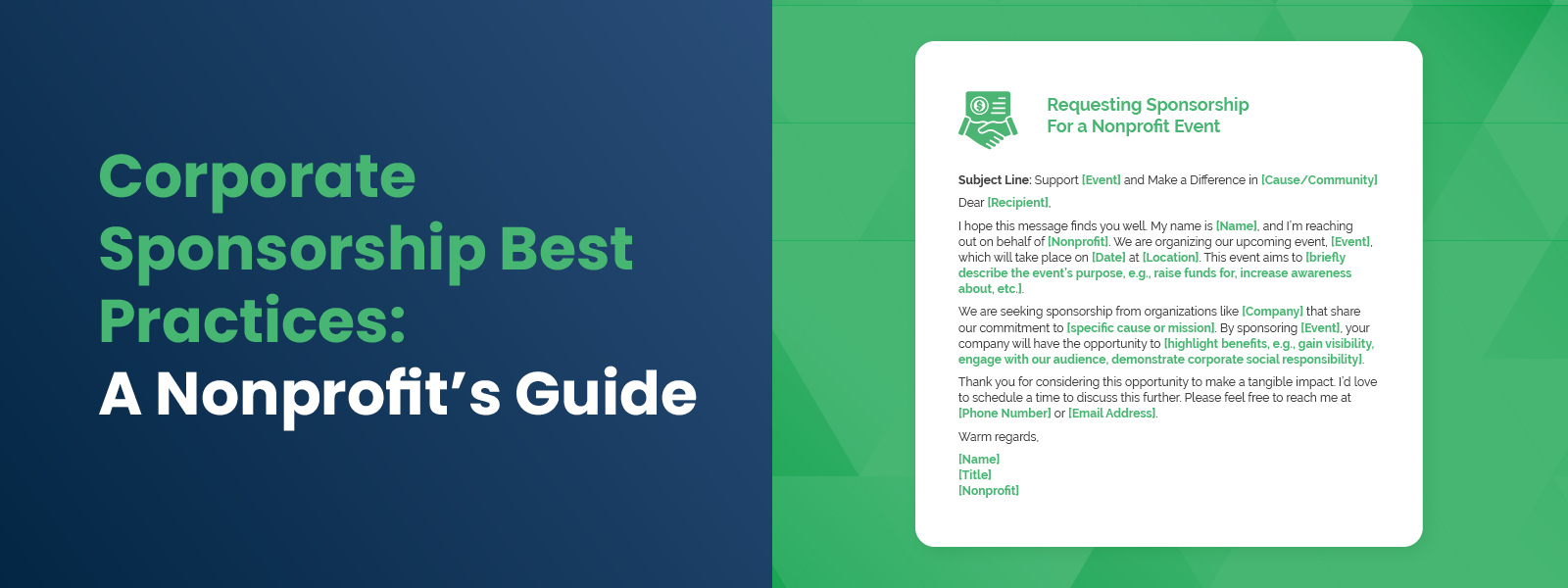
Corporate sponsorship blurbs are pre-written, strategic messages designed to open doors. By integrating these persuasive templates into your website, emails, and social media channels, you can clearly communicate the mutual benefits of partnering with your organization. Corporate sponsorships are not just about charity; they are strategic business partnerships. They offer a unique exchange of value where nonprofits gain essential resources and companies achieve marketing visibility, brand enhancement, or employee engagement goals. Despite these clear benefits, many opportunities are lost simply because the “ask” is not clear or compelling.

In this guide, we’ll cover:

By utilizing these templates, you can professionalize your outreach and position your nonprofit as a valuable partner to the business community.

The Strategic Value of Corporate Partnerships

Before utilizing these blurbs, it is essential to understand what you are asking for and why it matters to your potential partners. Corporate sponsorships generally fall into two categories: corporate grants and in-kind giving. Corporate grants are financial contributions made by businesses to nonprofit organizations that do not require repayment. In-kind giving refers to the donation of goods, services, or resources—instead of cash—to support a nonprofit’s mission.

For nonprofits, the benefits are clear. These partnerships provide increased resources to support programs, staff, and infrastructure. Beyond cash, they offer access to expertise, tools, and technology through in-kind donations that might otherwise be unaffordable. Furthermore, partnering with well-known brands enhances your organization’s credibility and visibility within the community.

However, the value proposition must be mutual. Companies benefit significantly from these relationships as well. Sponsorships enhance brand reputation and public goodwill, which can lead to increased customer loyalty among socially conscious consumers. They also strengthen employee engagement and retention, as employees value working for companies that support causes they care about. When you use the blurbs below, remember that you are offering a solution to a company’s Corporate Social Responsibility (CSR) goals, not just asking for a handout.

Did You Know? Corporate grants and in-kind giving create a powerful “win-win-win” scenario. Nonprofits gain resources; companies strengthen their social impact; and the ultimate beneficiaries (the communities served) receive better access to essential services like healthcare, education, and food security.

Website Blurbs: Your Partnership Hub

Your website is often the first place a potential corporate partner will look to verify your legitimacy and impact. It is crucial to have a dedicated presence that outlines exactly how businesses can get involved. Integrating corporate sponsorship blurbs into your site signals that you are open for business and ready to collaborate.

The “Partner With Us” Page

Create a dedicated landing page for corporate engagement. This page should serve as a menu of opportunities, detailing both grant needs and in-kind wish lists.

Template 1: The General Partnership Hook

Header: Become a Corporate Champion for [Cause]

Body: Does your company want to make a tangible difference in our community? We invite you to partner with [Nonprofit Name] through our Corporate Sponsorship Program. Whether through financial grants to fund our [Specific Program] or in-kind donations of [Specific Goods/Services], your support drives our mission forward.

Value Proposition: In return, our partners receive brand recognition, employee volunteer opportunities, and the knowledge that they are building a better future.

Call to Action: Contact our corporate relations team today to discuss a custom partnership package.

Template 2: The In-Kind Specific Appeal

Header: Turn Your Surplus into Social Good

Body: Your business has resources that can change lives. [Nonprofit Name] accepts in-kind donations of goods and services that help us keep our overhead low and our impact high. We are currently seeking [List 3-4 specific items, e.g., office furniture, consulting services, event space].

Call to Action: Have resources to share? Click here to fill out our In-Kind Donation Form.

Event Sponsorship Pages

If you host galas, 5Ks, or conferences, these are prime opportunities for sponsorship. Use these blurbs to highlight the marketing value of the event.

Template 3: The Event Visibility Pitch

Header: Sponsor the [Event Name]

Body: Align your brand with [Nonprofit Name] at our annual [Event Name]. This event attracts over [Number] community leaders and supporters. As a corporate sponsor, your company will receive logo placement, VIP tickets, and shout-outs during the program. It is the perfect way to demonstrate your commitment to [Cause] while reaching a dedicated local audience.

Call to Action: View our Sponsorship Tiers.

Quick Tip: Use a corporate giving database on your website to help visitors identify opportunities. Double the Donation’s database includes information on corporate grant opportunities, in-kind donation initiatives, and matching gift programs, creating a centralized resource for all types of corporate support.

Email Blurbs: Direct Outreach

Email allows for targeted, personalized communication. Whether you are reaching out to a local business owner or asking a board member to make an introduction, having a script ready ensures your message is professional and persuasive.

The Warm Introduction (Via a Donor/Board Member)

Your existing supporters are your best advocates. Provide them with this blurb to send to their employer on your behalf.

Template 4: The Internal Champion Script

Subject: Partnership opportunity with [Nonprofit Name]

Body: Hi [Manager/CSR Contact Name], I have been a proud supporter of [Nonprofit Name] for [Number] years. I know that [Company Name] is committed to supporting our local community, and I see a great alignment between our values and their mission to [Mission Statement]. They are currently seeking corporate partners for their upcoming [Project/Event]. I believe a partnership could offer us great visibility while making a real impact. Would you be open to a brief introduction to their development director?

Action: Let me know, and I can connect you via email.

The Cold Inquiry (Local Business)

When reaching out to a new potential partner, keep it concise and focused on alignment.

Template 5: The Value-Add Pitch

Subject: Partnership idea for [Company Name] and [Nonprofit Name]

Body: Dear [Contact Name], I am writing to you from [Nonprofit Name]. We have long admired [Company Name]’s commitment to [Specific Value, e.g., sustainability/education] in our community. Coming soon, we are launching a new initiative to [Project Goal], and we believe [Company Name] would be the ideal partner. We are seeking [Grant/In-Kind Request] to help us launch. In exchange, we would love to highlight your generosity to our [Number] newsletter subscribers and social media followers.

Call to Action: Do you have 10 minutes next week to discuss how we can collaborate?

The Stewardship Follow-Up

Once a sponsor has committed, keeping them engaged is vital for renewal.

Template 6: The Impact Update

Subject: Look what we achieved together!

Body: Dear [Sponsor Name], Thanks to your generous [Grant/In-Kind Donation], we were able to [Specific Achievement, e.g., serve 500 meals]. We could not have done this without [Company Name]’s support. To express our gratitude, we have attached a few photos of your team/products in action. We are proud to count you as a partner.

Action: Look out for our annual report next month for a special feature on your contribution!

Social Media Blurbs: Public Call-Outs

Social media is excellent for raising general awareness and publicly recognizing current sponsors to attract new ones. These platforms allow you to showcase the “fun” side of partnership.

LinkedIn

LinkedIn is the most effective channel for B2B engagement. Use this platform to speak directly to CSR directors and business leaders with whom you would like to partner.

Template 7: The CSR Appeal

“Is your company looking to expand its Corporate Social Responsibility impact? 🤝 [Nonprofit Name] partners with forward-thinking businesses to solve [Problem]. Whether through grants or in-kind services, your support changes lives. Let’s build a partnership that works for you and our community. DM us to learn more! #CSR #CorporateGiving #SocialImpact”

Template 8: The Sponsor Spotlight

“A huge thank you to [Company Name] for their recent grant supporting our [Program Name]! 🌟 Their investment allows us to help [Number] more families this year. We are grateful for partners who lead with their values. Interested in joining our corporate circle? Visit [Link].”

Twitter/X & Instagram

Use visuals and short, punchy copy to grab attention on these leading social media platforms. It can be a great way to increase awareness of sponsorship opportunities and get more potential partners involved!

Template 9: The In-Kind Wishlist

“We are looking for a few good partners! 📦 [Nonprofit Name] is in need of [Item 1] and [Item 2] for our upcoming drive. Does your business have surplus inventory or resources to share? It’s a tax-deductible way to do good! DM us to coordinate. 🚛 #InKindDonation #CommunitySupport”

Template 10: The Event Teaser

“Only 2 sponsorship spots left for our Spring Gala! 🎟️ Get your brand in front of [Number] local leaders and support a great cause. Don’t miss out on this prime visibility. Secure your spot today: [Link].”

Registration and Form Blurbs

Don’t miss the opportunity to capture corporate connections during event registration or volunteer sign-ups. Adding a simple question can reveal high-value prospects.

Event Registration Forms

Template 11: The Connection Query

Field Label: Employer / Company Name

Help Text: Does your company offer corporate grants or sponsorship programs?

Volunteer Intake Forms

Template 12: The Resource Check

Header: Skills & Resources

Body: Beyond your time, does your employer offer in-kind donations of goods or professional services (e.g., printing, legal, catering)?

Quick Tip: Prioritize companies where you already have a connection. Your current donors and volunteers are your best entry points. If a supporter works at a target company, use the “Internal Champion” email template above to help navigate the corporate hierarchy.

Best Practices for Implementing These Blurbs

Writing the copy is the first step, but deployment strategy is key. To maximize your success with corporate sponsorship blurbs, keep these best practices in mind.

1. Prioritize Mission Alignment

Don’t send proposals to every company in the phone book. Research businesses that have a strong presence in your community or support causes similar to your own. Use your blurbs to highlight this alignment. For example, if you are an environmental group pitching an outdoor retailer, emphasize your shared commitment to conservation.

2. Be Specific

Vague requests often get ignored. Especially for in-kind requests, be specific about quantities, delivery needs, and timing. Instead of asking for “help,” ask for “20 laptops for our computer lab” or “catering for 50 people.”

3. Demonstrate Impact

Companies view grants and sponsorships as investments. Use your blurbs to show them the return on that investment. Clear and concise language with measurable goals and outcomes shows how the partnership will benefit the community and reflect positively on the sponsor.

4. Leverage Technology

Use database tools to research potential partners before you reach out. A corporate giving database can tell you if a company offers cash grants, product donations, or both, as well as their application deadlines and eligibility requirements. This ensures you are pitching the right company with the right ask.


Wrapping Up & Next Steps

Integrating corporate sponsorship blurbs into your communications strategy is a high-leverage activity. By clearly articulating your needs and the benefits of partnership, you move beyond “begging” and into business development. Whether it is a grant that funds a new program or an in-kind donation of office space that lowers your overhead, these partnerships are vital for sustainable growth.

Start by adding a “Partner with Us” page to your website using the templates above. Then, segment your donor list to identify individuals who work for major local employers and send them the advocacy email script. Small steps in communication can lead to giant leaps in funding.

Ready to uncover more corporate giving opportunities? Request a demo of Double the Donation to see how our tools can help you identify matching gifts, volunteer grants, and corporate sponsorship prospects today.

Corporate Sponsorship Best Practices-A Nonprofit’s Guide

Corporate Sponsorship Best Practices: A Nonprofit’s Guide
In the modern nonprofit landscape, diversifying revenue streams is no longer a luxury—it is a necessity for survival and growth. While individual donations and matching gifts form the bedrock of many fundraising strategies, corporate sponsorship represents a high-potential avenue that remains untapped by many organizations. Unlike traditional philanthropy, which is often altruistic, corporate sponsorships are strategic business partnerships. They offer a unique exchange of value: funds or resources for the nonprofit, and marketing visibility, brand enhancement, or employee engagement for the corporation.

However, securing these partnerships requires more than sending out generic solicitation letters. It demands a sophisticated approach that mirrors business development. To succeed, nonprofits must adopt specific corporate sponsorship best practices that prioritize strategic fit, rigorous research, and exceptional stewardship. The goal is to move beyond transactional interactions and build long-term, mutually beneficial relationships that advance your mission.

Whether you are looking to underwrite a specific program, secure funding for a gala, or obtain essential technology through in-kind support, the principles remain the same. You must identify companies whose values align with yours, articulate a compelling business case, and deliver measurable results.

In this guide, we’ll cover:

By implementing these best practices, your organization can unlock a sustainable source of revenue and build a network of corporate allies dedicated to your success.

Understanding the Strategic Value of Sponsorship

Before executing a sponsorship strategy, it is vital to understand the landscape. Corporate giving is a growing ecosystem that benefits all parties involved. Corporate grants and in-kind giving are more than just transactions—they are mutually beneficial relationships that create meaningful impact for multiple stakeholders.

For the Nonprofit: Sponsorships provide increased resources to support programs, staff, and infrastructure. Beyond cash, they offer access to expertise, tools, and technology through in-kind donations. Furthermore, partnering with well-known brands enhances your organization’s credibility and visibility, potentially expanding your network to new donor pools.

For the Corporation: Companies are increasingly driven by Corporate Social Responsibility (or CSR). Sponsorships enhance brand reputation and public goodwill. They also strengthen employee engagement and retention, as employees value working for companies that support causes they care about. Additionally, sponsorships can drive customer loyalty among socially conscious consumers and open new business opportunities through local partnerships.

Did You Know? Corporate giving creates a powerful “win-win-win” scenario. Nonprofits gain resources; companies strengthen their social impact; and the ultimate beneficiaries (the communities served) receive better access to essential services like healthcare, education, and food security.

Best Practice 1: Prioritize Mission Alignment

The “spray and pray” method of sending proposals to every company in the Fortune 500 is a waste of resources. The first and most critical of all corporate sponsorship best practices is ensuring strict mission alignment. You must target companies whose giving priorities naturally overlap with your work.

Researching Alignment
Start by researching businesses that have a strong presence in your community or service area. Look for companies that support causes similar to your own. For example, if you are an environmental nonprofit, a partnership with a company focused on sustainability (such as Patagonia or a local green energy firm) is a natural fit. If you focus on education, look for businesses that prioritize workforce development or youth programs.

Reviewing CSR Reports
To determine alignment, review company websites and Corporate Social Responsibility (CSR) reports. These documents often explicitly state the company’s “pillars of giving” or focus areas. For instance, Bank of America focuses on workforce development and basic needs, while Google focuses on technology-driven solutions in digital equity and climate action.

Leveraging Existing Connections
Prioritize companies where you already have a connection. Your current donors, volunteers, and board members are your best entry points. If a donor already works at a target company, they can serve as an internal champion to help navigate the corporate hierarchy and advocate for the sponsorship from the inside.

Best Practice 2: Identify Open Applications and Guidelines

Once you have identified potential partners with aligned missions, the next step is to determine how they accept requests. Many large corporations have formalized sponsorship and grant application processes with specific windows and criteria.

Verify Giving Guidelines
Before investing time in a proposal, access and verify the giving guidelines. Each company has its own application timeline, eligibility criteria, and preferred method of contact. Ideally, you want to ensure that your cause is a good fit before applying. Look for details on whether they offer cash grants, product donations, or both, and check for geographic or 501(c)(3) status requirements.

Use a Database to Find Opportunities
Searching for these opportunities manually can be time-consuming. Utilizing a corporate giving database is a best practice for efficiency. Tools like Double the Donation’s database allow you to search for a company name and instantly see if they offer corporate grant opportunities, in-kind donation initiatives, or employee volunteer incentives.

Navigate to Request Portals
Many companies manage their sponsorships through online portals. A comprehensive database can provide direct links to these forms. For example, you can search for a company like “The Home Depot” or “Coca-Cola” and find buttons to “Go to In-Kind Donation Form” or “Go to Grant Request Form” immediately.

Quick Tip: Be aware of deadlines. Some companies have rolling application windows, while others operate on strict quarterly or annual cycles. Missing a deadline by a day can mean waiting a year for the next opportunity.

Best Practice 3: Don’t Overlook In-Kind Sponsorships

When nonprofits think of sponsorship, they often think exclusively of cash. However, overlooking in-kind sponsorships is a major missed opportunity. In-kind giving refers to the donation of goods, services, or resources instead of cash. This type of support can be just as valuable—sometimes even more so—than a financial grant because it helps nonprofits save money on operational costs.

Types of In-Kind Sponsorships to Pursue:

  • Products: Office supplies, furniture, food and beverages for events, or educational materials.
  • Professional Services: Marketing or public relations support, legal counsel, accounting services, or strategic planning consulting.
  • Technology: Donated or discounted access to software platforms, cloud storage, cybersecurity tools, or hardware.
  • Space and Facilities: Free or reduced-cost use of meeting spaces, offices, or event venues.

Examples of In-Kind Leaders
Many major corporations have specific programs for these types of gifts. For example:

  • Crayola: Donates art supplies and educational materials to schools and youth programs.
  • Marriott: Donates hotel stays, meeting space, and food and beverage services from surplus inventory.
  • Cisco: Offers networking equipment and software through its Product Grant Program.

By advocating for in-kind donations, you can access high-value resources that free up your budget for other critical needs.

Best Practice 4: Craft a “Business Case” Pitch

When you are ready to make the ask, your pitch must be professional, data-driven, and focused on mutual benefit. You are not asking for charity; you are proposing a partnership.

Tailor Your Message
Avoid generic requests. Tailor your application or proposal to the company’s specific interests and language. When approaching a tech company, highlight how their sponsorship will support digital literacy or STEM education. If approaching a local retailer, focus on community development metrics.

Demonstrate Impact
For the greatest chance at success, do not just ask for support; demonstrate impact. Companies want to know that their investment will yield results. Use clear, concise language with measurable goals and outcomes to show how the partnership will benefit the community and reflect positively on the sponsor.

Include Necessary Documentation
Professionalism builds trust. Ensure you have all required documentation ready, such as your IRS 501(c)(3) letter, a clear program budget, a description of the project, and specific sponsorship packages outlining recognition benefits.

Best Practice 5: Steward the Relationship

Securing the sponsorship is only the beginning. Retention is key to long-term sustainability. You must steward your corporate sponsors with the same care you give your major donors.

Prompt Acknowledgement
If your request is approved, acknowledge the gift promptly with a formal thank-you letter or email. This is the first step in building a lasting relationship.

Deliver on Promises
Ensure you deliver on all recognition benefits promised in your sponsorship package. If you promised logo placement on a website or a shout-out at an event, make sure it happens. Furthermore, provide impact updates as the project progresses so the sponsor can see their contribution in action.

Handle Rejection Gracefully
If your request is denied, ask for feedback on your proposal. Thank the company for considering your organization and express your desire to stay in touch for future opportunities. Maintaining a positive relationship can leave the door open for the next funding cycle.

Quick Tip: Use your donor data to impress sponsors. If you know that a significant number of your donors work for a specific company (data you can gather via matching gift tools), share this with the sponsor. It proves that their employees are already invested in your cause.

Best Practice 6: Measure and Optimize

To ensure your corporate sponsorship program grows, you must track your performance. Data allows you to refine your strategy and demonstrate ROI to your board and future sponsors.

Key Metrics to Track

  • Total Revenue: Track the total amount of funding generated through corporate grants and sponsorships.
  • In-Kind Value: Estimate the monetary value of donated goods and services to understand the full scope of corporate support.
  • Volunteer Engagement: If your sponsorship includes employee volunteering, track the number of hours logged. This is a key metric for corporate CSR reports.
  • Retention Rate: Monitor how many sponsors return year over year. A high retention rate signals strong relationship management.

Leverage Technology
Using a matching gift or corporate giving dashboard can help you visualize these trends. Tracking metrics helps you identify wins as well as pinpoint areas for improvement, ensuring your strategy continues to mature.


Wrapping Up & Next Steps

Implementing these corporate sponsorship best practices is a strategic investment in your nonprofit’s future. By shifting your approach from transactional asks to strategic partnerships, you can unlock a diverse range of resources (from cash grants to essential technology) that fuel your mission. Corporate sponsorships allow you to scale your impact, enhance your credibility, and build a network of support that strengthens your organization against economic uncertainty.

To get started, assess your current needs and identify which companies in your network align with your mission. Use a corporate giving database to research their open opportunities, and craft a pitch that highlights the mutual value of the partnership.

Ready to uncover more corporate giving opportunities? Request a demo with Double the Donation to see how our tools can help you identify corporate sponsorship opportunities and more.

Advocating For A Corporate Grant Program-A Nonprofit Guide

Advocating For A Corporate Grant Program: A Nonprofit Guide
Securing reliable funding is a constant challenge for nonprofit organizations striving to make a difference. While individual donations are the lifeblood of many charities, relying on them exclusively can limit your ability to scale operations or weather economic downturns. This is where advocating for a corporate grant program becomes a transformative strategy. Unlike loans or investment capital, corporate grants for nonprofits are financial contributions that do not require repayment, making them one of the most desirable revenue streams available. These funds allow organizations to launch new initiatives, strengthen infrastructure, and cover essential operating costs. However, obtaining them requires more than just filling out a form; it requires a strategic approach to advocacy that positions your nonprofit as an indispensable partner to the business community.

Advocating for these programs involves identifying businesses with aligned values, articulating a compelling case for support, and leveraging your existing network to open doors. For companies, offering grants is not just charity; it is a strategic move to enhance their brand reputation, engage employees, and demonstrate corporate social responsibility. For your nonprofit, it means accessing significant resources that fuel mission-driven work. Despite the clear benefits, navigating the landscape of corporate philanthropy can feel overwhelming due to varying guidelines and expectations. This guide creates a clear path forward, helping you advocate for the establishment or allocation of grant funds to your cause.

In this guide, we’ll cover:

Success in this arena requires a shift in perspective. You are not merely asking for money; you are offering a partnership that generates shared value. By mastering the mechanics of corporate grants, you can unlock a powerful source of funding that drives long-term sustainability.

Understanding the Power of Corporate Grants

To effectively advocate for a corporate grant program, you must first understand exactly what these funds entail and how they function. Corporate grants are financial contributions made by businesses to nonprofit organizations intended to support charitable programs, projects, or initiatives. Unlike sponsorships, which often function as marketing transactions, grants are typically rooted in community impact and social good.

Grants are generally awarded through a formal application process and come with specific guidelines regarding how the funds must be used. Understanding the specific category of grant you are advocating for is crucial for tailoring your pitch.

Program Support Grants

These funds are designated for specific initiatives. For example, you might advocate for a grant to fund a new after-school literacy program, a job training workshop, or a specific environmental conservation campaign. When advocating for this type of grant, your focus should be on the direct outcomes of the specific project.

Capacity-Building Grants

Nonprofits often struggle to fund “unsexy” but necessary improvements. Capacity-building grants help organizations improve infrastructure or internal capabilities. This could include upgrading technology systems, investing in staff training, or expanding service delivery capabilities. Advocating for these requires showing a company how a stronger infrastructure leads to better long-term results.

General Operating Support Grants

These are the “holy grail” of nonprofit funding. They provide flexible, unrestricted funds that allow a nonprofit to cover essential day-to-day expenses like staffing, rent, or technology. Because these funds are unrestricted, advocating for them often requires a high level of trust and a proven track record of success.

Matching Grants

While often discussed separately, matching grants are a form of corporate funding where a company matches donations made by employees or external donors. This encourages greater giving by leveraging the company’s funds to incentivize individual support.

Did You Know? Corporate grants create a “win-win-win” scenario. Nonprofits gain resources and credibility; companies enhance their brand reputation and employee retention; and communities see tangible benefits, such as more meals served or better access to healthcare.

Leveraging Donors as Internal Advocates

One of the most overlooked strategies in advocating for a corporate grant program is utilizing your existing donor base. Your donors are more than just supporters; they are employees, managers, and executives at companies that may have grant funds available. An engaged donor can serve as an internal champion, bridging the gap between your nonprofit and their employer.

The Warm Introduction

Cold outreach to a corporation can often result in your proposal getting lost in a pile of applications. A warm introduction from a current employee can bypass these hurdles. Donors can introduce you directly to their community affairs or CSR departments, ensuring your advocacy reaches the right decision-makers.

Internal Advocacy

Many companies have employee-led committees that determine where grant money goes. Your donors may already be sitting on these committees. By educating your donors about your specific funding needs, you empower them to advocate for a corporate grant program internally. They can make the case that supporting your organization aligns with the employees’ values and the company’s mission.

Communicating Value

Your donors already believe in your cause. Equip them with the data and language they need to articulate that value to their employers. Provide them with one-pagers or impact summaries that they can share with leadership. When an employee advocates for a grant, they are telling their employer that this cause matters to the workforce, which is a powerful motivator for companies looking to boost employee engagement.

Identifying the Right Corporate Targets

Advocating for a corporate grant program is most effective when you target companies whose philanthropic priorities align with your mission. A scattershot approach rarely yields results. Instead, you need to conduct thorough research to find businesses that have a vested interest in your success.

Researching Alignment

Start by identifying businesses that have a strong presence in your community or service area. Local businesses often prioritize grants that benefit their immediate neighbors. Look for companies that support causes similar to your own. For example, a healthcare company is more likely to fund a medical clinic than an arts program.

Utilizing Resources

You can locate these opportunities by reviewing company websites and their Corporate Social Responsibility (CSR) reports. Additionally, referencing a philanthropy database like Double the Donation can streamline this search by providing detailed information on existing grant programs and their specific focus areas.

Evaluating Established Programs

Familiarizing yourself with major players can help you understand what a successful grant program looks like.

  • Bank of America: Focuses on workforce development and basic needs, awarding grants to nonprofits creating economic progress.
  • Google: Offers grants focused on technology-driven solutions in areas like digital equity and climate action.
  • Target: Provides funding for racial equity, early childhood education, and community engagement.
  • Cisco: Supports nonprofits using tech for social change, specifically in crisis response and economic empowerment.

Quick Tip: Prioritize companies where you already have a connection. Your current donors, volunteers, or board members are your best entry points. If a supporter works at a target company, ask them to help navigate the corporate hierarchy to find the right person to pitch.

Structuring Your Pitch for Funding

Once you have identified a potential partner, the next step in advocating for a corporate grant program is crafting a professional, persuasive appeal. Whether applying through an online portal or pitching a partnership to a CSR director, your message must be clear, concise, and mutually beneficial.

Tailor Your Message

Avoid generic requests. Tailor your application or pitch to the company’s specific interests and language. If a company focuses on sustainability, highlight how your grant proposal advances environmental goals. If they prioritize education, emphasize your metrics related to student success.

Demonstrate Impact

For the greatest chance of success, do not just ask for support; demonstrate impact. Companies view grants as investments in the community. You must show them the return on that investment. Use clear, measurable goals and outcomes to show exactly what the grant will achieve.

Highlight Mutual Benefits

Show how the partnership will benefit both parties. While the nonprofit gets funding, the company should get enhanced brand reputation, visibility, or employee engagement opportunities. Clearly articulate how sponsoring your organization helps them achieve their specific CSR goals.

Prepare Necessary Documentation

Corporate advocacy often requires specific paperwork to prove your legitimacy and financial health. Be prepared to provide:

  • Your organization’s IRS 501(c)(3) determination letter.
  • A clear budget or financial summary for the project.
  • A detailed program description.
  • Impact metrics or testimonials that prove your effectiveness.

Advocating for a corporate grant program often involves navigating complex application procedures. Each company has its own guidelines, timelines, and preferred methods of contact.

Verify Guidelines

Before investing time in a proposal, access and verify the giving guidelines. Check if the company offers the specific type of grant you need (e.g., cash vs. product). Ensure you meet all eligibility requirements, such as serving a specific geographic region or addressing a particular social issue.

Understand Timelines

Be aware of application deadlines and cycles. Some companies have rolling deadlines, while others operate on strict annual or quarterly schedules. Missing a deadline can mean waiting a full year for another opportunity, so rigorous tracking is essential.

Leverage Technology

You can use database tools to navigate directly to request portals. For example, you can search for a company like Coca-Cola in a corporate giving database, review the guidelines provided, and click through to the specific grant request form. This saves time and ensures you are applying through the correct channels.

Stewardship and Relationship Building

Your advocacy efforts do not end when you hit “submit.” Implementing a strong follow-up strategy is essential for maximizing your chances of securing the grant and building a long-term relationship.

Track Your Progress

Create a simple tracking system or spreadsheet to monitor your submission dates, key contacts, and follow-up deadlines. If you haven’t heard back within the expected window (usually two to three weeks), follow up politely with a brief email to reiterate your interest and offer additional information.

Handle Approvals with Gratitude

If your request is approved, acknowledge the gift promptly with a formal thank-you letter or email. Deliver on any promises made regarding impact updates or public recognition. Celebrating the partnership publicly reinforces the value for the company and strengthens the bond for future funding cycles.

Learn from Denials

If your request is denied, treat it as a learning opportunity. Ask for feedback on your proposal to understand why it wasn’t selected. Thank the company for considering your organization and express your desire to stay in touch for future opportunities. Maintaining professionalism even in the face of rejection positions you as a reliable partner for the future.

Did You Know? Thoughtful stewardship now can open the door to long-term corporate relationships down the line. Every interaction is a chance to build trust and lay the groundwork for future support.

Measuring Success and Optimizing Strategy

To ensure your advocacy for a corporate grant program is effective, you must track your results. By analyzing your success rates and the return on your time investment, you can refine your strategy for the future.

Key Metrics to Track

  • Total Grant Revenue: The total dollar amount secured through corporate grants.
  • Application Success Rate: The percentage of proposals that result in funding.
  • Donor Advocacy: How many introductions or internal referrals came from your existing donor base.
  • Retention: How many corporate partners renew their grants the following year.

Leveraging Tools

Tools like Double the Donation’s corporate giving database can help you locate opportunities with Double the Donation’s database. While best known for matching gifts, this resource creates a centralized hub to identify which companies offer corporate grant opportunities and what types of contributions are available. Using data to drive your strategy ensures you are focusing your advocacy efforts on the highest-probability targets.


Wrapping Up & Next Steps

Advocating for a corporate grant program is a strategic process that can yield significant financial rewards for your nonprofit. By securing these funds, you gain access to resources that fuel your mission without the burden of repayment, while building meaningful relationships with the business community. These partnerships offer a powerful synergy: your organization gains vital funding, companies strengthen their social impact, and the communities you serve see real benefits.

To get started, assess your current needs and identify which types of corporate support would be most beneficial. Leverage your existing donor network to find warm introductions and internal champions. Use tools like the Double the Donation database to research potential partners and streamline the application process. With a structured plan and persistent advocacy, you can unlock the full potential of corporate philanthropy.

Ready to uncover more corporate giving opportunities? Request a personalized demo with Double the Donation to see how our tools can help you identify corporate grant opportunities and more!

Advocating For An In-Kind Donation Program-Tips & Templates

Advocating For An In-Kind Donation Program: Tips & Templates
Every nonprofit professional knows the struggle of balancing a tight budget with the need for high-quality resources. You want to allocate every possible dollar to your mission, yet operational necessities like software, office space, legal advice, and event supplies can quickly drain your funds. This is where advocating for an in-kind donation program becomes a transformative strategy. While cash grants and matching gifts often dominate the conversation around corporate philanthropy, in-kind donations for nonprofits offer a unique avenue to access tangible goods and professional expertise that would otherwise be out of reach.

Advocating for these programs involves more than simply asking for free items. It requires building a strategic partnership where businesses donate their products, services, or employee time to support your cause. For companies, this is an opportunity to showcase their products, engage employees through skills-based volunteering, and demonstrate tangible community support. For your nonprofit, it means accessing high-value resources without the price tag. Despite these clear mutual benefits, many companies have not yet formalized their in-kind giving channels, or they restrict them to specific partners. This creates a prime opportunity for your organization to step in, educate corporate leaders, and advocate for establishing or expanding an in-kind donation program.

In this guide, we’ll cover:

Success in securing these resources requires a shift in mindset. You are not just looking for handouts; you are offering companies a way to repurpose their assets for social good. By understanding the mechanics of in-kind giving, you can position your nonprofit as a valuable partner in a company’s corporate social responsibility strategy.

Understanding the Scope of In-Kind Giving

To effectively advocate for an in-kind donation program, you must first articulate exactly what it entails. In-kind giving refers to the donation of goods, services, or resources instead of cash to support a nonprofit’s mission. In a corporate context, this occurs when a company donates its products, services, employee time, or other tangible resources to a nonprofit organization.

This type of support can be just as valuable, and sometimes even more so, than a financial grant because it helps nonprofits save money and access tools they might not otherwise afford. When advocating for these programs, it helps to categorize the potential asks so corporate partners understand the breadth of what they can offer.

Products and Goods

This is perhaps the most recognizable form of in-kind giving. Companies often donate items that directly support a nonprofit’s operations or beneficiaries. Examples include office supplies, furniture, or equipment. For events, businesses might provide food and beverages. Nonprofits serving specific populations might request clothing or hygiene kits. Educational nonprofits often benefit from donated educational materials.

Professional Services

Accessing high-level professional expertise can be prohibitively expensive for nonprofits. Advocating for pro bono services allows you to tap into corporate talent pools. This can include marketing or public relations support, legal counsel or accounting services, and IT consulting or web development. Strategic planning or HR consulting are also valuable services that companies can offer.

Technology and Software

In the digital age, technology donations are critical for capacity building. You can advocate for donated or discounted access to software platforms. Companies may also provide cloud storage or cybersecurity tools, as well as design or productivity software.

Space and Facilities

Physical space is a significant overhead cost. Corporations can support your mission by offering free or reduced-cost meeting space, offices, or event venues. They might also provide warehousing or storage space for goods or allow the use of corporate training centers for your staff or volunteers.

Did You Know? In-kind giving creates a powerful “win-win-win” scenario. Nonprofits gain resources and credibility; companies enhance their brand reputation and employee retention; and communities see real benefits like more meals served or better access to healthcare.

Why Companies Should Establish In-Kind Programs

When you advocate for an in-kind donation program, you are essentially pitching a business solution. Corporate leaders need to understand why donating inventory or billable hours makes business sense. You must articulate that while giving is rooted in altruism, companies also benefit significantly from supporting nonprofits.

Enhanced Brand Reputation

In-kind giving offers a unique branding opportunity. When a company’s products are seen doing good in the community, such as a tech company providing laptops to underfunded schools, it creates a tangible connection between the brand and positive impact. This leads to enhanced brand reputation and public goodwill.

Employee Engagement and Skill Development

Donating professional services is a fantastic way for companies to engage their workforce. Employees who provide pro bono legal or marketing services get to use their skills in a new, rewarding context. This strengthens employee engagement and retention. It effectively serves as a skills-based volunteering program that boosts morale.

Inventory Management

For retail and manufacturing companies, in-kind product donations can be a strategic way to manage inventory. Donating surplus goods, overstock, or seasonal merchandise prevents waste and can provide tax advantages for the business, all while supporting a charitable cause.

Identifying the Right Corporate Partners

Not every company is ready to implement a comprehensive in-kind donation program immediately. To maximize your advocacy efforts, you must identify businesses that are primed for partnership. Start by researching businesses that have a strong presence in your community or service area. Local businesses are often more inclined to donate space or goods to neighbors they can see.

Look for companies that support causes similar to your own. If you are an environmental nonprofit, a local outdoor retailer is a more logical target than a software firm. You should also check if they have established grant programs or existing in-kind donation initiatives. Companies that already offer employee volunteer or matching gift programs are statistically more likely to be open to in-kind giving because they have already invested in corporate philanthropy.

Examples of Generous In-Kind Programs

Familiarizing yourself with major players can help you understand what a successful program looks like.

  • Crayola: Donates large volumes of art supplies and educational materials to schools and youth programs.
  • Target: Regularly donates merchandise, including clothing, home goods, and food, to local nonprofits through its Target Product Donation Program.
  • Marriott: Donates hotel stays, meeting space, and furnishings to qualified nonprofits.
  • Verizon: Offers technology donations, refurbished devices, and internet access solutions.
  • Cisco: A leader in technology donations, offering networking equipment and software through its Product Grant Program.
  • Big Lots: Regularly donates overstock and seasonal merchandise like furniture and toys.

Quick Tip: Use resources like company websites, CSR reports, and philanthropy databases to streamline your research. Tools like Double the Donation’s database can help you uncover hidden opportunities for in-kind donations and verify eligibility requirements.

Leveraging Donors as Internal Advocates

One of the most powerful assets in advocating for an in-kind donation program is your existing donor base. Your donors are not just supporters; they are employees at companies that may have surplus goods, available meeting space, or skilled teams looking for volunteer opportunities. An engaged donor can serve as an internal champion, bridging the gap between your nonprofit and their employer.

Warm Introductions

Cold outreach to a corporation regarding product donations can be difficult. However, a well-placed introduction from a passionate employee can bypass hurdles and build instant trust. Donors can introduce you directly to their CSR or HR contacts, ensuring your proposal lands on the right desk.

Internal Championing

Many companies have employee-led committees focused on community impact or CSR. Your donors may already be sitting on these committees. By educating your donors about your specific resource needs, whether it’s new computers or a venue for your gala, you empower them to advocate for your organization during internal discussions.

Flagging Opportunities

Employees often have visibility into discretionary giving budgets or inventory cycles that are not publicly promoted. A donor might know that their office is upgrading furniture and looking to offload the old desks, or that their team has a budget for pro bono work. Donors can flag these funding and resource opportunities for you.

Templates: Employee Advocacy and Nonprofit Pitches

Ready to kick off your advocacy efforts? We’ve created a few helpful templates to guide your outreach. Feel free to customize the messaging to fit your own unique use case!

Template: Employee Advocacy Email

To help your supporters advocate for you, provide them with a template they can customize and send to their HR or CSR department.

Subject: Proposal for In-Kind Donation Program: Supporting [Nonprofit Name]

Dear [HR/CSR Contact Name],

I hope you are having a great week.

As you may know, I am a proud supporter of [Nonprofit Name], an organization dedicated to [Brief Mission Statement]. I have seen firsthand the incredible impact they make in our community by [Specific Example of Impact].

I am writing to propose that [Company Name] consider establishing a partnership with [Nonprofit Name] through an in-kind donation. I noticed that we often have [mention specific resources, e.g., surplus inventory, old office equipment, specific professional skills] that could be incredibly valuable to their operations.

Donating these resources would not only support a great cause but also align with our company values of [Company Value 1] and [Company Value 2]. It is a fantastic way for us to reduce waste/utilize our skills while boosting our community engagement profile.

I would love to connect you with their team to discuss how we might be able to support their work. Please let me know if you would be open to a brief introduction.

Best regards,

[Employee Name]
[Job Title]

Template: Nonprofit Request Letter

Use this template as a starting point when reaching out to a corporate partner directly.

Subject: Partnership Opportunity: Supporting [Project Name] with In-Kind Contributions

Dear [Contact Name],

I am writing to you on behalf of [Nonprofit Name], where we are dedicated to [Brief Mission Statement]. We have long admired [Company Name]’s commitment to [Company Value or Community Interest], particularly your work in [Specific Relevant Initiative].

We are currently launching a new initiative, [Project Name], which aims to [Goal of Project]. To achieve this, we are seeking in-kind support in the form of [Specific Request: e.g., 20 laptops, venue space for 100 people, pro-bono legal counsel].

We believe that [Company Name]’s [products/services] are the gold standard in the industry, and your support would play a pivotal role in ensuring the success of this project. In return for your generosity, we would be thrilled to recognize [Company Name] by [List Recognition Benefits, e.g., logo placement, social media shoutouts, impact report feature].

I have attached our 501(c)(3) determination letter and a brief overview of the program for your review. I would welcome the opportunity to discuss this potential partnership further.

Thank you for your time and for considering this request to make a tangible difference in our community.

Sincerely,

[Your Name]
[Your Title]
[Nonprofit Name]

Crafting a Compelling Pitch

Once you have identified a potential partner and perhaps secured an introduction, the next step in advocating for an in-kind donation program is crafting a professional appeal. Whether applying through an online portal or submitting a proposal via email, your materials must be clear, concise, and mission-aligned.

Tailor Your Message

Avoid generic requests. Tailor your application to the company’s specific interests and language. If you are asking a tech company for software, highlight how their specific tools will modernize your operations and allow you to serve more beneficiaries.

Be Specific

Vague requests often get ignored. Be specific, especially for in-kind requests, regarding quantities, delivery needs, and timing. If you need event space, specify the date, expected attendance, and A/V requirements. If you need consulting, outline the specific project scope.

Prepare Necessary Documentation

Corporate advocacy often requires specific paperwork. Be prepared to provide:

  • Your organization’s IRS 501(c)(3) determination letter.
  • A clear budget or financial summary.
  • A detailed program description.
  • Impact metrics or testimonials that prove your effectiveness.
  • Sponsorship or recognition packages, if applicable.

Quick Tip: For the greatest chance at success, don’t just ask for support. Instead, demonstrate impact and show how the partnership will benefit both parties.

Advocating for an in-kind donation program often involves navigating specific corporate procedures. Each company has its own application timeline, eligibility criteria, and preferred method of contact.

Verify Guidelines

Before asking, access and verify the giving guidelines. Check if the company offers cash grants, product donations, or both. Ensure you meet all eligibility requirements, such as being a 501(c)(3) or serving a specific geographic region.

Understand Timelines

Be aware of application deadlines and cycles. Some programs are rolling, while others operate on annual or quarterly schedules. Missing a deadline can mean waiting a full year for another opportunity, so rigorous tracking is essential.

Leverage Technology

You can use database tools to navigate directly to request portals. For example, you can search for a company like Air Canada in a corporate giving database to see if they offer corporate sponsorships or in-kind donations, and then click through directly to their donation form.

Stewardship and Follow-Up

Your advocacy efforts do not end when you hit “submit.” Implementing a strong follow-up strategy is essential for maximizing your chances of securing the donation and building a long-term relationship.

Track Your Progress

Create a simple tracking system or spreadsheet to monitor your submission dates, key contacts, and follow-up deadlines. If you haven’t heard back within the expected window (usually 2-3 weeks), follow up politely with a brief email to reiterate your interest.

Handle Approvals with Gratitude

If your request is approved, acknowledge the gift promptly with a thank-you letter or email. Deliver on any promises made regarding impact updates or public recognition. For in-kind gifts, verify the receipt of goods and check their condition immediately.

Learn from Denials

If your request is denied, treat it as a learning opportunity. Ask for feedback on your proposal to understand why it wasn’t selected. Thank the company for considering your organization and express your desire to stay in touch for future opportunities. Maintaining professionalism even in the face of rejection positions you as a reliable partner for the future.


Wrapping Up & Next Steps

Advocating for an in-kind donation program is a strategic process that can yield significant tangible rewards for your nonprofit. By securing donated goods, services, and technology, you access vital resources that fuel your mission while building meaningful relationships with the business community. These partnerships offer a powerful win-win-win scenario: your organization gains resources and expertise, companies strengthen their social impact, and the communities you serve see real benefits.

To get started, assess your current operational needs and identify which types of in-kind support would be most beneficial. Leverage your existing donor network to find warm introductions and internal champions. Use tools like the Double the Donation database to research potential partners and streamline the application process. With a structured plan and persistent advocacy, you can unlock the full potential of corporate philanthropy.

Ready to uncover more corporate giving opportunities? Request a personalized demo with Double the Donation to see how our tools can help you identify even more in-kind donation opportunities.

Advocating For Corporate Sponsorships-A Helpful Guide

Advocating For Corporate Sponsorships: A Helpful Guide
In the competitive world of nonprofit fundraising, relying solely on individual donations can limit your organization’s potential for growth. To truly scale your impact, it is essential to diversify revenue streams by building robust relationships with the business community. Advocating for a corporate sponsorship is one of the most effective ways to secure substantial resources, yet it remains an underutilized strategy for many development teams. While matching gifts often dominate the conversation around corporate philanthropy, sponsorships (encompassing both corporate grants and in-kind donations) offer a unique opportunity to access funds, specialized expertise, and essential goods that might otherwise deplete your budget.

Corporate sponsorships are more than just a logo on a gala program or a banner at a 5K run. They represent a mutually beneficial partnership where businesses support charitable programs that align with their values, community priorities, or social impact goals. Whether through financial contributions that do not require repayment or the donation of tangible goods and services, these partnerships can be transformative. However, securing them requires a proactive approach. It involves identifying the right partners, articulating a compelling value proposition, and empowering your existing supporters to champion your cause from the inside.

In this guide, we’ll cover:

By mastering the art of advocacy, you can position your nonprofit not just as a beneficiary but as a vital partner in driving positive change. This guide will equip you with the insights and strategies needed to navigate the corporate landscape and secure the support your mission deserves.

Understanding the Scope of Corporate Sponsorships

To effectively advocate for a corporate sponsorship, you must first understand the different forms these partnerships can take. While the term “sponsorship” is often used broadly, it typically encompasses two primary categories of support: corporate grants and in-kind giving. Understanding the nuances of each allows you to tailor your advocacy efforts to the specific resources a company has to offer.

Corporate Grants
Corporate grants are financial contributions made by businesses to nonprofit organizations. Unlike loans, these funds do not require repayment, making them a highly desirable form of revenue. These grants are generally intended to support specific charitable initiatives that align with the company’s social impact goals.

There are several types of grants you might advocate for:

  • Program Support Grants: These funds are designated for specific initiatives, such as an after-school program or an environmental campaign.
  • Capacity-Building Grants: These help nonprofits improve their infrastructure, such as upgrading technology systems or investing in staff training.
  • General Operating Support Grants: These provide flexible, unrestricted funds to cover essential day-to-day expenses like rent or staffing.

In-Kind Giving
In-kind giving refers to the donation of goods, services, or resources instead of cash. In a corporate context, this occurs when a company donates its products, employee time, or other tangible resources. This type of support can be just as valuable as cash, helping nonprofits save money and access expertise they might not otherwise afford.

Examples of in-kind contributions include:

  • Products: Office supplies, furniture, food, beverages, or educational materials.
  • Professional Services: Marketing support, legal counsel, accounting services, or IT consulting.
  • Technology and Software: Discounted access to software platforms, cloud storage, or cybersecurity tools.
  • Space and Facilities: Free use of meeting spaces, offices, or event venues.

Did You Know? Corporate giving creates a “win-win-win” scenario. Nonprofits gain resources and credibility; companies enhance their brand reputation and employee retention; and communities benefit from the expanded services and support.

Leveraging Donors as Internal Advocates

One of the most powerful assets in advocating for a corporate sponsorship is your existing donor base. Your donors are not just check-writers; they are often employees at companies that have established Corporate Social Responsibility (CSR) budgets and giving programs. An engaged donor can serve as an internal champion, bridging the gap between your nonprofit and their employer.

Warm Introductions
Cold outreach to a corporation can be difficult, but a well-placed introduction from a passionate employee can bypass hurdles and build instant trust. Donors can introduce you directly to their HR or CSR contacts, ensuring your proposal lands on the right desk rather than getting lost in a general inbox.

Internal Championing
Many companies have employee-led committees focused on community impact or CSR. Your donors may already be sitting on these committees or have the influence to bring your cause to their attention. By educating your donors about your sponsorship needs, you empower them to advocate for your organization during internal budget discussions or charity selection processes.

Flagging Opportunities
Employees often have visibility into discretionary giving budgets or grant cycles that are not publicly promoted. A donor might know that their branch has a specific budget for local community support or that the company is looking to sponsor an event in a particular sector. By maintaining open lines of communication, you can encourage donors to flag these funding opportunities for you.

To activate this network, consider including a section in your donor materials that asks, “Are you in a position to connect us with your CSR team or suggest us for a sponsorship?” You can also add a simple “refer your company” form to your website to capture this interest.

Identifying the Right Corporate Partners

Advocating for a corporate sponsorship is most effective when you target companies whose giving priorities align with your mission. A scattershot approach rarely yields results; instead, you need to conduct research to find businesses that have a vested interest in your success.

Researching Alignment
Start by identifying businesses that have a strong presence in your community or service area. Look for companies that support causes similar to your own or have established grant programs and in-kind donation initiatives. You can find this information by reviewing company websites, CSR reports, and LinkedIn profiles.

Using Corporate Giving Databases
Tools like Double the Donation’s database can streamline this process significantly. While often used for matching gifts, these databases also contain valuable information on corporate grant opportunities and in-kind donation initiatives. This centralized resource helps you identify which companies offer financial support and provides details on how to access them.

Examples of Generous Corporate Programs
Familiarizing yourself with major players can help you understand what to look for.

  • Bank of America: Focuses on workforce development and basic needs, offering grants and skills-based volunteering.
  • Google: Offers grants for technology-driven solutions and provides free or discounted access to products like Google Workspace.
  • The Home Depot: Offers opportunities for nonprofits to apply for grants.
  • Cisco: Supports nonprofits using tech for social change through cash grants and product donations.

Quick Tip: Prioritize companies where you already have a connection. Your current donors, volunteers, and board members are your best entry points. If a supporter works at a target company, ask them to help navigate the corporate hierarchy.

Crafting a Compelling Pitch

Once you have identified a potential partner, the next step in advocating for a corporate sponsorship is crafting a professional appeal. Whether applying through an online portal or submitting a proposal via email, your materials must be clear, concise, and mission-aligned.

Tailor Your Message
Avoid generic requests. Tailor your application to the company’s specific interests and language. innovative technology is a priority for the company, highlight how their sponsorship will help you modernize your operations. If they focus on community development, emphasize your local impact metrics.

Demonstrate Mutual Benefit
For the greatest chance of success, do not just ask for support; demonstrate impact and show how the partnership will benefit both parties. Companies are looking for partnerships that enhance their brand reputation, engage their employees, and demonstrate values-driven leadership. Clearly articulate how sponsoring your organization will help them achieve these CSR goals.

Prepare Necessary Documentation
Corporate advocacy often requires specific paperwork. Be prepared to provide:

  • Your organization’s IRS 501(c)(3) determination letter.
  • A clear budget or financial summary.
  • A detailed program description.
  • Impact metrics or testimonials that prove your effectiveness.
  • Sponsorship or recognition packages, if applicable.

Advocating for a corporate sponsorship often involves navigating complex application procedures. Each company has its own guidelines, timelines, and preferred methods of contact.

Verify Guidelines
Before investing time in a proposal, access and verify the giving guidelines. Check if the company offers cash grants, product donations, or both. Ensure you meet all eligibility requirements, such as serving a specific geographic region or addressing a particular social issue.

Understand Timelines
Be aware of application deadlines and cycles. Some companies have rolling deadlines, while others operate on strict annual or quarterly schedules. Missing a deadline can mean waiting a full year for another opportunity, so rigorous tracking is essential.

Leverage Technology
You can use database tools to navigate directly to request portals. For example, search for a company like Coca-Cola in a corporate giving database, review the guidelines provided, and click through to the specific grant request form. This saves time and ensures you are applying through the correct channels.

Stewardship and Follow-Up

Your advocacy efforts do not end when you hit “submit.” Implementing a strong follow-up strategy is essential for maximizing your chances of securing a sponsorship and building a long-term relationship.

Track Your Progress
Create a simple tracking system or spreadsheet to monitor your submission dates, key contacts, and follow-up deadlines. If you haven’t heard back within the expected window—usually two to three weeks—follow up politely with a brief email to reiterate your interest and offer additional information.

Handle Approvals with Gratitude
If your request is approved, acknowledge the gift promptly with a formal thank-you letter. Deliver on any promises made regarding impact updates or public recognition. Celebrating the partnership publicly reinforces the company’s value and strengthens the bond.

Learn from Denials
If your request is denied, treat it as a learning opportunity. Ask for feedback on your proposal to understand why it wasn’t selected. Thank the company for considering your organization and express your desire to stay in touch for future opportunities. Maintaining professionalism even in the face of rejection positions you as a reliable partner for the future.

Did You Know? Every connection you make is more than a transaction. It is a chance to build trust and lay the groundwork for future support. Thoughtful stewardship now can open the door to long-term corporate relationships down the line.


Wrapping Up & Next Steps

Advocating for a corporate sponsorship is a strategic process that can yield significant rewards for your nonprofit. By securing grants and in-kind donations, you access vital resources that fuel your mission while building meaningful relationships with the business community. These partnerships offer a powerful win-win-win scenario: your organization gains funding and expertise, companies strengthen their social impact, and the communities you serve see real benefits.

To get started, assess your current needs and identify which types of corporate support would be most beneficial. Leverage your existing donor network to find warm introductions and internal champions. Use tools like the Double the Donation database to research potential partners and streamline the application process. With a structured plan and persistent advocacy, you can unlock the full potential of corporate philanthropy.

Ready to uncover more corporate giving opportunities? Request a personalized demo with Double the Donation to see how our tools can help you identify matching gifts, volunteer grants, and corporate sponsorships.

Corporate Grant Guidelines-What to Know to Increase Funding

Corporate Grant Guidelines: What to Know to Increase Funding

Corporate philanthropy represents a massive, often untapped reservoir of revenue for the nonprofit sector. While individual donations and annual fundraising events are the lifeblood of many organizations, corporate grants for nonprofits can provide the substantial capital injections necessary to launch new programs, expand facilities, or stabilize operations. However, unlocking these funds requires more than just a worthy cause and a compelling story. It requires a mastery of corporate grant guidelines.

These guidelines serve as the rulebook, the map, and the gatekeeper to corporate treasuries. Every company that engages in philanthropy, from local businesses to Fortune 500 giants, operates under a specific set of criteria designed to ensure its charitable giving aligns with its business goals, brand values, and community footprint. For a nonprofit development director, understanding these guidelines is the difference between a rejected application and a funded proposal. Ignoring them is the quickest way to have your application discarded, while adhering to them signals professionalism and partnership potential.

In this guide, we’ll cover:

Securing corporate grants is a competitive process, but it is not a lottery. It is a strategic exercise in alignment. By thoroughly understanding corporate grant guidelines, you can stop wasting time on long-shot applications and focus your energy on the partners who are actively looking for an organization just like yours.

What Are Corporate Grant Guidelines?

At their core, corporate grant guidelines are the parameters set by a company or its corporate foundation to manage the flow of charitable requests. Because corporations receive thousands of solicitations annually, they must establish strict filters to manage the volume and ensure their giving remains strategic. These guidelines are not meant to discourage you but rather to save time for both the applicant and the grantor by clearly defining what is—and what is not—a good fit.

These guidelines typically outline the “Who, What, Where, When, and How Much” of the company’s giving strategy. They are usually found on the company’s “Corporate Social Responsibility” (CSR), “Community Relations,” or “Investor Relations” webpages. For nonprofits, these documents are the cheat codes to the test. They tell you exactly what the funder wants to accomplish.

For example, a technology company might have guidelines that restrict funding to STEM education initiatives, while a grocery chain might focus strictly on hunger relief and nutrition. If your nonprofit focuses on art history, applying to the tech company would likely be a waste of resources, regardless of how well-written your proposal is. Understanding the “why” behind the guidelines helps you appreciate that these rules exist to maximize the impact of the corporation’s specific philanthropic vision.

Did You Know? Corporate grants often differ from private foundation grants in that they are frequently tied to the company’s marketing or employee engagement goals. While a private foundation exists solely to give money away, a corporation exists to generate profit, and its philanthropy often supports that goal by building brand loyalty or improving community relations in areas where they operate.

Decoding Eligibility: Mission and Location

The two most significant hurdles in any set of corporate grant guidelines are mission alignment and geographic scope. These are usually the first two questions on any eligibility quiz, and failing either results in an immediate disqualification.

Mission Alignment and Focus Areas

Corporations rarely give to “general good causes.” Instead, they establish specific pillars of giving that align with their industry or brand identity. This is often referred to as strategic philanthropy.

  • Industry Alignment: A bank is likely to fund financial literacy programs, housing stability, or economic development. A pharmaceutical company will focus on health outcomes and medical research.
  • Values Alignment: Companies often support causes that matter to their employees or customers. A retailer with a young customer base might focus on environmental sustainability, while a company with a veteran-heavy workforce might prioritize veteran affairs.

When reviewing guidelines, look for keywords that match your programs. If a guideline specifies “K-12 Education,” do not apply for your adult literacy program unless you can draw a very direct line between the two. The most successful grant writers are those who can frame their existing programs to fit the specific language used in the funder’s guidelines.

Geographic Restrictions

Unlike national foundations that may fund anywhere in the country, corporate grant giving is often intensely local. The mantra for corporate grants is often “give where we live and work.” Corporations want to improve the communities where their employees reside and where their customers shop.

  • Headquarters vs. Footprint: Almost all companies give in the city of their corporate headquarters. However, retail chains, banks, and utility companies often have grant programs for every region where they have a branch or store.
  • The “Employee Presence” Rule: Many guidelines state that they only fund organizations in communities with a significant number of employees. If you are a local nonprofit in Ohio, applying to a corporation based in California with no Ohio presence is likely futile.

Always check the “Locations” or “Where We Give” section of the guidelines before proceeding. If you are outside their footprint, your only chance of funding is usually if you have a personal connection to a high-level executive, and even then, the guidelines often prevail.

In the world of corporate grants, timing is everything. Corporate grant guidelines will detail the submission process, which generally falls into one of two categories: rolling deadlines or fixed funding cycles.

Rolling Deadlines

Some companies, particularly those with local community grant programs, accept proposals year-round. They review applications periodically (monthly or quarterly) and disburse funds until their annual budget is depleted.

  • The Strategy: Apply early in the fiscal year. Once the budget is gone, even the best proposals will be turned away or deferred to the next year. Knowing when the company’s fiscal year starts is a crucial piece of intelligence.

Fixed Funding Cycles

Larger corporate foundations often operate with strict windows. The guidelines might state, “Education grants are accepted from January 1st to March 31st,” or “Health grants are reviewed in Q3.”

  • The Strategy: Mark these dates on your calendar well in advance. These systems often close automatically at 5:00 PM on the deadline day. Attempting to submit a proposal at 5:01 PM usually results in being locked out.

The Letter of Inquiry (LOI)

Some guidelines require a preliminary step called a Letter of Inquiry. This is a short summary of your project. Only if the LOI is approved are you invited to submit a full proposal. This saves you from writing a 20-page narrative for a grant you have no chance of winning. If the guidelines mention an LOI, do not send a full proposal; it shows you cannot follow instructions.

Quick Tip: Create a “Grant Calendar” specifically for corporate opportunities. Unlike private foundations that might have consistent annual deadlines, corporate cycles can change based on business performance or shifts in corporate strategy. Review the guidelines on their website at the start of every quarter to ensure your calendar is up to date.

Understanding Grant Amounts and Budgetary Rules

One of the most common mistakes nonprofits make is asking for the wrong amount of money. Corporate grant guidelines almost always provide parameters regarding grant sizes. Asking for $100,000 from a program that typically awards $5,000 shows a lack of research and can lead to a quick rejection.

Minimum and Maximum Awards

Guidelines will often list a range, such as “Grants typically range from $2,500 to $10,000.”

  • The “Sweet Spot”: If you are a new applicant, it is generally wise to ask for an amount in the mid-to-lower range. Once you have successfully managed a smaller grant and built a relationship, you can ask for larger amounts in subsequent years.
  • Outlier Requests: If you need $50,000 for a capital campaign, do not apply to a local community grant program capped at $5,000. You need to find a different funding vehicle, perhaps through the company’s corporate headquarters or a specific capital campaign initiative.

Use of Funds

Guidelines also dictate how the money can be used.

  • Program Support vs. General Operating: Most corporate grants are restricted to specific programs (e.g., buying books for a reading program). General operating support (keeping the lights on) is harder to find in the corporate world, though some progressive companies are moving in this direction.
  • In-Kind Limitations: Some guidelines specify that they do not give cash but are willing to provide in-kind donations for nonprofits or services. If you need cash, do not apply to an in-kind program. Conversely, if you need products (like lumber from a hardware store or food from a grocer), look for guidelines specifically governing in-kind requests.

The Application Process: From Guideline to Grant

Once you have analyzed the corporate grant guidelines and determined that you are a perfect fit, it is time to apply. The application process acts as the final filter, testing your ability to communicate your mission clearly and compliantly.

The Online Portal

Most major corporations now use online grant management systems (like CyberGrants, Benevity, or YourCause). You will likely need to create an account, complete an eligibility quiz, and upload documents.

  • Preparation: Have your Tax ID (EIN), IRS determination letter, list of board members, and current operating budget ready as PDF files. The eligibility quiz will ask the “knockout questions” based on the guidelines (e.g., “Are you a 501(c)(3)?” “Are you located in X county?”). Answering “no” to any of these based on the guidelines will end the application immediately.

The Narrative

Your proposal narrative should mirror the language found in the guidelines. If the company uses the term “food insecurity,” do not just say “hunger”; use their terminology. Explain how your program directly advances the goals they outlined in their guidelines.

  • Measurable Outcomes: Corporations love data (ROI). Your application should clearly state the expected return on their investment. “This grant will allow us to serve 500 more meals,” or “This funding will provide job training to 50 veterans.”

Stewardship and Reporting

The guidelines often detail what happens after you get the money. Most corporate grants come with a reporting requirement. You will need to tell the company how the money was spent and the impact it achieved. Failing to submit a report is a guaranteed way to be blacklisted from future funding. Read the reporting guidelines before you accept the money to ensure you have the capacity to track the required data points.

Did You Know? Employee engagement is often a hidden guideline. Many companies prioritize grants to organizations where their employees already volunteer. If you have a group of volunteers from a specific company, mention that relationship in your grant application. It proves you are already a trusted partner in their ecosystem.

Maximizing Success with Technology and Research

Trying to manually track the changing guidelines of hundreds of corporations is a recipe for burnout. Savvy nonprofits leverage technology to streamline this process.

Corporate Giving Databases

Tools like Double the Donation are essential for modern fundraising. While often used for matching gifts, these comprehensive databases also house vital information on volunteer grants and community giving programs. They can help you quickly identify which companies have guidelines that match your mission and location. By using a database, you can filter thousands of companies down to a manageable prospect list in minutes rather than days.

Employer Appends

Another strategy is to look at your existing donor data. Using a service to append employer information to your donor records can reveal “hidden” connections. If you discover that 50 of your donors work for Bank of America, you have a compelling case to present to their local grant officer. You can demonstrate that their employees are already financially invested in your success, which strongly aligns with guidelines regarding employee engagement.


Conclusion: Wrapping Up & Next Steps

Mastering corporate grant guidelines is the cornerstone of a successful corporate fundraising strategy. These documents are not just bureaucratic hurdles; they are the keys to the kingdom. They tell you exactly what a company values, where they invest, and how they want to be engaged. By respecting these rules and tailoring your approach to fit them, you distinguish your nonprofit as a professional, strategic partner.

When you align your mission with a corporation’s CSR goals, respect their geographic footprint, and adhere to their submission cycles, you move from “chasing money” to “building partnerships.” This shift leads to sustainable revenue, deeper relationships, and ultimately, a greater impact on the communities you serve.

Ready to start securing corporate grants?

  • Audit Your Prospects: Look at your top local employers and vendors. Visit their websites and download their grant guidelines.
  • Check Eligibility: Be ruthless. If you don’t fit the guidelines, don’t apply. Focus your limited time on the “high fit” opportunities.
  • Leverage Your Network: Ask your board and volunteers where they work. Use those internal connections to get a “warm introduction” to the community relations department.
  • Utilize Tools: Explore databases that aggregate corporate grant and matching gift information to save time and uncover new opportunities.

Corporate funding is out there, waiting for organizations that take the time to read the map. Start studying the guidelines today, and chart your course to your next major grant.

See how Double the Donation’s corporate giving database can help! Request a personalized demo to get started today.